Passover 5771
Posted by Joshua Sharf in Jewish on April 19th, 2011
So as Passover 5761 is here, a few thoughts, some old some new.
Passover commemorates, in effect, the birth of the Jewish people as a nation, as opposed to simply being a collection of tribes, or individuals descended from Jacob. The Haggadah is in a very real sense, the story that we as Jews, tell ourselves about ourselves. The Seder admonishes us to relive the Exodus as though it actually happened to us. And for anyone who becomes Jewish, it becomes their story, as well.
I know I’ve mentioned before that there’s a story in the Haggadah about five rabbis discussing the Exodus. All five rabbis are either converts, descended from converts, or in one case, a Levi (according to Jewish tradition, the members of the tribe of Levi weren’t forced into labor). So none of them actually had ancestors who were enslaved, yet all were allowed and encouraged to adopt, that story as their own.
I like to compare this to what we, as Americans do, every time a new round of immigrants is sworn in as citizens. Our story is now their story. The Declaration and the Constitution are my inheritance, even though my ancestors were stuck in eastern Europe and Russia at the time. It’s one of the reasons that I find Dennis Prager’s notion of an Independence Day Seder to be brilliant. (I’ve been asked to help design the program for one such seder this year; I’ll work on it with relish, but seriously, wish me luck.)
Michael Medved’s article about the “Preposterous Politics of Passover” in the current Commentary, seems to make a similar connection between freedom and the value of tradition and ritual:
Ironically, the Jewish festival that most explicitly emphasizes freedom and liberation simultaneously highlights the inescapable bonds of tradition—especially with a surprising 77 percent of American Jews reporting that they observe the holiday of Passover, according to the National Jewish Population Survey of 2003, more than any other form of religious participation.
It’s an article worth reading, a warning against the hijacking of sacred tradition for transient politics. I do have one objection, though. Medved mentions, but glosses over, “Christian” Seders, which I have to say, I do object to. It’s one thing to attend (or recreate) a Jewish ceremony for the purposes of better understanding the Jewish roots of Christianity, it’s something else entirely to appropriate a Jewish tradition, make the Jews disappear, and recast the symbolism as Christian. There’s Easter. There’s Passover. They are different and separate things, that embody different notions of man’s relationship to God and to the world.
That said, Medved makes a tour of the modern Haggadah. We always make it a point of getting at least one new Haggadah each year. We always get one with a traditional text, but with a commentary we don’t have yet. A couple of years ago, we got a compilation of Rav Soloveitchik’s commentaries on the Haggadah. This year, it was Rabbi Samson Raphael Hirsch and Rabbi Jonathan Sacks.
Probably the wittiest Haggadah we have is the IDF Haggadah. On the night before the holiday starts, we’re obliged to do a “search for chametz,” or leavened bread. The Haggadah’s illustrative photograph is of an IDF unit examining a smuggling tunnel in Gaza.
(Written Monday evening, before the actual start of Passover, for those of you who are wondering.)
Atlas Shrugged – Part I
Posted by Joshua Sharf in Movies, PPC on April 18th, 2011
Susie and I went to go see Atlas Shrugged last night over at the Aurora 16. I’m not a big fan of saying something just to hear myself blog, so I’ll limit myself here to comments that I don’t think I’ve seen anywhere before.
The consensus – that the acting seemed good, the fidelity to the book about right, and that the writers picked the right parts to hold onto and the right portions to let go – seems about right to me. The budget – a mere $10 million, shot quickly to retain the rights – should also be kept in mind.
That said, the movie could have benefitted from slowing down in a couple of ways. Dagny’s entrance in the book – riding the train, taking control of a muddled situation on the line, musing about promoting Owen Kellogg – would have made the scene with Kellogg work better. It’s ok to make Midas Mulligan disappear after introducing him to a really pompous-sounding John Galt. We don’t need to know him, and we don’t know Galt. But Kellogg isn’t a Producer, he’s a potential producer who right now is just a competent guy. Dagny needs him because the line is falling apart all over the country, and that’s the only context in which we’re going to care about him either.
We’re told that American infrastructure is disintegrating into dust with footage from a train wreck and an opening scene that looks like it was pulled from the Kobe, Japan earthquake. A scene where Dagny has to basically take control of a side-tracked train would show it to us, which is what movies are supposed to do. I know $10 million doesn’t leave a lot for on-location shooting. One of the reviewers’ favorite complaints is that the move spends too much time with people talking in offices. But that’s true of all boardroom and courtroom dramas, including a couple of my favorites, Executive Suite, and Sabrina.
One complaint that I had about Atlas Shrugged the book is that I don’t think Rand really articulated what drives the Carnegies, Vanderbilts, and Fords to build. She has her stand-in for them, Hank Rearden say that his only purpose is to make money. I think this slightly misses the mark, that Arthur Brooks’s “earned success” is closer, and that making money is largely a by-product of that success. You’ll hear that from any number of wildly successful businessmen.
The movie actually captures this notion better than the book, in a brief scene where Rearden turns down an offer for the rights to his metal, “Because it’s mine,” in a way that the iron mines and foundries weren’t. Those were all managed by him, but his contribution is his metal.
Most reviewers will also allow their impatience with the subject matter to cloud their judgment about the movie as a whole. There’s almost nothing to be done about that. It’s an inherently political movie as much as an inherently economic one. Wesley Mouch, in announcing his czar-like plans for the country’s economy, sounds almost exactly like Obama. I’m afraid that too many reviewers will assume that the dialog was written with current Democrats in mind, without realizing that it’s Obama who sounds like Mouch.
That openning scene with Dagny would also have let us see her listening to Richard Halley’s music on her iPod or iPad3. The train, finally on track, speeding off into the dark towards New York, to what Rand described as his “heroic” music, would not only have given us insight into Dagny’s character, it would have given the lie to the idea that only the industrial is beautiful to industrialists.
The overall per-screen take for the weekend was pretty good, (via the Charlottesville Libertarian) and hopefully, good enough to get it some additional screens this weekend when the acid test of a word-of-mouth movie comes. (The movie’s website had actively promoted “demanding” the film, which had resulted in a more screens being added at the last minute, including one in Omaha and one in Lincoln.)
Harmon Kaslow, the movie’s producer, has said that he needs $100 million in box office to justify making Part II. I hope he gets it.
Unions & Civil Rights
Posted by Joshua Sharf in Business, Economics, PPC on April 18th, 2011
One of the themes of April 4th’s Union Rights rallies across the country was the attempt to link state workers’ collective bargaining rights with civil rights. The date chosen was not only just before the Wisconsin Supreme Court special election, it was also the anniversary of the assassination of Martin Luther King, when he was in Memphis on his pro-labor campaign.
Now comes evidence that It Ain’t Necessarily So. From the heart of Unionland, Detroit Mayor Dave Bing and Detroit Public Schools chief Robert Bobb, both black, have proposed unilateral cuts to union benefits:
A new state law has emboldened the Detroit mayor and schools chief to take a more aggressive stance toward public unions as the city leaders try to mop up hundreds of millions of dollars in red ink.
Robert Bobb, the head of the Detroit Public Schools, late last week sent layoff notices to the district’s 5,466 salaried employees, including all of its teachers, a preliminary step in seeking broad work-force cuts to deal with lower enrollment.
Earlier last week, Detroit Mayor Dave Bing presented a $3.1 billion annual budget to City Council in which he proposed higher casino taxes and substantial cuts in city workers’ health care and pensions to close an estimated $200 million budget gap.
Mr. Bobb, already an emergency financial manager for the struggling and shrinking public school system, is getting further authority under a measure signed into law March 17 that broadens state powers to intervene in the finances and governance of struggling municipalities and school districts. This could enable Mr. Bobb to void union contracts, sideline elected school-board members, close schools and authorize charter schools
Mr. Bobb, appointed in 2009 by Democratic Gov. Jennifer Granholm and retained by Republican Gov. Rick Snyder, pledged last week to use those powers to deal decisively with the district’s $327 million shortfall and its educational deficiencies. Mr. Bobb raised the possibility of making unilateral changes to the collective-bargaining agreements signed with teachers less than two years ago.
This linkage involved trotting out Historic Local Lefties, probably all of whom marched with Dr. King at Selma, and singing old civil rights and union songs, and served as further evidence (as though any were needed) that the Left is caught in a 1960s time warp, evoking images from an era now 50 years old.
Given the average age at the union rally I was at, this doesn’t exactly resonate with people born since then.
And in the face of fiscal realities, as opposed to political wishful thinking, it doesn’t resonate much with leaders who happen to be black, either.
Rand and Cloward-Piven
Posted by Joshua Sharf in Business, Economics, PPC on April 17th, 2011
Leaving the movie aside, since I haven’t seen it yet, this certainly ranks as one of the weirdest criticisms of Atlas Shrugged:
For the past two years Glenn Beck has successfully demonized what he calls the Cloward-Piven strategy amongst his conservative audience. Using a 1966 article written by academics Richard Cloward and Frances Fox Piven, Beck has claimed that progressives are attempting to “collapse the system” by causing an economic downfall. Theoretically, this collapse would then usher in a new, socialist government. However, conservatives seem to be ignoring the fact that the same strategy is used, with an opposite goal, in the newly released movie Atlas Shrugged.
…
Atlas Shrugged is based entirely on “collapsing the system” upon itself in order to achieve a better ends. In the movie, if it stays true to the novel, a group of industrial leaders purposefully leave their businesses in order to collapse the economy.
While Atlas Shrugged reads at times more like a political tome than a novel, that’s no excuse for not reading like a novel.
First, the Strike – the Captains of Industry going on strike to protest their inability to actually create wealth – is a thought experiment. Capitalists, innovators, will do what they love to do, and they’ll find someplace to do it. They won’t go “on strike,” they’ll go to someplace where they can be capitalists. That used to be the US, and in order to demonstrate the thought experiment, Rand had pretty much every other country on earth turned into a People’s Republic, so there was no other place to go.
Second, the capitalists are people, but they’re also a stand-in for capital, which has gone “on strike” in the past, when punished for success, or when regulatory uncertainty is too great. Done so in the past, and may have been doing so for the last couple of years.
Third, at least one half of Cloward-Piven actively encourages street violence to get their way. There’s none of that in Atlas Shrugged. Societal breakdown is never pretty, but from Rand, it’s a warning, from Piven it’s a means.
Finally, and a little tangentially, the goal of the strikers isn’t a more “pro-business” environment. It’s a pro-market regulatory environment. One of Rand’s main points is that Big Business is perfectly able and willing to collude with Big Government and Big Labor to lock out the little guy, whether he be businessman or worker.
Honestly, this looks like another in a series of “I’m Rubber, You’re Glue” arguments by the left.
Notes From a Train
Posted by Joshua Sharf in PPC, Transportation, Uncategorized on April 17th, 2011
Yes, literally from a train. I’m writing this on Amtrak’s #5, the westbound California Zephyr, on my way home from Omaha for Passover.
I’ll confess a weakness for trains. In this, I’m not unlike most Americans, although unlike the Americans running the government, I recognize the economic limitations of passenger trains in a country with a relatively low population density. But hey, if I’m already subsidizing the thing, I may as well use it, especially if planes are more expensive and buses are dirtier, more expensive, and take longer. Driving, in this day of $4-a-gallon gas, just means I’m spending too much money to also lose 8 hours of productivity.
With all but the northeast corridor reduced – essentially – to tourist service, Amtrak has scheduled the dull parts of the ride at night. The train goes from Chicago to San Francisco, and as there’s a fair amount of majesty in Colorado, and not so much on the fruited plain, the segment from Omaha to Denver is mostly at night both ways. This makes it the rare practical alternative to flying. I can leave Omaha at 11:00, and (usually) be in Denver by 7:30, and leave Denver at 7:30 PM, and be in Omaha by 5:00 AM.
It’s also a better class of passenger than on the bus, even with the lower fares. The problem is sleeping. When I was just out of college, I took a long train trip from DC, up to Toronto, and then across Canada on the Canadian, all the way out to Vancouver. I came back from Seattle to Washington. Another time, I took a trip down to Orlando to visit my parents. On both trips, I got a sleeper car. (On the second one, I took my electric typewriter with me and wrote a twenty-page term paper in my berth.) I can tell you that sleeping in a chair, even when you get both of them, with a CPAP, is a somewhat different experience. In any case, train travel has always been less North By Northwest, than our romantic imaginations would imply. For one thing, in that shot, it’s the scenery that moves.
The other thing I’ve re-discovered is that it’s easier to take pictures of trains than to take pictures from trains. When you’re driving, you can stop the car, maybe double back to take a shot you saw from the road. The train frowns upon that sort of behavior. Added to that, in recent years, Amtrak has changed its rolling stock on its cross-country trains. When I took that cross-country trip, the observation car looked like this:

Now, the trains are all double-decker:
.jpg)
You can see the problem. When the whole train is double-decker, you can’t see ahead, you can only see out the side of the train. You can’t see as much to begin with, and by the time you see something worth photographing, your shot ends up be perpendicular to the train’s motion, leaving you with a lot of blurry pictures. It also had the side-effect of slowing us down Thursday night because of high winds, costing us about 90 minutes into Denver.
The thing is, despite the somewhat newer rolling stock, the train still has an air of faded glory. The bathrooms are clean enough, but often not fully stocked. There seem to be plenty of staff, but on the train, it’s not entirely clear what they do when not at the station. The first time back at Denver, it took 30 minutes to move the luggage across the street from the train to the station. The one thing they don’t do it grope you on the way to your destination or make you stand in line for 2 hours, and I overheard a number of conversations that indicated Amtrak was benefiting from that behavior at airports.
The fact is, the train is an anachronism. It’s fun, it’s less money and less work than flying. But because it takes more time, it’s not how people travel these days. Most cross-country routes are tourist trains, and so there’s sense of guilty luxury, in spite of the price. And if you’re going farther than overnight, the cost of a room really does turn the trip into a luxury outing. These routes couldn’t exist with taxpayer subsidies; even with a fairly good ridership, I doubt they come close to breaking even. And they’re only half-full because there’s only one train a day, which limits your options.
But if it makes economic sense, it’s still a great way to go.
Some Tax Day Thoughts on the Tax Code
Posted by Joshua Sharf in Business, Economics, PPC, Taxes on April 15th, 2011
As Americans, for the third year running, hold Tax Day Tea Parties, it’s worth setting down a few thoughts on the tax code itself.
1) It’s too progressive
The US has the most progressive tax structure in the developed world. More progressive than the Japan, more progressive than the UK, more progressive than Sweden, for crying out loud. You make it big with Ikea, you’re better off going back to HQ than staying here.
This is a result of generations of structuring the code based on “who can afford” rather than “who has a stake.” Well, of course if you make more you can afford more. But it also means you can afford more shoes, maybe a nicer car, possibly a boat. It also means you can afford – if you choose – to indulge in hobbies or possibly lead charitable efforts.
The question “who can afford” answers itself, but it notably fails to ask, “afford what?” Pretty much every activity except stuffing cash under the mattress helps create more wealth, and in a society with a rule of law and secure property rights, even – perhaps especially – the poor get to participate in that wealth, too. So when the government says that it “needs” more of your money, it really “needs” to be sure that the least important thing it’s going to do with that dollar is more important than the most important thing its owner can do with it. That’s a high bar to get over. As it should be.
2) It picks favorites
Any tax system is going to do this sort of thing. Sales taxes will exempt food or clothing. But the possibilities for rent-seeking seem almost endless with out current tax system. Regulations may raise barriers to entry, but the Aristocrats of Pull are really made through the tax code, rewarding political allies and misdirecting massive amounts of resources in the process.
The income tax, since it’s stated as a percentage of some known amount – what you made last year – also encourages the government’s delusion that it’s really all their money, except for what they let you keep. It’s only with a tax code susceptible to endless manipulation that a President could talk about “reducing spending in the tax code.” When it gets to that point, there’s really nowhere left to go.
3) It encourages debt
This used to be worse. It used to be that all interest was deductible, but that was phased out a couple of decades ago, so now for individuals, we’re down to the mortgage interest deduction. But for businesses, most interest is still deductible, and while this encourages capital formation, it also leads to a debt-heavy capital structure. We’ve all seen what excess leverage can do, but other decisions get distorted as well. Successful mergers tend not to be financed with debt, but with cash, and it’s likely that a whole lot of bad M&A activity – doomed deals – wouldn’t happen if that interest weren’t deductible.
4) It can’t be complied with
Not, “it’s hard to comply with.” It can’t be complied with. We all know about the NTU studies asking IRS employees to work a difficult tax question, and having each of them come up with a different answer. The fact that an average citizen has to spend hundreds of dollars to file taxes every year, and still could end up getting hauled into tax court because he got the wrong one of twenty different right answers is an offense against everything we expect from the rule of law.
5) Business taxes are too high
Right now, the US not only has the most progressive tax system in the western world, we also have the highest business taxes in the industrialized world. Inidividually, either of these would be enough to start chasing wealth production out of the country. Together, they virtually guarantee it, particularly because we also tax dividend income. Dividends, of course, are just a distribution of profits to the owners. Profits which have already been taxed. Not all countries do this. Some allow a tax credit against dividends, and some just don’t tax them at all.
So as we go to our Tax Day Tea Parties, remember, it’s not just how much they’re taking. It’s the way they’re taking it.
Circular Logic on Gov’t Pensions
Posted by Joshua Sharf in Budget, Colorado Politics, Economics, PERA, PPC on April 5th, 2011
In this morning’s Denver Post editorial, explaining why government employees should only temporarily be asked to take more partial responsibility for their own retirement, comes this remarkable claim:
But it shouldn’t be a long-term fix. Shifting the makeup of the pension funds could adversely affect the financial soundness of PERA.
That’s because employee and employer contributions are treated differently. The money that employees put in the system goes with them if they leave the system. If the fund mix gets too out of whack, it could be a financial problem.
This is a classic example of thinking inside the fiscal box they’ve put the rest of us in. These pensions – the ones in question – are defined benefit plans. As has been pointed out in a number of places this morning, Colorado is uncommonly generous with the percentage of an employee’s income it tries to replace in pensions.
At a minimum, shouldn’t that obligation be either contingent on the employee leaving his money with the plan? If not, if they have the right to take that money with them, then ought not the pension plan’s obligation be reduced, proportional to the amount funded by the employee? If it’s the employee’s money, then, well, it’s the employee’s money, and if they want to be responsible for investing half of their retirement money on their own, then they should live with the consequences of that. It certainly doesn’t make any sense for the plan to have to shoulder more of the burden for an employee who leaves before retirement.
The real problem here is that it’s a defined obligation plan in the first place, and that it’s less than fully-funded. If the plan were fully-funded, if every dollar of future obligation were already invested for, then this wouldn’t be a problem. It’s complicated by the fact that none of these plans is fully-funded, so all of them rely on current contributions to pay current obligations, rather than socking that money away under the account for the individual.
It’s a result of lousy accounting having had a meet cute with lousy political incentives starting about 10 years ago. It’s no longer sustainable, and eventually we’re going to have to convert all of these plans over to defined benefit plans. If we can’t do that in one fell swoop, we can at least start by having public employees permanently assume a greater responsibility for their own retirement.
Scenes From Lincoln’s Union Rally
Posted by Joshua Sharf in Economics, Labor, National Politics, PPC on April 5th, 2011
So why is the IBEW out there at a rally dominated by AFSCME and SEIU?

“Keep your government hands off my…government pension!” Seriously, you can’t make this stuff up.

I wonder if he knows the history of the Davis-Bacon Act?

How To Help In Wisconsin – Now
Posted by Joshua Sharf in Labor, PPC on March 31st, 2011
Game on.
We all know about the efforts by unions and other lefties to recall eight Wisconsin Republican state senators, and to overturn the results of last year’s election, and this year’s vote to limit public sector unions.
You may not know about another effort to do so by politicizing a race for the Wisconsin State Supreme Court. Unlike our justices, who need only face retention votes, Wisconsin State Supreme Court justices run against each other in nominally non-partisan elections. Via National Review:
The Greater Wisconsin Committee is preparing to throw $3 million into the judicial election to defeat Prosser — not because it is feared that he will fail to administer the law impartially, but because it is feared that he will. To that end, Wisconsin Democrats are working to install one of their own on the court and, if the GWC ad is any indicator, they are prepared to do just about anything to win. Because of legal restrictions, Prosser cannot solicit contributions to aid his campaign under this onslaught. But you can help his campaign by helping the Wisconsin Club for Growth (donate here) or donating to Wisconsin Manufacturers & Commerce (donate online here; fax donation form here).
It is important that conservatives nationwide make this campaign their own.
Indeed it is. The elections is next Tuesday, April 5, and the day before, Monday, April 4, unions across the country plan to hold “events.” It’s quite clear that the “event” in Wisconsin will be little more than a campaign rally for Prosser’s opponent.
As Ross Kaminsky has pointed out in recent days, what’s needed is a national effort here, not just against the recall efforts (that will come later), but also for Justice Prosser. If successful here, unions may succeed in cowing the one Republican they need in Ohio’s State Senate to kill a bill limiting public unions in that state. You can forget about making progress in California. And they’ll feel a free hand to go on the offensive in places like Colorado, where thus far, efforts to organize state workers have more or less been a bust.
State legislators across the country will learn a lesson about who’s in charge, and their resulting unwillingness to take bold positions will demoralize the Tea Party movement at a critical moment, and deny citizens victories over would-be aristocrats at a moment when we had all the political momentum, and stretch these battles out for years.
The Left picked this battlefield because it looks like the friendliest turf around for them. If they can’t win in Wisconsin, it’s hard to see where they can win. If we can win in Wisconsin, it’s hard to see where we can’t.
Folks, we’ve seen this movie before, right here in Colorado, where it was test-piloted and perfected: it’s called “The Blueprint,” and this is it on a national scale. It’s a scaled coordination of resources at a point where they can make the most difference. In fact, this may even be the national rollout of that plan. Here’s State Senator Randy Hopper on Fox News:
HOPPER: Well, I can tell you in my district the person that’s heading up the recall effort in my district was doing some work on behalf of either the administration or big labor in Colorado prior to moving into my district to do my recall.
Tea Parties don’t like to be astroturf (as opposed to the Left, which merely has an aversion to looking like astroturf), which sometimes leads them to be resistant to coordination. And independent-mindedness is a virtue. But in situations like this, it plays right into the strengths of union-led activism: their ability to coordinate money and activists on whatever scale is necessary, their exemption from many campaign finance restrictions, and the fact that they’re an easy address to find.
It is necessary – now – to contribute to these advertising efforts, and to the recall campaigns of affected senators. No Republican, Tea Party, or activist event should go by without passing the hat.
It’s hard, raising money for someone else, out of state. But that’s where the battle is.
It’s hard, raising money for an election, when you’re not a party member. But it’s one thing to punish Republicans in office for doing the wrong thing. It’s another thing altogether to let the other side punish them for doing the right thing.
Ethanol and Natural Gas
Posted by Joshua Sharf in Business, Economics, Energy, PPC, Regulation on March 30th, 2011
UPDATE: And as if on cue, this morning, JJG, Barclays ETF on grains, is up almost 5% this morning. This is not just a generalized inflation play (meaning this isn’t just about the Fed printing dollars), since GLD and TBT (the bearish bet on the 10-year Treasury) are up, but only about 1%.
Much has been said about the contradictions between the energy policy that President Obama announced today, and how his government has behaved up until this point. But even taken on its own terms, today’s ethanol-and-natural-gas announcement contains enough internal contradictions to make it fall over like a basketball player with his shoes tied together.
The key point here is that ethanol already depends heavily on natural gas. Twice. Directly, as an ingredient in its production. But ethanol is made from corn, and corn – especially when planted in the same fields, year after year – requires a lot of fertilizer. And the key component in ammonia-based fertilizers like anhydrous ammonia, urea, and ammonium nitrate in nitrogen. From natural gas.
When I worked at the brokerage, one of the companies we covered was a fertilizer company (since bought out), based in the heart of the corn belt. We considered it an ethanol play, with the company remaining profitable as long as corn plantings increased and natural gas didn’t get too expensive. Again. Here’s the chart for the wellhead price of US natural gas:
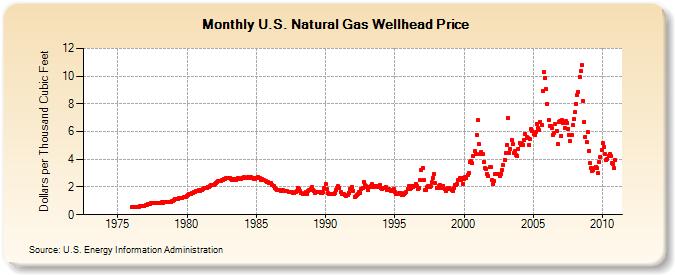
In 2007, during the last burst, corn planting came at the expense of soybeans, which returns nitrogen to the soil. This meant a large increase in the amount of fertilizer necessary. For the last few years, soybean planting has returned to its long-term trendline, and increased corn production appears to have occurred at the expense of winter wheat, which uses a comparable amount of fertilizer:

Up until now, that’s meant that increased corn plantings, inadequate though they may be, haven’t in and of themselves driven up the price of natural gas. This year, however, soybean plantings may be down, as corn nears its postwar high, meaning additional natural gas demand.
All of this is happening even without Obama’s intervention to commandeer even more of our food for fuel. We already push 1/3 (yes, one third) of our corn harvest into ethanol plants rather than kitchen tables, which amounts to about 8% of the world supply of corn. Any additional ethanol subsidies will only make things worse.
Moreover, Obama’s plan does absolutely nothing to increase natural gas production. To do that, he seems satisfied to ride herd on oil and gas companies that already have more than enough incentive to increase production, if only our government would let them. (Sadly, Colorado, between Ken Salazar and Diana DeGette, is playing a disproportionate role in enforcing that dictate.) He does, however, propose all sorts of subsidies to encourage increased natural gas consumption, promising to drive the price up even farther.
To circle back to my original point, this is going to make ethanol unprofitable even with subsidies. Just for fun, I went back and looked at the gross profit margin for Green Plains (GPRE), a major ethanol producer, and compared it to the natural gas price six months earlier, for the last 8 quarters:

The correlation is an astounding -0.96, which is about as close to metaphysical certainty as you get in statistical analysis. Those who know something about statistics will say that the outlier increases the correlation, and they would be right. If we get rid of the outlier, the correlation is still -0.84, and the slope of the line only changes slightly. If the other points, the ones below 6.00 on the price scale, were clustered together, that would be a problem. But they lie on a nice line of their own.
Using a very rough model, using the company projections for unit sales over the next year, assuming that interest rates don’t rise and the company doesn’t take on any additional debt, the wellhead price of NG would have to rise to 6.8 to eliminate the company’s pre-tax earnings completely for the next year. That’s happened twice over last decade, and this administration’s policies will only make it more likely. Let that happen, or interest rates rise, or both, and see how fast Green Plains decides that it really does need those subsidies – and more – after all.
To the extent that ethanol production can increase, it will help drive up natural gas prices. To the extent that it can’t, its price will rise, and it will need compete for ever-more-scarce natural gas.
Even if ethanol weren’t already a colossal waste of money and resources, this plan couldn’t be designed any better to make things worse.
In this at least, Obama’s being consistent with the rest of his economic policies.
-
You are currently browsing the archives.


