Ethanol Changes Tactics
Posted by Joshua Sharf in Economics, Energy, PPC on March 27th, 2011
The ethanol industry is changing tactics to keep those universally unpopular subsidies coming.
Today’s ethanol industry can prosper without government incentives, the founder of Green Plains Renewable Energy Inc. said Thursday.
Ethanol has become an integral part of the country’s energy picture, in demand not only from motorists but also from oil refiners who use it to boost the octane of the gasoline they produce, said Todd Becker, president and CEO of Omaha-based Green Plains.
The economics of the fuel industry, combined with new production technology, make ethanol 40 cents a gallon cheaper than gasoline, on average, Becker said. That gives ethanol producers like Green Plains a cost advantage that will outlast the government’s 45 cents-a-gallon tax credit for ethanol-blending companies.
The blenders’ tax credit eventually will end, he said, but should be followed temporarily by incentives that would increase demand for ethanol. Those incentives would encourage gas stations to install equipment to sell high-ethanol fuel and the auto industry to make and sell vehicles that use high-ethanol fuel.
If Mr. Becker thinks ethanol is profitable, then he should be able to borrow against those earnings to build the delivery infrastructure himself. If gas stations think that ethanol is profitable, they should be able to finance the dispensing equipment. If I think ethanol is profitable, I’ll lend it to them.
But if they can only make all this happen with government subsidies, then maybe it isn’t really all that profitable after all, and directing resources to it is just more of the massive misdirection of resources that has been part and parcel of trying to grow fuel rather than drill, mine, or capture it.
Bob Balink and Duncan Bremer Weigh In
Posted by Joshua Sharf in Colorado Politics, PPC, State GOP Chair on March 25th, 2011
Bob Balink, El Paso Treasurer and former El Paso County Clerk & Recorder, and Duncan Bremer, former El Paso County Commissioner, have weighed in with a precise tactical nuclear strike about what putting people like Jon Hotaling and Dudley Brown (more about him in a moment) in charge of the State Republican Party would mean, including a number of angles that, not surprisingly, I hadn’t considered.
Primaries don’t have to be divisive. The can make both the winner and loser stronger candidates, can generate interest, and can help the party define itself. But the sort of behavior that Hotaling et. al. engage in makes one wonder if there ought to be a maturity exam for graduating high school.
As for Mr. Brown, he’s also closely associated with Jon Hotaling. Well, birds of a feather.
I have my own experience with Dudley “Just Call Me ‘Zool'” Brown, one that is apparently not dissimilar from that of other candidates who didn’t return his questionnaire. With the same unerring instinct for alienating those who agree with him, Dudley decided to chime in on a completely unrelated FB thread to torpedo my own candidacy:
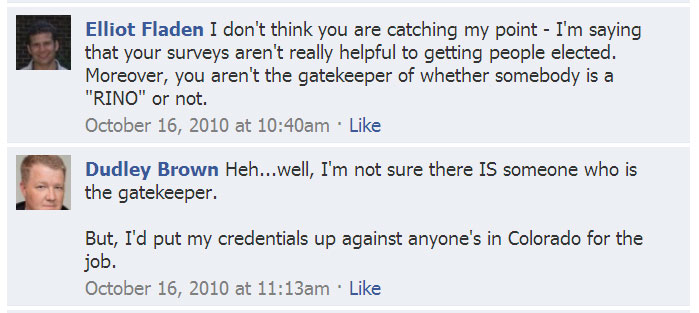
This was in the general election, fer cryin’ out loud. A number of friends – people who are actually familiar with my politics – jumped to my defense, of course, but I’m a big boy, and schoolyard taunts from people of Dudley’s stature don’t particularly bother me. But this sort of behavior – along with its entitlement mentality – transplanted to the Party HQ is going to start costing us elections.
Before we elect Ted Harvey State Chairman, it’s time for him to tell his posse to stay home.
Hotaling Letter a Fraud
Posted by Joshua Sharf in Colorado Politics, PPC, State GOP Chair on March 24th, 2011
Well, it turns out that being first isn’t always being right.
The letter sent out over Jon Hotaling’s name, using the PO Box address of the Colorado Christian Coalition in Denver turns out not to have been written by Jon Hotaling, but by someone playing an extraordinarily dirty game for relatively low stakes.
As mentioned before, the letter was received by a number of members of the State Central Committee, one of whom scanned the letter.
I suppose if you blog enough, this sort of thing is bound to happen, but that doesn’t really excuse it. Dirty politics is one thing, but this is fraudulent through and through, and it was through misfortune and over-eagerness that I got caught in it.
My apologies to Jon Hotaling directly, and to Ted Harvey, for having run with a story that was evidently calculated by someone to damage their reputations.
Since there’s no benefit to leaving a fraudulent letter posted on the net, I’ve removed the post, and posted Hotaling’s reply , and will embed it here when it’s done processing over at SlideShare.
Keep On Truckin’
Posted by Joshua Sharf in Business, Energy, PPC, Regulation, Transportation on March 21st, 2011
That was one of the less forgettable catch-phrases from the 70s, when the independent trucker seemed to embody what remained of the free spirit of America. The part, anyway, that was engaged in constructive work rather than the self-indulgent self-destructiveness that came to pass for independence during that decade.
In fact, trucking has become increasingly regulated over the years, so much so that the notion of the independent trucker, gamely staying awake to deliver his load, is a thing of the past. And with good reason. These are very large, very dangerous vehicles. They’re necessary, but they share the road with, and occasionally crush, passenger vehicles a fraction of their size and weight. As a result of making sure that drivers get a decent amount of rest, the number of fatalities involving heavy trucks, per 100 million miles traveled, was at 2.34 in 2005, down from 6.15 in 1979. More recent analyses have it falling even farther. And those same statistics show truck driver fatigue as a factor in only 1.7% of those crashes. The accident rates continue to decline.
So naturally, what we need is: more rest time!
That’s right. The government has proposed rules that will require longer rest times, fewer hours on the job, more frequent breaks. At first, this sounds like something truckers might like. Until you realize that it’s basically forced idleness, with little marginal benefit to the rest of us using the roads. Truckers hate sitting around. They have loads to deliver, and a forced 15-minute break is actually more stressful, because instead of taking the break when the need it, they’re just as likely to be sitting around watching the clock tick until they can get back on the road.
The company that I am currently contracting for, Werner Enterprises, ran a little experiment with one of their more seasoned drivers, asking him to work to the rule for a month to see what would happen. Turns out that idle trucks aren’t just the Devil’s workshop, they’re also expensive. Two-day trips stretched into three days, and his income, which is based on miles covered, dropped 6% year-over-year. Adopted nationwide, these standards would not only play havoc with the many businesses that use just-in-time inventory management, they would amount to a pay cut for the drivers they’re supposed to help. And in an industry that tends to face driver shortages in good times, anyway, it would require even more drivers, and even more trucks, with all of the overhead that implies, even before they drive their first mile.
This is not an industry that opposes regulation for opposition’s sake. They ended up supporting, for instance, the stricter rules against cell phone use. There are signs on many of the tables in the company cafeteria warning truckers against cell phone use, not on the grounds that if they get caught, they’ll lose their commercial license and have to hitchhike back home from Keokuk, but because it’s dangerous.
They object to this brilliant idea, cordoning off I-70 at certain hours, because it would greatly complicate route planning, on a fairly major truck thoroughfare. (C’mon guys, just widen the road, already.) In combination with the new rules, mandating stops where it might or might not be possible to stop, it would turn driving that stretch into a nightmare.
Colorado’s own Cory Gardner serves on the House Energy and Commerce Committee, which might be able to exercise some oversight here. (Although, so does Diana DeGette, who’s probably miffed that even after decades of trying, there are still trucks on the road at all.) Perhaps he can take a look at this.
Why Purim Matters – Fate and Destiny
Posted by Joshua Sharf in Israel, Jewish on March 20th, 2011
Today is Purim, the holiday that celebrates the victory of the Jews over Haman’s genocidal faction in ancient Persia, during the Babylonian exile. As always, there are questions.
On most holidays, Jews recite a set of Psalms of praise and thanksgiving collectively known as Hallel. We do recite it on Chanukah. We do not recite it on Purim. Why?
Rav Yosef Soloveitchik argues that the reason is that Chanukah established Jewish independence, and therefore regaining control over our own destiny. Purim, on the other hand, was a reprieve, but one that left our fate in the hands of a king and a system that had been proven arbitrary. (The difference between Fate and Destiny is one that Rav Soloveitchik explores in greater depth in an essay, later released as a short book, by that name, Fate and Destiny.) Purim thus established the “Fiddler on the Roof” scenario, the shtetl paradigm, that would come to dominate and define Jewish existence for most of the next 2500 years, interrupted only by the 2nd Commonwealth.
And arrested again by the establishment of the State of Israel.
While many times Ahashveraus, the Persian king, is depicted as foolish, rather like the king in Aladdin, the rabbinical commentators see him as considerably more malevolent, anywhere from looking for a reason to exterminate the Jews to hostile, and willing to let himself be persuaded in the matter. They note that it was under his rule that reconstruction on the Temple came to a halt, under obstacles and threats from the throne.
Which brings us to today.
While history doesn’t repeat, President Obama is certainly doing a fine, fine Ahashveraus impersonation when it comes to Israel. His hostility is manifest, and even if he’s not willing to take positive action himself on the matter, he doesn’t seem very interested in doing anything to impede Israel’s neighborhood enemies. His recent on-again-off-again veto or not of yet another Security Council resolution on Israel was designed as much to show the Israelis who was in charge, as though Israel really believes it can willingly alienate an American president. His lecture to American Jewish leaders that they need to “search their souls” on Israel’s (and their) desire for peace, made the implicit threat almost explicit.
Much of the point of Fate and Destiny is the difference between being active in your future, and being passive, at the mercy of other people and forces. (I’m not sure if the essay, written to provide a theological basis for Orthodox support for Israel, uses the Purim-Chanukah comparison. Undergoing an Omahavian exile myself, I don’t have access to my copy.) Unfortunately, then, as now, too many Jews are more comfortable acting under those parameters. It is too much like a replay, at a national level, of the deals-for-today that Jews had to make for centuries for their communities to survive.
Instead, we should be acting forcefully to shape our own future. Forcefully doesn’t mean recklessly or insultingly. But as an Orthodox Jew and a patriotic American, I believe that Israel’s interests & principles, and those of the US coincide far, far more often than they collide, and lucky for me that they do.
Right now, when we have a President who shows himself to be uncertain at best about American interests and principles, the temptation is to try to ride things out. But such decisions, taken cumulatively, have long-term consequences. It’s one of the reasons why I supposed Sharon’s disengagement strategy – it was an attempt to seize the initiative and set the terms of the debate, and but for his age and health, it might have succeeded.
We need to remember that we do have another choice. We are lucky to live in an age when we can choose Chanukah over Purim.
Why Nobody Takes the Arabs Seriously
Posted by Joshua Sharf in Uncategorized on March 20th, 2011
This post isn’t about the wisdom of imposing a no-fly zone on Libya. I’m leery of this in the same way I was a little leery about our involvement in Kosovo: we’re on the right side, I’m just not sure we’re doing the right thing. But troops are in action, and that calls for support, and prayers for their safety and success.
This post is about Arab fecklessness and manipulativeness, which often go hand-in-hand. March 12:
The league’s secretary-general, Amr Moussa, was quoted in the German weekly Der Spiegel as advocating a no-fly zone in advance of the meeting, though he conceded it wasn’t clear who would impose it and how.
“I am talking about a humanitarian action,” Moussa said. “It is about standing by the Libyan people with a no-fly zone in their fight for freedom against an increasingly inhumane regime.”
The Arab League does not have the ability to impose the no-fly zone itself, but the decision is seen as an essential first step before the European Union, the United Nations and the United States move forward with official considerations of the proposal. (Emphasis added)
But Arab League chief Amr Moussa said what was happening was not what Arabs had envisaged when they called for the imposition of a no-fly zone over Libya.
“What is happening in Libya differs from the aim of imposing a no-fly zone, and what we want is the protection of civilians and not the bombardment of more civilians,” he said.
For some reason, the Arab League’s support was considered a diplomatic necessity before stepping in. I’m sure there’s a reason this qualifies as “Smart Diplomacy,” but hopefully we’ll at least file this away for future reference. This group of impotent “leaders,” running militaries incapable of imposing a no-fly zone by themselves, even with the air forces we’ve supplied them over the decades (I’m looking at you, Egypt and Saudi), turn to NATO to do the work, and then turn around and complain about it when, you know, the work gets done.
Don’t tell me they didn’t know what was involved. There was no-fly zone over parts of Iraq for over a decade, and its enforcement occasionally involved breaking things and killing people. These folks have a remarkable capacity for sympathy about human suffering when it’s politically useful, and not too often otherwise.
I’m sure we’ll hear the normal plethora of explanations about this. They really didn’t want us to go in. They really wanted us to go in, but to do more. They really want us to go in and do more, but they have secret reasons of their own. They really don’t want us to go in, but they said so to placate their people, and now, they’re doing the same thing once the shooting started. They really want to be able to blame whatever happens on Israel, so they can distract people. They’re telling us one thing behind closed doors, and saying something different in public because they think they have to, or want to, or have some other agenda. They’re using this to bargain for something else.
The fact that Arabs do this sort of thing all the time – saying one thing, then saying something else, then doing a third thing – doesn’t make it normal.
And it certainly isn’t any reason to take them seriously.
Kibbutzim Go Private
Posted by Joshua Sharf in Economics, Israel, PPC on March 19th, 2011
Not much of a surprise, at this point, as noted by Claire Berlinski over at Ricochet:
Beit-Oren was founded as a die-hard socialist settlement in 1939. Predictably, it went bankrupt, because socialism doesn’t work. By the 1980s it had no means of subsistence, and the world’s ideological tides having turned, the larger kibbutz movement cut it off. In 1987 about half the population of the kibbutz decided to leave, an event known as the Beit Oren Incident.
In 1988, after an intense period of discussion and decision, the New Kibbutz was on its way with renewed strength and vigor, and many new members. The kibbutz’s financial situation improved, empty apartments were rented to new residents, the kitchen and dining room became an events hall, and various kibbutz enterprises recovered. In June 1995, the decision was taken to privatize services and individual income. This was to be the first in a series of privatizations. Within a short time after this decision, most kibbutz members expressed satisfaction with this arrangement.
As socialisms go, Kibbutzim were among its more humane manifestations. Unlike residents inmates of the Soviet bloc, people were free to go any time they wanted, and join the majority of Israel that was at least somewhat more capitalist. The country may have been conceived of and run by socialists, but actual kibbutzniks were always a small minority, and capitalism was a vital, if largely latent force in Israel from its beginnings.
In fact, as Sol Stern points out, Tel Aviv was a very capitalist enterprise from the beginning. And since Netanyahu, as Finance Minister, began privatizing large swatches of the economy, its entrepreneurial spirit has been given free rein.
So while it’s not surprising that Israelis are innovators when it comes to water, it’s at least a little ironic that a major Israeli venture capital firm, specializing in water projects, would be located in “Kibbutz” Lavi.
All this must be giving Haman fits.
Jon Hotaling & Ted Harvey
Posted by Joshua Sharf in State GOP Chair on March 19th, 2011
For some people, you just can’t be socially conservative enough to vote for. Not Jeff Crank:

Jeff, of course, is the head of the Colorado branch of Americans for Prosperity. Hardly RINOs, that’s one of the national organizations that’s help Tea Parties achieve success.
Not Ken Buck.
And now, apparently, not Mark Waller. Yeah, that Mark Waller, the Representative who’s held down the fort on little things like taxes, TABOR, spending, and coming from Colorado Springs, doesn’t exactly have the social views of Arlen Specter.
And it’s all over a bill that isn’t even about abortion.
Rep. Waller introduced HB-1256, which was intended to provide legal recourse to women whose unborn children were killed in automobile accidents. It was intended only to address this lacuna in the law, had nothing whatever to do with abortion, and went out of its way to make sure that was understood. It’s a gap in the law that even pro-choice Democrats understand, and the bill, according to Waller, had broad bipartisan support.
The architects of this fratricidal strategy are Mark and Jon Hotaling, the social absolutists’ less-effective answer to the Koch brothers. Mark headed the Colorado Christian Coalition at the time they produced the above flyer about Crank, and Jon has a long association with Colorado Right to Life, a group that was effectively tossed out of National Right to Life for being too radical.
Colorado Right to Life, the Judean People’s Front (or is it the People’s Front for Judea?) of Colorado politics, decided that since the bill didn’t address abortion, it had to be killed.
RTL issued the following mailer, calling the bill “monstrous:”
They then went on to say that the correct bill would have just implemented the Personhood Amendment, leaving this letter for Rep. Waller:
Since the bill was written not to touch existing abortion law in any way, it also didn’t touch parental notification. But that didn’t stop RTL from using that inaccuracy to whip up opposition to the bill, creating such a political hot potato that Rep. Waller finally had to pull it.
If that’s all it was, it would be another self-defeating act by Colorado Right to Life.
But here’s where it gets interesting. Remember, Jon Hotaling has a long history with Colorado Right to Life. The same Jon Hotaling who:
was manager of (State Senator Ted) Harvey’s short and unsuccessful race against 6th District Congressman Mike Coffman and Wil Armstrong in 2008.
Sen. Harvey still owes Hotaling almost $20,000 for his work on that campaign.
And here’s what he recently had to say about Mr. Hotaling:
Rumors persist that Harvey, if elected chair, will hire the Hotaling brothers to run the state party office. That, his detractors fear, would also mean the party’s candidates would be screened to pass ultra-conservative principles. If so, that might doom the party to failure in more moderate races.
“If only we could be so lucky to hire Jon Hotaling, nobody has a better track record for winning campaigns than he does. Jon would have to take a pay cut to work for the party”, said Harvey.
Look, politics, especially in a middling-size state like Colorado, is a small pond. And the higher you go up the pyramid, the more people know each other. There’s nothing the matter – necessarily – with Harvey using a friend of his to manage his campaign.
But this is absolutely not the sort of thing we want out of a State Political Director. There is a legitimate debate to be had about abortion, but state level-politics requires coalition-building and teamwork, not casting out everyone who doesn’t agree with you 100% on particular issue.
I know plenty of people who, unlike me, voted for the Personhood Amendment, and still voted for me – twice – for State House of Representatives. They don’t want to purify the party, or use good bills like Rep. Waller’s to push their position, to the exclusion of progress on another front.
So, given that, I think it would benefit the party, in advance of next Saturday’s vote for State Chairman, to know his answers to the following questions:
I’m on record in this space arguing that parties are coalitions, and that coalitions need to be big enough to win majorities. Not every election, not all the time. But big enough so you have a chance to implement your ideas and promote your ideals.
Moreover, Ted Harvey has secured considerable – although far from universal – Tea Party support, by focusing not the social issues, but economics and the promotion of liberty. He has a chance here to make a concrete promise that would give credibility to that campaign claim, and to show that those really are his priorities for the state.
The Long Recall
Posted by Joshua Sharf in History, PPC on March 16th, 2011
I discovered The Long Recall blog over at the American Interest site a couple of months ago, but only now am I getting around to posting on it. The folks there have decided to do a real-time, day-by-day blog of the Civil War, on its ongoing 150th Anniversary. It’s a brilliant idea, and so far, they’re pulling off what must be a great deal of unpaid work quite beautifully.
The effort seems to be led by Walter Russell Mead, and I’ll quote from his intro to the blog, but it’s worth reading the whole thing:
We will use a modern form to present the daily news: our Civil War aggregator that combines a short daily summary of the news along with links to articles that a well-informed Civil War-era reader would have wanted to read. Our goal is to allow readers today to get a feel for what it was like to experience the conflict in real time, to hear the many voices trying to make sense of the conflict, and to sift through sometimes confused and misleading news accounts to try to discern what was actually taking place.
…
The Long Recall will do its best to help 2010 readers understand the economic dimension of the conflict. At times this will involve us in something more active than simply linking to Civil War era news sources; we will provide commentary that helps the readers of today understand what yesterday’s news meant to intelligent readers of the day.
…
In The Long Recall, we will carry foreign news as it became available to American readers, not the day it actually happened. At times of crisis, as during the Trent Affair late in 1861, this uncertainty about foreign events was a major factor in American politics and policy. Because the US economy and financial markets were so dependent on London at this time, the uncertainty about foreign developments was also an important factor in the economic news….
Finally, a word on language and ‘political correctness.’ The United States has always been and remains a prudish society with strict limits about the kind of language that is allowed — and about the subjects that may be discussed. In the Civil War era, Americans were very strict about sexual matters — but when it came to race, they were extremely permissive. …words that could never be used today in polite discourse were routinely used in those days to describe different racial groups. Worse, racial humor and stereotypes were deeply embedded in the culture. Politicians and political writers frequently resorted to anecdotes and humor that would justifiably end careers today to score points with public audiences.
At The Long Recall, we have made the decision to link to Civil War era material without censoring or toning down racial language, images and ideas that modern readers (including, we must say, ourselves) find offensive. The use of such language and the prevalence of such ideas is too central to American life and culture at the time — and too vitally involved with attitudes toward the Civil War — to be edited away or softened down.
While I was born after April 1965, when the Centennial ended, I do remember this Peanuts cartoon from a book I had as a kid:
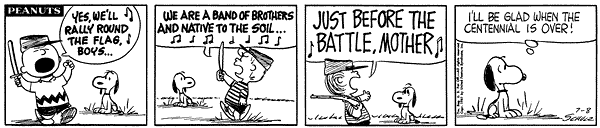
For some reason, the Sesquicentennial hasn’t attracted the same amount of publicity as the Centennial apparently did, when even kids reading comic strips could be expected to know about it, and possibly even recognize some of the songs. It’s probably a combination of a decline in cultural literacy, and a harrowing sensitivity about race. Or maybe the Civil War was just unlucky enough to have its 150th Anniversary start in a year when the Founders were hogging all the attention.
One has to admire the audacity of the authors to undertake such an effort, and the courage of their approach.
A Wind-Assisted “Win”
Posted by Joshua Sharf in Constitution, History, Labor, National Politics, PPC on March 15th, 2011
In track and field, when a runner has the wind at his back, and records he sets don’t count. Of course, in track, the win is still fair, because all the runners run under the same conditions. With the press, it’s always uphill and against the wind for Republicans and Tea Parties, downhill and wind-assisted for Democrats and unions.
In a previous post, I put up a little retrospective of some of the more troubling behavior by Wisconsin public servants, aided and abetted by college students, Organizing for America, and the DNC. I doubt whether even Mike Littwin would be able to claim this as a “win” if most of the country had seen these events as they were happening. The national media, which goes out of its way, if necessary, to make up stuff about Tea Partiers, was rigorously careful not to expose the American public to these scenes.
What are perceived as heavy-handed tactics often have a way of backfiring. (In Pennsylvania during the Constitutional ratification convention, for instance, dissenting members of the convention fled the scene to deny the convention a quorum, and two of them had to be hauled back bodily to Independence Hall to get the 2/3 necessary for business. This, along with the refusal of the press to publish speeches critical of the Constitution and the refusal of the convention’s official journal to record all the speeches, forced the Federalists to tread much more carefully in succeeding states, particularly Massachusetts, New York, and Virginia.)
But they don’t usually backfire when the targets are unsympathetic louts.
Just to pick on Mike a little, the last lines in his column suggest that the DC Democrats might find the inspiration and spine to make bold entitlement reform proposals from the events in Wisconsin. This makes no sense. In Wisconsin, the Democrats were defending the insupportable and unsustainable status quo. Failing to deal with entitlements, as the President has failed to do, would be more in keeping with that strategy.
-
You are currently browsing the archives.


