Wisconsin – A Retrospective
Posted by Joshua Sharf in Media Bias on March 15th, 2011
While it remains to be seen if the public sector unions in Wisconsin can (re)build a political movement based on coercion and extortion, it’s worth remembering that they’d have no chance of doing so without help from their friend in the working press. Let’s a take a little trip down memory lane, so close it almost seems like yesterday:
Walker = Hitler + Mubarak
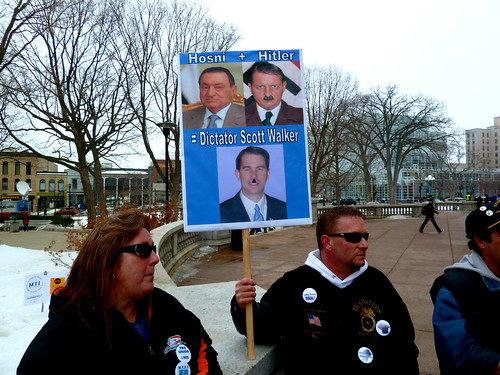
Walker = Nazism

Another Party Crushed the Unions

Attack FreedomWorks’ Tabitha Hale
Door Panel Smashed In

Damage to Door Handles

Protesters re-take the Wisconsin Capitol
Wisconsin GOP Senator Glenn Grothman chased, trapped by hecklers, saved by Dem. Rep. Brett Hulsey
Wisconsin Union Wisconsin Republican senators leave through secret tunnel after march 9th vote
Chances are, unless you were reading Ann Alhouse’s blog or Instapundit you didn’t know about much of this. That, combined with the national media blackout on the death threats against Wisconsin Republicans, and the protestors who’ve taken to taking down license plate numbers of their political opponents, constitutes the sort of propaganda that money literally can’t buy.
The Denver City Council Wants Your Money
Posted by Joshua Sharf in Colorado Politics, Denver, Denver Mayor, PPC, Taxes on March 15th, 2011
Well, that shouldn’t be any surprise to anyone living in Denver over the last few years. But usually they have the decency to pretend that it’s for someone else. This time, the Denver City Council wants your money for themselves and the office some of them hope to occupy come May.
At last night’s City Council meeting, they voted themselves (10-3, the Denver Post article neglects to mention who the three were) a 6.6% pay raise, starting two years from now:
Denver is the only large city in Colorado that pays its council members a living wage — $78,173 a year, plus about $30,000 in benefits.
The raise would give the council members an annual salary of $83,332 by July 2014. The council president makes about $10,000 more.
The mayor’s salary will grow to $155,211 from its current $145,601. The salaries of both the clerk and recorder and the auditor would be $134,235, up from their current $125,924.
Right now, the seasonally unadjusted unemployment rate for Denver is 10.9%; a seasonal adjustment might bring that down to 10.4% or so. This is the highest that it’s been going all the way back to 1994, when the CDLE numbers begin.
In addition, Denver is looking at a $100,000,000 budget gap this year, slated to get worse over the next decade. To City Council chairman Chris Nevitt, this may only be “symbolic,” but it’s pretty clear what it’s symbolic of.
Ghosts of Constitutional Debates Past – Part IV
Posted by Joshua Sharf in Constitution, History, PPC on February 27th, 2011
Continuing to work my way through the Debates on the Constitution, at a languid pace, I came to this letter from James Madison to Thomas Jefferson. Jefferson was, at the time, Minister to France, so had no direct role in drafting the Constitution. Madison’s main concern in the letter is federalism, and the division of powers between the states and the national government. The letter serves as a reminder that the work of a committee, even a Constitutional Convention, is a work of compromise. In particular, these paragraphs:
It was generally agreed that the objects of the Union could not be secured by any system founded on the principle of a confederation of sovereign States. A voluntary of the federal law by all members, could never be hoped for. A compulsive one could evidently never be reduced to practice, and if it could, involved equal calamities to the innocent & the guilty, the necessity of a military force both obnoxious & dangerous, and in general, a scene resembling much more civil war, than the administration of a regular Government.
Hence was embraced the alternative of a Government which instead of operating, on the States, should operate without their intervention on the individuals composing them: and hence the change in principle and proportion of representation. (Emphasis added.)
This is critical, because it means that while the states would have a say in the federal government, in the form of the Senate and the Electoral College, the federal government would have no say in the selection of state officers, nor a direct veto on state legislation. (Both of these options were considered.) It also, I think, affects our reading of the Tenth Amendment, adding weight to the notion that individuals have standing to challenge federal attempts to overstep their bounds.
Right now, the Supreme Court is considering such a case:
Surveillance cameras captured Ms. Bond stealing an envelope from Ms. Haynes’s mailbox and stuffing potassium dichromate in her car’s muffler. That led to federal charges of stealing mail—and violating criminal statutes implementing the international Chemical Weapons Convention, which the U.S. ratified in 1997. Ms. Bond, who in 2007 was sentenced to six years imprisonment, appealed on grounds that Congress lacked authority to punish her for the chemical assaults.
In Philadelphia, the Third U.S. Circuit Court of Appeals denied Ms. Bond the right to raise that claim, ruling that only state officials had legal standing to assert a 10th Amendment violation of their authority. When Ms. Bond appealed to the Supreme Court, the Justice Department abandoned the Third Circuit’s decision, conceding individual defendants were entitled to argue that they were charged under laws exceeding congressional power.
For the record, keep your eye on another moving part here: whether treaties are permitted to override Constitutional protections. This could mean that even if the US were to sign a small arms treaty of some kind, provisions that violate our understanding of the 2nd Amendment might not apply here in the US. This isn’t to imply that signing or ratifying such a treaty would be a good idea, or that the Court would agree with me, just that the Court’s decision on this case might signal its current thought on the matter.
An Oldie But Goodie
Posted by Joshua Sharf in Colorado Politics, Denver Mayor, PPC, Taxes on February 27th, 2011
With the Denver Mayoral race starting to heat up, and with Chris Romer trying to position himself as a ‘pro-business’ candidate, it’s good to revisit exactly what he means by that.
This comes from a conversation he had with the DaVita CEO who remarked that Coloradoans don’t know what investment means. Apparently, aside from normal infrastructure spending, it means getting taxpayers to fund businesses.
Podcast: Play in new window | Download
All Parts of the Constitution Are Equal
Posted by Joshua Sharf in Colorado Politics, PPC, Taxes on February 21st, 2011
But some are more equal than others.
I’ll be writing a lot about SCR-001 in the next few days and weeks. It’s an attempt to make it harder to amend the state Constitution, and the way it’s written, its target is TABOR.
The giveaway is the provision concerning repeal thresholds. Here are those provisions:
- It will take 50% to pass this amendment
- It will take 60% to pass amendments in the future
- It will take 50% to repeal amendments passed before 2013
- Except for this amendment, which it will take 60% to repeal
Got that? If something was passed with 60%, it takes 60% to repeal. If something was passed with 50%, it takes 50% to repeal. Except for this amendment itself, which takes 50% to pass and 60% to repeal.
Under the Colorado Constitution, not all portions of the Constitution would be subject to the same rules. Some parts of the Constitution would be more equal than others.
As nearly as I can tell, this is without parallel in the United States. I made a quick review of the 50 state constitutions this evening and their amendment processes. None of them has different thresholds for different parts of themselves.
Massachusetts, in provisions that only a lawyer, or a Puritan, or a Purtian lawyer, could love, does restrict the subject matter than initiative-based amendments can address, but doesn’t set separate thresholds, and doesn’t separate merely by date.
Mississippi does say that certain sections of its constitution can’t be amended by initiative, including:
(a) For the proposal, modification or repeal of any portion of the Bill of Rights of this Constitution;
(b) To amend or repeal any law or any provision of the Constitution relating to the Mississippi Public Employees’ Retirement System;
(c) To amend or repeal the constitutional guarantee that the right of any person to work shall not be denied or abridged on account of membership or nonmembership in any labor union or organization; or
(d) To modify the initiative process for proposing amendments to this Constitution.
And Florida does have a 2/3 requirement for raising or initiating new taxes or fees.
But as far as I can tell, that’s it. While the initiative and referendum process varies significantly from state to state, states use subject matter, not the manner of adoption, as the standard for whether or not it’s subject to repeal. And they don’t set different thresholds for those sections, they just say that it has to come from a referred measure or in a state constitutional convention, and can’t be addressed by initiative.
Colorado, by adopting this idea, would be unique in the country in this regard.
Motive Force or The Information Superhighway?
Posted by Joshua Sharf in PPC on February 15th, 2011
Tax Day has never been this anticipated. Go file your return, and then catch a matinee of Atlas Shrugged. Tom’s already posted the trailer.
Most of the concerns in his post center around fidelity to the book. The compromise between strict fidelity and actual movie-making is always an issue when dealing with a beloved book with rabid fans. It led the first two Harry Potter movies to be little more than scene-by-scene recreations of the books, and pretty much drained the life out of Prince Caspian.
Now, despite Rand’a paean to motive force, Atlas Shrugged isn’t really about railroads. It was written in 1957, and the gradual decline of American railways, along with the special place they hold in our imagination, made them the natural industry for the book to focus on. But today, most Americans don’t ride on long-haul trains, and unless you live near a hub, you look for them on long-distance road trips the same way you’d try to spot buffalo or pronghorn or elk. They’re just not central to most people’s lives the way they were 54 years ago. As someone who helped his dad build N-scale models and is currently working a stone’s throw from The Union Pacific, I take no pleasure in saying this. But it’s true.
No, the book is about stifling innovation and creativity and wealth creation by mediocrity’s need to crush greatness, and the damage that does to all those people who aren’t great. (It’s also about lots of other stuff, too, but that’s the point I want to focus on.) So in an era when people are liable to ask, “why on earth would they stoop to bother about a train?” would the film’s power be better served by making Dagny and Hank something else, something that really is on the cutting edge right now?
You can think of dozens of examples without trying very hard. She’s got an internet business model that will change the world, but it needs Hank’s new infrastructure to carry the data. She’s got a vaccine to cure a disease, but it needs Hank’s delivery system. More bleeding edge: she’s ready to make commercial space travel as common as, well, a commuter rail trip from Boston to NY, but needs Hank’s metal. Wyatt sits ready to provide her the power, but his next-generation nuclear plant sits idle for lack of plutonium.
Obviously, such a substitution would do violence to the project of literally translating the book to the screen, but it’s completely in the spirit of this. The question is, would it get in the way of the story to make the industries affected more immediate, or would it help? Would it complicate or simplify the filmmakers’ task? We have, today, in the headlines, the FCC trying to force internet service providers into being candidate for the DJ Utilities Index. We have, today, Obamacare doing to the same to insurance companies and, eventually, hospitals and doctors. Would a change have made the story more relevant, or just have made the filmmakers seem opportunistic and editorializing?
So while it’s completely unthinkable that Dagny Taggart could be anything other than a railway executive, and that Hank Rearden could have anything other than a super-strong, super-light metal to sell, what if?
With the premiere two months away, it’s probably exactly the wrong time to be asking this question. It’s too late to do anything about it, it would probably just be better to wait and see how well they’ve done with the original source material.
But hey, that’s what blogs are about.
UPDATE: And this, too. A little behind-the-scenes featurette from a few months ago over at reason.tv
Looking for Torah in Ayn Rand
Posted by Joshua Sharf in Jewish, PPC on February 15th, 2011
Of all the rhetorical baits-and-switches the Left has pulled over the last 100 century or more, perhaps none has been as complete, enduring, or damaging as the identification of “Jewish values” and liberal politics. The historical roots are in European socialism, and there is even some evidence that the prominence of leftist Jewish political activity contributed to the merger between Democrat urban patronage and socialist policies. Regardless of the roots, for many if not most American Jews, the labels Liberal and Democrat are part and parcel of being Jewish. And attempts to assert capitalist, small-l libertarian, or conservative views are often met with accusations of not being Jewish enough.
But folks, It Ain’t Necessarily So.
Rabbi Gross out here in Omaha is in the middle of a 3-class lecture and discussion series on “Looking for Torah in Ayn Rand.” I missed the first lecture on “The Virtue of Selfishness,” but I caught last night’s on The Fountainhead.
There’s no particular reason to think Howard Roark is Jewish, but he’ll do. His life is a pattern as old as that of Pharaoh Jews: his talents are used, his ambition thwarted, his virtues caricatured as vices. Like Yaakov, he takes pleasure in his work (there is ample textual basis for this belief), and is often able to work out a modus vivendi with the Powers That Be (Esav, starring as Peter Keating) to continue to do that work, although his status is often precarious.
But Rand’s villains-as-cautionary-tales are usually more interesting, both for what not to be and what not to fall for. In this case, that’s columnist Ellsworth Toohey, who doesn’t actually wish that the US could be China for a day, but might have. His techniques for making it so are straight out of the manipulations of the worst of the Torah villains.
Toohey sets up altruism as the greatest ideal; once men inevitably fail to live up to it personally, he then offers them the chance to make amends by living up to it vicariously, by turning power over to someone who clearly has no interest in money – him.
This is straight out of Lavan’s playbook. Lavan uses Yaakov’s guilt over the moral complications concerning the birthright to manipulate him into increasingly unfavorable deals, which he has no intention of keeping to in any case. In each instance, when Yaakov tries to enforce the terms of the agreement, Lavan argues that it’s unfair, or that that’s not how things are done there, or that Yitzchak would never have done that.
Toohey deligitimizes greatness, even the idea of greatness, by elevating mediocrity. Yes, it’s handicapping people for the sake of control. It’s also a direct parallel of the rhetoric Korach uses to undermine Moshe. What’s special about this blue thread, when I can make a whole garment of them? What’s special about washing this way, when I’ve just taken a whole bath? What’s special about this scroll on my doorway, when I’ve a whole library of sefarim? In Rand’s world is actual achievement and originality that suffers. In the Torah, it’s holiness.
Finally, Toohey recognizes the destructive power of laughter. The ancient Greeks understood it. Umberto Eco’s monks killed over it. And Rabbi Hayim Luzatto in Mesillat Yasharim (The Path of the Righteous) makes exactly the same point – that laughter and ridicule obliterate reverence. (The Rabbis keep this power under wraps by giving it free rein for one day each year, on Purim.) Both ridicule and mediocity serve to eliminate rivals for people’s admiration and models for their aspiration.
All this said, one has to understand Ran’s limitations. As Whittaker Chambers noted in his devastating National Review critique, a purely materialist philosophy is by definition incomplete. Rand’s philosophy may suffice for Rav Soloveitchik’s Adam I – Dignified Man – but only Torah is broad enough to satisfy Adam II – Man who hungers for a faith community.
Still, that Rand mistakenly considered her philosophy to be complete doesn’t mean that we have to evaluate it on that basis. We can stipulate that it’s incomplete, evaluate it on the basis of where it actually applies, and recognize that some of its most liberating aspects are both rooted in and consonant with Torah ideals.
A History Lesson for Sen. Bacon
Posted by Joshua Sharf in Colorado Politics, PPC on February 14th, 2011
This afternoon, the Senate State, Veterans, and Military Affairs Committee took up SCR11-001, what will likely become yet another referred measure from a legislature desperate to keep you, the citizens, from exercising any sort of oversight. So much so that when it came time for the committee to comment, after grassroots organization after grassroots organization testified against, while a number of large, mainstream lobbying groups had argued in favor, Sen. Boyd argued that there was considerable grassroots support for the Referendum.
She also praised Sen. Bacon’s “history lessons.” In this case, Sen. Bacon made an interesting point – that many witnesses were claiming that the original meaning of the right to petition the government meant something quite different from the right to citizen initiative to amend the Constitution. He noted – accurately – that many of the western states added citizen referenda during the Progressive period in the early part of the 20th Century. Colorado did so in 1910.
I’m not usually a fan of the Progressives, either historical or contemporary, but in this case, I think they were onto something. The reason that it was difficult to amend the federal Constitution was largely that federal powers were weak, and its powers enumerated. The likely effect of amendments was to expand the central government’s power.
From the ratification debates, it’s clear that it was generally understood that state constitutions were different. It was believed that state constitutions were inclusive: the state could pretty much do anything except what was forbidden explicitly. So while state constitutions generally didn’t include an initiative process until the Progressives, as a means of preventing governmental overreach, in their case, they make sense.
We’ll have a lot more to say about the policy and the politics of this mistake as we go along. For the moment, though, given the obvious motivations of the Democrats who will vote unanimously for this referred measure, it’s tough to argue with the logic of the folks who passed and voted in favor of this in the first place.
…and Ryan Call Enters
Posted by Joshua Sharf in Colorado Politics, PPC, State GOP Chair on February 8th, 2011
As Dick Wadhams bows out – hopefully to pursue managing a winning Senate or even Presidential campaign – outgoing Denver County Chairman Ryan Call enters the race. Ryan will be touting Denver’s success in the last elections, its return to relevance after a brief hiatus, and experience gained from being the legal counsel for the state party over the last few years.
I will point out that Ryan is a friend of mine, and that we worked closely together in the 2009-2010 election cycle, when he was Denver Chairman and I was one of the Vice Chairmen, as well as our candidate in HD-6. I saw how hard Ryan worked to make this election cycle a good one for Denver’s Republicans, and to leave us with a basis to build on.
Probably the most important point for me is that in my own discussions with Ryan, I’ve come to believe that we share a basic conception of what the party chairman’s job is. I’ve elaborated on that before, so I won’t go over it again, and Ryan’s more than capable of making the case for himself. But I will mention that his emphasis on politics as a “team sport,” and the need to build coalitions around ideas and issues is something I place a lot of stock in:
It’s no small challenge to be a principled Republican in Denver, but that experience has taught me that while we may not always agree on everything, politics is a team sport….
One of the strengths of our Party is that we are all a group of principled and independent-minded individuals. That sometimes makes it a challenge to build consensus and agreement, but I believe we need a broad and welcoming Party in order to win elections and govern effectively – the stakes are just too high for us to be divided. Although there is room within our Party for certain disagreements on specific matters of legislative policy, we share certain common values about what is right and wrong, and a commitment to those core Republican principles of limited government, personal responsibility, and freedom and opportunity that unite us as Colorado Republicans.
The only way that can happen is if the chairman isn’t perceived as being a part of one faction or another, and I think Ryan’s managed that well here in Denver. I know of both Tea Party members and old-timers who were impressed with the way he handled the job. The party’s vote totals – with some percentages the highest they’ve been since the early 90s – should be read as a broadening of the coalition here in town.
Now, some of Ryan’s hard work can be seen in a different light, and when I put the question to him, he responded that he knew that he’d have to delegate responsibility at the state level in a way that he didn’t at the county level. Certainly, he’ll have resources and institutional memory to draw on at state that Denver just didn’t have available.
The circumstances facing the state party are substantially different from those facing Denver: the new chairman will be expected to deliver victories, not merely let the party compete in a dignified manner. A chairman can only deliver those victories with recruiting and building a staff he can rely on, and it would certainly be reasonable to ask how he intends to go about building and leading that staff, not only serving on it.
Of course, these would be fair questions for any of the candidates. There are two other prominent candidates for state chair right now, State Senator Ted Harvey and Larimer County Chairman Larry Carillo. Being State Chairman is fundamentally different from being an office-holder, and state is much bigger than Larimer County.
Between now and the State Central Committee meeting in March, there will hopefully be a number of candidate forums. I understand that R Block Party will be hosting two, details below, at which all three candidates are confirmed. I don’t think readers here need any urging from me to show up and ask questions.
Wadhams Bows Out
Posted by Joshua Sharf in Colorado Politics, PPC on February 7th, 2011
Dick Wadhams has withdrawn from the race for Colorado GOP Chairman, sending the following email to members of the State Central Committee:
It has been an honor and privilege to serve as Colorado Republican Chairman but after much reflection I have decided to not seek reelection.
I am very grateful to a clear majority of the members of the Colorado Republican State Central Committee who offered their support and encouragement over the past several weeks.
I entered this race a few weeks ago looking forward to discussing what we accomplished in 2010 and to the opportunities we have in 2012 to elect a new Republican president; to increase our state House majority and win a state Senate majority; and to reelect our two new members of Congress.
However, I have tired of those who are obsessed with seeing conspiracies around every corner and who have terribly misguided notions of what the role of the state party is while saying “uniting conservatives” is all that is needed to win competitive races across the state.
I have no delusions this will recede after the state central committee meeting in March. Meanwhile, the ability of Colorado Republicans to win and retain the votes of hundreds of thousands of unaffiliated swing voters in 2012 will be severely undermined.
For the past four years, I have devoted all of my professional time and energy to serving as state chairman and am very proud of what we accomplished in the face of unique and unprecedented challenges in both the 2008 and 2010 election cycles.
I will always remain humbled and grateful for the opportunity to travel this magnificent state where I was born and raised and to work with Republican leaders and elected officials in all 64 counties as state chairman.
This leaves the race open to a number of conservative candidates who have declared, and perhaps opens up the race to couple of new entrants. In any event, the race is no longer simply a referendum on Dick Wadhams’s tenure, but a ballot on what sort of leadership the state Republican party wants. So unless explicit, please don’t read anything below as a direct criticism or praise of Dick’s tenure.
-
You are currently browsing the archives.


