Welcome to the Middle East, Where the Window is Always Closing
Posted by Joshua Sharf in Israel on June 3rd, 2013
At least in the minds of American and European diplomats. It’s a bipartisan affliction, but one to which Democrats and Europeans seem especially prone, probably because it’s an excuse to pressure Israel.
Today we can add another pronouncement from another US Secretary of State that it’s time for Israel to repent, as the end is near. John Kerry assured the American Jewish Committee’s Global Forum that, “Well, the difference is that what happens in the coming days will actually dictate what happens in the coming decades. We’re running out of time. We’re running out of possibilities. And let’s be clear: If we do not succeed now – and I know I’m raising those stakes – but if we do not succeed now, we may not get another chance.”
Here’s the list as it stood when I last posted on the Window of Perpetual Closing, back in November of 2010:
- February 26, 1995 – South Florida Sun-Sentinal – “Middle East Peace in Pieces”
- “Many U.S. diplomats say in confidential interviews that the partners for peace had but a short window of opportunity, a window that opened when the PLO and Israelis issued the declaration of principles for peace 18 months ago. Now, U.S. officials fear, that window has closed.”
- October 15, 1998 – Austin American Statesman – “Decks Clear for Mideast Talks”
- The decks literally cleared in southern Israel a few days later, when a bomb injured 64 people
- July 24, 2000 – St. Paul Pioneer Press – “Clinton Rejoins Peace Talks, Pressure High, Time is Short“
- August 14, 2000 – New York Times – “Washington Feels Time is Short for Restarting the Mideast Talks”
- April 5, 2002 – Jerusalem Post – “The Postwar Window of Opportunity”
- December 12, 2003 – New York Times – ‘A Bush Aide Criticized Israel For Not Doing More To Foster Peace”
- “In Rome international donors to the Palestinians said that, because of the installation of a new Palestinian prime minister, a ”window of opportunity” had reopened, permitting the resumption of negotiations with Israel.”
- October 19, 2006 – UN Security Council – “Mideast Peace Envoy Tells Security Council…Urgent to Help Restart Dialogue”
- “ELLEN MARGRETHE LØJ ( Denmark) said the challenge for the parties to the conflict, as well as for the international community, was to ensure that they embarked on a process leading towards lasting peace…. It was now up to the parties to avail themselves of that window of opportunity.”
- March 31, 2007 – Bloomberg – “EU Says Palestinian Government Gives Window for Mid East Peace”
- May 2, 2008 – MonstersAndCritics.com – “Rice Warns Time Is Limited For Achieving Mideast Peace Deal”
- November 16, 2010 – Washington Post – “Israeli officials say time growing short for West Bank peace deal” (I speculated at the time that elements within Israel might be coordinating with the Obama Administration)
Feet of Clay
Posted by Joshua Sharf in Constitution, History, National Politics on June 3rd, 2013
For the last few weeks, I’ve been working my way through Henry Clay: The Essential American. Such political biographies are inevitably histories of the times, and Clay’s times basically bridged the America of the early Constitution and the America just before the Civil War.
I may or may not have time for a longer, more thorough post on Clay, but I wanted to throw out a few observations, as Clay spends a few years at Ashland, recovering physically and financially in preparation for one last stint in Washington, after his defeat as the Whig nominee in 1844.
Clay was, by any account, a remarkable and remarkably intense politician. He was quickly elected Speaker of the Kentucky House of Representatives, and then, on his first day in the US House, elected Speaker of the House there. Clay would revolutionize that role, taking the Speakership from a mostly administrative role to a center of political power. When he moved to the Senate, he would wield similar power there as a floor leader, even without the formal role of Majority Leader that we have today.
Because of his long Congressional career, we know Clay today as the Great Compromiser, remembering his roles in the Missouri Compromise of 1820, and the Compromise of 1850, both of which helped stave off disunion over slavery. Those are merely the largest, best-known of his compromises. He led successful compromises over the tariff (despite being a westerner, he favored a high protective tariff), and over a renewed Bank of the United States and internal improvements, the last two thwarted by presidents rather than Congress. These three aspects of his program comprised what he referred to as the American System.
For being almost 200 years old, the politics of the 1830s and 1840s is strikingly modern. Much of this is the result of Andrew Jackson’s populist revolution in American politics, but Clay’s and the Whigs’ response to it also resonates with today’s reader. For instance, in vetoing the recharter of the Bank of the United States, Jackson’s message essentially dodged constitutional questions, and boiled down to the fact that he didn’t much like banks. Clay thought that Jackson’s lack of intellectual coherence in his veto message would cost him politically in the Mid-Atlantic states, where the Bank was popular. He underestimated the populist appeal of Jackson’s message. It wouldn’t be the last time Clay misread the politics vs. the policy of an issue.
Clay also had to deal with the changing nature of presidential campaigning. While personally outgoing and optimistic, and a fine public speaker, he never really enjoyed or thought seemly the public appearances and speeches that marked presidential elections in the 1840s. And in the 1844 campaign, he never could get his fellow Whigs to understand the importance of a centralized party organization. Counting on the popularity of their program and ideas to carry the day, they narrowly lost to James K. Polk, whose Democrats better understood the politics of faction.

The Whigs also might well have won, had they been able to keep the focus on the economy. They had won handily in 1840 on that basis, although Harrison’s death and Tyler’s allegiance to Democrat, rather than Whig, ideas, cost them mightily as the public perceived them as unready to govern. But the party in power often controls the public agenda, and it was to Tyler’s benefit – until he dropped out – to bring Texas, and the inevitable conflict over slavery – to the forefront. It was the 1844 equivalent of running on a supposed “War on Women,” in order to avoid talking about a wretched economic record.
It was also in the 1830s that we start to see the philosophical differences that would define American politics from then on. The Democrats favored a strong executive – first pioneered by Andrew Jackson – while the Whigs really coalesced initially around resistance to what they saw as the usurpation of legislative priority. But it was the Whigs who favored a more nationalist policy, Clay’s American System – a central bank, protective tariffs, and federally-funded internal improvements. So it was possible for Tyler to resist Jackson’s executive power grab by joining the Whigs, and still oppose the Whig federal program.
Clay never would be president, despite being a perennial nominee or mentionee for decades. It’s entirely possible that this was for the best. His time at the State Department under John Quincy Adams was miserable. Clay always supported legislative supremacy, believing that the Constitution put Congress in Article I for a reason, and there’s no reason to doubt his sincerity on this point, or to believe that it was one of convenience. Had he been elected President, he would likely have found crafting legislative compromise more difficult from the other end of Pennsylvania Ave., since he wouldn’t have been in a position to control the process as thoroughly as he did from the floor or the Speaker’s chair. The Presidency has not been kind to those with a legislative, rather than an executive temperament.
CFCs, not CO2?
Posted by Joshua Sharf in Regulation on June 2nd, 2013
Could CFCs, already known to be responsible for the ozone hole, also be responsible for global temperature change, rather than CO2?
That’s the conclusion from a new paper in Modern Physics B, a high-level peer-reviewed journal. The paper found that while the correlation between recent temperature anomalies and CO2 was close to 0 – as in, no correlation whatsoever – the correlation to CFCs was close to 1, almost a perfect fit:

Climate scientists have been hard-put to explain the fact that there’s been no net warming since 1998, despite increases in atmospheric CO2. If this is true, it is extraordinarily good news. CFC usage has been heavily reduced since their effects on the ozone layer were discovered, and are slowly being removed from the atmosphere. The 15-year lull in warming would not, then, be a pause before further warming, but the top of the roller coaster before we headed back down.
But more important, even the publication of the piece pulls the rug out from underneath the climate alarmists, who have been telling us for well over a decade that The Science Is Settled, and that CO2 emissions are responsible for global warming – or, as they now prefer, “climate change.” There has been plenty of reason to doubt these conclusions – historically, CO2 levels have closely led, rather than closely training, global temperatures. Moreover, climate has been changing for millennia, long before the industrial revolution. And recent papers have also cast doubt on the speed with which temperatures have actually been increasing.
CO2 emissions have become something of a totem in current policy debates, inserting themselves into just about every discussion, and they have been responsible for some of the most distortionist of recent economic policies. The people who suffer from these policies most are, of course, the poorest. Globally, the poorest find themselves victimized by added costs for their countries to industrialize and modernize. Locally, Americans find themselves with higher utility costs from green subsidies, higher food costs from diverting massive amounts of corn to ethanol, higher housing costs from mandatory efficiency requirements in building codes, and higher transportation costs from boondoggles like “cash-for-clunkers.” And of course, such policies make jobs scarcer for college grads, and less remunerative for a middle class already finding it hard to save for their futures.
On a grander scale, “greenhouse gas emissions” end up being the justification for wasteful light-rail, high-speed rail, and streetcar projects, and the excuse for diverting ever-more tax dollars into losing efforts to force people out of suburbs an into higher-density city centers. The Supreme Court’s ruling that CO2 is a pollutant has given the EPA carte-blanche to interfere in just about every industrial process in the country. This despite the fact that natural gas use has allowed the US’s CO2 emissions to fall to 1992 levels, even as actual industrial production has risen, without massive government intervention.
As, the climate alarmists have been seeing the debate slip away from them, they have resorted to more anti-science, political hardball tactics. The Climategate I and Climategate II emails laid bare the ruthlessness with which they treated those who questioned their orthodoxy. Recently, it was revealed that the Texas A&M Atmospheric Sciences Department was requiring what amounted to a climate loyalty oath for its faculty – usually not a sign of security that one’s position is supported by the actual science.
Add this paper to the growing body of evidence undermining the need for massive reordering of the global economy in order to stave off a disaster that looks increasingly unlikely.
Anonymity Matters
Posted by Joshua Sharf in National Politics on May 24th, 2013
During the IRS hearings, a recurring Democrat theme was that the IRS’s interpretation of 501(c)4 status, combined with the Citizens United ruling opened the door to political corruption by allowing – gasp! – anonymous political speech. The argument, of course, is that you need to discount the speech based on the speaker.
This claim ignores the fact that there’s nothing inherently corrupt about anonymous speech, or in the Supreme Court’s interpretation, the anonymous funding of speech. As many have pointed out, anonymous speech on substantive, even existential, political issues goes back to the founding days of the Republic. The most famous example is the Federalist Papers, but even if you accept the notion that people didn’t know who Publius was the way that people today don’t know who Richard Bachman is, there are other contemporaneous examples. Pauline Maier, in her fine survey of the Constitution’s ratification, Ratification, cites numerous anonymous anti-federalist writers, including a few that historians still haven’t been able to identify.
Unfortunately, for Democrats, a lack of anonymity is a feature, not a bug. Via Instapundit, Kim Strassel’s column in today’s Wall Street Journal explains why:
In early August 2008, the New York Times trumpeted the creation of a left-wing group (a 501(c)4) called Accountable America. Founded by Obama supporter and liberal activist Tom Mattzie, the group—as the story explained—would start by sending “warning” letters to 10,000 GOP donors, “hoping to create a chilling effect that will dry up contributions.” The letters would alert “right-wing groups to a variety of potential dangers, including legal trouble, public exposure and watchdog groups digging through their lives.” As Mr. Mattzie told Mother Jones: “We’re going to put them at risk.” (emphasis added)
In an perfect example of blaming the victim, some Democrats would like to change the story from one of Democratic corruption of the IRS to the imaginary corruption of the political process by the Tea Party groups who found themselves on the wrong end of a partisan IRS proctological examination.
The Democrats argued that the sole purpose of claiming 501(c)4 status rather than forming a 527 was to keep donor lists secret. There’s absolutely no evidence that this is true, but given Mattzie’s manifest intent to make Republican and conservative donors suffer personally for their political speech, could you blame conservative groups if it were?
Daily Glimpse May 21, 2013
Posted by Joshua Sharf in PPC on May 21st, 2013
Daily Links From Glimpse From a Height
- Mission Impossible, White House Style
The American Spectator reports that according to White House visitor logs, President Obama met with the head of the IRS employees union the day before the IRS began targeting Tea Party groups for special attention: According to the White House Visitors Log, provided here in searchable form by U.S. News and World Report, the president of the anti-Tea Party […]
Obamacare’s Perverse Incentives
Posted by Joshua Sharf in Health Care on May 20th, 2013
The Wall Street Journal reports that some businesses may be moving towards plans that meet Obamacare’s minimum requirements, and little else:
Benefits advisers and insurance brokers—bucking a commonly held expectation that the law would broadly enrich benefits—are pitching these low-benefit plans around the country. They cover minimal requirements such as preventive services, but often little more. Some of the plans wouldn’t cover surgery, X-rays or prenatal care at all. Others will be paired with limited packages to cover additional services, for instance, $100 a day for a hospital visit.
…
Experts worried that plans lacking hospital or other major benefits could leave workers vulnerable to major accidents and illnesses. “A plan that just covers some doctor visits and preventive care, I wouldn’t say that’s real health-insurance protection,” said Karen Pollitz, a senior fellow at the Kaiser Family Foundation and former federal health official.
This, of course, is precisely the opposite of what we should be encouraging. These plans pay for routine and predictable expenses, which means you’re paying for 100% of those costs, in addition to the administrative expenses for such plans. As Ms. Pollitz notes, they leave you just as vulnerable to financial catastrophe. In the meantime, the young and relatively healthy, who benefit most financially from catastrophic insurance, and the least physically from these base-bones plans, will be increasingly priced out of such coverage.
And while paying for as many expenses out of pocket as possible is the best way to control prices (assuming it’s accompanied by posted prices and performance comparisons), that manifestly isn’t true for ruinous expenses like emergency hospitalization, where the difference between 2X bankruptcy and 3X bankruptcy is meaningless.
In this case, Obamacare’s effects are useless on one hand, and worse-than-useless on the other.
Who’s Panicking?
Posted by Joshua Sharf in PERA on May 15th, 2013
Last week, former PERA Executive Director Miller Hudson penned an op-ed for the Denver Post, arguing that PERA’s situation has improved to the point where we need not worry about it, and that no further tinkering with it is necessary (“There is no need for panicky ‘fixes’ to PERA“). Unfortunately for the taxpayers of Colorado, Mr. Hudson’s comforting conclusions are belied by some uncomfortable facts.
Let’s begin with where Mr. Hudson places the blame for the current funding problems. He identifies one of them correctly – overly generous benefits that amount to promises that cannot be kept, except at great expense. He is also correct that the dot-com bubble was fool’s gold for the legislature, which led it to create the overly-generous benefits.
But PERA’s portfolio managers (who predate Mr. Hudson’s tenure as Executive Director), allowed the fund’s investments to become dangerously overweight in volatile stocks, in effect letting their winning bets ride. When the dot-com bubble burst, so did PERA’s funded ratio, and it continued to decline throughout the decade, recovering only slightly in the mid-00s:
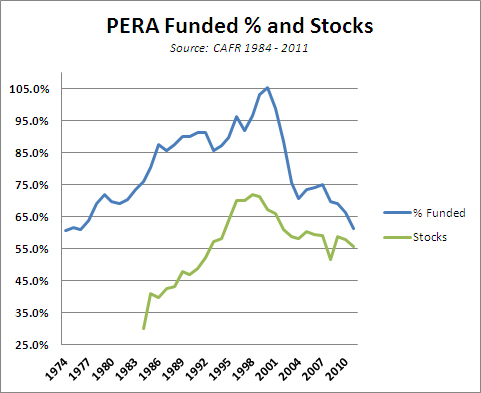
This chart also shows the folly of relying on long-term returns to determine a fund’s solvency. If a plan is underfunded, adding additional return may look like the way to catch up. But along with that additional reward comes additional risk and volatility. When the portfolio has a bad year, as in 2000, 2001, and 2008, it doesn’t have the option of drastically reducing its payout that year, as you or I would with our own retirement accounts. The need to pay benefits regardless of the fund’s annual return can put it in a hole that it can never recover from. PERA’s estimate of 8% may indeed be a realistic return over 30 or 40 years. But benefits need to be paid when they need to be paid, and the results of this thinking are all too obvious in the above chart.
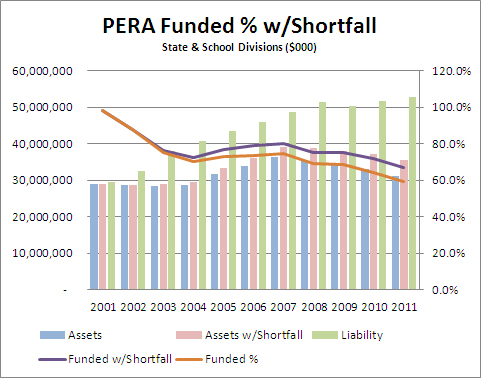
And while the legislature rarely met its Annual Required Contribution (a contribution set by Government Accounting Standards Board, and designed to ensure actuarial soundness), this shortfall was only a relatively minor factor in the fund’s increasing unfundedness. According to the chart below, had the legislature made the ARC every year from 2000 on, the State and School Divisions, which comprise the overwhelming part of PERA, would only have been about $4 billion better-off last year. PERA admits to a $23 billion unfunded liability, although there is reason to believe it is much larger:
Mr. Hudson also argues that, because overall, PERA contributions account for less than 3% of public spending, the burden is light. This ignores that for many entities – school districts, in particular – PERA spending is eating up an increasing portion of their operating expenses:
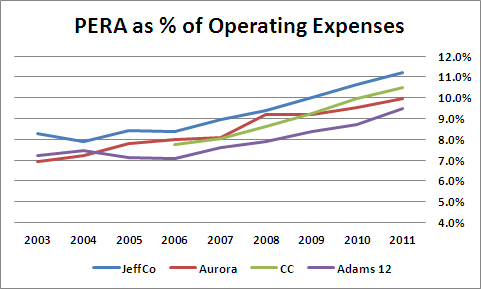
This is a result of the very supplemental payments (SAEDs) that are designed to save the system from ruin. PERA is correct that the supplemental payments were envisioned as being shared between the districts and their teachers. But with many, if not most, school boards under the thumb of the teachers’ unions, they have decided to have their districts absorb the entire supplemental payments. This means that as of 2011, for four major Denver-area school districts, roughly 11% of their operating expenses were going to teacher pension plans, money that could have gone into the classroom.
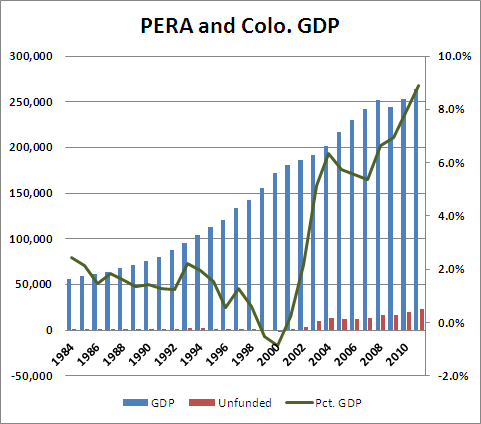
Mr. Hudson tries, implicitly, to discredit those who are concerned about PERA’s fiscal condition by claiming that it is only “in recent decades” that concern has grown up around the unfunded liability. While it is true that in the past, PERA has been significantly under-funded, two conditions make that of greater concern now. First, the PERA unfunded liability is much larger now as a percentage of the state GDP, meaning that should a fix become necessary, the pain to the state’s taxpayers will be considerable greater than it has been in the past. In the 1980s and early 90s, the unfunded liability hovered around an unthreatening 2% of state GDP. That has since grown to 9%:
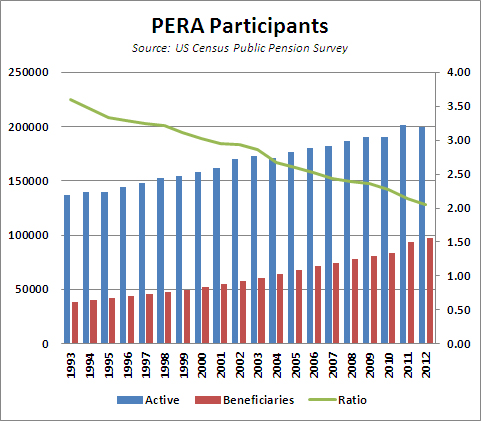
Second, since PERA has an unfunded liability, it means that some of its current expenses are paid for by current employees. (A fully-funded program would, by definition, have all current expenses in the bank.) The ratio of current employees to retirees has been falling for decades, as well, meaning that any increases in contributions will fall more heavily on future employees and future taxpayers:
As part of his rhetoric, Mr. Hudson contrasts the concrete – and real – improvements from SB10-001 with unnamed and undescribed “fixes” proposed by those who worry about PERA’s financial condition. This leaves the reader to imagine all sorts of horribles. Let’s look at some of the “panicky” fixes proposed in the state legislature over the last several years:
- HB13-1040: Would have calculated benefits on the basis of seven, rather than three years’ pay, making “spiking” more difficult to achieve
- SB13-055: Would have applied the same liability discount rate rules to PERA as apply to US private pensions and European public pensions
- HB12-1142: Would have given all PERA members the option to join PERA’s own defined contribution plan
- HB12-1179: Would have broadened the composition of PERA’s board to reduce conflicts of interest and increase accountability
- SB12-016: Would have given local governments the same option the state government has to make plan members pick up more of their benefit contributions in times of fiscal distress
- HB12-1250: Would have calculated health care benefits on the basis of costs, rather than employees’ salaries
- SB12-082: Would have set the PERA retirement age to that of Social Security for non-public safety members, a matter of basic fairness
- SB12-119: Would have forced PERA make adjustments until its plans could meet a 30-year amortization window, the standard for pensions
- SB12-136: Would have included PERA benefits in the state’s Biennial Compensation Report
All of these changes are designed to increase transparency, increase accountability, and decrease conflicts of interest. All of them are designed to increase fairness, and increase the likelihood that PERA retirees will be able to rely on promises made to them.
It is telling that each of these changes – every last one – has been opposed by PERA and its allies in the public employees unions here in Colorado.
And it’s enough to make you wonder who’s really panicking.
Yes, PERA Is Worse Now
Posted by Joshua Sharf in PERA on May 14th, 2013
Defenders of PERA often argue that while the liabilities have been under-funded in the past, it is only now that PERA’s critics have begun to worry about the matter. The implied message is that the complaints are political, rather than financial. Here’s why this isn’t the case:
Yes, Colorado’s economy has grown, but the PERA liability has grown faster. While through the 80s and most of the 90s, the unfunded liability hovered around 2% of the state’s GDP, since 2000, it has grown to 9%. Of course, during the good economic years, it declined somewhat, and it may well decline a little again this year, as PERA’s returns are expected to be around 12% on its portfolio. But sooner or later, we will hit a cyclical recession, and even as the economy shrinks, PERA’s unfunded promises will continue to accumulate.
Daily Glimpse May 13, 2013
Posted by Joshua Sharf in PPC on May 13th, 2013
Daily Links From Glimpse From a Height
- Three Views on the UKIP
The UK Independence Party did quite well in this past week’s council elections in England, at least in terms of the popular vote. They didn’t win control of any councils, although they did end up with representation on some of them. So the talk of a Tory-UKIP coalition, or even of an electoral alliance, grows […]
- Alas, Colorado
Colorado immigrant Sarah Hoyt, on not moving from Colorado: So, now to everyone who keeps sending me notes asking me what I intend to do about the Colorado legislature and its laws to ensure we never get to have a say in governing again. I’m not stupid. I see the Detroit writing on the wall. […]
Banana Democrats
Posted by Joshua Sharf in Colorado Politics on May 12th, 2013
There’s an area of Colorado, near Buena Vista in the south-central part of the state, known as the “Banana Belt” for its temperate climate. It’s unknown if State Sen. Greg Brophy (R-Wray) had that in mind when he claimed that HB13-1303 will turn the state into a “banana republic,” but his comments remain accurate nonetheless. The new law will, among other things, lower the residency requirement to 22 days, pre-register 16-year-olds when the get their drivers licenses, replace precinct voting with vote-by-mail and the occasional vote center, and permit same-day registration to cast regular ballots. It will require that mail ballots be sent to all registered voters, and will do away with the “Inactive Voter” status, which voters attain by not voting for several consecutive elections.
To many Republicans, this one included, these changes sound like a stamped, self-addressed invitation to vote fraud. Vince Carroll of the Denver Post has detailed some of the problems with the bill.
The bill would retain all the current means of registration – including being able to register using a utility bill and the last four digits of your Social Security number the license plate you saw outside, and then to proceed immediately to vote, using a regular ballot, not a provisional one set aside for after the registration was verified. County clerks had argued in favor of the bill, claiming that the SCORE system currently used to track voter registrations could easily be expanded to statewide use, and that once a statewide system is set up, there will be little trouble tracking voter registrations.
The fact is, the system we have now is manifestly riddled with bad registrations, old registrations, and dead people. And the very same people who wrote this bill, in collusion with the legislative Democrats, are the ones who not only stand in the way of cleaning up the rolls, but have tried to pry open the system with a judicial crowbar in the past.
I’ve been directly involved in a number of campaigns that involved going door-to-door for signatures. I don’t even bother with apartments, since the odds of the registrant matching the resident are somewhat south of hitting a given number on a roulette wheel. The voter rolls for these precincts are literally (not figuratively) filled with bad registrations. And it’s no good saying it’s not a problem because we’re only 6 months away from the last election. Since Colorado routinely has odd-year elections for ballot initiatives and school boards, we’re also only 6 months away from the next one.
The groups that were called into help write the bill – notably not including the Secretary of State’s office – have, in the past, sued the Secretary of State for ridding the voter rolls of dead people, criticized him for trying to get non-citizens off the registrations rolls, and filed suit in 2004 seeking to permit anyone to vote the full ballot anywhere, without any form of identification. In the decision in that case, the judge noted that:
But at the moment, if I were to try to design a system that maximizes the chances that fraudulent and ineligible registrants will be able to become fraudulent voters, I’m not sure I could do a better job than what Plaintiffs are asking me to do in this case—allow voters to vote wherever they want without showing any identification.
The entire opinion is worth reading, and I’ve quoted salient paragraphs from it at length before. For the moment, bear in the mind what that quote says about the character of Common Cause and the other co-conspirators to this hijacking of our electoral system.
The Democrats who wrote and voted for this bill have to be well aware of these fact. These are elected state representatives and state senators. Every last one of them – especially the Democrats who tend to come from urban areas – is a professional politician who got elected by working these very precincts. It beggars the imagination to believe that they are so unacquainted with their districts that they don’t know how detached the voter rolls are from reality. And that’s now, before these changes are put in place.
The only conclusions to draw are that the Democrats who voted for this bill are at best unconcerned about the integrity of our elections, and at worst see elections as a whole not as contests to be won, but as boxes to be checked off in the ratification of their power.
We are all from Buena Vista now.
-
You are currently browsing the archives.


