Daily Glimpse November 18, 2013
Posted by Joshua Sharf in PPC on November 18th, 2013
Daily Links From Glimpse From a Height
- China Offers Administrative Fix to Labor Camps
Via Quartz: The question now is what exactly abolishing laojiao will entail. According to Human Rights Watch (HRW), the government has considered replacing it with another system, which also allows long-term detention without trial but with some new rights like access to counsel. “It is therefore unclear, after the government ‘stops using’ the system, whether it will be reformed, […]
Tidbits from the Gessler Campaign
Posted by Joshua Sharf in Colorado Politics, Governor 2014 on November 17th, 2013
One of the leading candidates for the Republican nomination to unseat sitting Governor John Hickenlooper is Secretary of State Scott Gessler. Gessler has been a solid conservative, and has taken his share of arrows from Colorado’s progressive left for his insistence on ballot integrity and his resistance to the HB1013, the Democrat Weaponization of Voter Fraud Act of 2013.
This isn’t a post with an extended analysis of the governor’s race, but I did want to mention a couple of interesting items that haven’t gotten the play that I think they should have, mostly because they’re good stories.
First, Gessler essentially suspended much of his field operation (calls for contributions presumably went on as usual) in order to redeploy his staff on behalf of the Douglas County School Board reform candidates. Those were important races not just for Douglas County, but also with state and national implications. The unions essentially tossed everything they had into those races, reducing support to their Denver and Jefferson County candidates. They were gambling that even if they lost there, a win in DougCo would send a warning message to other school boards. They lost that gamble, in part because of the field support that Gessler gave them.
This is called, “leadership.” To be sure, it wasn’t entirely selfless. The information and visibility gained in a Republican-dense county will be helpful in both primary and general election campaigns. But showing up for a fight that nobody would blame you for sitting out builds loyalty, and shows a willingness to sacrifice for the team. In 1966, Richard Nixon campaigned all over the US for Republican Congressional candidates, all of whom won, and all of whom remembered it in 1968. That Gessler was willing to do the same speaks well of him. To the extent that there’s a concern here, it’s that he hasn’t done a better job of publicizing this story.
That actually could be a serious concern, since one of Gessler’s potential picks for Lieutenant Governor, State Rep. Calrice Navarro-Ratzlaff of Pueblo, is seen by many as more moderate than Gessler. Now, that would be, in my mind, a silly reason not to support Scott. Lt. Governors operate at the behest of the Governor. And as this chart shows, in Colorado, that post is a launching pad to obscurity. You have to go back to the 2nd Eisenhower Administration to find a Lt. Governor who was later elected to a significant statewide position in his own right. This isn’t Reagan positioning Bush as his successor.
As a district captain, I have to retain strict neutrality when it comes to primary races, but that doesn’t preclude me from writing about interesting and informative aspects of the race.
Changes to PERA’s Assumptions Not All Good News
Posted by Joshua Sharf in PERA on November 17th, 2013
Friday, the PERA Board decided to make two significant changes to their actuarial assumptions. First, they lowered their expected return on their portfolio from 8% to a more realistic 7.5%. Second, they lowered their inflation expectation from 3.5% to 2.8%.
This is being advertised as a more realistic set of assumptions, in effect, an admission against interest that outside players such as Treasurer Walker Stapleton have been agitating for for some time. The lower rate of return will, according to the Denver Post report, raise the unfunded liability from $23 billion to $29 billion.
It’s true that the 7,5% rate is more conservative than 8%, and closer to the average rate of return being assumed by most public pension funds around the country. On that basis, the change is to be welcomed. But for a long time, I’ve felt that the rate of return was very much out of line.
In fact, the lower rate of return should have no effect on the unfunded liability. The only reason that the unfunded liability will grow is that PERA will use the lower rate of return as the new discount rate. Of course, as we’ve discussed before, the discount rate should be independent of the rate of return; it should be the state’s long-term cost of borrowing, or even the risk-free rate of return, the 30-year US Treasury rate.
In addition, many of the benefits of the lower rate of return are more than offset by the lower inflation rate. Before, the real rate of return was 8 – 3.5, or 4.5%; now it’s 7.5 – 2.8, or 4.7%. PERA is decreasing the increase in future liabilities here, by lowering the expected future increase in salaries. This means that the net effect of both changes is to increase the real rate of return.
Unfortunately, we won’t know exactly how this plays out until PERA releases its next CAFR – next July, 8 months from now.
Daily Glimpse November 14, 2013
Posted by Joshua Sharf in PPC on November 14th, 2013
Daily Links From Glimpse From a Height
- Putting African “Power Pimps” Out of Business
What do you do when you have cell phones but no power? It’s hard to imagine the concept of a “power pimp” in Africa unless you have lived there. But it makes sense and cents on a continent that lacks a unified power system. There is basically no electric power in most rural places unless […]
- Tea Party Despair and ObamaCare
A piece from a few weeks ago that’s still valid: Despair is a contagion that can kill a political movement. As Pete Wehnerbrilliantly noted here earlier today in his piece about the Tea Party mindset, the apocalyptic view of the ObamaCare defunding fight has led many conservatives to take an all-or-nothing position that sees greater value […]
- Fed Really, Really Wants to End Too Big to Fail
Barry Ritholtz at Bloomberg notices consensus at the Fed on at least one policy issue: Perhaps most notable is Dallas Federal Reserve Bank President Richard W. Fisher’s remarks, Ending ‘Too Big to Fail,’ earlier this year. A conservative who dislikes government intervention in markets and despises bailouts, Fisher is concerned that TBTF will eventually require more of both. […]
Daily Glimpse November 13, 2013
Posted by Joshua Sharf in PPC on November 13th, 2013
Daily Links From Glimpse From a Height
- 100 Best, 100(+) Years Ago
The perishability of immortality. The 100 Best Novels, as selected in 1898: Sometime editor of the Illustrated London News, an authority on the Brontës and Napoleon, Clement K. Shorter was in the middle of a flourishing career when this list appeared in the monthly journal called The Bookman. He doesn’t explain what exactly makes a book one of […]
- State And Local Government Austerity Is Over
So says Bill McBride over at Calculated Risk: The blue bars are for residential investment (RI), and RI was a significant drag on GDP for several years. Now RI has been adding added to GDP growth. The red bars are the contribution from state and local governments. Although not as big a drag as the housing […]
- The Case for Kurdistan
It’s not just cynical manipulation, or at least, it doesn’t have to be: The Kurds scattered contiguously across Iran, Iraq, Turkey and Syria, are a group whose interests make them a natural partner to the US in the Middle East. While they are Sunni Muslims, the Kurds identify overwhelmingly with their cultural and linguistic heritage, […]
- Republicans, Some Democrats Backed Failing Energy Company
It turns out there’s an energy boondoggle worse than Solyndra out there: Public support for the United States Enrichment Corp. far exceeds what was lost on the infamous Solyndra solar energy boondoggle, and funding provided ostensibly to build a new plant will almost certainly yield the same results for taxpayers — nothing. The company has […]
- Why Ken Cuccinelli Really Lost
Rich Shaftan, an experienced political consultant, brings a sober analysis to the table, dispelling myths and drawing lessons. Everything I’ve seen from Rick is level-headed and devoid of the blamethrowing that’s become far too common in these post-mortems. Among the key items: THE “REPUBLICAN PARTY SCREWED CUCCINELLI” MYTH The Republican Governor’s Association put $8 Million […]
Who’s Funding Hudak Defenders’ Scare Tactics?
Posted by Joshua Sharf in Colorado Politics on November 11th, 2013
We’re not quite sure, that’s who.
Complete Colorado reported Friday on another attempt to scare Jefferson County residents away from signing recall petitions for State Senator Evie Hudak (D). “Democracy Defense Fund,” which had previously been responsible for door-hangers claiming that signature-gatherers were criminals, is now using robocalls for the same purpose.
A poster on the Grassroots Radio Facebook page found the TRACER record for the Democracy Defense Fund, registered on October 10, 2013, for the purpose of opposing the SD19 recall. While the principals for DDF are local to Colorado, the Fund’s entire $25,000 bankroll came on an October 18 donation from a group named Environmental Majority, out of Washington, DC.
The PAC is expressly partisan, and solely focused on elections.
The $25,000 expenditure represents more than it had spent in the 2014 cycle up to this point. Not more than it had spent on specific races. More than it had spent, period.
The PAC reported receipts of roughly $29,000 in the first half of the year, about $23,600 came through the site ActBlue, which serves as a small-donor platform for progressive and Democrat causes, sort of a partisan Piryx. Of the $21,000 spent, about $9300 went to the Massachusetts special Senate election to replace John Kerry; just under $6000 went to the New Virginia PAC, other money went to various Democrat digital consulting firms. Small Potatoes.
Yet, with just over $8000 cash on hand reported at the end of June 2013, the Fund found $25,000 for scare-robocalls and scare-door-hangers in the Hudak recall race. Admittedly, Hudak has a 100% Lifetime rating from the Colorado Conservation Voters. But still, she’s a state senator, not a Congressman or a US Senator, and Environmental Majority states:
Our objective is straightforward: elect a pro-environment Democratic majority in the United States Congress and raise the political importance of environmental issues, especially climate change.
It appears that the decision to funnel the money through Environmental Majority, rather than immediately through Democracy Defense Fund, may have been deliberately made in order to avoid disclosure until after the signature-gathering period ended. DDF has already been fined $50 for being late on one reporting deadline, but according to TRACER, their next filing would be due November 25. The Hudak recall effort has until December 2 to turn in its petitions.
Since 2013 is an odd-numbered year, it appears that the FEC will only require Environmental Majority to file a new report by January 31 of next year, well after the Hudak signatures have been gathered or haven’t been. This means that we may well not know who’s been funding the scare tactics that Hudak’s defenders have been using until the issue of there being a recall election at all is settled.
UPDATE: Colorado Observer notes that Environmental Majority has also given $5000 to Stand With Evie.
Yes on 66 Campaign Goes Brave Sir Robin
Posted by Joshua Sharf in Uncategorized on November 3rd, 2013
When danger reared its ugly head
He bravely turned his tail and fled
Brave, brave, brave, brave Sir Robin
“Monty Python and the Holy Grail”
That was roughly the approach taken by Abigail Hinga of the Yes on 66 campaign Sunday morning.
In response to WatchdogWire’s coverage of Amendment 66, News Director Roman Moore of Krystal 93 FM in Dillon invited me and a representative of the Yes on 66 campaign to participate in a radio forum of about 45 minutes, to be aired at least once, and podcast on the site. The show was to be recorded at 1:00 PM.
As I was driving up to Dillon this morning, I got a call from Mr. Moore saying that the Yes on 66 representative had cancelled – without giving a reason – and that he didn’t feel it would be right to continue with the forum with only one side in attendance. Mr. Moore asked be for a statement, and I gave him the following: “It’s sad that the out-of-state money and union interests that are backing this amendment don’t want the residents of Summit County to have access to a full and fair debate. That’s probably because under the new funding formula, it’ll just mean more broken promises to Summit County public school students.”
It should be noted that Watchdog Wire has not taken an official editorial position on Amendment 66, however, we have devoted a fair amount of time to discussing the inconsistencies of those who are supporting the measure, including Governor Hickenlooper and ProgressNow’s Alan Franklin.
Let’s be reasonable here. The Yes on 66 side has bought a tremendous amount of airtime on Krystal 93 for advertising. Without a participant, it was clear that Moore wouldn’t be able to have a forum. And without a forum, they would effectively muzzle the opposition. The way this game is normally played, the side who thinks they have nothing to gain ducks and dodges, while the side who wants the debate accuses them of ducking an dodging. But it’s highly unusual – to say the least – to commit several times to a forum and then pull out of it at virtually the last minute. That’s not politics, it’s just poor form.
Obamacare – When Lawlessness Under the Law Just Isn’t Enough
Posted by Joshua Sharf in Colorado Politics, Health Care on October 25th, 2013
The Washington Post reports this morning that 10 Democratic Senators – including both Colorado Senators – have asked the Obama Administration to extend the open enrollment period for new insurance under Obamacare. Their request stems from the well-publicized problems with the rollout of the insurance exchange websites, the primary mechanism for enrolling in Obamacare and purchasing new insurance, as required by the individual mandate. The letter reads, in part:
Given the existing problems with healthcare.gov and other state-run marketplace websites that depend on the federally-administered website, we urge you to consider extending open enrollment beyond the current end date of March 31, 2014. Extending this period will give consumers critical time in which to become familiar with the website and choose a plan that is best for them. Individuals should not be penalized for lack of coverage if they are unable to purchase health insurance due to technical problems.
While this may sound like a good idea, it likely won’t work without a delay in the individual mandate (See Solution #7), and is almost certainly illegal under Section 1311 of the law:
The three-month open-enrollment period isn’t statutory; instead, the ACA directs the Secretary to establish an “initial open enrollment” period. Normally she’d have the discretion to tinker with that as necessary. But the statute also requires her to establish that initial period by “not later than July 1, 2012.” Well, she’s blown through that already — and the provision appears to preclude her from rethinking the determination now. For years after 2014, the statute’s quite clear that she’s got discretion to set annual enrollment periods. But that broad discretion exists only “for calendar years after the initial enrollment period.” That reinforces the suggestion that she can’t rethink the open-enrollment period now.
Apparently, a 2700-page law that’s generated 11000 pages of regulations, includes almost unlimited waiver capacity for the President’s friends, excludes all manner of people responsible for passing and implementing it, and even permits the executive to ignore whole sections of it, still didn’t provide enough flexibility after the election. Now, Democratic Senators who are staring political mortality in the face are encouraging the HHS Secretary – and by extension, the President – to just ignore the law altogether to help get them out of this mess.
Either Senators Udall and Bennet knew this was illegal when they signed the letter, or they didn’t. Either way, this amounts to an abdication of responsibility of elected representatives.
If they did know, they’re encouraging not merely this Administration’s habit of arbitrary rule and lawlessness within the law, but actual black-letter lawlessness. If they didn’t know, it’s a testament to the dangers of voting on bills you couldn’t have read, much less understood, that hand over wholesale lawmaking authority to another branch of government. The problem with the latter is that it becomes a habit, and little by little, and then all at once, you find yourself running for an office that doesn’t matter at all, while the real power has coalesced into a single executive and an unelected civil service.
How about this. Since Senators Udall and Bennet don’t seem interested in governing, how about elect someone who is?
Transparency At A Steep Price
Posted by Joshua Sharf in Colorado Politics, Finance, Taxes on October 22nd, 2013
This post originally appeared on Watchdog Wire Colorado (“Gov. Hickenlooper Channels His Inner Pelosi“).
Rep. Nancy Pelosi (D-CA) famously said about Obamacare that, “We have to pass the bill so that you can find out what’s in it, away from the fog of the controversy.” That seems to be the line that Gov. John Hickenlooper (D) is taking with respect to PERA spending by the state’s school districts, and Amendment 66.
In a recent post that has garnered attention from both the Colorado Springs Gazette and the Denver Post, we discussed the governor’s approach to PERA spending by the districts, which is to increase transparency in order to drive public opinion:
Gov. Hickenlooper: Well, if you want to fix that, if that’s what’s happening, then we can’t legislate that. There’s a certain amount of money that goes into the districts, and that is the way our education system is structured. If you want to fix that, put it up on our website, how much of that money the district is spending on PERA. And I guarantee you the parents will go nuts.
In response to another question at that same October 8 event, Hickenlooper touted the transparency website as part of the “Grand Bargain” of Amendment 66, that the entrenched interests and monopoly power of the districts and the teachers unions would likely not have accepted the transparency without the additional money from Amendment 66’s tax increase:
And the other question of whether you could just do this – let’s assume the website was for free, to get that into the bill, the school districts, and the school administrators, would have fought it like crazy, because it’s going to make their life hell.
The only reason they were willing to let it be in this bill was because we had a tax increase.
It’s why they call it, “The Grand Bargain.” We’ve got all this stuff that no other state – I mean – doesn’t it sound like a great idea to have that transparency? And yet why is it that not a single other state has that kind of a website. (Emphasis Added.)
In short, he’s arguing that the only way to get the transparency is to vote for the tax increase first.
However, the legislature has in the past mandated transparency, and with no objection from the districts. In 2010, the legislature approved HB10-1036, the Public School Financial Transparency Act, virtually without objection. Among other things, it’s the reason that school districts have to post Comprehensive Annual Financial Reports and Quarterly Financial Statements online, along with check registers and credit and debit card purchase statements within 60 days of incurring the expense.
The bill passed without dissent through both Education Committees, and registered only one “No” vote on the floor of the House. It appears as though nobody testified against it in committee. Our own Ben DeGrow did testify in favor of it before the House Education Committee.
If the governor is now arguing that such an extension of the transparency requirements would meet with stiff resistance from the school boards and teachers unions, he’s essentially arguing that there’s not enough support within the majority Democratic caucus in the legislature to get such a bill passed, and admitting perhaps more than he would like about union influence within that caucus.
In order to garner support for the tax increase from reluctant parties, Gov. Hickenlooper has pledged to put SB10-191’s tenure reform on the ballot in the form of a Constitutional amendment, should the expected legal challenges succeed. If the tax increase amounts to the price to be paid for bringing his own caucus along on transparency, it calls into question his ability to fulfill that pledge once the tax increase has already passed.
Can’t Anybody Here Play This Game?
Posted by Joshua Sharf in Health Care on October 21st, 2013
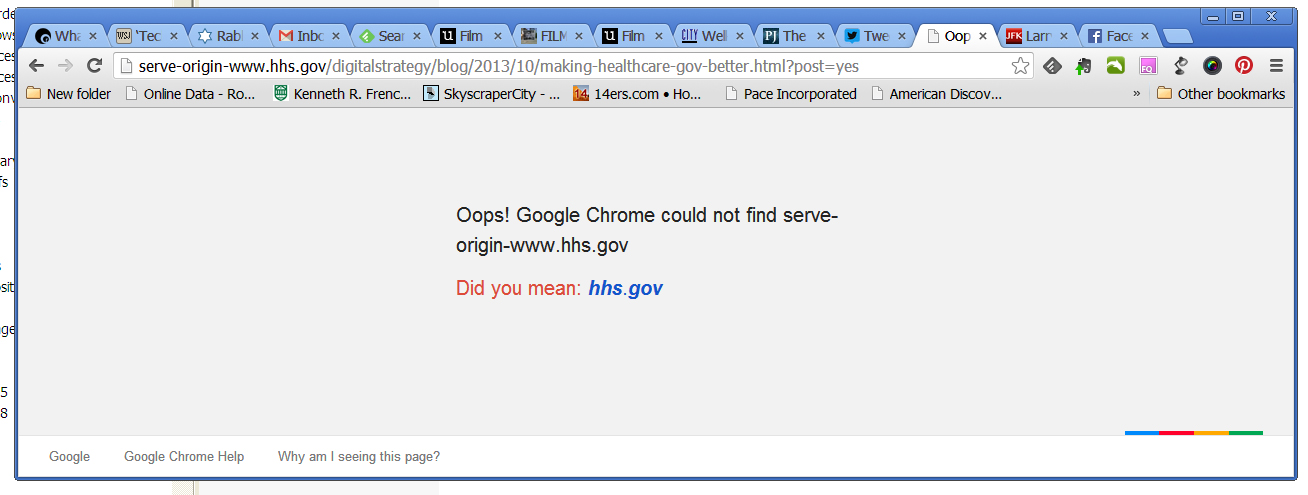
This morning, Colorado Speaker of the House Mark Ferrandino retweeted this from the White House:

Nice. Here’s what you get:
-
You are currently browsing the archives.


