Devouring the School Budget From Within
Posted by Joshua Sharf in Education, PERA, PPC on July 6th, 2012
PERA’s problems don’t stop with the state. While the Colorado government has consistently shorted PERA on its Annual Contribution (theoretical) Requirement, local school districts have less flexibility in kicking the can down the road. As a result, their PERA contributions have increased rapidly, in some cases very rapidly, over the last decade or so. Here are the compound annual growth rates for four of the largest school districts from 2003 – 2011 (except for Cherry Creek, for which data was only available starting in 2006).

These numbers include all PERA contributions, both to the School Trust Fund and to the Health Care Trust Fund HCTF).
What does this mean for school budgets? Well, taking the Schedule 4 disclosures in the Statistical sections, we can derive the annual operating expenditures. For the government funds, we take the total expenses, subtract out the CapEx and the Debt Service, and then divide that number into the annual PERA contribution (described three years rolling in the Financial Section Notes).
The result? Not pretty:
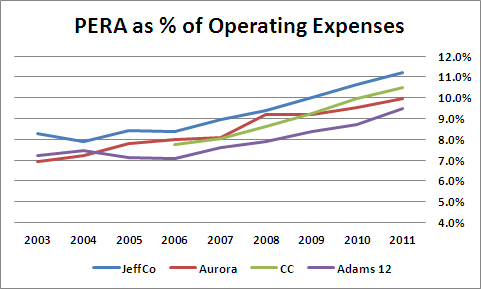
The role of debt service in school finance is another matter well worth examining, but in this case, adding it in would just alter the level, not the trend. But consider that in JeffCo, 1 in every 9 dollars goes to PERA. In Cherry Creek and Aurora, it’s 1 in 10 dollars.
It’s not that school spending isn’t rising. It’s that PERA contributions are skyrocketing. And school budgets are starting to feel the pressure.
UPDATE: A typo in the Cherry Creek numbers prior to 2009 exaggerated the rate of increase, and created a “knee” in the data between 2008 and 2009. The 2006-2008 contributions were actually higher than I had reported. I’ve corrected the charts.
Memory and History, Jews and the 4th
Posted by Joshua Sharf in Uncategorized on July 4th, 2012
George Washington’s letter to the Newport Synagogue is justly celebrated as one of the first official descriptions of what Free Exercise and Non-establishment meant in the United States, although the Bill of Rights wouldn’t become officially part of the Constitution for over a year. What’s less well-known is the letter of congratulation written by Moses Seixas to Washington, as the new President visited Newport as part of a tour of the country. Here are the two letters:
Yosef Hayim Yerushalmi, in his short book, Zachor, makes the claim that Jews, up until the Enlightenment and its rationalist influences, had essentially given up recording history, instead seeing events through a shared cultural memory. While history happens to someone else, your memories can only be of things that happened to you. As a result, almost all Jewish recordings of contemporary events are in a voice that either echoes Biblical events, or analogizes to Biblical personages. Instances where local kings intervene to prevent massacres are recorded in scrolls that mimic Megillat Esther (the Book of Esther), for example. This has the effect of providing a context for everything, but it also prevented Jews from seeing anything as actually new.
Western civilization, on the other hand, studies history as events that may have happened to others, but from which we can learn. That historical accounts are not treated as entertaining stories, but as a description of how we got where we are, doesn’t change the fact that they’re written with the distance of time.
These two views of history are on full display in the two letters. Seixas makes no fewer than four scriptural analogies. The whole tone of his letter is one that is trying to shoehorn current events into ancient paradigms. Washington’s letter is more familiar to our way of thinking. His history – with which he was personally fully conversant – is implied, rather than stated, and his Biblical reference is a blessing, not an event.
Washington was President of a Constitutional Convention filled with men who studied the Greeks, the Romans, and other republics in-between, and put their lessons to use in designing our own government. Seixas was struggling to describe his awe that he had the privilege to live in a time when a new concept of citizenship had been born and put into practice.
And yet, each realizes that this country is something new under the sun. It’s not just that bigotry gets no sanction, it’s that “tolerance,” which implies that (in this case) the Jews have their rights by sufferance of the majority, isn’t the operative principle here. Full citizenship and participation in the government are completely unconditional on one’s faith or religion.
Which is why, as Jews, we ought to celebrate Independence Day with a special fervor and gratitude, and why we have a special obligation to help preserve that order,
PERA – Wait Till Your GASB Gets Home
Posted by Joshua Sharf in PERA, PPC on June 29th, 2012
So we knew that when the new Government Accounting Standards Board requirements for public pension reporting came out, reported funding levels across the country would drop like a rock, but we didn’t really know how much.
Turns out that the good folks at the Center for Retirement Research at Boston College did some of that work for us a couple of years ago, studying 127 public pensions across the country.
Remember, the new standards have two parts: pensions must report their holdings at current market value, and not average those values over 3-5 years as they had before. And the unfunded liabilities, the portion that they do not believe are funded by current holdings, would have to be discounted at the long-term borrowing rate for the municipality involved, producing a blended rate likely lower than then expected return, and thereby decreasing the apparent funded level.
As of 2009, the numbers for Colorado didn’t look good at all. The school portion of PERA would fall from 65% funded to 52%, and the state portion from 63% to 48%. With current funded levels slightly lower, the actuals are also likely lower now.
It’s important to remember that these are accounting changes, and that the plans didn’t suddenly become less solvent overnight. But as a better reflection of reality, they are still pretty sobering.
A New Form of Revenue
Posted by Joshua Sharf in Health Care, PPC, Taxes on June 29th, 2012
Just as physicists long ago realized that light is neither a particle nor a wave, the Democrats have now, evidently, discovered a form of revenue that is neither a penalty nor a tax:
President Obama:
Deputy Campaign Manager Stephanie Cutter:
Austan Goolsbee:
HHS Secretary Sebelius:
A Loss Wrapped in a Tie Shrouded in a Defeat
Posted by Joshua Sharf in Health Care, PPC on June 29th, 2012
References to yesterday’s 98th anniversary of the assassination of Archduke Franz Ferdinand may be overwrought, But contrary to those who see this as a win disguised as a loss inside of a tie wrapped in a stalemate, it was a loss.
Yes, the Court may have drawn some lines with regards to the elasticity of the Commerce Clause, but replacing the ever-elastic Commerce Clause with the taxing power isn’t necessarily a win. Especially as conservatives have always held that property rights are a key underpinning of political rights. There is nothing here that necessarily keeps Congress from doing what it pleases, as long as the penalties are collected by the IRS. What happens then, if they add on an additional provision that, much like student debt, you can work off your sins against the state, but you can work it off more quickly in certain favored ways?
I’ve also heard it asserted that in the political climate, it will make it more difficult to pass large changes, since they’ll have to use the taxing power. This seems overly-optimistic to me in at least three ways. First, the ruling in no way begins to roll back nearly a century of mistaken Commerce Clause jurisprudence, and if anything has shown, it’s that the current boundaries of the Commerce Clause are plenty broad enough to contain all sorts of trouble.
Second, I doubt that further massive changes are on the agenda, anyway. The gargantuan administrative state that this law is going to require, the tens of thousands of pages of regulations and rules and boxes to check off, will provide more than enough machinery for Change as they stand.
But mostly, it’s not as though the individual mandate was ever sold as a tax in the first place. Taxes may be toxic, but the Court ruled – probably correctly – that something doesn’t have to be expressly declared a tax in order to be valid under the taxing authority. Even the silver lining here is double-edged: what can be repealed under reconciliation can be passed under reconciliation. And repeated use of the phrase, “taxing power” has the ability to drain the word “tax” of its deserved fearsomeness.
In terms of this election, it’s certainly a net plus. It will make Obama’s life miserable on the campaign trail, as he finds himself explaining that “it all depends on what the meaning of ‘tax'” is. Those who have been calling for him to play against type an imitate Clinton probably didn’t have that part in mind.
It also means that it’s true, as Romney will now say, that “in order to get rid of Obamacare, you have to get rid of Obama.” The Court essentially eliminated the severability clause between Obama’s presidency and this law.
But this election really is the game. Not only would Obama’s re-election, or the retention of a Democrat Senate, ensure the eventual transformation of freeborn citizens into subjects, even a victory doesn’t guarantee victory. The electoral wipeout of 2010, and its foreshocks (Scott Brown) and aftershocks (Keith Judd), have left the Democrats undeterred. To believe that they won’t use every Senatorial procedural option available to them is probably to hope for too much. Even the hoped-for lame duck period between November and January will be fraught with opportunities for administrative mischief.
If elections are to continue to have meaning, if indeed, they haven’t already been emptied of their power to reflect change in any but one direction, this one needs to count.
Many Not-So-Happy Returns for PERA
Posted by Joshua Sharf in Budget, Colorado Politics, PERA, PPC on June 26th, 2012
As PERA prepares to release its 2011 Comprehensive Annual Financial Report, keep an eye on 2011’s returns. Treasurer Walker Stapleton understatedly calls 2001’s anemic 1.8% return, a “serious warning sign.” I’d call it a big, red, flashing LED billboard.
“What’s the big deal? It’s only one year,” I hear you cry.
Well, it turns out that if you’re projecting returns over a long period, the early returns have a disproportionate effect on whether or not you’ll make your targets. And while PERA projects an overly-optimistic 8% annual return, even meeting that as an average cumulative return is no guarantee of solvency to the end.
Returns aren’t smooth, they vary over time, and while the exact distribution is a matter of dispute, that fact isn’t. While the actuarial outlays are relatively smooth, returns can bounce around all over the place, and poor early returns can mean that you’re eating into your principal, and won’t be able to make it up on the back end, even if the returns rise to meet your project cumulative average.
Take three sets of return profiles, one constant, one with slightly higher-than-expected returns the first two years, and one where the fund loses 5% a year for the first two years, but settles in at a higher rate.

All of them converge to the save Cumulative average at the end of the 20-year run:

But because they have to take money out each year, the end of year balances tell a starkly different story for the three funds:

One fund slowly declines from $1 million balance to $800K. The one with higher early returns also declines, but ends up above its starting balance. And the one with poor early returns never recovers.
In fact, 20 data points is a very small sample, and even a distribution of returns that averages 8% could easily produce, over 20 samples, returns far higher or, more likely, far lower. The graph below shows the average returns and final balances from a 10,000-run Monte Carlo simulation:

Below about 10%, there’s a virtual guarantee that some of the funds will go bankrupt. Let me emphasize that this is a very simplified model, for display purposes only. Do not try this at home. (Actually, go ahead and try this at home. You’ll probably be as depressed and I was.)
What this shows, though, is that even using a lower rate of return doesn’t necessarily guarantee the fund’s soundness, and certainly doesn’t model the fund’s future. The only way to do that is through a Monte Carlo simulation, using the historical returns of the assets in which the fund is invested.
While more complex to do, and very hard to model on a spreadsheet, there is precedent for incorporating Monte Carlo modeling into financial planning, pension solvency analysis, and even into accounting. The Black-Scholes method, for instance, is used to calculate the value of stock options granted to employees and expensed on corporate financial statements. And allowances for bad debt are routinely audited for fidelity to previous customer defaults. There’s no reason that we couldn’t require pensions to do the same.
At the very least, it would perhaps keep today’s 1.8% return announcements from being such a surprise, and from taking such a toll on PERA’s solvency estimates.
Knowledge Without Understanding
Posted by Joshua Sharf in PPC on June 24th, 2012
It’s safe to say that Tom Holland is one of the better popular historians going right now. I thoroughly enjoyed his Rubicon, for instance. And he takes on big subjects, like the origins of the Roman Empire, the Persian Empire, and Christianity. Now, he’s examining the origins of Islam using traditional scholarly techniques, in In the Shadow of the Sword: The Birth of Islam and the Rise of the Global Arab Empire. I haven’t read it, this NPR interview shows both the promise of the book, and the utter cluelessness of the author in regards to modern Islam.
Holland is to be commended for questioning the founding myths of Islam (a myth, of course, is not necessarily untrue), and he ends up questioning Muhammed’s illiteracy, the time of the Koran’s authorship, and even Mecca as the original homeland of Mecca.
Jews and Christians are familiar with these sorts of critiques of their religious writings, but for Muslims, this is yet another encounter with a modernity in which Islam has fared poorly. And Holland, for all his book-learning, seems to have absolutely no idea what he’s up against:
But what about those who say Holland shouldn’t question a sacred text? “I’m not a Muslim,” he says. “It seems to me that the Quran palpably is a late antique document. It recognizably comes from a certain context. And I don’t think that a Muslim would begrudge a non-Muslim an attempt to explain a text that he doesn’t believe to be of divine origin in human terms.” (Emphasis added.)
Seriously? In just this year, Kuwait has passed blasphemy laws, which include non-Muslims, and a Danish court acquitted a writer of violating its hate-speech laws, only because of intent to disseminate. Last year, an Austrian court, convicted a woman of, “vilifying religious teachings.” The countries of the Organization of the Islamic Conference have persistently tried to get western countries to sign on to the idea of “slander” of a religion. Paul Marshall, a senior fellow at the Hudson Institute, discussed the threat not only to European law but to US freedoms earlier this year at Hillsdale College, and the bill of particulars is worth reiterating:
Few in the West were concerned with such laws 20 years ago. Even if still on some statute books, they were only of historical interest. That began to change in 1989, when the late Ayatollah Khomeini, then Iran’s Supreme Leader, declared it the duty of every Muslim to kill British-based writer Salman Rushdie on the grounds that his novel, The Satanic Verses, was blasphemous. Rushdie has survived by living his life in hiding. Others connected with the book were not so fortunate: its Japanese translator was assassinated, its Italian translator was stabbed, its Norwegian publisher was shot, and 35 guests at a hotel hosting its Turkish publisher were burned to death in an arson attack.
More recently, we have seen eruptions of violence in reaction to Theo van Gogh’s and Ayaan Hirsi Ali’s film Submission, Danish and Swedish cartoons depicting Mohammed, the speech at Regensburg by Pope Benedict XVI on the topic of faith, reason, and religious violence, Geert Wilders’ film Fitna, and a false Newsweek report that the U.S. military had desecrated Korans at Guantanamo…
In an academic study of the famous Danish Cartoons, Yale University Press refused to print the cartoons, the very object of study.
Here in Denver, Imam Ibrahim Kazerooni, a student at the University of Denver’s Iliff School of Theology, speaking at a mosque in Dearborn, exhorted young Muslims to enter to academy, specifically to prevent this kind of inquiry. (Videos here, and here).
Holland apparently believes that because he’s a westerner applying academic principles to the Koran that he’ll be spared the wrath of the radicals. He’s just spent years studying the origins and theology of Islam, an still can’t fathom that all too many of it current practitioners have a mindset that is not merely alien to his own, but utterly hostile to it.
Union Concessions Not So…Concessional
Posted by Joshua Sharf in Colorado Politics, Education, Labor, PPC on June 24th, 2012
This morning, the Douglas County Federation of Teachers responded to the School Board’s thoughts on the state of contract negotiations. The response is notable, because it appears to walk back a number of concessions that the union had made in earlier negotiations.
The union’s justification, laid out in a letter to its membership (see below), is that since the Board wasn’t negotiating in good faith, it has the right to rescind these concessions pending either mediation, arbitration, confrontation, or litigation.
Particularly, it appears to renege on two issues that it had agreed to defer to to the courts: the matter of union heads being full-time employees on the the district payroll (although all current expenses would be borne by the union), and union dues collection by the district.
Registration They Can Believe In
Posted by Joshua Sharf in PPC on June 22nd, 2012
A campaign wedding registry? Really?
Like so much else I find distasteful about the insinuation of politics into every corner of my life, it starts out as eye-rollingly dumb, until it becomes the norm.
I’m not sure this is evil in and of itself, but it certainly is tacky. It’s asking people to overtly politicize personal and family events. I already can’t stand it when sporting events, symphony concerts, non-topical plays, become the platform for someone’s idea of evangelizing for their political affiliation. I think it’s insidious and destructive to the country – and I mean that exactly – when people begin choosing what body shop or barber shop to patronize based on the owner’s political affiliation.
There should be certain events that are, by their nature, non-political, unless the politics is related directly to the people hosting the event. The clowns running this country really think that it’s healthy for politics to be as important to you as it is to them.
A Bridge Loan Over Troubled Waters?
Posted by Joshua Sharf in Business, PPC on June 22nd, 2012
As mentioned yesterday, the Denver Democrats have invited Rep. Maxine Waters to speak at the annual State House District 7 Unity Dinner this Saturday night. While we think Waters is a terrible excuse for a Congressman, she’s all-too-representative of her party in at least one respect – a belief that it’s possible to give money to one person without taking it away from someone else.
As the interview deteriorates from a policy discussion into Waters’s patented grievance-mongering, CNBC’s redoubtable Mark Haines former analyst and Erin Burnett go from incredulity to resignation, that they’re dealing with someone with roughly a 1st grade understanding of accounting. In fact, you can only arrive at her beliefs through a rigorous process of re-education; 1st grade math problems routinely feature apples being taken away from Johnny and given to Timmy.
In the past, HD7 has invited Mayor Michael Hancock, Auditor Dennis Gallagher, and Speaker Andrew Romanoff. Say what you will about them, they have the virtue of being adults. Hancock and Gallagher have demonstrated fiscal common sense in their positions with the city, and while we’ve had our disagreements with Romanoff in the past, he at least demonstrated some understanding of economic and fiscal matters. (Who knows? Maybe she’s even one of the idiots who needs educating?)
People like Hancock, Gallagher, and Romanoff have actually had responsibilities to larger groups that have pulled them to the center, in rhetoric, if not always in deed. Waters, with a safe seat in south-central, has the luxury of indulging her worst impulses on a regular basis, and probably isn’t the ideal figure for a broad-based party to unify around.
If the Denver Democrats insist on inviting folks like Maxine Waters to keynote these dinners, perhaps they need to rename them the Fragmentation Dinner.
-
You are currently browsing the archives.


