Call This the Paris Hilton Peace Prize
Posted by Joshua Sharf in Uncategorized on October 9th, 2009
Look, there are a half-dozen obvious ways of interpreting what the Swedes were thinking
This was the left-of-liberal left congratulating itself. This was the left-of-liberal left honoring the President who will lead the US into retirement. This committee was trying to encourage him in a Young-World-Leader-Most-Likely-to-Succeed sort of way. The committee really believed what it said about “outreach.” The committee was meeting in Malmo. The Scandanavians were sorry about how the IOC treated him the last time he was over there.
What’s clear is that this award isn’t for actually having done anything.
There was a time when Time Magazine’s “Man of the Year” was eagerly awaited. Right up until they named. “The Computer” the Person of the Year, never mind the actual, you know, people who had invented, marketed, and exploited it.
This is a continuation, almost a logical conclusion, of the phenomenon of being famous for being famous that Daniel Boorstin wrote about in The Image all those years ago. It’s a world where celebrity is based on prior celebrity, rather than on concrete achievement or accomplishment.
In a way, it’s a surprise that it took this long. We’ve had science-by-press-conference, wherein little actual peer-reviewed science is done, but plenty of politics is practiced. And the Middle East has long been a bastion of “peace by press conference,” where meeting and negotiations are announced, and everyone sits around reading the coffee grounds to see what they mean. (Hint: they still hate us.)
The worst thing about this prize is that it’s not likely to encourage actual peace-making, it’s just going to encourage all that’s worst about the Cult of Obama, and its practitioner-in-chief. Winning what used to be the world’s greatest secular moral award is likely to reinforce Obama’s sense of his own magnificence. Any hopes – and they were slim – that he might have learned something from last week’s Denmark Debacle are dashed. The man could probably walk away from the Infinite Perspective Vortex unscathed at this point.
If this were just the Nobel Equivalent of 4th grade social promotion, it might not be so bad. That’s what it’s been in the past. You collect your prize, you go home to Georgia or Ramallah and hang it on a wall. (In Al Gore’s case, you find some way to electrify it so it lights up the night sky.) But this is to a sitting President, with real duties to discharge. Failures have real-world consequences for the US and its citizens, and nurturing Obamanian Infaalability isn’t likely to help him avoid them.
If the Nobel Committee had really wanted to do what all of its apologists suggest – encourage peace prospectively – they could have given it to the Iranian opposition, who are busily dying in the streets for their liberty and their country. Hanging the mullahs by their turbans in the public square and establishing a decent secular regime there would do more to promote peace at this point than just about anything.
Of Reports Serious and Unserious
Posted by Joshua Sharf in Israel on October 9th, 2009
The Goldstone Report, the UN’s attempt to indict Israel for defending itself, has failed on so many levels that only an organization as twisted as the UN could continue to hold it out as anything other than propaganda. Right now, the PA sees more advantage in using it to attack Hamas, but that may not last much longer. Daled Amos has done yeoman work comparing the report’s absolution of Hamas with contemporaneous news accounts to the contrary. At the same time, Max Boot notes the report’s bizarre application of standards that would make national self-defense impossible for Israel were they actually followed. Gerald Steinberg, in his laundry list of biases, both through active hostility and laziness worthy of the MSM, comes close the uncovering the problem:
Mr. Goldstone’s professional qualifications are anchored in international law, but if anything, this report highlights the absurdity of a vocabulary and framework that are anachronistic. Applying classical concepts and terms to terror and asymmetric urban warfare, in which the entire population is a massive human shield and hospitals are used as command headquarters, as in the case of Gaza, is ridiculous.
The report, according to Mr. Steinberg, fails because it is little more than a collection of category errors, applying what amount to civilian law-enforcement standards to a matter of national self-defense. If the consequences of international law producing such a document weren’t so dire, the report would be deeply unserious.
For a serious look at the Operation Cast Lead, look to the serious people at Azure, a journal dedicated to revitalizing the intellectual life of religious Zionism. It has published a detailed analysis of Israeli actions during the operation, according to Just War Theory. Asa Kasher, the author of the article, co-founder of the Journal of Military Ethics, and a professor emeritus at Tel Aviv University. Kasher is not seeking to address every action by every soldier, but instead attempts to place the entire operation, its goals, means, and methods as laid out by the Israeli military, in a philosophical framework. If the Goldstone report attempts to convict the operation by virtue of often-questionable specifics, Kasher makes the case for the overall justness of the war, and the values by which it was fought.
For the time being, then, we should focus on the first stage of investigation mentioned above and restrict ourselves to examining the moral, ethical, and legal requirements to which decisionmakers and participants in military actions are bound. These requirements predate and are not dependant on the specific facts of Operation Cast Lead. However, though we are not in a position to provide a comprehensive answer to all the questions raised about what took place in the Gaza Strip during January 2009, the data collected so far permits us to conclude that a significant part of the criticism directed at Israel and the IDF during and after the operation was, to say the least, based on flimsy evidence.
Just War Theory lays out eight principles forming the “basis of the standard moral discussion of war.”
- A state must have a compelling justification for taking military action against a state, entity, organization, or individuals outside its borders
- The use of military force is, therefore, justified only if all other alternatives have been exhausted. In just war theory, this is known as the principle of last resort
- The principle of right intention demands that a state not only wage war in a just cause, but that all of its intentions, on every level, be equally justifiable
- The probability of success principle prohibits taking military action—which inevitably involves death, suffering, and destruction—if it is certain to fail
- The principle of macro-proportionality: The positive results of the operation should be measured in terms of the protection it has provided to the state and its citizens at the conclusion of the military campaign and its aftermath. The negative results should be measured in terms of the death, suffering, and destruction inflicted on the other side
- The principle of micro-proportionality: in regards to specific military actions that endanger harmless enemy non-combatants
- The most important aspect of the relationship between a state and its citizens is the obligation of self-defense. This is one of the highest duties of a properly functioning democratic state
- The principle of distinction, one of the most important when fighting an enemy who both attacks your civilians and hides behind his own:
The principle of distinction presents the combatant with three different standards of conduct to guide him in any military action: (a) a standard he should follow when facing a group comprising enemy combatants and no one else; (b) a standard he should follow when facing a group of enemy non-combatants who are not participating in the fighting and are not in proximity to enemy combatants; (c) a standard he should follow when facing a mixed group of combatants and non-combatants.
Kasher then goes on to examine the Israeli decision to go to war, and its conduct therein, in light of these principles. Read the whole thing.
If international law seems remote from these considerations, it is a failing of international law, not the ethical framework. Paul Robinson, of the University of Pennsylvania, gets it right:
Because international law has no enforcement mechanism, it is almost wholly dependent upon moral authority to gain compliance. Yet the repuration international law will increasingly earn from its rules on the use of defensive force is one of moral deafness.
Legislative Council Predicts…
Posted by Joshua Sharf in Budget, Colorado Politics on October 2nd, 2009
Every three months, the Legislative Council comes out with a report saying that the state budget is in even worse shape than we thought it was. And with every report, we’re told how Legislative Council keeps missing because of the unprecedented speed and size of the change. Fortunately, we can go back and see how well the LC has done in the past. I don’t think I’ve seen the data presented this way before, but apologies if someone has done so.
The LC makes predictions up to 5 years out (although their latest report only goes through the FY2011-12), so here’s a rolling graph of the predictions of General Fund revenue (in $M) since March of 2000. The numbers are not net of TABOR, meaning they do not account for the TABOR limits, so it’s purely an estimate of gross revenues. The gaps represent reports that the LC has not posted on their site:
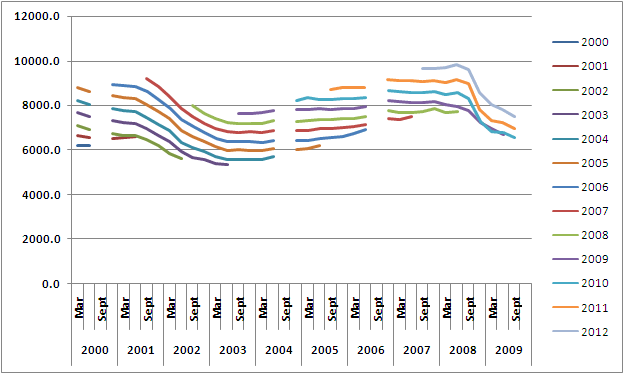
So the first thing you notice is that, no matter what the current conditions, LC almost always predicts a rising income curve even though that generally doesn’t reliably happen. In fact, it’s not just a rising income curve, it’s a almost always a constantly rising income curve. It looks like those pictures you used to draw in 1st grade, taking all the different-colored crayons or chalk or markers and running them along the page in unison. The current year estimates represent reality, but after that, LC assumes more robust growth rate that declines slightly towards Year 5.
Why? To put it simply, they have no idea what the actual economic growth rate is going to be, so they fake it. And it’s responsible for their consistent over-statement of future revenues throughout the decade.
The other thing you notice is that the recession of 2001-2002 took a pretty hefty toll on state revenues, and that it caught the LC completely by surprise. If it hadn’t, they wouldn’t have had to adjust their predictions so radically. In fact, the decline in dollar amounts is pretty close to the decline in the 2007-2009 recession, although the falloff wasn’t as fast.
Another way of looking at this is on a percentage basis of the eventual revenue:
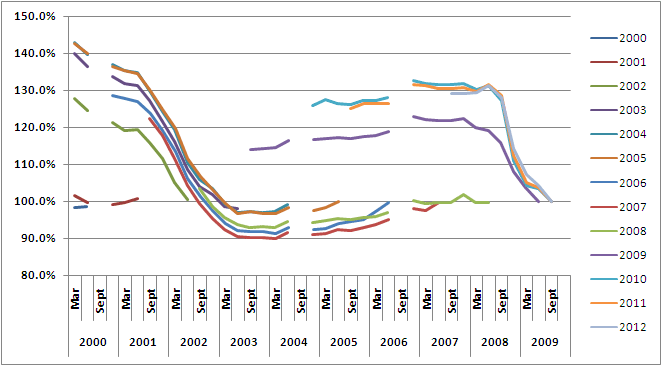
On this basis, the 2001 recession was every bit as bad – if not worse – for state revenues as the current one has been so far, it just took longer for the forecasts to fall. Remember, it was this recession, and the resulting drop in state revenues, that convinced the public to pass Referendum C. More on that in a moment.
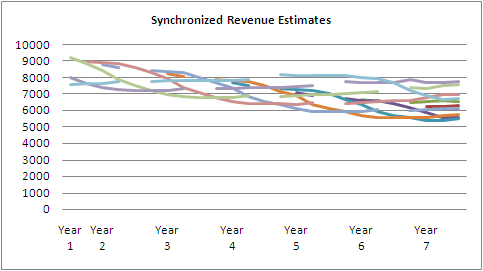
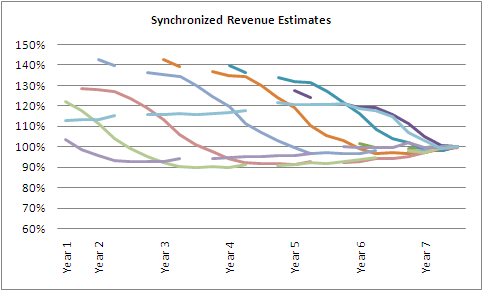
The pattern of overestimating revenues and then mildly over-correcting is even more obvious if you synchronize the estimates at their endpoints. (The budget year ends in June, but the preliminary revenue numbers aren’t available until September, so 6 year projections stretch over 7 calendar years.)
Some of this might be understandable if the secular trends were of declining revenues, but it hasn’t been:
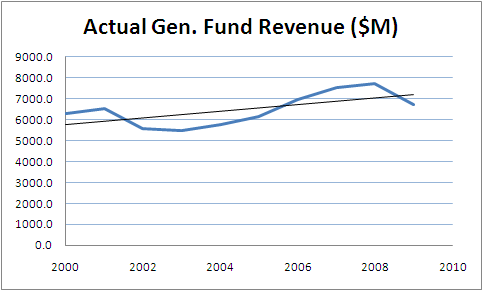
Which means that even in a era when the general trend has been upwards, the Legislative Council has overwhelmingly overestimated upcoming revenue. Again, this is almost certainly a result of using a plug-in number for economic growth during the out years. This is standard practice – we used to do something similar all the time when modeling companies’ top lines – but we weren’t responsible for their budgets. It clearly shows the dangers of actually relying on these predictions for budgeting and for policy-making. Certainly it contributed to the over-confidence that led to Amendment 23, and the same overconfidence that has led the legislature to spend every last non-existent dime of Referendum C monies.
Now about that. Proponents of TABOR, among whom I count myself, have often argued that TABOR’s limitations helped limit the damage from the 2001-2002 recession. Is this true? Well, probably, but it didn’t prevent the damage altogether, otherwise there would have been no cry for Referendum C. Nevertheless, by looking at the revenue estimates for one year, and comparing them with the TABOR-revenue estimates, we can see that the raw numbers varied much more than the TABOR-adjusted estimates. We use 2005 because it’s one year for which we have a full


As you can seen, the raw revenue estimates fell to as low as 72% of the original estimate, finishing up at 75%, while the revenues including TABOR refunds stabilized at 80% of the original. Someone doing budgeting even a year out would have had to cut an additional 8% from programs had they used the raw numbers, as we do under Referendum C, compared to someone who had limited himself to TABOR-adjusted revenues. This isn’t exactly Armageddon, but it ain’t chicken feed, either. Given the howls of pain that come from even modest cuts in government programs, the 8% surely must be counted significant.
None of this is intended to beat up of Legislative Council. They’re being asked to do an impossible job, and appear to be doing it much better and with more integrity than the governor’s office is. But to repeat – it indicated the foolishness of relying on long-term estimates for actual budgeting, and makes a case for the sort of conservatism that TABOR forces upon the legislature.
Depends on the Definition of “Gains”
Posted by Joshua Sharf in War on Islamism on September 27th, 2009
A few days ago, the New York Times was trumpeting President Obama’s “gains” at the UN concerning Iran’s nuclear program.
With a beaming Mr. Obama standing next to him, Mr. Medvedev signaled for the first time that Russia would be amenable to longstanding American requests to toughen sanctions against Iran significantly if, as expected, nuclear talks scheduled for next month failed to make progress.
Well. That was then, this is now:
China will not support increased sanctions on Iran as a way to curb its nuclear program, a government spokeswoman said Thursday. Although China has generally opposed the use of sanctions, the announcement is sure to complicate President Obama’s efforts to impose tougher penalties on Iran, should international talks over Tehran’s nuclear ambitions, scheduled for Oct. 1, fail to make headway.
Even if China had supported sanctions – and Obama may yet find concessions to bring them on board – there’s no particular reason to think Russia would abide by them. It’s also perfectly reasonable to believe that Russia consulted with China prior to making its own announcement. And the batting average of sanctions in getting countries to abandon nuclear programs is roughly .000, with Israel’s strike on Osirak (Iraq) and our invasion of Iraq (Libya), along with the Allied occupation of Berlin (Germany) being the only successes in that field I can recall.
As Powerline points out, some are arguing that it was the public revelation of Iran’s facility that moved Russia to reluctantly support sanctions, and if so, the President might have thought to present that information to them before handing them the diplomatic gift over missile defense.
So, according to the Times, “gains” means giving up tangible defenses obtained at a serious diplomatic price, abandoning allies who came through for us on those defenses, achieving the vague promise of weak sanctions at some point in the future, contingent on a lack of “progress” at talks that do nothing but give credibility to a monstrous regime that seeks to run out a clock we keep trying to reset.
Some gains.
Notes From the Senate Race
Posted by Joshua Sharf in Colorado Politics, Senate 2010 on September 27th, 2009
A couple of notes on the race for the Republican nomination. First of all, despite the headline – and the weight of the party’s senior ex-officeholders – former Lt. Gov. Norton did win the straw poll, but did not “clobber” her opponents. Mrs. Norton will no doubt point out that she hadn’t had much time to organize for the straw poll, and yet still came out first. Her opponents will note that this should have been, in many ways, her natural constituency, the old-line party activists, and that she got barely 1/3 of the vote. So while her assumed fundraising prowess still makes her the odds-on favorite, it appears that this race has some room yet to run, and that she’ll have to earn it.
Evidence that she knows that came Thursday night at a meeting of the R Block Party, a group of mostly Arapahoe County- and Centennial-based activists. While there was some grumbling that she didn’t stick around for questions, the mere fact that she showed up indicates that she understands she’ll have to court the new activists that last year’s elections generated, and can’t simply rely on the old guard to dominate the caucuses they way they have in the past. (For the record, the only candidate for Senate or Governor who didn’t show up or send a representative was…Scott McInnis.)
For the moment, the favorite of the new activists still seems to be Ryan Frazier, who performed well at Wednesday’s Liberty on the Rocks South Metro, and seemed to have a lot of fans at the R Block Party as well. Still, Norton’s bearing and presence seemed more senatorial; whether that bears up under tough questioning remains to be seen.
Gates of Sofia
Posted by Joshua Sharf in UN on September 23rd, 2009
While most of the attention at the UN was focused on Obama’s speech, Ghadafi’s theatrics, Ahmedinejad being Ahmedinejad, and Sarkozy taking on Obama at the Security Council (what, you missed that one?), another little all-too-UN election drama was playing out at UNESCO. This is the United Nations Education, Scientific, and Cultural Organization, and it’s one of the few UN organizations that the Islamic bloc hasn’t managed to corrupt beyond recognition. For instance, the official UNESCO page for Israel lists its capital as Jerusalem, which is almost more than the State Department can muster these days.
So naturally, it made perfect sense that the next chairman should be an Egyptian culture minister who claimed that he would personally burn any Israeli books found in the new Library of Alexandria,and boasted (somewhat innacurately) that Egypt banned any books insulting to religion (Protocol of Zion and Mein Kampf notwithstanding). That last should be particularly chilling, given official-Islam-in-Europe and increasingly, official-Islam-in-America’s desire to define itself as “religion” in such matters. (Naturally, all of this was only enough to get Mr. Hosni “accused” of anti-semitism by the New York Times, self-accusation not actually being enough to convict.)
Fortunately, the civilized members of UNESCO managed to unite behind an alternative: a former Communist Bulgarian diplomat in charge of “political and human rights issues” under that regime, now a member of the former-Communist Bulgarian Socialist Party, whose father was editor (in a Winston Smith sort of way) of the key Bulgarian newspaper. Like all former Communists, she doesn’t claim she was just following orders, rather that she did it for her career, one of the reasons that the east never underwent a de-Stalinization, akin to Germany’s and Japan’s post-war cleanising. And one of the reasons why former Communists, Putin included, are pretty much given a pass on their pasts.
Like a good former Communist, she sees what should be a cultural and arts position as a means to advance myriad lefty political agendas: “She said she would strive to give Unesco a more prominent role in talks on climate change and would focus more resolutely on gender roles, the financial crisis and other issues.” If that UNESCO gig doesn’t work out, I understand the Obama administration has a couple of vacancies over at the NEA.
Look, Bokova is probably an improvement over Hosni, but it’s not clear that an organization whose top two contenders for the world’s premiere cultural post are a former Communist and an anti-Semite is one that’s benefited from our “engagement” over the years.
And what of Mr. Hosni? He seems to be taking his defeat with the Egyptian equivalent of Al Gore-like grace, the “accused” anti-Semite blaming a Jewish conspiracy and declaring a kulturkampf on Israel (but not Jews, of course). The last part has gone unreported by the Times, probably because it comes a little too close to promoting Hosni past the “accused” status.
Denver’s Employment Not Quite So “Stabilized”
Posted by Joshua Sharf in Denver, Economics on September 22nd, 2009
Still catching up from Rosh Hashanah this weekend – it’s going to be that way for a few more weeks as the Holidays of Tishrei descend on us for another season.
So Colorado’s Executive Director of the Colorado Department of Labor and Employment pronounces it “encouraging” that Colorado gained 3100 jobs while shedding 15,200 workers. The unemployment rate will probably get worse again before it gets better, but mostly because people will re-enter the job market as things do improve.
But Denver’s job market, not so good. According to the release, the Denver-Aurora MSA accounted for more than the state’s net labor force loss, dropping 15,552 workers (and 6,400 jobs). The rest of the state gained 9500 jobs, and actually added a few hundred to the labor force. In fact, Denver-Boulder and Colorado Springs MSA were the only areas to lose significant jobs in August.
In related news, the city council will fail to ask citizens to re-direct Referendum A-I money to useful projects.
Venture Capital, Take Note
Posted by Joshua Sharf in Economics, Finance, Health Care on September 22nd, 2009
In the generally miserable venture capital environment of that last few quarters, one bright spot has been the health sciences market. It’s one of the area where Colorado can compete effectively, and an area where America is well ahead of the rest of the world. It produces actual long-term savings and real quality-of-life and lifespan improvements.
And the Senate – presumably with the agreement of Colorado’s Bennet and Udall – is getting ready to kill it.
First, the numbers. VC itself has, not surprisingly, gone cliff-diving along with the rest of investment capital recently. After the dot-com craziness, total VC investment seemed to return to a normal growth curve this century before crashing in the recent downturn:

The one exception to this has been Life Sciences. While well behind last year’s pace, VC in life sciences has recovered fairly well in Q2, to the average over the last 5 years, and close to 2005 levels:

Note the steep drop-off in Healthcare Services VC after 2000. I’m not certain why that’s so, but it’d be interesting to find out. Also note that medical device investment has grown not only in dollars, but also as a percentage of total LS investment.
While the National Venture Capital Association doesn’t provide crosstabs between regions and sectors, it’s reasonable to assume that at least some of Colorado’s growth from 3.0% of venture capital dollars in 2008 to 4.3% in 2009 is a result of our strong biotech sector.
Now, the Senate is proposing what is, in effect, a national excise tax on medical device sales, to help pay for the health care takeover. (Hat tip: TigerHawk) Exactly where do they think the large companies come from? Exactly where do they think the large companies get their devices to re-sell? They don’t free-ride on this technology, they buy it once the ideas have been developed by smaller, ie, venture firms.
Brilliant idea, gentlemen.
More Community Reinvestment
Posted by Joshua Sharf in Finance on September 18th, 2009
As though forcing banks to loan to bad risks had worked before:
The Obama administration’s chief steward over small-business policy visited Colorado on Thursday, in part to deliver a message that the state’s banks need to do more to extend emergency stimulus aid to struggling businesses.
In remarks to The Denver Post before a speech to the U.S. Hispanic Chamber of Commerce, Small Business Administration head Karen Mills said her staff has ramped up efforts here to promote America’s Recovery Capital loans. Banks make the $35,000 loans while the SBA guarantees them at 100 percent.
Mills met with Gov. Bill Ritter, who is trying to promote the program, and Don Childears, head of the Colorado Bankers Association, who has criticized ARC lending as unprofitable for banks unless they take on large volumes.
Of course, it’s not the banks who are on the hook here. It’s you. I’m sure that not all of these businesses are bad risks. Most probably aren’t. But enough probably are to poison the whole pool if banks are expected to loan en masse, and the government doesn’t exactly have a sterling record in distinguishing between the two
We’re not in the business of promoting panic here, but it’s not as though the banking and mortgage systems have exactly been put on sound footing. The Congress – notably that savant Carl Levin – is encouraging the FDIC to borrow from the Treasury (who will borrow from the Fed, who will either print the money or borrow it from the Chinese or take it from the banks in question, anyway), at the same time that the FHA is tightening lending standards after discovering that the subprime business may be riskier than we thought. Horse, meet barn door.
‘Bama Bigfoot
Posted by Joshua Sharf in Colorado Politics, Senate 2010 on September 18th, 2009
It’s good to know that it’s not only Republicans who are dealing with out-of-staters eager to pick winners:
President Barack Obama endorsed U.S. Sen. Michael Bennet today, throwing the force of the White House into a Democratic primary battle that officially is just over a day old.
…
The direct endorsement of a president still enormously popular among progressive voters is perhaps the biggest hammer that national Democrats can bring to Bennet’s primary battle against former Colorado House Speaker Andrew Romanoff, and they wasted no time in wielding it.
Does this make sense? Only if it works. Rumors had abounded that Romanoff had about $1.5 million (roughly 0.0001% of Obama’s deficit spending) ready to come on board, and to make him immediately competitive. Certainly Romanoff wasn’t going to be able to run to Bennet’s left, but the endorsement of The Big Leftie himself probably gives Bennet some room to move to the center if he has to. Of course, the primary is 11 months from now, and who know what Obama’s endorsement will be worth by then.
-
You are currently browsing the archives.


