Mark Udall and J Street
Posted by Joshua Sharf in Israel, National Politics on October 24th, 2009
View From a Height has learned from a very reliable source that as of now, Sen. Mark Udall will not be removing his name from J Street’s Dinner host committee. His reasoning is as follows:
- Udall is reluctant to bring more attention to the controversy by removing his name
- Sen Udall will not attend the dinner, nor endorse or support J Street as an organization
- Udall doesn’t want to embarrass General Jones
- The press covering the issue seems interested in embarrassing the administration
My reactions:
- This is about as weasily as it gets. By staying on the host committee, he leaves open the option of endorsing them in the future if it’s worthwhile, if indeed being on the host committee isn’t already in effect an endorsement. Staying on it certainly supports J Street as an organization.
- The administration’s sending Jones has accomplished its goal of stopping the bleeding.
- What press inquiries can he be referring to? The coverage has been on Powerline, the Weekly Standard blog, and the Commentary Magazine blog, Contentions. The Washington Post finally has a piece on it in tomorrow’s paper, but the MSM appears to be several weeks behind the curve, as usual, but is unlikely to be seeking to embarrass the administration.
- If the administration hadn’t sent Jones and invited J Street to host its conference call, while excluding the WZO, it wouldn’t be embarassed.
- Adding more attention? If there already are press inquiries, then the attention’s already there. If there aren’t, then he ought to be able to slip out un-noticed. One would think that with the WaPo finally picking up on the controversy, Senator Udall may be overstating his national importance, a truly bipartisan condition not unknown to senators.
- Senator Udall was one of 76 (or 71, accounts differ) Senators who did sign a letter back in August urging the administration to back off its pressure on Israel for a settlement freeze. This suggests that, like a number of those listed on the host committee, he was placed there by staff who didn’t examine J Street’s positions very carefully.
- Unlike most of the other mainstream Jewish organizations, including AIPAC, J Street has an explicit and unapologetically partisan domestic political agenda, tied to a PAC. It is banking on enough liberal Jews being seduced by its heroic (in their eyes) liberalism that they are willing to marry themselves to that agenda, while overlooking or excusing its harmful positions vis-a-vis Israel.
- It is also banking on liberal Jews’ unwillingness to defer to Israel on matters of its national security, while more hawkish American Jews have generally done so for dovish Israeli governments. Here it’s important to recall that J Street is an American political organization, not an Israeli one, whose job it is to lobby the American government. It’s one thing to argue that dovish policies are wrong, another to argue that a dovish American administration should actively undermine a determined Israeli government
- So J Street’s goal is threefold. It aims to promote the left-wing agenda domestically, weaken American’s support for Israel, and divide the Jewish c8mmunity in America in order to do so.
J Street’s donation to the state party is an emblem of its alliance with ProgressNow and the far left-wing of the Democratic party. Just as ProgressNow began small, and built into a major force in the state, J Street will try to do the same. People who judge their eventual effectiveness in legitimizing their views about Israel by their current size are underestimating them.
J Street and the Colorado Delegation
Posted by Joshua Sharf in Israel, National Politics on October 23rd, 2009
The following is the text of a Letter to the Editor that I wrote, and that the Intermountain Jewish News published today (not available online):
Over the past several decades, both the Democratic and Republican parties have prided themselves on their support for Israel. Now, a group that calls itself – a little too loudly – “pro-Israel” threatens the liberal Democratic wing of that support. And some Colorado legislators appear to be taken in.
J Street is holding its first national conference in DC next week, and is hosting its annual banquet on October 27. Four Democratic Colorado Congressmen and Senator Mark Udall are on the host committee.
Founded in 2007, J Street poses as a “pro-Israel, pro-Peace” lobby, founded specifically to provide an alternative to what it calls the “right-wing dominated” AIPAC. (AIPAC defers to the citizens of Israel in foreign policy, and is certainly not right-wing. Its former president, Steve Grossman, chaired Howard Dean’s Presidential campaign.
By contrast, J Street has adopted a comprehensive platform of appeasement. It accepts Iran’s pursuit of nuclear weapons. It equates Israel’s Operation Cast Lead and Hamas’s terror rockets. It supports the division of Jerusalem. None of these positions draws even a plurality of American Jews. Collectively, only a small minority approves.
Until a last-minute cancellation, J Street had scheduled to appear a “street poet” who had compared Guantanamo to Auschwitz, and had accused Israelis of tattooing numbers on the arms of Gazan children. Slightly less repugnant is J Street Advisory Board member Henry Siegman’s insidious comparison of Israel to apartheid South Africa.
No wonder that board members of NIAC, lobbyists for Saudi Arabia, and PR flacks for campus anti-Israel campaigns have contributed upwards of tens of thousands of dollars to support J Street’s agenda.
So suspect is J Street that Israel’s Ambassador to the US, Michael Oren, turned down an offer to lend his credibility to the group by appearing, noting that “certain policies of the organization may impair the interests of Israel.” What other “pro-Israel” group would he refuse to address on that basis?
J Street’s ultimate agenda is to buy acceptance to the liberal wing of the Democratic Party through its PAC, and then use that credibility to mainstream certain destructive policy positions. At the same time, Jewish liberals will be less likely to question a solidly liberal lobbying group.
Both would do well to steer clear. J Street represents only a small minority of American Jews, and American Jews have many other options for helping to elect liberal Democrats to office.
In the last week, over a dozen Congressional members of the dinner’s Host Committee have removed their names from the list. Neither Republican representative, nor Senator Michael Bennet, appears ever to have been on the list, and Rep. John Salazar (CD-3) has withdrawn.
This leaves Representatives Diana DeGette, Jared Polis, Betsy Markey, Ed Perlmutter, and Senator Mark Udall. I personally believe that their presence is in response to J Street PAC’s $1000 contribution in 2008 to the Colorado Democratic Party, and that they signed up believing that they were attending a function at a mainstream, pro-Israel, Jewish organization. They, too, should withdraw.
Israel cannot become a partisan issue; too much would then hinge on American electoral politics. Colorado Democrats should step back from this attempt to seduce them away from their principles.
I would also point out that the State Democratic Party was the only state party to receive any money from J Street during the 2008 cycle. Those familiar with the Colorado Model and the genesis of J Street may be able to figure out why.
Scozzafava Should Withdraw
Posted by Joshua Sharf in National Politics on October 22nd, 2009
By now, it should be clear that Dede Scozzafava cannot win in NY Congressional District 23 (NY-23). It’s a fairly conservative district, with a history of voting Republican, so there’s no need to run someone just to show the party colors.
With a viable alternative still in the race, and gaining rapidly, Mrs. Scozzafava should put personal ambition aside – for the moment – and withdraw from the race.
Some may want to draw comparisons to what’s happened here, but the comparison doesn’t bear weight. Colorado has seen its share of bigfooting by out-of-state interests, and not just on the Republican side. But all of the candidates touted by arms of the national party are at least credible conservatives, who have a chance to earn the nomination in a fair fight, and who poll well against their opposition. They may be exposed as ineffective campaigners once the race begins, but nobody’s going to confuse them with their Democrat opponents.
Scozzafava was appointed in the run-off because she had long service with the party and good connections. These are not to be taken lightly, and many people who pay their dues, serving the party and its candidates faithfully, do so with the expectation that they’ll be given consideration when it’s “their turn.” While that sort of thinking on the national level has given us Bob Dole and John McCain, it’s also the basis for a cohesive party structure.
But it’s also not enough. As Mark Steyn put it in the Corner, the local Republican Party moguls chose to abandon the two-party system, and give the voters a choice between Dem and Demmer. It’s an imitation of the sclerotic European party system, where the two main parties are indistinguishable, and in any case, the government is run by the bureaucracy. The race stands as an example of the abandonment of principle by party powers-that-be who are more concerned about the final score than what that score is supposed to represent.
The Party Elders who put Mrs. Scozzafava in this position will never publicly ask her to step down. At this point, they have too much of their own credibility at stake, and they absolutely had to know who they were nominating. Caught between a rock of an unprincipled choice and the hard place of a disgruntled grass roots, no outcome there – short of an increasingly unlikely victory – will be a happy one for them.
Mrs. Scozzafava would be doing them, the party, and ultimately the county, a service by stepping aside. At this point, who she throws her support behind probably doesn’t much matter.
State Unemployment “Stabilizes,” Maybe
Posted by Joshua Sharf in Colorado Politics, Economics on October 21st, 2009
The state unemployment numbers came out today, and the papers are all agog that that the unemployment rate is down to 7.0%. Now while that’s a lot better than the national rate of 9.8%, it’s also a little misleading. Almost all of the improvement came from a reduction in the labor force – people ceasing to look for work. While the number of people employed has stopped declining, the total labor force continues to fall:
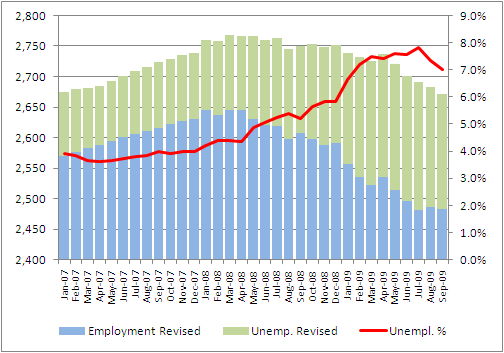
The employment graph doesn’t start at 0 in order to better show the trends. The red line is the unemployment rate, and it’s to the scale ont he right-hand side. A couple of things stand out. First off, the number of employed seems to have stabilized. But it also seemed to have stabilized at least twice before: in mid-to-late ’08 and in Spring of this year. We then got two large drop-offs. There’s no guarantee that we’ve hit bottom yet, although we all hope to God we have.
The other interesting thing is the unemployment rate from Spring of ’07 to Spring of ’08. It rose from about 3.5% to about 4.5%, even as the number of people employed was also rising, from about 2.56 million to almost 2.65 million. Note that the number of people looking was rising even faster. Which meant that at that point, even though we hadn’t felt the slowdown, new jobs weren’t being created fast enough to keep up with population growth. Now, the unemployment rate is dropping, even though it’s almost entirely due to people dropping out of the market. There’s considerably hidden labor inventory out there, and when it returns to the job hunt, the unemployment rate won’t be falling so quickly.
Note that these are all seasonally-adjusted numbers, too, so they already taking to account seasonal retail, summer jobs, and teachers’ summer vacations.
I’d also point out that here in Denver County, the seasonally-unadjusted were even worse, with the labor force dropping by over 3000, and the number of employed dropping by almost 2000. Whatever the job market looks like elsewhere, we’re not creating jobs locally.
Here’s a graph I’ve updated since April:
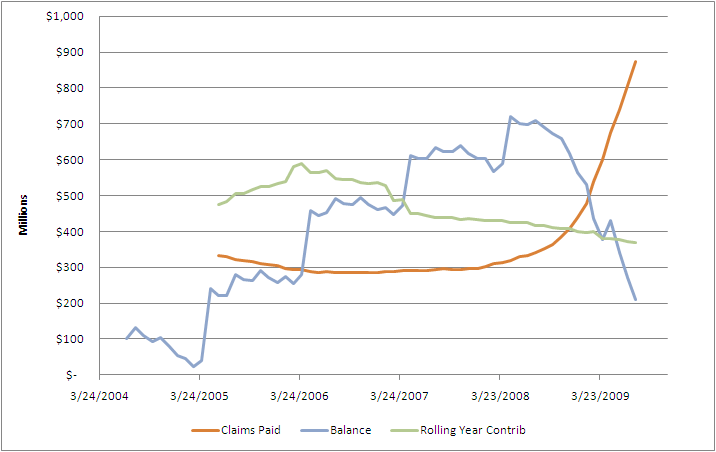
It’s the state Unemployment Insurance Fund, and it’s a mess. While we talk about PERA, and taxing Peter to pay for Paul’s rent-seeking appendectomy, the fund is in serious trouble. It got almost no seasonal bump from the May solvency assessment, the numebr of claims paid has been skyrocketing (red), and the rolling 12-month payments by business (green) have been sloping downward because they’re not employing as many people. The net result is a cliff-diving account balance (blue). We were told that the account actuarily sound, but it should have been obvious at the time that we were facing not-normal circumstances.
And it’s even worse than it looks. The feds kicked in an extra $127 million in exchange for SB 247 and more long-term commitments. Some of us pointed out at the time that borrowing short to go long wasn’t really matching obligations to receipts, but like the true addict it is, the state government saw the federal dollar signs and just couldn’t say no. Don’t hold your breath waiting for the Democrats in the legislature to admit they made a mistake.
Colorado Insurers Weight In – Finally
Posted by Joshua Sharf in Economics, Health Care on October 20th, 2009
Possibly too late, Colorado insurers are finally pointing out some of the economic fallacies inherent in the propose federal takeover of health care. Unfortunately, the insurers don’t go far enough in their condemnation. Fortunately, their opponents are simply reflexively trying to demonize them, and in the process, saying some really stupid things.
First, the insurers:
At issue are what insurance companies consider absurdly low penalties for people who choose not to buy health insurance.
Their concern: People will buy insurance only when they desperately need it, such as after they’re diagnosed with cancer or heart disease.
Healthy people might choose to pay the penalty, now proposed at a few hundred dollars per year, because it is far less expensive than buying insurance.
This is is true as far as it goes, but it’s not clear that even universal coverage would alleviate this problem. Still, the insurance companies have put their finger on a problem: if you’re not actually required to buy insurance until you’re sick, then that’s when you will buy insurance.
Naturally, this has led to howls on indignation from those defending the President’s and Congress’s proposals:
“They are assuming that people would game the system,” said Denise de Percin, executive director of the Colorado Consumer Health Initiative.
“They are looking at the worst-case scenario. People aren’t stupid — they are not going to pay a penalty and get nothing,” de Percin said. (emphasis added -ed.)
Guaranteed issue is, in and of itself, only part of the problem. Colorado has, in effect, a government guaranteed issue for a high-risk pool. The reason that this is unacceptable to those pushing reform is that by lumping the high-risk (or, already-established-risk) patients together, it creates a pool whose premiums are higher. They therefore argue for the concurrent requirement of “community rating.” which in effect pools the entire community – usually the state – together into one large pool where everyone gets charged the same amount. The various Democratic bills all contain some sort of community rating proposal as well.
In fact, we’ve already run this experiment in several states. The result is universally higher premiums, and it’s not hard to see why. Because now, as a healthy, premium-paying insured, I also need to cover the actual costs of people who waited until the diagnosis to get insurance, and the estimated costs of new people likely to enter the system who haven’t been diagnosed yet.
De Percin is right; people aren’t stupid, which is why they’d rather pay a penalty than pay for insurance they don’t need. They could take the difference and save it, invest it, or buy catastrophic insurance, which doesn’t qualify as “insurance” under the plan, even though it comes much closer to the ideal of insurance. The penalty is just the cost of participating in the system in the way they think is most to their benefit. The insurance companies’ argument, that the penalty for not playing has to be bigger than the overall cost of playing – is perfectly sound.
There are two fundamental flaws with how we think of insurance, and the way they interact is complicated by the fact that they’re mutually incompatible: 1) we think we’re spending other people’s money, and 2) we think of insurance as pre-paid medical expenses. One of these is a shell game, and the other is counter to the notion of insurance. The “guaranteed-issue/community-rating” combination just plays to the worst of both assumptions.
Billions Short on Bureaucrats’ Wish List
Posted by Joshua Sharf in Budget, Colorado Politics on October 16th, 2009
That’s really how this morning’s Denver Post story should read:
The state would need an additional $8.5 billion per year in revenue to provide the level of services Coloradans want, a commission looking into the state’s long-term budget problems was told Thursday. That’s bigger than the $7.5 billion general fund, the state’s largest pot of money that funds most operating needs. Even to reach a “middle” level of services, the state would need an additional $2 billion a year, members of the Long-Term Fiscal Stability Commission were told.
So how to we know this? Who measure what Colorado really wants? Why, the department heads:
Those estimates come from legislative analysts who added up the amounts that officials from various state agencies said would be needed to reach the level of services that Coloradans want. (emphasis added -ed)
How the department heads determined “what Coloradoans want” is left the the readers’ imagination, but I’m guessing that the result more closely tracks what Colorado’s department heads want. I’m also guessing that not too many of them came back with a report saying that they really could manage with less. Whenever you ask a government department head how much he needs, the answer is, inevitably, “more.”
Note, by the way, that the $2 billion is still considerably larger than the decrease in tax revenue the government has had to deal with in this recession, and that a $8.5 billion increase would essentially double the size of state government. That size, by the way, has been relatively static at about 8% of state GDP for over a decade.
Democrats on the committee naturally took up the legislative committee’s description of this wish list as, “what the people think they want.”
Perhaps most disgraceful of all was Rollie Heath’s suggestion to circumvent little things like democracy:
More controversial was his proposal to ask voters in 2010 to allow a 23-member commission appointed by the Legislature, governor and Colorado Supreme Court to examine constitutional spending requirements and limitations like the Taxpayer’s Bill of Rights and Amendment 23. That group would have the power then to refer any proposed changes to the 2012 ballot without needing to get legislative approval or collect voter signatures and would be exempt from a state law requiring all ballot measures be limited to just a single subject, Heath proposed.
This is bizarre on many levels, not least the complete abdication of legislative responsibility, as well as an admission of the futility and uselessness of the commission that Heath is chairing at the moment. The inclusion of representatives from the Supreme Court on a policy-making body would, I suppose, just formalize an inappropriate role they’ve increasingly taken on in recent years.
So here you have it. Even as your salaries and job options are shrinking, the legislative Democrats are trying to find new ways to raise your taxes, to pay for their wish list, without having to take responsibility for it.
$691,000 Per Job
Posted by Joshua Sharf in Colorado Politics, Economics on October 16th, 2009
Although the Denver Post doesn’t do the math, that’s how much each job created in Colorado has cost the Federal Government, er, you.
$583 million in Recovery Act funds have flowed to 96 different companies, individuals and other entities such as housing authorities.
Though Colorado was ranked as the top job creator among states — given TeleTech’s hiring of 4,231 people to staff a series of call centers — only 379 of those employees worked in Englewood. The rest were scattered throughout the country, such as in London, Ky., and Ocala, Fla.
So, it’s not 4695 jobs, it’s 843 jobs here in Colorado, and that’s if we include the 379 that have since gone away from TeleTech.
$583 million spent, 843 jobs. Quite a deal you made for us there, Rep. DeGette and Sen. Bennet.
Why We Miss the Rocky
Posted by Joshua Sharf in Media Bias on October 16th, 2009
CNN and the Detroit Free Press remind me of why we miss the Rocky Mountain News.
Years ago, the News had a foreign affairs editor named Holger Jensen. Jensen was relentlessly anti-Israel, reliably making excuses for her attackers, and faulting Israel for defending herself. His fact-checking was always a little suspect, but in April 2002, Jensen went too far. He reprinted offensive excerpts from an Amos Oz interview purported to be with Ariel Sharon. In fact, the interview was not with then-Prime Minister Sharon, but with another soldier.
This was, you remember, mere weeks after the murderous Passover Bombing in Netanya. Israel’s response, which was drawing howls of indignation, and Jensen probably thought the timing was right.
The timing couldn’t have been worse. The Rocky had finally had enough, and Jensen was forced to retire.
The *best* respose so far to the Limbaugh Quote Fabrications has been a sort of looking-down-at-one’s-feet-while-poking-the-ground-with-one’s-toe that you’d get from a kindergartener. More typical has been a pro forma, “sorry,” while skipping away to the next maladventure, typical of a sixth grader.
Which is what you get when the Adult Supervision has left the room.
California vs. Texas – Exports
Posted by Joshua Sharf in Economics on October 12th, 2009
We all know that as California has failed, Texas has prospered. We all know that jobs and people are fleeing Paradise for Hell. We all know that it costs about 3 times as much to rent a truck from California as to make the return trip from Texas. What I haven’t seen is an analysis of the role that exports have played in this reversal.
In fact, Texas exports more that California does, and has since 2002:
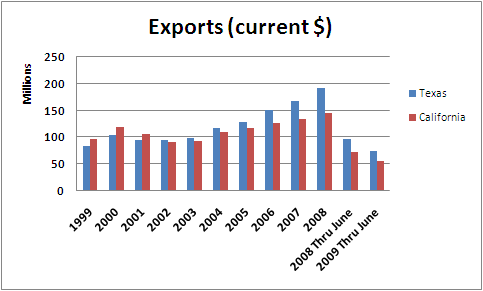
Both states have suffered from the global recession, but California on a percentage basis has suffered more, losing roughly 1/3 of its exports, while Texas has lost only about 25% of its exports year-to-date. The numbers will be at year’s end, but Texas won’t be nearly as bad off.
Some of this is accountable to a general growth in exports over the last decade, but to the extent that’s true, California hasn’t benefitted, and Texas has outperformed the rest of the country, even as its exports have outperformed the rest of its economy, while California’s have languished (watch out for the color switch):
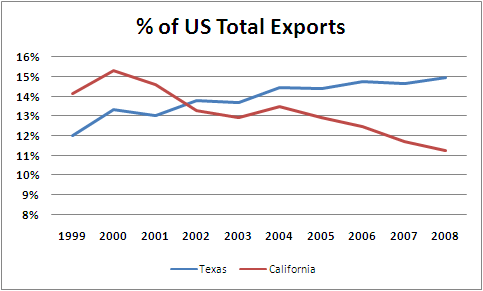
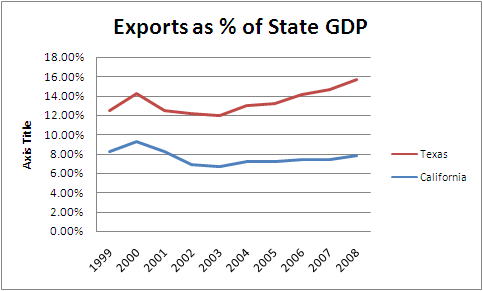
Now technically, tourism is an export, but this isn’t a result of Mexican day-visitors coming across the border for shopping and Six Flags. The biggest contributors to Texas’s export growth have been Chemical Manufactures, Petroleum and Coal Products (yes, exporting oil products), Machinery manufactures, and Computers and Electronics. Petro exports had multiplied 7x from 1999 to 2007, even before the 2008 run-up in oil prices. Over the same period, Chemical exports tripled, and Machinery exports grew by 150%.
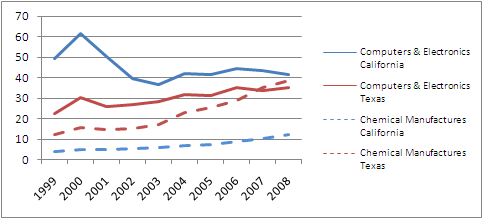
In the meantime, California’s Silicon Valley hardware exports suffered after the dot-com bubble burst in 2000, and have never recovered. In 1999, over 50% of California’s exports were Computers & Electronics. They now constitute just under 30%, down 16% in dollar terms from 1999, and almost 1/3 from their 2000 peak. The diversification in California’s exports should be a benefit, and may yet be. But the exports are going to have to actually grow and be competitive for the state to benefit.
Here’s the comparison between a couple of sectors of the two states’ exports over the period in questions:
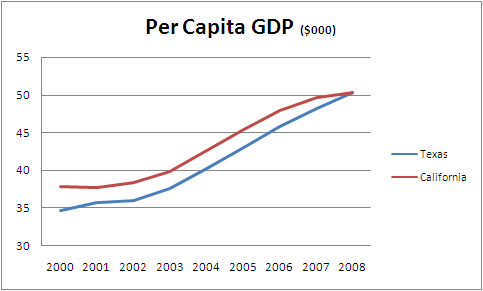
All of this might be moot if it were just a matter of underselling the competition and running sweatshops. But in fact, Texas’s GDP has been growing, and over the last decade, its per capita CDP has caught up with California:

All these numbers, by the way, are from the Census Bureau, which also operates an fantastic site for cruising a state’s export numbers.
Now before we go all gaga about this, and show how this proves that under current conditions, Americans can compete with anyone overseas, these numbers don’t show how much of Texas’s exports come from cannibalizing from the rest of the country. And a State Business Tax Climate ranked #11, compared with California’s #48, would indicate that some of these exporting businesses have relocated. Still, there’s no doubt that exports are a major – and under-reported, factor in Texas’s move past California as an economic engine.
Chinese Futures Markets
Posted by Joshua Sharf in China, Economics on October 12th, 2009
The Wall Street Journal reports this morning that China is seeking to upgrade and expand its commodities futures markets in order to influence commodities prices, arguing that on-shore exchanges will help increase market efficiencies:
Government officials say the country is positioning its futures markets to be major players in setting world prices for metal, energy and farm commodities. By letting the world know how much its companies and investors think goods are worth, China hopes to be less at the mercy of markets elsewhere.
But what’s more likely is that China wants to lure traders on shore in order to use its national bargaining power to obtain more favorable prices. It’s not until the very end that the reason to be suspicious is mentioned:
International futures-market benchmarking has been slow to shift to China from long-established exchanges like the New York and Chicago venues. Despite China’s huge volumes, its futures markets allow foreigners limited access. By contrast, the London Metal Exchange says 95% of its business emanates from overseas.
General Motors Co., Ford Motor Co. and Tyson Foods Inc. are some of the companies that use futures in the U.S. to protect themselves from volatility in commodity prices. Despite expanding production in China, and being technically eligible to hedge on China’s exchanges, all three say they haven’t used its futures markets.
Instead, the big footprints in China’s futures markets belong to state-owned groups, primarily commodity trader Cofco Corp. and Beijing’s secretive stockpiling agent, the State Bureau of Material Reserve. That makes the government both player and policy maker. (emphasis added)
Right. Which means that China, which has a classic mercantilist approach to economics – seeking to use national power for the benefit of its industries – will be able to set the trading rules to its own benefit. China has been practicing what can only be described as a neocolonialist policy all over the world in pursuit of cheap commodities. It has been, as the article notes, deploying its navy to protect shipping routes, discovering the colonial truth that far from trade following the flag, the flag necessarily follows trade.
In fact, as the first paragraph in the above quote points out, these are world markets, and there’s no reason that China can’t trade openly in accounts no matter where they’re located. In fact, the three companies mentioned in the second paragraph manufacture in China, and hedge on the US markets. One likely advantage of trading with a home field advantage is that its government players won’t have to reveal their moves the way they will in more tightly regulated London and New York.
One expects that eventually, with the trading markets established, the right to continue doing business on favorable terms will come with increasing conditions, one of which may be that a company has the hedge its local commodities exposure with Chinese futures. Given the compromises that companies make to do business in China in the first place, including rarely owning 50% of their own subsidiaries and seemingly deferring profits until the late 22nd Century, hedging on local markets will just be another in a long line.
The eventual effect of such a policy, if successful, would be to drive up commodity prices for the rest of the world while keeping them low for China, hampering competition, shutting down industries in competing countries, such as the US, while allowing China’s exports and domestic markets to develop. Such a strategy only works, of course, if there’s no comparably-sized competitor, which argues for countermeasures by the US, combined with more open trade with India (which has protectionist problems of its own).
In the long run, of course, such a strategy is doomed. The imbalances that it creates will inevitably provoke a reaction from the rest of the world, such as what Japan saw in the 1980s. Moreover, it’s not sustainable forever. Exports demand markets. China is aging, and is an unlikely autarky, which is why it’s seeking to use its political (and eventually militaryp) power to secure resources. But the long run can be very long, indeed, and the damage that China can inflict on us in pursuit of this policy can be great. Which, of course, may also be all part of the plan.
-
You are currently browsing the archives.


