Archive for category War on Islamism
All Things Considered, It’s a Bad Deal, But Only Israel Thinks So
Posted by Joshua Sharf in Iran, War on Islamism on July 23rd, 2015
 Last night, NPR’s All Things Considered ran a report by Eleanor Beardsley about the eagerness of European businesses to get back into Iran after the lifting of sanctions. Such a story could and should have been reported without passing judgment on the merits of the agreement itself.
Instead, over a minute of the report is devoted to explaining that the deal is uncontroversial in France, that this is because it’s a strong deal, Iran “can’t even think about making a bomb for 15 years,” and that France deserves credit for helping to make it so. These assertions by the French Foreign Minister are simply accepted at face value. In fact, the assertions about the strength of the deal are demonstrably false; and so, therefore, and the claims that France extracted any worthwhile concessions from Iran during the negotiations. Left implied, but unasked, is the conclusion that if the agreement is solid because of French-demanded concessions, it have been weak and unverifiable had the US been left to negotiate on its own.
But the next quote is even worse, from Thierry Coville of the French Institute for International and Strategic Affairs:
Most of the newspapers consider it a good agreement, and it’s good for peace. But, let’s say you have some experts which are taking the Israeli line, criticizing Obama, but it’s a minority.
Coville, whose focus of studies is Iran’s economics, politics, and the historical interplay between the two, ghettoizes criticism of the deal into Israeli criticism of Obama. There’s no valid debate, no valid critique, and indeed, even though it was the French who allegedly gave the agreement its teeth, the criticism is of Obama.
Beardsley let this characterization go without objection.
Let’s review Beardsley’s options. She could have asked for another quote that didn’t take the discussion off into anti-Bibi Land. She could have continued the discussion with Coville until she got such a quote. She could have talked to another expert. She could have not used a quote at all, since she reads the French press and knows perfectly well what they’re saying about the deal. She could have not devoted 25% of her report to selling the deal to us in the first place.
Instead, she did none of those things, and let the words of an allegedly independent authority indict criticism of the deal as emanating from Jerusalem.
It would appear, then, that the editorial position of NPR is the same as that of Obama: opposition to the deal will come only from Israel and her lobbyists.
Your tax dollars at work.
Fools and Knaves: Iran Edition (with apologies to Powerline Blog)
Posted by Joshua Sharf in Iran, War on Islamism on July 21st, 2015
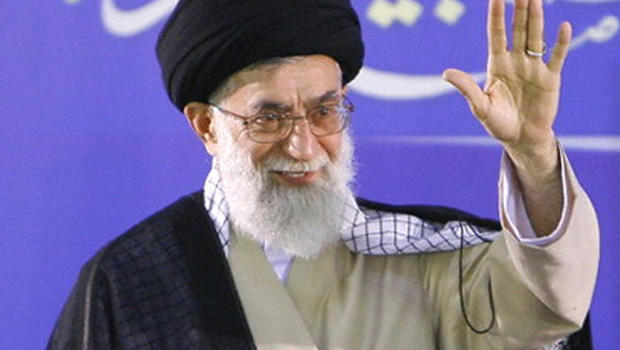 The willful foolishness of our leaders and what passes for their foreign policy continues. Today, Reuters reports that the US is “disturbed” by Ayatollah Ali Khameini’s sermon on at Saturday’s “al-Quds Day” prayers.
“I don’t know how to interpret it at this point in time, except to take it at face value, that that’s his policy,” [Kerry] said in the interview with Saudi-owned Al Arabiya television.
“But I do know that often comments are made publicly and things can evolve that are different. If it is the policy, it’s very disturbing, it’s very troubling,” he added.
While a full translation of the sermon isn’t available, you can get the flavor of the remarks from Khameini’s official website. As you might imagine, if you weren’t living in a dream world of US-Mullah cooperation, there is only confrontation and aggression towards the US and Israel, and a reiteration of Iran’s regional ambitions.
The speech, given only days after the Vienna Agreement was announced, echo the victorious tone of Hitler’s speech at Saarbrücken, given on October 9, 1938, barely more than a week after Munich. (There’s a text of the speech available online, but I’m not comfortable linking to the site that has it. Google, if you like.) The New York Times gave the following assessment of that speech:
Those who had hoped that giving in to virtually all of Hitler’s demands at Munich would lead to European appeasement will find little consolation in the speech of the Fuehrer at Saarbruecken. The moral that Hitler draws from the events of the past few weeks is that only by military strength and threats of war can Germany get what she wants.
Since Kerry is having a hard time figuring out what’s going on here, let me help: the Ayatollah, as befits a man of the cloth, is a True Believer. That is, he really, truly believes in his cause, really truly believes that it is right, really truly believes that God is on his side, guiding history in his direction. Indeed, he may well believe that all of history up to this point is nothing more than prologue to Iran’s ascendancy.
From his point of view, the Western collapse in the face of Iranian resolve is nothing less than divine vindication. Yes, the West is weak, decadent, and lost. But it is materially and militarily strong. What else, other than Allah, could have prompted it to collapse so thoroughly, to accede on virtually every substantive point? What else, other than divine intervention, could have brought a President Obama, so friendly to the Iranian cause, to power just in time to rescue the regime from its own people?
To such a mind, the outcome of the talks is a ratification of his genocidal ideology, not a reason to modify it. It’s been disturbing and troubling for 35 years.
Presidential Temperament
Posted by Joshua Sharf in 2016 Presidential Race, Iran on July 20th, 2015
The fi rst substantive debate of the Republican primary has broken out between Scott Walker and Jeb Bush, over the Iran Deal. Both Walker and Bush have denounced the deal, and called on Congress to reject it. Walker, however, has said that he would nullify the agreement “on day one.” Bush has called that position unrealistic, and arguing that a newly-sworn-in President wouldn’t be positioned to undertake such a potentially complex arrangement.
Bush has a point – the policy implications aren’t simple, and such a move would have to be part of a broader strategy. That said, there’s no reason that a President-elect couldn’t get that into place before January 20. He’ll have a good idea who his foreign policy team will be, and he’ll have been receiving intelligence briefings almost since election night. If he puts his foreign policy advisors on the job now, they should be able to come up with a strategy by then.
More than anything, this confirms my own fears about electing Jeb president. To be sure, Bush has a lot of assets as a potential president. Unlike some on the right, I’ve never considered Bush to be “progressive” or “lefty.” Anyone who paid the least bit of attention to how he governed in Florida would be hard-put to characterize him that way. His own experience as governor, as well as his discussions with both his father and brother about what it’s like to be president have prepared him better than almost anyone else in the field to serve in the Oval Office.
That said, the two most important qualifications for the White House are temperament and judgment. My own sense that Bush’s temperament, while it might have served well through the bulk of the 20th Century, is ill-suited the situation we find ourselves in.
In the past, periods of Progressive expansion have been followed by periods of consolidation. The changes effected had be largely popular, even if the Presidents implementing them had not. There was an incentive for the succeeding Republicans to be happy keeping things the way they were, and to execute the powers of the office in a relatively conservative way. Coolidge, Eisenhower, and Nixon all followed that pattern. Even Coolidge, who lowered taxes and reduced regulation, and referred to the more activist Hoover as “boy wonder,” didn’t succeed in legislatively rolling back any of Wilson’s 1913 “progress.”
Today, we don’t have that luxury – Obamacare will eat us alive, and our overseas situation will likely be the worst inherited by a President since at least 1981. The EPA has grown into an unelected super-government, and along with its partner in crime, the Department of Interior, is depriving millions of Americans of the ability to make a living, or to better their lives. Moreover, these changes are wildly unpopular. The Iran Deal flies in the face of public opinion; Obamacare was the prime mover in the 2010 elections, and will only become more hated as tens of millions of Americans are forced onto Medicaid.
A Republican president will almost certainly have the backing of a strongly Republican House and Senate. He will likely find state governments that remain overwhelmingly Republican. It’s hard to imagine a better situation in which to devolve power back to the states and away from the executive.
The American people may be exhausted of drama, ready for a period of quietly being able to get on with their lives. What they don’t realize is that neither our enemies abroad, nor our bureaucracy at home, are willing to grant us that.
Bush’s comments suggest that, rather than confront this opportunity head-on, he would maneuver cautiously, and likely end up ratifying most of Obama’s changes. His temperament is one of caution, rather than boldness, at a time when boldness is called for.
Which is why judgment is temperament’s partner.
Yeah, But Does Free Speech Have To Be So Speechy?
Posted by Joshua Sharf in War on Islamism on May 7th, 2015
Seen on a friend’s Facebook page: “Pam Geller makes is awfully hard to defend the First Amendment.”
Let’s stipulate for purposes of this post that gratuitous sexual innuendo – or outright graphic depiction – aren’t really my style, and I don’t think they do much to advance the discussion about what to do about Islamism. I don’t think that’s what Pam Geller is about, but if it lets you keep reading, we’ll stipulate that.
Let’s also stipulate the Pam Geller is a rhetorical bomb-thrower, who tells Islamists to suck it up, cupcake, and non-Islamist Muslims to examine what they’re doing (or need to do) to get their religion’s crazies back under control. The purpose of the “What’s your jihad?” campaign isn’t to accuse Muslims of sharing Hamas’s co-joining of politics, hatred, and religion. It’s to challenge normal, everyday Muslims to re-examine their religion’s relationship to politics. These are unpleasant subjects, and unpopular themes.
Even with that, my friend’s commenter has it exactly backwards.
It’s not Pam Geller who makes it hard to defend the First Amendment.
It’s newspapers like the New York Times, and publishing houses like Yale University Press, who refused to publish the Danish Mohammed Cartoons – even in articles and books discussing them – out of fear. Even Reza Aslan, in the Times article, argues for including the cartoons not because it’s correct, but because it’s now safe.
By failing to stand up to the Islamist bullies at the time, they effectively conceded that self-censorship for self-preservation made sense. Had they done so, Geller’s event might not have even been necessary. Indeed, had they done so, Geller herself might be either less relevant (if as inflammatory) or less inflammatory (in order to stay relevant).
Nobody decent defends the attacks by the two ISIS fanboys from Phoenix, nobody who makes excuses for them is decent. So a denunciation of them as a prelude to, “But…” doesn’t buy the author or speaker any credibility. The mere act of denouncing them implies there might be some decent audience who thinks they might be acceptable.
Also troublesome is the comparison of Geller to an arsonist, either by her defenders or her detractors. The Islamists are not a force of nature, devoid of moral agency; they are people, responsible for their actions, and for the despotic creed they promulgate.
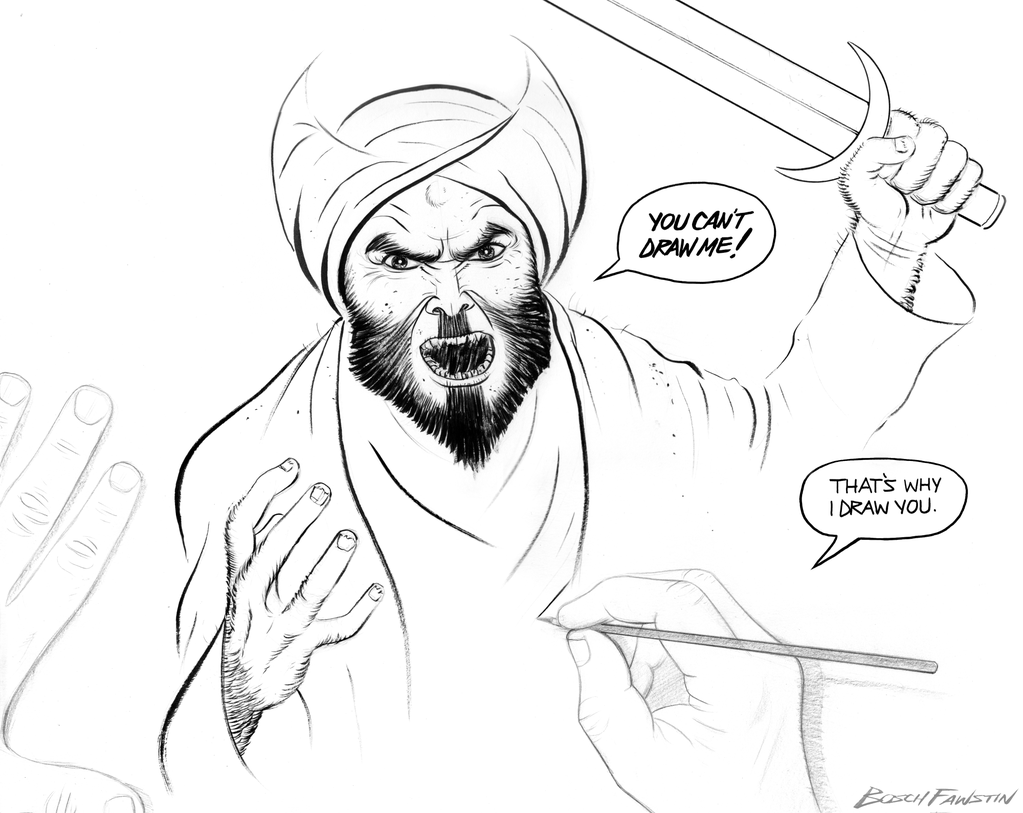
In the end, the winning cartoon wasn’t even about Muhammad per se, it was a meta-cartoon about its own right to exist:
Obama Negotiates
Posted by Joshua Sharf in Iran on April 17th, 2015
In his joint press conference today with Italian Prime Minister Matteo Renzi, President Obama commented on the state of negotiations with Iran, specifically on the issue of sanctions. While most of the discussion has focused on the question of being able to reimpose sanctions, or abandoning them, or being able to reimpose them after abandoning them, this line caught my ear:
I would just make a general observation. That is that how sanction are, lessened, how we snap back sanctions if there is a violation, there are a lot of different mechanisms and ways to do that. Part of John’s job and part of Iranian negotiators’ job and part of the P5+1’s job, is to sometimes find formulas that get to our main concerns while allowing the other side to make a presentation to their body politic that is more acceptable.
Obama publicly said that, in part, the negotiations with Iran consist of an effort to get what we want, while letting the mullahs present some palatable line to their “body politic.”
In other words, he just told the Iranian people that their leaders are lying to them about the terms of the deal, in order to make the sale.
It’s no doubt true that part of a negotiation can be, under the right circumstances, when you hold the high cards and have been driving a hard bargain, to find some way of letting the other side save face.
None of those conditions obtains here. We’ve been getting rolled, and all Obama has just done with that comment is give the mullahs an excuse to pretend they’ve been backed into a corner where they have to drive a harder bargain. He seems have mistaken conducting a seminar in foreign policy for actually conducting foreign policy.
As Mark Steyn likes to ask, “If he were on the other side, what would he be doing differently?”
Sen. Cotton on Attacking Iran
Posted by Joshua Sharf in Iran, War on Islamism on April 8th, 2015
CNN is quoting Sen. Tom Cotton as comparing a US military operation on Iran’s nuclear facilities to President Clinton’s brief 1998 Desert Fox air campaign.
I admire Cotton for the courage to write The Letter™, round up colleagues to sign it, and publish it, and I think he’s both right and wrong about the prospects of an attack on Iran’s nuclear facilities.
He’s right, in that it won’t be anything like the invasion of Iraq, the rescue of Kuwait, or the invasion of Afghanistan. It will be conducted mostly from the air, with specialized units on the ground to support the air ops. It won’t be an invasion, and people who talk of “another war in the Middle East” are trying to conjure up the wrong images, as Cotton points out.
That said, Iran isn’t just Iran. It’s Hamas, Hezbollah, Yemen, and forces in Syria and Iraq. It’s got assets in Europe, South America, and possibly Central America. It almost certainly has sneaked assets into the US, with the ability to do a little more than kidnap the Saudi ambassador. Expect them to wreak as much mayhem and terror as they can muster, either in immediate response, or over time afterwards.
The argument for attacking them now, is that it’s better to fight a non-nuclear Iran now, before it’s consolidated its grip on the region and further developed its missile technology, than to fight a nuclear one later, with all the resources it will have at its disposal. That may or may not be the best or only course of action, but it’s one that may well be required.
Given the nature of the regime, any effective negotiation needs to be backed by the credible use of force, and any credible use of force needs to include the enemy’s retaliatory capability.
Robert Zubrin on Iran
Posted by Joshua Sharf in Iran, Israel, War on Islamism on April 6th, 2015
Robert Zubrin, in three succinct Facebook posts, explains his objections to the Iran “deal.” First, the problems with the deal itself:
The problem with the Obama-Teheran Pact is that no genuine deal is possible. This is so because the entire purpose of the Iranian nuclear program is to produce nuclear bombs. The proof of this is:
- Iran does not need nuclear power for electricity, as it is currently flaring vast quantities of natural gas.
- If Iran did want nuclear power for electricity, it could buy 3.7% enriched U235 (reactor grade) for power generation purposes from either France or Russia at much lower cost than it can producing it domestically.
- Therefore, the only reason why Iran needs its own enrichment capability is to further enrich reactor grade U235 to bomb grade material.
- Further proof of this is supplied by the fact that Iran is actively developing ICBMs, whose only purpose is to deliver nuclear warheads.
- Therefore there can be no genuine deal, because any arrangement which stops Iran from developing nuclear weapons would defeat the entire purpose of its nuclear bomb program, while any deal that does not stop Iran from developing nuclear weapons would represent a complete capitulation by the West.
- And since Iran cares deeply about what actually results from any deal, while Obama only cares about how the deal appears, it is clear that any deal which is made will be one in which Iran is allowed to develop atomic bombs while Obama gets to pretend otherwise for a few months.
The simplest way to stop the Iranian nuclear bomb program completely is to strike Iran’s oil export terminal on Kharg Island. As you can see, it is a very soft target. Two dozen JDAMs would suffice to set the whole place ablaze. Without oil exports, Iran would go bankrupt, and not only the bomb program, but the entire regime would be brought to an end, as they would be unable to meet payroll. No bucks = no bombs.
I observe that my previous posting identifying Iran’s extreme vulnerability to a strike on Kharg Island has provoked numerous responses objecting to US military action and pointing out a variety of possible negative consequences. However those authors misunderstand my point entirely. I am not calling for a US military strike on Kharg Island. That obviously is not going to happen under the Obama administration, as its current energetic efforts to make any deal with Iran, regardless of consequences, clearly shows. I was simply pointing out that if someone actually did want to stop Iran from getting atomic weapons, they readily could do it using much smaller military forces than the US has at its disposal.
Therefore, those people who find the idea of a strike on Kharg island and its potential aftermath unpleasant should do everything in their power to prevent the Obama administration from sealing a deal that would make such a strike an existential necessity for the Israelis.
It will be observed that everywhere Obama has abandoned America’s commitments, chaos and mass bloodshed has erupted. Look at Libya, Syria, Iraq, Yemen, and Ukraine. Consider what will happen to Afghanistan, particularly the women and girls of Afghanistan, as soon as Obama withdraws American forces. Should Obama be allowed to proceed with his policy of ending the containment of Iran, the level of violence he has already unleashed will continue to expand without limit.
When the policeman abandons his post, it does not bring peace to the neighborhood.
Today’s Private-Public Purim
Posted by Joshua Sharf in Iran, Israel, Jewish, War on Islamism on March 3rd, 2015
More than history, the Jews have memory.
In his marvelous little book, Zakhor (“Memory”), Yosef Hayim Yerushalmi notes that Jewish historiography ends with the destruction of the Second Temple, revived only with the Continental Enlightenment and its reach into the communities of France and Germany.
Jewish memory, by contrast continues on, making sense of current events by analogy with Biblical ones. It’s a method not entirely alien to American history itself. The New England settlers saw themselves as latter-day Israelites, guided by God across a forbidding body of water, fleeing a corrupt Egypt to establish His kingdom on Earth in a new land. Franklin proposed that the Great Seal of the United States feature the Israelite crossing the Red Sea. Bruce Feiler’s America’s Prophet (I have not read it, so I can make no recommendation one way or the other) chronicles the role of Moses in American thought, American memory.
But if America could draw on a new founding to make Moses its central prophet, the Jews, in exile, usually turned to a different Biblical story, the Book of Esther. Scattered, everywhere a minority, at the mercy of temporal powers who were usually not friendly, the Jews frequently found reason to compare their situation to the Jews in the Babylonian exile, rescued from extinction by Divine Providence hidden in natural events, hopeful of soon returning home.
It was not unusual for local communities, and even families, to celebrate such rescues by declaring local “Purims,” often recording the events in local chronicles by paralleling the very words of the Book of Esther.
Even though there is now a Jewish Commonwealth for the first time since 70 AD, the current Purim Parallel practically writes itself. Genocidal theocratic Persian seeks nuclear bomb for destruction of Jewish people, twists current world power’s leader to its own ends to obtain such. The comparison was given an added push by the timing of Prime Minister Netanyahu’s speech to Congress – on Tuesday, the day before the Fast of Esther, commemorating Esther’s own fast before she approached the King to plead her case. Most of the commentaries I’ve seen put Netanyahu in the role of Esther, braving the dangers of speaking truth to power (in the old Lefty phrase) in order to save his people.
I don’t think that’s quite right.
Netanyahu’s role here much more close parallels that of Mordecai, imploring Esther to do the right thing and risk her own position and comfort to save her people. Netanyahu deftly explained why the approaching deal is a bad idea, why it’s a threat to Israel, but also – more importantly, given the audience – a threat to the United States. He appealed to the common civilization and shared values between Israel and the United States.
But thought Bibi can persuade, he cannot directly influence. He has no vote in the US, he must act through others, igniting a serious debate where there had been none, inviting others to bring to bear direct political pressure.
Which means that you and I, friends, are Esther.
It is incumbent upon us to act, to persuade Congress to oppose the agreement when it is reached, to retain or increase sanctions, to prevent the administration from giving power, legitimacy, and trade to our enemies as Americans and Jews.
It is our role to step out of our comfortable positions in a wealthy, friendly, welcoming society and use what influence and power we have to prevent any agreement that even contemplates an Iranian bomb from being anything more than a dead letter.
Given this, the actual words of Mordecai’s plea are even more ominous for an American Jewish community used to security but facing new demographic and ideological threats:
Do not imagine to yourself that you will escape in the king’s house from among all the Jews. For if you remain silent at this time, relief and rescue will arise for the Jews from elsewhere, and you and your father’s household will perish. And who knows if you became Queen for such a time as this?
There is actually a dispute as to how to translate Mordecai’s last sentence. Some translate it as, “And who knows if you will remain Queen a year from now?” meaning that Esther might lose her position as Queen. Others translate it as, “And who knows if this isn’t the reason you became Queen?”
The two translations aren’t necessarily at odds: the calendar date for the actual massacre was a year off from Esther’s approach to the King. Mordecai could have been arguing that if Esther didn’t fulfill her purpose in being Queen, God could easily enough arrange for her fall from power and its protections.
There is, or should be, a growing unease among Jews in the United States, this exceptional home for us with its exceptional relationship to us. Too many Jews have traded in their Jewish identity for a Democratic Party one, replacing eternal transcendent values for temporary, political issues of the day. A small minority, the 10% who are Orthodox, are having the great majority of the children, and with even Modern Orthodoxy teetering a little unsurely, the future of Judaism in the States looks potentially smaller, poorer, and more inward-looking.
The President, in his desire to reach a deal with Iran’s mullahs, has put Jewish Americans, but especially Jewish Democrats, in a position of having to choose between identities many had come to see as identical. There are any number of powerful and influential Jewish Democrats, and who knows that they didn’t achieve these positions for such a time as this?
Rabbi David Fohrman points out something I hadn’t noticed before. Two tribes – Judah and Benjamin (plus some Levites, but leave them aside, they’re not a full tribe here) – are actually in exile in Babylon. Those are the only two tribes left in the southern Kingdom of Judah after the northern Kingdom of Israel had been conquered a couple of centuries earlier.
Mordecai was from Benjamin. Esther was from Benjamin. But the decree was phrased as “Yehudim,” Judahites. Haman didn’t care about tribal differences, but Mordecai would have caught the wording. Benjamin and Judah had often had a somewhat tense relationship. Would Esther think that the decree didn’t mean Benjamin, that she and others from her tribe could ride this out?
Mordecai’s demand means this, too: we’re all in this together, Benjamin and Judah. Don’t think this doesn’t mean you. It does.
Similarly Netanyahu is telling American Jews: don’t think this doesn’t mean you. The Islamists, the anti-semites, the BDS-ers and the campus radicals have it in for all of us. You may be secular, you may be comfortable, you may be wealthy, you may even be intermarried or atheist, it doesn’t matter. They mean you, too.
And to non-Jewish Americans, Netanyahu is saying the same thing: the Islamists are coming for you, too. This is a civilizational war we’re fighting, and we’re part of the same team. Some of you may think you can buy safety by cutting a deal that puts Israel at risk, but you can’t. And you’re putting your country and your children and your future in danger if you try.
Will the American Jews extend themselves on behalf of the Israeli Jews, or will we huddle together, trying to ride out the storm?
There are some, Alan Dershowitz, AIPAC, Larry Mizel & Norm Brownstein, who have risen to the occasion. Since 2005, I’ve been on the email list for Jewish NOLA, and its president, Michael Weil, sent out an email this afternoon very supportive of Netanyahu’s speech and its message.
Too many, however, including our own JCRC here in Denver, the ADL, and other organizations charged specifically with advocating for Israel, have taken the safe route. Happy to opine on just about any partisan political social or economic issue, they have fallen silent, ostensibly afraid to make Israel “partisan.” In doing so, of course, they are acquiescing the an administration that has chosen to politicize Israel to try to isolate it, because it stands in the way of its Middle East Grand Strategy. They have, perversely, allowed Israel to become the one topic they won’t discuss.
That’s not good enough.
There is one final parallel. The Purim story doesn’t end with the King revoking his decree and saving the Jews. In some interpretations, the King is prevented by Persian law from revoking a decree, in others he’s too proud to admit a mistake. Regardless of the reason, the King instead issues another decree – a change in policy, if you will – permitting the Jews the defend themselves. It’s a striking thing, a King risking the internal stability of his empire by permitting a subject people to take self-defense into their own hands on a national scale. But he does it, confident that he’s not unleashing chaos, but rather encouraging justice.
Too often, we have valued stability in the Middle East above all else (indeed, stability is given as the reason for welcoming a nuclear-tipped Iran into a role a regional hegemon). It would take a brave president indeed, or at least a confident and secure one, to welcome an Israeli effort to defend itself against an Iranian bomb. It may mean waiting until the next president, who, while not repudiating whatever agreement this one reaches, winks and nods at such an effort.
The White House and Free Speech
Posted by Joshua Sharf in Iran, War on Islamism on January 27th, 2015
It goes without saying that reporting, opinion, and satire are not occasions for retaliatory violence.
Yet at the January 12th daily White House press briefing, Press Secretary Josh Earnest repeated it no fewer than eight times.
Who can this bland truism of a sermon be meant for? Westerners take it for granted. Islamists reject it out of hand. It simultaneously fails to reassure, persuade, or defend.
It was meant, instead, to threaten. Each repetition was paired with a reason why news organizations might do well to consider self-censoring their reporting and their commentary. A number of times, Earnest invoked the idea that printing potentially offensive material might endanger the lives of American service personnel serving overseas – a notion for which there is approximately zero evidence. (One wonders whether or not the servicemen and women themselves were ever consulted about being used in this fashion.)
Earnest ominously suggested that newspapers might need to take into account their own calculations of the risks to themselves involved in reprinting cartoons or controversial material, that they or their reporters might be subject to violent attacks as a result:
The first thing is I think that there are any number of reasons that media organizations have made a decision not to reprint the cartoons. In some cases, maybe they were concerned about their physical safety. In other cases, they were exercising some judgment in a different way. So we certainly would leave it to media organizations to make a decision like this.
He also proposed that considerations of taste, journalistic judgment, and ethics might come into play:
And, again, those decisions aren’t just driven by safety; they’re also driven by certain ethics and journalistic standards. And these are complicated issues but ultimately ones that journalists should make.
There was a faint mention, prompted by insistent questioning, that a free press was something that our military is out there defending, but that only served to heighten the need for self-censorship in order to protect them.
And I think you could make the case, as I mentioned earlier, that a lot of men and women in uniform — not just from American soldiers, but French soldiers and British soldiers and others are fighting for that principle in a very real way.
In fact, given the opportunity in a question to say that American newspapers really should consider themselves safe, Earnest passed it up, in favor of another statement that journalists were just going to have to make that assessment themselves:
Q: Are you saying that based on your knowledge, the White House — you guys know a thing or two about security — that American media organizations shouldn’t be afraid of writing something or showing a cartoon that would offend jihadis because, hey, you, as the White House say, America is the place where you don’t have to be afraid of that because we have sufficient security here? …
A: What I’m saying is that individual news organizations have to assess that risk for themselves.
Earnest then went on to mention the risks journalists routinely take to bring stories to their readers – without mentioning that reporting on ISIS from Iraq entails, or should entail, slightly different security concerns from printing satirical cartoons in Paris or New York.
Put together, the logic of the briefing reads like satire itself: No speech can justify violence like what we saw in Paris, but news organizations need to think about what they’re printing, the kinds of risks they’re taking printing it, since we really can’t protect them, and how they might endanger our servicemen who are fighting to protect their right to print this sort of thing.
Here’s what a robust defense of the spirit of the First Amendment would look like: “Americans – indeed all people – have the right to unfettered free speech, be it reporting, opinion, or satire. It is not the job of this government to pass judgment on the content of that speech. It is the job of this government to make sure that Americans can exercise that right without fear for their safety.”
We didn’t get that.
Instead, then-Secretary of State Clinton supported the Organization of Islamic Cooperation’s (OIC) notorious UN Resolution 16/18. That resolution would effectively criminalize criticism of Islam, encouraging countries to ban speech that serves as an “incitement to violence.” While under Western law “incitement” means encouraging violence, Islamists interpret it to mean “offending to the point of provoking violence.” Such laws would surrender our free press to the Islamist mob.
The administration’s support for Resolution 16/18, and active cooperation in its development, lends a decidedly more sinister cast to its statements. In this context, the repeated statements that nothing that gets printed can justify violence begins to seem a little less like an attempt to state a principle, and a little more like a Chicago politician’s traditional warning: nice little newspaper you got there, shame if anything happened to it.
How long will it be before we see Earnest making the case for Resolution 16/18 simultaneously on the patriotic grounds of protecting our troops, and as a preferable alternative to the violence that “irresponsible” speech invites? We would then have the spectacle of a United States President using the threat of Islamist terror attacks to justify Islamist restrictions on a free press.
Even though, it goes without saying, such violence can’t be justified.
Provocation Is Not Incitement
Posted by Joshua Sharf in War on Islamism on January 16th, 2015
Overseas and in Canada, Islamists have succeeded in using the notion of “defaming” a religion in order to misuse libel laws and shut down criticism of Islam or Islamic leaders. Fortunately, the US has proven more resistant to such abuses.
As an end-around, Islamists seeking to suppress free speech in the name of “respect” for Islam are using a treacherous linguistic bait-and-switch to get restrictions written into national laws.
Historically, incitement to violence – or any criminal act – has been considered at least a justification for prior restraint, and sometimes even a criminal act in itself. This Findlaw page on the legendary Judge Learned Hand discusses changing standards for what constitutes incitement – and therefore what written material might be subject to prior restraint. It is clear that the term means encouraging or instructing someone to commit a crime:
At that time, the legality of written or spoken words was usually judged by the probable result of the words—that is, if the words had the tendency to produce unlawful conduct, then they could be banned. Hand took a different approach: his solution focused on the words themselves, rather than on a guess at the public’s reaction to them. He invented what became known as the incitement test: if the words told someone to break the law, if they instructed the person that it was a duty or interest to do so, then they could be banned. The Masses magazine praised conscientious objectors and antiwar demonstrators, but it never actually told readers they should behave similarly. For this reason, Hand ruled that the postmaster could not ban the magazine.
Here’s a case of modern-day incitement, although for some obscure reason, charges were never brought:
[youtube]https://www.youtube.com/watch?v=IETZ7kgDuBg[/youtube]
This definition places the burden where it belongs: on the mob and on the guy who yelled, “Burn it down!” or “Kill the Jew!” That is, the mob who actually did the destruction, the individual who actually committed the act, and the person who inspired them to commit that act.
Islamists seek to reverse this logic, and therefore, gain power over our speech and our writing. They do this by subtly redefining incitement, so that if someone published cartoons insulting to Islam, and a mob uses that as a pretext for wreaking havoc, the publisher of the cartoons will have “incited” the mob’s behavior, even though this wasn’t the intent of the speech or the writing.
Take this 2012 oped by Randall Hamud, a San Diego attorney who gained brief notoriety in the aftermath of 9/11 for representing some men accused of being involved with the plot. Here, Hamud is trying to make the case that Mark Nakoulay, of Beghazi Video fame, may have committed a criminal act by making and distributing the video.
In 1919, U.S. Supreme Court Justice Oliver Wendell Holmes Jr. wrote that free speech did not include the right to falsely yell “fire” in a crowded theater resulting in a panic. If there were a clear and present danger of substantive evil, such speech would not be protected. In 1969, the Supreme Court held that government cannot punish advocacy in the abstract. However, advocacy can be criminalized where it urges “imminent lawless action and is likely to incite or produce such action.”
You see what he did there? The video doesn’t even come close to urging imminent lawless action, and the action presumed taken – riots by an Islamist mob – are certainly not what Nakoulay had in mind. On a nontrivial technical note, the Court said “and” rather than “or,” meaning that the lawless action taken has to be the one contemplated by the speaker.
Consider the following scenario. Jyllands-Posten publishes a series of juvenile cartoons making fun of Muhammad. The local imam takes those cartoons, waves them around at Friday prayers, and demands satisfaction. Young Arab men then stream out of the mosques, burning and smashing the business district of their town.
Under the traditional definition of “incitement,” the imam would be guilty of incitement, and the mob would be guilty of property destruction.
Under the revised, Hamudian definition, the publisher would be guilty of incitement, and the imam would off scot free.
Whenever Muslim mobs rampage allegedly over some perceived slight, or Islamists walk into a newspaper and murder the staff, apologists would argue that they were “incited” to do so by the cartoons/editorial/image/oped/sandwich, effectively giving the most-touchy, most thin-skinned guy with access to a knife veto power over what we can say.
I’d like to be able to report that the US government, leader of the free world and primary defender of liberty across the globe, is having none of it. Sadly, in 2011, then-Secretary of State Clinton enthusiastically endorsed UN Human Right Council (sic) Resolution 16/18. Whether this is the result of useful idiocy or active sympathy is beside the point – the US government has opened to door to subverting the 1st Amendment at the behest of our enemies.
Randall Hamud, by the way, was presented in 2002 with something called the “Alex Odeh Freedom of Speech Award.”
-
You are currently browsing the archives for the War on Islamism category.


