Forty Years of PERA
Posted by Joshua Sharf in Budget, Colorado Politics, PERA, PPC on March 13th, 2013
We’ve been here before with PERA. Sort of. Most people following the issue remember that in 2000, PERA was over 100% funded, and that its funding ratio has fallen steadily since then. What they don’t know is that back in 1974, PERA was woefully under-funded, at about the same 60% funded ratio that it is now. It took advantage of the long bull market to pull itself out of that situation:
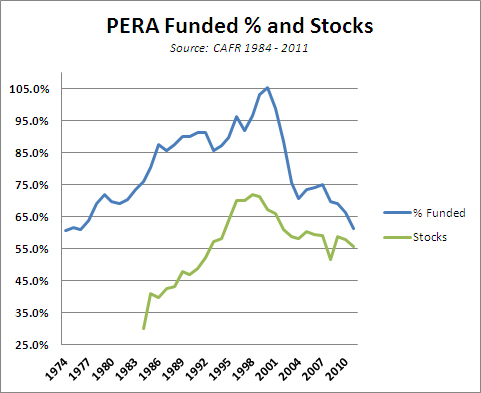
Note that as the funded ratio rose, so too did the percentage of the portfolio allocated to common stock (both domestic and foreign) rose, as PERA basically decided to let the bets ride, rather than re-allocate to maintain the lower-risk portfolio. When the bubble burst, they ended up paying the price for having stayed too long at the fair. Now, PERA has returned to a somewhat more conservative allocation strategy, targeting 25% of its money for fixed income, and a target of 58% in stocks. Nevertheless, this is a far cry from the 45% or so in bonds that they held up until 1992 or so, and the nebulous “Alternative Investments,” which includes things like venture capital (and in which I’ve included the Lumber investments), suggests that PERA is still chasing yield there:

So this just puts us back where we were before, right? We climbed out of this hole before, we can do it again.
Not so fast. First, as noted before, PERA’s in a less aggressive portfolio now than it was in 2000. This is a good thing, since it takes out some of the volatility from its portfolio. But it also means that it probably can’t count on a run of good luck to lift it out of unfundedness the way it did last time. Also, as we’ve previously noted, the fall from grace in 2001 and 2002 wasn’t just a matter of poor returns, it was also a matter of increasing liabilities with more generous benefits. That hasn’t gone away.
And not all 60% funded ratios are created equal. Here are PERA’s inflation-adjusted, per-capita unfunded liabilities since 1974 (constant 1983 dollars):

On a per-capita basis, the overhang is about 4x what it was in 1974. So in fact, we’re in much, much worse shape than we were 40 years ago when this roller-coaster ride began.
Public Pensions and Real Returns
Posted by Joshua Sharf in PERA, PPC on March 4th, 2013
In the discussion on public pensions, there’s been a great deal of focus on the projected rate of return. I’ve posted on what I think is PERA’s optimistic 8% here, and on the fact that that’s actually an improvement from the 8.75% that they were projecting as recently as 2002. That said, for pension estimates, their inflation assumptions matter as much as their raw return assumptions. The actuarial consequences of poor inflation estimation are too much to summarize here. But even on the basic question of returns inflation matters: the real return on an investment is the nominal return minus inflation.
Over the last 10 years, public pensions have gotten some credit for modestly reining in aggressive growth assumptions. PERA, for instance, has moved from a 8.75% growth assumption to 8%, and CalPERS has made similar adjustments. Overall, the average growth assumption has dropped slightly from 8.04% to 7.86%. But the average inflation assumption for public pensions nationally has dropped from 4.0% to 3.31%. This means that instead of decreasing the real return assumption has actually gone up from just over 4% to just over 4.5%.


For the record, PERA’s inflation assumption was dropped from 4.5% to 3.75% in 2003, where it has stayed. Both the investment return and inflation numbers are higher than the national average and national median, though.
I don’t really think that the inflation numbers here are unreasonable. And my problem with PERA’s 8% return assumption goes beyond the average itself – 8% has been the historic return on stocks, and doesn’t take into account the additional volatility and risk that come with higher return. But it’s clear that PERA and other plans have been dining out on their flexibility on returns, while the increase in real expected returns goes unremarked-on.
The disconnect also highlights the price we’re going to pay – in accuracy, and eventually in dollars – for using the rate of return as the discount rate. Interest rates are closely tied to expected inflation, and here the funds themselves are admitting that the gap between the rate of return and the proper discount rate has been growing.
Sharyl Attkisson Brings Us Up To Date On Benghazi
Posted by Joshua Sharf in Defense, PPC on March 3rd, 2013
Not everyone has forgotten about Benghazi. Among those who’ve been pursuing the story, none has been more dogged than CBS’s Sharyl Attkisson. A few days ago, she tweeted out the current state of affairs. Here are the collected tweets:
As promised, I will give an update on the Benghazi info CBS asked the Admin. to provide last Oct. I tweeted out the outstanding questions a month ago. Since then, while the Admin. hasn’t provided CBS additional info some of the questions were asked by Congress, and some of them were answered. So let’s go through the answered and as-yet-unanswered. This is to the best of my knowledge. Since answers weren’t provided to me, I’ve tried to find them in hearings, etc.
UNANSWERED: What time was Ambassador’s Stevens’ body recovered, what are the known details surrounding his disappearance and death, including where he/his body was taken/found/transported and by whom?
UNANSWERED: Who made the decision not to convene the Counterterrorism Security Group (CSG) the night of the Benghazi attacks?
UNANSWERED: We understand that convening the CSG a protocol under Presidential directive (“NSPD-46”). Is that true? If not, please explain..
UNANSWERED: …. if so, why was the protocol not followed?
UNANSWERED: Is the Administration revising the applicable Presidential directive? If so, please explain.
ANSWERED AT CONG. HEARINGS: Who is the highest-ranking official who was aware of pre-911 security requests from US personnel in Libya? Secy Clinton said she was unaware of Stevens’ security concerns/requests & that Undersecy Kennedy was highest official below her who knew. However, Chmn of Jnt Chiefs Dempsey & Def Secy Panetta testified they knew of the security requests, but State didn’t ask for their aid.
UNANSWERED: Who is/are the official(s) responsible for removing reference to al-Qaeda from the original CIA notes?
UNANSWERED: Was the President aware of Gen. Petraeus’ potential problems prior to Thurs., Nov. 8, 2012?
UNANSWERED: And What was the earliest that any White House official was aware? Please provide details
UNANSWERED: What is your response to the President stating that on Sept. 12, he called 911 a terrorist attack, in light of his CBS interview on that date in which he answered that it was too early to know whether it was a terrorist attack?
UNANSWERED: Is anyone being held accountable for having no resources close enough to reach this high-threat area within 8+ hours on Sept. 11
ANSWERED: and has the Administration taken steps to have resources available sooner in case of emergency in the future? Chmn of Jt Chiefs Dempsey testified that troops in the region were put on higher alert status after the 9/11/12 attacks he said he wasn’t sure how long the higher alert status could be maintained. He didn’t address the alleged lack of certain aircraft at major US naval base very close to libya
UNANSWERED: A Benghazi victim’s family member stated that Mrs. Clinton told him she would find and arrest whoever made the anti-Islam video. Is this accurate? If so, what was Mrs. Clinton’s understanding at the time of what would be the grounds for arrest? If true, what is the Administration’s view regarding other videos or future material that it may wish were not published, but are legal?
PARTIAL ANSWER: We requested timeline of Pres. Obama’s actions and decision making on Benghazi night. Secy Clinton testified Pres. Obama didn’t speak to her that night or throughout the attacks. After the initial briefing on LIbya and other matters at the very outset, Chmn of Jt Chiefs said Pres. Obama didn’t communicate with him and Def Secy Panetta testified Pres. Obama didn’t speak with him either throughout the attacks. Officials have said Pres. Obama was very much kept informed of what was happening.
UNANSWERED: White House still will not respond to our request for any White House photos taken Benghazi nite.
UNANSWERED: Admin. still hasn’t provided Benghazi surveillance video originally promised for public release around last Thanksgiving
UNANSWERED: Admin. hasn’t provided accounting of Benghazi survivors or the transcripts of their interviews done shortly after the attacks.
At a press conference 11/14/12, President Obama stated that his Admin. has provided all info regarding “what happened in Benghazi.” No agency has provided documents responsive to our Freedom of Info (FOI) requests on Benghazi. We’ve asked the NSA, State Dept, Defense Intelligence Agency, CIA. So far, not one piece of paper generated by these public agencies on Benghazi nite is deemed a document the public is entitled to see.
Let’s be real: if enough people in the public, media and Congress don’t ask, then any Administration has the option to not answer. I’m a big fan of FOI (Freedom of Info) but the Administrations I’ve covered (both Dem & Repub) seem to have made an art form out of ignoring
One more thing. The White House reportedly has turned over a stack of Benghazi-related documents to the Senate Intel Committee and there are reportedly a lot of blacked out pages.
Some of these questions, and the lack of White House response, and quite damning in and of themselves. We are evidently supposed to believe that the President was kept fully informed of events on the ground, even as he didn’t communicate with the Chairman of the Joint Chiefs of Staff, the Secretary of Defense, or the Secretary of State as they unfolded.
It also seems that the Pentagon’s highest levels were aware of requests for more security by a State Department embassy, but the Secretary of State was not.
Attkisson is right about the FOI problem. Many Republicans had hoped that Benghazi would prove to be Obama’s Watergate, or at least his Tet Offensive. But even in the case of Watergate, Woodward and Bernstein could only go so far. The fact is that the case only really got moving once Congressional investigators, with their subpoena power, got involved. And even then, it took the intervention of a federal judge to get the most damaging information released. With Congressional Republicans proving to be inept investigators, and the press having lost interest in the story since, oh, September 12, it’s hard to see where additional pressure will come from.
If you’re on Twitter, though, and not following @SharylAttkisson, you should be.
PERA – More Retirees, Fewer Workers
Posted by Joshua Sharf in PERA, PPC on March 3rd, 2013
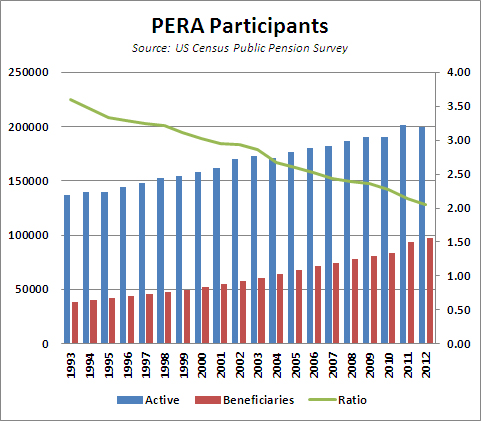
This chart is more or less self-explanatory. Over the last 20 years, the number of workers per beneficiary within PERA has dropped from about 3.6 to just over 2.0:
PERA’s CAFR includes the following disclaimer:
By itself, a declining ratio of actives to retirees and beneficiaries does not pose a problem to a Division Trust Fund’s actuarial condition. However, to the extent that a plan is underfunded, a low or declining ratio of actives to retirees and beneficiaries, coupled with increasing life expectancy, can complicate the Division Trust Fund’s ability to move toward full funding, as fewer active, contributing workers, relatively, are available to amortize the unfunded liability.
This is about right, although even a fully-funded system won’t stay fully-funded for very long under these conditions. Indeed, PERA was fully-funded as late as 2001. In the 90s, PERA’s long-term problems were masked by a tech bubble, and when that burst in 2000, the fund started to fall into an under-funded state that it’s never recovered from. Since under an underfunded defined-benefit plan, current expenses have to be paid for out of current contributions, and fewer workers are pulling the cart for each retiree, the deficient horsepower will have to be supplied by the taxpayers.
Aristotle’s Rhetoric on Acid
Posted by Joshua Sharf in Colorado Politics on March 1st, 2013
Tom, over at People’s Press Collective, conducts a mini-course on the rhetorical devices used by the Left to derail rational discussion, illustrated by a Twitter fight:
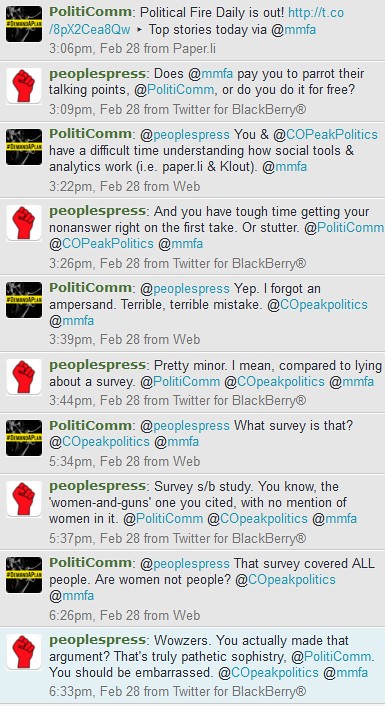
Most of us would focus on the logical fallacy in PolitiComm’s last tweet. By their argument, the study was about middle-aged Czech immigrants. After all, are they not people?
But that’s not the point of the post. Instead, Tom looks at the rhetorical devices used to distract, derail, and otherwise distort an argument. These are tactics that not only can ensnare smart people, they’re specifically designed to ensnare smart people. For instance:
- Distractions: responses aimed at luring their opponent into talking about something else, taking them “down a rabbit hole” and “into the weeds” by focusing on some trivial or secondary facet of their opponent’s argument, thereby miring their opponent in minutiae;
- Diversions: responses aimed at changing the subject entirely, moving it away from a topic they find threatening to their own interests or worldview and instead onto something threatening to their opponent’s;
- Deflections: explanations, justifications, or rationalizations which redirect criticism aimed at their sacred cows and onto their opponent, in an attempt to put the latter on the defensive instead;
Why is it important to learn how to recognize and counter these? Because they’re all tools used to limit our effectiveness. Too often we make the mistake of assuming that their paucity of logic and supporting facts is obvious to anyone following the debate. It’s not. And using them back at the Left is only marginally better than succumbing altogether: they lower the level of discourse to the point where rational argument can’t prevail, either because the discussion itself is so debased, or because other people listening lose interest and walk away convinced that there’s no difference between the sides.
Why are these tactics so common across so many sites and platforms? I suspect there are three main reasons: first, there are professional online activists who are trained to do this kind of thing in much the way Media Matters and others train people for appearances on television or teach them to call talk radio shows or write letters to the editor; second, many more people consciously or subconsciously emulate what they see other like-minded commenters doing; and third, there are people who are just
sociopathicnaturally gifted in this regard and need neither training nor example to create and employ such tactics.It’s important for center-right activists to learn to recognize these things so as not to be suckered in by them, and to fight back effectively when encountering leftists using them. Being able to spot, identify, understand, and respond to these tactics undercuts their power. Given enough education and discipline, perhaps we can return to a more rational and persuasion-based political conversation and jettison the juvenile bickering that seems to have become the norm since the emergence of social media and the ascendance of the infantile Progressive movement which dominates its political channels.
Purim as an Argument Against Gun Control
Posted by Joshua Sharf in Colorado Politics, Jewish, PPC on February 22nd, 2013
I’m always reluctant to re-read religious texts with a political slant. The Left has, for the most part, sought to replace religion with politics with the sort of baleful results we saw in 20th Century Europe and Russia. Even today, the American Jewish left uses such Jewish concepts as “Tikkun Olam” to justify pretty much the entire leftist political agenda, and JCPA General Assembly resolutions to that effect almost always find some Torah text to torture into testifying on their behalf. So to the extent that I’m edging across a self-imposed line here, the people it’s most likely to unnerve are the very liberals who’ve gotten used to thinking of the Torah as their personal political property.
But to the extent that Judaism has a political holiday, Purim is it. The internal power and factional politics of the Persian Empire, the Jews’ place in a multi-ethnic society, Megillat Esther is steeped in politics, and thus, human nature.
So for those who think that voluntarily disarming Jews is a good idea, consider the manner in which Ahasuerus’s decree of doom is reversed. Not by repeal, which the text tells us is beyond the King’s legal authority. Instead, it’s negated this way (8:11):
…that the king had given to the Jews who are in every city, [the right] to assemble and to protect themselves, to destroy, to slay, and to cause to perish the entire host of every people and province that oppress them…
We don’t need to carry the argument to the reducto ad absurdum of the Holocaust or the Holocaust-that-wasn’t in the Megillah to make this point. Even in the US, from time to time, anti-Semitic riots do happen.
The President of the United States has invited the instigator of two such riots to the White House to advise him on economics, and granted him a television interview. Both the Crown Heights riots and the Freddy’s Fashion Mart riots were anti-Semitic and Sharpton’s handiwork.
The ADL was founded as the result of one such riot that turned into the lynching of a Jewish man – in spite of the efforts of the authorities to prevent it.
And Seraphic Secrets’s hair-raising description of being defenseless during the Rodney King riots in LA, when the police abandoned the field, should drive home the point that riots need not be anti-Semitic in nature to be deadly.
In a country where we have that right by law – the same as all other citizens, and without any special royal dispensation necessary – why would we voluntarily cheapen Jewish blood again by disarming ourselves?
So tomorrow night and Sunday, when we’re celebrating our victory over our enemies, let’s also spare a thought for the fact that, unless we choose to give it up, here in the US, we have as a matter of course the very same rights that gave us that victory.
Happy Purim!
The Higher-Ed Bubble, In One Chart (and one article)
Posted by Joshua Sharf in Budget, Colorado Politics, Education, PPC on February 16th, 2013
Rep. Mike Coffman took a lot of heat for suggesting that perhaps it was time to re-evaluate these priorities, with his words being distorted into an attack on the liberal arts in particular, and higher education in general. Turns out he was onto something.
- Sociology
- Fine Arts
- Education
- Religious Studies/Theology
- Hospitality/Tourism
- Nutrition
- Psychology
- Communications
Just for grins, I looked up how many of CU’s undergraduate degress over the last quarter-century (well, since 1989), have been awarded in these majors:

For fun, I added in almost anything with the word “Studies” in it, and that’s what the percentage line (right-hand axis) shows.
Peaking at just over one-third of all bachelor’s in 2004, over 30% of all undergraduate majors are still in these low-return majors. The dropoff occurred between 2004 and 2008, but has since – astonishingly – stabilized since the popping of the housing bubble, when job prospects for graduates have almost never been worse. Students are taking on crushing burdens of debt to graduate with these degrees.
You and I will be subjected to sob stories about how Colorado is under-funding its higher education. Instead, perhaps we ought to be taking a closer look at what we’re funding.
Daily Glimpse February 6, 2013
Posted by Joshua Sharf in PPC on February 6th, 2013
Daily Links From Glimpse From a Height
- Essays in Biography
I’m working my way through Joseph Epstein’s highly entertaining and instructive Essays in Biography, a bite at a time. Instructive not only for the objects of the essays, but in the nearly flawless construction and execution of the essay form. Epstein has an uncanny eye for the telling, lingering detail, often provided by a contemporary […]
Uber vs. PUC
Posted by Joshua Sharf in Business, PPC, Regulation, Transportation on January 29th, 2013
This past Saturday’s Wall Street JournalWeekend Interview was with Uber founder Travis Kalanick (“Travis Kalanick: The Transportation Trustbuster“). Uber allows a customer to summon an otherwise idle limo or SUV, on demand, through a smartphone app. The prices are competitive with town car service, and don’t require pre-arrangement. The article details, in part, Kalanick’s battles with various municipal regulatory authorities, who, often acting on behalf of established taxi interests, seek to keep his company from operating:
When I suggest to Mr. Kalanick that Uber, in the fine startup tradition, was using the “don’t ask for permission, beg for forgiveness” approach, he interrupts the question halfway through. “We don’t have to beg for forgiveness because we are legal,” he says. “But there’s been so much corruption and so much cronyism in the taxi industry and so much regulatory capture that if you ask for permission upfront for something that’s already legal, you’ll never get it. There’s no upside to them.”
…
Then, last year, came the clash with regulators in the city where they order red tape by the truckload: Washington, D.C. A month after Uber launched there, the D.C. taxi commissioner asserted in a public forum that Uber was violating the law.
This time Uber was ready with what it called Operation Rolling Thunder. The company put out a news release, alerted Uber customers by email and created a Twitter hashtag #UberDCLove. The result: Supporters sent 50,000 emails and 37,000 tweets. Mr. Kalanick says that Washington “has the most liberal, innovation-friendly laws in the country” regarding transportation, but “that doesn’t mean the regulators are the most innovative.” The taxi commission complained that the company was charging based on time and distance, Mr. Kalanick says. “It’s like saying a hotel can’t charge by the night. But there is a law on the books, black and white, that a sedan, a six-passenger-or-under, for-hire vehicle can charge based on time and distance.”
In July, the city tried to change the law—with what were actually called Uber Amendments—to set a floor on the company’s rates at five times those charged by taxis. “The rationale, in the frickin’ amendment, you can look it up, said ‘We need to keep the town-car business from competing with the taxi industry,’ ” Mr. Kalanick says. “It’s anticompetitive behavior. If a CEO did that kind of stuff—you’d be in jail.”
A determined PR campaign by Uber was able to derail DC’s efforts. By coincidence, this week, Uber posted on its Denver blog that the Colorado PUC is up to the same tricks:
Unfortunately, the Colorado Public Utilities Commission proposed rule changes this month which, if enacted, would shut UberDenver down. We need your help to prevent these regulations from taking effect! Sign the petition!!
Here’s a sampling of what’s being proposed (Proposed Rules Changes):
- Uber’s pricing model will be made illegal: Sedan companies will no longer be able to charge by distance (section 6301)
- This is akin to telling a hotel it is illegal to charge by the night.
- Uber’s partner-drivers will effectively be banned from Downtown — by making it illegal for an Uber car to be within 200 feet of a restaurant, bar, or hotel. (section 6309)
- This is TAXI protectionism at its finest. The intent is to make sure that only a TAXI can provide a quick pickup in Denver’s city center.
- Uber’s partner-drivers will be forced OUT OF BUSINESS — partnering with local sedan companies will be prohibited. (section 6001 (ff))
The PUC has run interference for the taxicab cartel here before, last year shutting down a popular airport ride sharing program. In 2011, they denied additional permits to Yellow and a proposed start-up, Liberty Taxi. And the Union Taxi Cooperative’s battle to begin service (eventually successful) was the stuff of legend. Their actions to the detriment of electricity ratepayers have been well-documented by Amy Oliver and Michael Sandoval over at the Independence Institute. But at least in those cases, they had the fig leaf of enforcing existing law. Here, as in DC, they’re actually proposing to change the rules in order to run the company out of town.
As a living, breathing example of regulatory capture, Colorado’s PUC is in a league of its own. Let’s hope that Uber’s supporters are able to persuade them to cease and desist their harassment of the company.
Is Legislative Stinginess to Blame for PERA’s Problems?
Posted by Joshua Sharf in Finance, PERA, PPC on January 28th, 2013
One of the favorite tropes of PERA apologists runs like this: PERA was fully-funded in 2001 or so, at which point the state legislature began failing to make 100% of its Annual Required Contribution (ARC). It was then that PERA’s funded level began to drop off. Therefore, if the state legislature had fully-funded the ARCs, today, PERA would not face a massive unfunded liability.
It’s a rhetorical masterstroke, redirecting blame for the current situation on a stingy state legislature that put PERA last in its priorities. And while grounded in a grain of truth, it severely understates and misattributes the nature of PERA’s financial crisis-in-the-making.
The grain of truth is this: the state legislature, beginning in 2003, began to under-pay its Annual Required Contribution. Of course, this affects not only the immediate year, but all future years going forward. Not only is the money from the shortfall not there, but the accumulated return on those dollars aren’t there, either. For this post, I’m just going to focus on the two largest divisions, the School Division and the State Division. They were combined in 1997, and separated again in 2006, so I’ll consider them as a unit.
Here are the yearly shortfalls, along with their future values to the end of 2011 (the latest year for which we have data). The first year for each underpayment is dollar-cost-averaged, so we give half the year’s return, and full yearly returns thereafter:
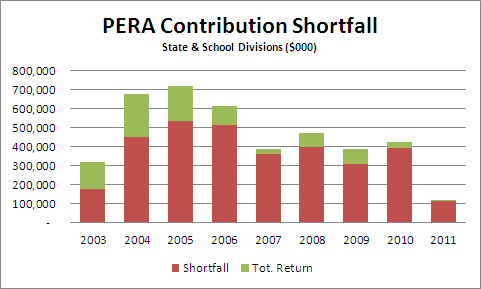
For 2003, the legislature underpaid by about $177 million, costing about $142 million in future returns, for a total effect in 2011 of $319 million. If you add up the total effect, year-by-year, you get the following result:

So by the end of 2011, the cumulative effect of 9 years’ worth of funding shortfalls is a little over $4 billion. The argument by PERA hinges on the fact that it’s at 2003 that PERA began to be underfunded:
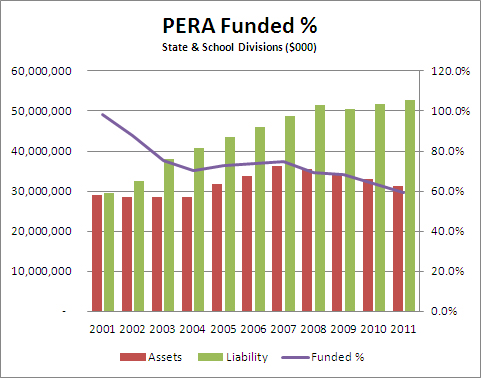
As you can see, though, PERA was already suffering from poor 2001 and 2002 returns, even though there was no shortfall from the state those years. What did increase substantially was the size of the liability; the size of the assets actually held steady. From 2004 to 2007, solid returns managed to keep the dollar amount of the gap from growing. But then 2008 hit, and the size of the obligations continued to increase even as the fund got clobbered in the market. The liability dropped as a result of certain stop-gap changes that were made in 2009, but has since resumed its upward march, even as the actuarial value of the divisions’ assets has continued to fall.
Would it have made a difference if the state had made good on its entire ARC for 2003-2011. The answer is yes, but not very much. Adding in the cumulative shortfall each year, here’s the effect on the assets and the funded ratio for the State and School Divisions:

Despite some increased, they’re still seriously underfunded. Since it’s difficult to see the difference between the two charts, I’ve made the comparisons here. First, the difference in assets:

An increase of total assets from $31 billion to $35 billion is not nothing, as they say down at the station, but it’s also not nearly enough to start to close the gap with liabilities. So little that the difference in funding ratio barely moves the needle:
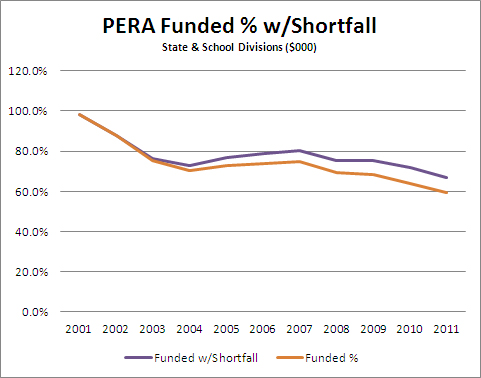
For those of you who want it all on one chart, possibly for optical exams, here it is:
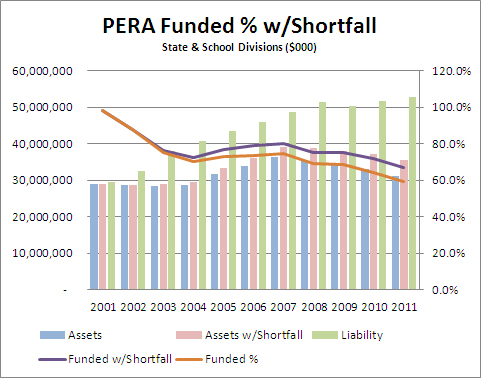
In reality, it’s worse than this. Prior to 2006, PERA didn’t report a sensitivity analysis on its assumed rate of return, so we have only the values for 8%. If we assume a more realistic 6.5% return going forward the unfunded liability grows from $25 billion to about $40 billion, and the extra $4 billion makes even less of a dent.
PERA isn’t suffering from a legislature that isn’t keeping its promises, it’s suffering from having made promises it can’t keep. And it’s the very PERA members who are going to get hurt the most, the ones who’ve been sold a bill of goods about what’s waiting for them when they retire.
-
You are currently browsing the archives.


