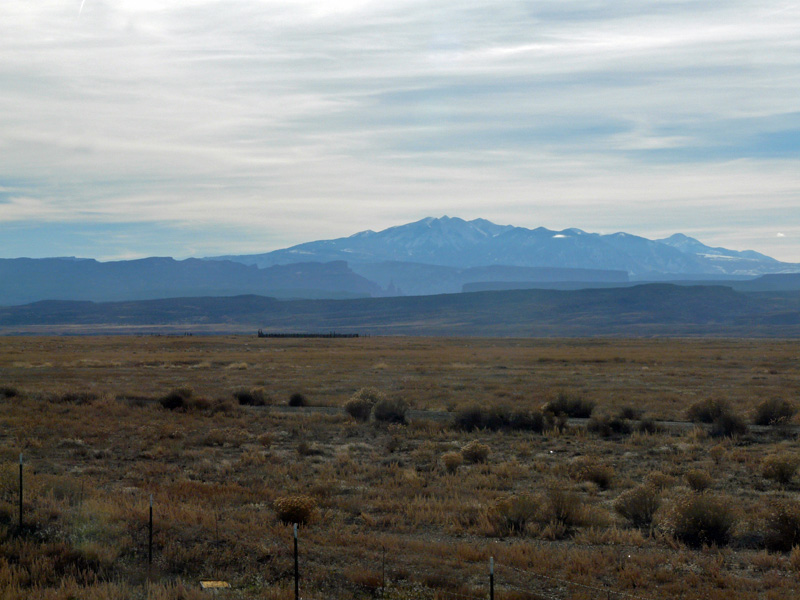
Finally, The Photos From the Las Vegas Road Trip
Posted by Joshua Sharf in Photoblogging on December 22nd, 2010

















Did Colorado Republicans Really Outperform Democrats?
Posted by Joshua Sharf in Colorado Politics, PPC on December 21st, 2010
Since the election, Colorado Republican Chairman Dick Wadhams, who has still officially not announced for re-election, has been regularly sending out emails defending his and the state party’s performance during the campaign season. In particular, he has addressed two issues that are not always clearly understood: vetting, and the role of the party’s turnout operations. I’ll save vetting for another post, because there are some worrisome signs that the Old Bulls of the party have learned nothing from this cycle, and it deserves a separate treatment. For the moment, let’s talk about turnout operations.
Now, before I start, I want to make it clear that I’m not here to defend or attack Dick’s overall performance as party chairman. Dick was personally very supportive during my 2008 run, and financially supportive at the beginning of the 2010 campaign. It’s for that reason among others that I want to stay clear of personalities. He’s more than capable of speaking for himself and defending his own record with its considerable accomplishment. He doesn’t need me to do that.
Now Dick’s answer to the question I pose in the title is a resounding, “Yes!” He points to the large edge that Republicans had in turnout. In a state with about as many registered Dems as Republicans, many more Republicans turned out to vote. Dick would argue that that turnout edge may not have been enough to save Ken Buck, but did provide the edge in the other statewide races, and took back the State House of Representatives. He draws a line – traditionally correct – between the party’s job to turn out its voters and the candidate’s job to persuade unaffiliated voters.
And by that standard, the party succeeded and the candidates – all of them, except for John Suthers – failed. Because the only way you get a 100,000 vote edge in turnout and win by substantially less than that is if the unaffiliated voters turn against you. In this case, they turn against you radically and decisively in a way that’s not predicted in any poll leading up to the election.
I believe that the Democrat turnout effort was focused not only on registered Democrats, but also on Democrat-voting unaffiliated voters. That the Left – not just the Democrat party – has done a better job of identifying, contacting, engaging, and recruiting those unaffiliated voters who lean their way than we have, while we are content with robocalls to right-leanings U’s in the weeks leading up to the election. I believe that their focus on social networking and social media, both on their own sites and on larger social networking sites, has helped them identify these voters.
It is also true that, for the moment, the Democrats can call on the foot soldiers of the labor unions to go walk precincts on Election Day, which provides them with an advantage in that regard. But this is not new, and there is no reason we can’t develop our own sources of manpower.
What I am seeing from the State party is a lack of constructive self-criticism, instead focusing on what went well, rather than on how the game has changed and what the proper responses to it are. The Republicans are playing checkers, and the Democrats are playing three-dimensional chess, and we had better hope that the answer to the above question is a decisive, “No.” Otherwise, we have pretty much lost the middle permanently, and are looking not at the middle of a comeback, but at a high-water mark. I don’t believe that’s true; there’s almost no polling that supports that thesis. But we’ve probably come as far as we can with the old model of how things work.

Colorado Misses Out On Another Wave
Posted by Joshua Sharf in Business, Colorado Politics, Energy, PPC on December 20th, 2010
The Wall Street Journal reports that resource-rich states are recovering quite well from the recession:
Wages of workers in 10 states and the District of Columbia have more than regained ground lost during the recession, with the recovery concentrated in regions benefitting from the commodities boom and federal spending.
Many of the laggards, meanwhile, are states where the housing bust hit hard or where the collapse of the auto industry and other old-line manufacturing pulled down wages during the slump, according to a Commerce Department figures released Friday.
That Colorado is a resource-rich state can hardly be doubted. We have coal and natural gas in abundance, minor metals like molybdenum, potentially uranium. While real estate has suffered, we never had the kind of overbuilding seen in Florida, Arizona, or southern California, so we never had the kind of collapse, and manufacturing hasn’t been a mainstay of the Colorado economy for a while.
So why aren’t we recovering? Why is the state’s unemployment up to 8.8%, with only modest improvements projected (for whatever that’s worth)? Well it’s true that, unlike DC, northern Virginia, and suburban Maryland, we lack the ability to coerce the rest of the country to pay for our standard of living. But more importantly, the outgoing Ritter administration and its Democrat allies have waged an ongoing war against the exploitation of our natural resources.
I don’t want to see the state return to the boom-bust cycle that characterizes an economy overwhelmingly dependent on drilling and mining. But Colorado is clearly suffering from a national policy -seemingly unique in the industrialized world, and reinforced by state government – of refusing to exploit natural resources that our economy actually depends on.
I Guess It Depends on Who’s “Troubled”
Posted by Joshua Sharf in Media Bias, PPC on December 1st, 2010
hen I read a television column, I want to see reviews of shows. I’ll even read reviews of one-time shows like the Academy Awards, if the column is entertaining enough. But Tom Shales’s long slide down to irrelevance started, I think, when he began turning his reviews into political columns.
Nobody’s going to confuse Joanne Ostrow with Tom Shales, but she’s following his lead in turning her TV column into political commentary. First, there was the snark-filled review of Sarah Palin’s Alaska, where she finds the show more “troubling” than just about every other reality genre including “numerous shows about families with 19 kids, hoarders, polygamists and JonBenet look-alikes.” Like her or not, there are plenty of people out there willing to make fun of Bristol’s formerly delicate condition, without Ostrow’s needing to join the fun. It’s not worth refuting her point-by-point, of course, but we don’t come away knowing if the show’s any good.
Then, yesterday, Ms. Ostrow decided that the public’s distaste for self-pornification and borderline sexual assault was little more than a media fiction, getting far more attention than it deserved.
Those lascivious X-ray eyes. Those groping hands. What a perfectly titillating story. The American Civil Liberties Union, the Libertarian Party and the Tea Partiers were in rare agreement.…Only later did we learn (via a CBS poll) that 81 percent of those surveyed had no objections to the new screenings.
I don’t know where Ms. Ostrow works, but this year’s big April 15 Tea Party rally, on the west side of the State Capitol, right across the street from the Denver Post building, was hosted by the then-Libertarian candidate for CD-6, and featured more libertarians, small- and large-L, than Republicans. Anyone who’s bothered to read more than a sentence or two about the Tea Parties knows that they’re far more small-l libertarian than anything else.
As for the CBS poll:
On the eve of one of the nation’s busiest travel days, a poll has found that 61% of likely voters oppose the newly enhanced security measures at the country’s airports.
The poll by Zogby International of 2,032 likely voters also found that 48% said they would probably seek alternatives to flying because of the new measures.
…
The Zogby poll, taken online Nov. 19-22, seems to indicate a change in public opinion over the last few weeks. A CBS News telephone poll taken Nov. 7-10 found that 81% of Americans questioned said they approved of the use of the full-body scanners at airports. The CBS poll did not ask about the new pat-down search techniques.
Now, that LA Times story was only a week old, so the Post’s computers may not have access to it yet, but those of us on the outside have known about it for some time.
Question for Ms. Ostrow: you want to be a TV critic, or a lefty ombudsman?
“I’ve Never Gone to Work…I’ve Only Gone to Fly”
Posted by Joshua Sharf in General on November 30th, 2010
The last words of Denny Fitch, subject of the best of Errol Morris’s First Person interviews. If you’ve never heard of Denny Fitch, watch this interview, and you’ll never forget him.
Believe it not, this was a success.
In 1989, Fitch was a check pilot. dead-heading home to Chicago from Denver, where he had been testing the emergency-readiness of other flight crews, when the hydraulics on the DC-10 went out. Well, “went out” wasn’t quite right: they were severed, all three systems, at the single point of failure, when the tail engine more or less exploded.
When Fitch went up front to help the crew, he joined its battle to do what no other airplane crew had ever done – survive a total failure of their plane’s hydraulic systems. As Fitch points out, there are no cables on a DC-10, because they wouldn’t do any good. The large control surfaces would simply overwhelm the strength of any one man. Essentially, the only control that the crew had over the plane was through the right and left engine power.
Fitch guides us through the crew’s battle to stabilize the plane’s flight, decide where to try to land it, and the eventual crash-landing through which 2/3 of the crew and passengers lived. He dead-pans his way through some of the decisions the crew had to make: “It is better to land in a corn field with the gear up or down? There’s not a lot of test data on that.” He comes across as a thoroughly serious, but likable guy, who can simplify even complex aeronautical problems.
Morris’s pacing is also superb, alternating between the tension of the cockpit and the stakes of success or failure, and the personal and technical background needed to tell to the story. I sent the link to the first segment to my Dad last night, and he ended up watching the whole thing, beginning to end. I suspect you will, too.
Thanksgiving and Other Holidays
Posted by Joshua Sharf in General on November 25th, 2010
For a while now, Dennis Prager has been championing the idea of a 4th of July Seder, paralleling the Passover Seder, as a mean of using ritual to preserve the ideals of the day. I’m not sure that I’ve ever seen him explicitly explain how Passover’s position within Judaism is similar to Independence Day’s role in our civil religion. Just as Passover celebrates the emergence of Israel as a nation, so does the 4th of July. Just as the Declaration of Independence declares principles without specifying the legal form of the new nation, so is the Exodus only half the story, incomplete without Sinai. And just as on Passover we recount the story of the Exodus, so in the 4th of July, we remember – often by re-enacting – the events of the Revolution.
It’s also been noted that Passover is the most specifically Jewish of the holidays, stands in contrast to Rosh Hashanah, the most universal holiday on the Jewish calendar. I would like to suggest that Thanksgiving occupies a similar spot on our secular calendar.
Now, Rosh Hashanah is a Jewish holiday, no doubt about it. But the theme is of creation of the world, and God as universal monarch, which is different from the concept of gods that had existed before, usually as local gods, whose power didn’t extend beyond the territory of those who worshiped them. There’s little more universal than that. Likewise, there’s the mystical notion that the shofar is the sound of our soul, something that all humans share.
Similarly, while Thanksgiving has distinctive American overtones – our material prosperity is a function of both our resources and our resourcefulness (and the freedom to use the latter to make use of the former) – the notion that our blessings ultimately are a result of a partnerships between God and ourselves is something that could be celebrated by anyone fortunate to be free. It was first celebrated before and exists independent of America as a political entity.
This isn’t to suggest identity between the two sets of holidays, much less between America and Judaism. Rosh Hashanah is not Thanksgiving; Passover is not the 4th of July. The ideas actually embodied by the holidays are very different. And I’ve been highly critical of those (mostly Reform and secular) Jews who replaced religion with politics, trading eternal values for temporary politics.
But their places within their respective systems are very, very similar.
Those GAO Reports
Posted by Joshua Sharf in PPC, Privacy on November 21st, 2010
From Holly Doodruff Lyons, those GAO reports I promised:
1.) “Systematic Planning Needed to Optimize the Deployment of Checked Baggage Screening Systems”, (GAO-05-365, March 2005)
“According to TSA’s analysis, in-line EDS would reduce by 78 percent the number of TSA baggage screeners and supervisors required to screen checked baggage at these nine airports, from 6,645 to 1,477 screeners and supervisors.” (Page 42).
2.) Classified GAO Report (April 2005), GAO reviewed the TSA’s own covert screener testing data and concluded that TSA’s data indicated that passenger checkpoint screeners at airports participating in the PP5 Program performed better overall on the tests than checkpoint screeners at the totally Federalized airports. GAO concluded that differences in these test results were statistically significant.
3.) “Screener Training and Performance Measurement Strengthened, but More Work Remains”, (GAO-05-457, May 2005)
“For the two-year period reviewed, overall failure rates for covert tests (passenger and checked baggage) conducted at airports using private-sector screeners were somewhat lower than failure rates for the same tests conducted at airports using federal screeners for the airports tested during this period.” (Page 34).
4.) “Aviation Security: TSA’s Cost and Performance Study of Private-Sector Airport Screening”, (GAO-09-27R, January 2009)
“The limitations in the design of TSA’s study comparing the cost and performance of SPP and non-SPP airports were due to several key factors related to the study’s purpose and data availability. For example, TSA officials stated that they did not include some cost elements in the study because they wanted to determine the impact of the SPP on TSA’s budget, rather than to determine the impact to the federal government as a whole. In addition, for its comparison of performance, TSA analyzed measures for which information was most complete, among other things. Because of these limitations, we [GAO] believe that TSA should not use the study as sole support for major policy decisions regarding the SPP.”
What Does Technology Want?
Posted by Joshua Sharf in Uncategorized on November 21st, 2010
First, take about half an hour and listen to the following RadioLab podcast. Go ahead, I’ll wait; the comments won’t make sense without it, and I don’t want to have to set up the whole thing, piece by piece, before commenting.
It’s an interesting question, then. Does technology have to have advanced more or less in the way that it did? Or could certain things have been invented sooner, or later? Did we have to get the railroad about the same time as the telegraph? Did we have to wait for the automobile until well after the telephone? The authors would seem to say yes.
Why do things get invented? Because all the necessary technologies have been invented, they answer. It’s like a chess game, where you can only make certain moves once the board’s in a certain position, i.e., once the moves needed to get there have been made.
I’m not so sure. There’s a point, somewhere in the mid-to-late 1800s, stretching until the 1920s or so, when things seem to get invented at such a rapid pace that it’s hard to believe that the order was pre-ordained, that there weren’t just so many potential useful inventions out there waiting to be invented, that they didn’t overwhelm the number of inventors at least a little bit. If that’s so, then technology advances at least as much because people are looking in a certain place, as much as that the tools for inventing it were around.
Take the space program. There’s no reason to believe that the tools for a civilian space program weren’t lying around in 1960. What was lacking was the belief that anyone other than the government could make it happen. Or so-called “green energy.” As much as we’re subsidizing its development, there’s no reason to think there won’t be some breakthroughs there, but we’ll never know the opportunity cost of those breakthroughs. Suppose we just built a bunch of nuclear power plants, and all those inventors had to go to work on household appliances or nanotechnology instead?
Another fascinating notion, tantalizingly cut short in the radio piece, is the notion that technological evolution seems to be an extension of the evolutionary processes that produced us. As a believer who also believes in human evolution, that was a bit jarring at first. No doubt, some materialists would choose to believe that it obviates the need for a creator. But this, like all Ideas, is self-proving. To a believer, it’s perfectly reasonable that if we’re created in God’s image, then our intelligence is a reflection of His. The authors can’t quite being themselves to say that.
The notion that our networks will self-actualize at some point isn’t a new idea; science fiction authors have been playing with it for years, and they generally aren’t as sanguine as the two authors are. I remember reading an Asimov story where the telephone network gains consciousness, and SkyNet is another example.
Towards the end, I think they read Krulwich’s unease incorrectly. There’s something at least unsettling about the idea that we’re just midwives for other intelligences, that we’re not the logical end of evolution, but just another link in the chain. Because if we are, then the intelligence that we’re creating may eventually decide we’re more trouble than we’re worth. Krulwich isn’t, as one author states, worried about next Tuesday. He really is worried about the next 10,000 years.
The risk, I believe, comes in taking them too literally. I don’t really believe that the Internet will gain consciousness someday. I do believe that the idea of man-and-his technology as an organism is useful as a metaphor for understanding what’s going on. In an earlier edition, RadioLab accepts the metaphor that a city breathes energy in and out. (But if they know that’s a metaphor, why do they so easily accept the Technology metaphor as real?)
Podcast: Play in new window | Download
DIA and TSA – What We Can Do, and What We Can’t
Posted by Joshua Sharf in National Politics, PPC, Privacy on November 18th, 2010
I just got off the phone with Holly Woodruff Lyons, who’s a staffer with the US House Transportation Committee. She was kind enough to spend about 15 minutes with me, discussing Rep. Mica’s letter, and the opt-out program, and was extremely helpful given that she didn’t know me from Adam.
It turns out that private contractors, while quite popular in the places where they are used, still have to obey TSA screening policies, and if TSA decides to put electronic strip-searchers at DIA, there’s no mechanism for DIA to resist. TSA is responsible for security, not DIA. This also means that the private contractors almost always are contracted to TSA, not to the local airport authority. The airport applies for an opt-out, after which the Feds put out an RFP and go through the normal contracting processes. There are some other models, where the private contractors work for the airports, but they still have to operates federal processes under federal supervision.
The innovations that Mica refers to are operational, not policy, but Mrs. Lyons did note that (not surprisingly) the private companies tend to be more responsive, more willing to open new lines, and more concerned about their public perception that the TSA. For instance, the handling of heavy bags has led to a higher rate of injury for security workers, and many have subcontracted out baggage-handing to cut down on injuries. In other instances, the turnover rate at private companies is far lower, further reducing operating costs.
When the TSA tried to run through a study comparing itself to its competition, and – surprise! – found that the competition was less efficient and more expensive, the GAO called them out on it, showing that the cost savings generally resulted from not counting federal pensions, and that sort of thing. In fact, there’s every reason to believe that operationally, contractors do save money. Mrs. Lyons has promised to pass along the relevant GAO reports and the studies that validate Rep. Mica’s statements.
We need to remember that the opt-out is a program that was written into the original TSA law, but that Rep. Mica is obviously a strong supporter of it. Rep. Rogers, who currently heads the Transportation subcommittee of the Appropriations Committee, and it challenging earmark baron Jerry “The Minority-Maker” Lewis (R-CA) for the chairmanship of the whole committee, is also a strong supporter.
Remember, Rep. Mica’s letter was sent before these procedures starting causing a public sensation, so he’s really not referring to them in his letter. Of course, that doesn’t mean we can’t use the opt-out to reduce the number of TSA employees, and thus its budget, and therefore its bureaucratic position. Bureaucrats never like to be on the defensive, never like to be in the public eye, and their employees certainly don’t like being The Enemy.
Whether or not this is enough to get them to stop treating us as The Enemy remains to be seen.
-
You are currently browsing the archives.


