Archive for category National Politics
First, They Came For the Salt…
Posted by Joshua Sharf in National Politics on April 21st, 2010
 According to the Wall Street Journal, the Obama Administration wants to do for potato chips what the Bush Administration did for the incandescent light bulb:
Packaged food and restaurant meals may face federal limits on sodium, following a report Tuesday from the Institute of Medicine that said high-salt diets are putting Americans at risk of high blood pressure and heart disease.
The institute, an arm of the National Academy of Sciences whose findings have significant influence on health policy decisions, said the Food and Drug Administration should set mandatory national standards for sodium content.
…
But changing the formula of well-loved food products is a risk for manufacturers: Consumers could be put-off by a low-salt version that doesn’t taste the same as the original. The White House and the institute are encouraging the industry to cut sodium collectively, so no one maker is at a competitive disadvantage.
It’s good to know, I suppose, that the President has enough time in-between golfing outings, to worry about this sort of thing. By the way, how’s that whole quitting smoking thing going?
But at another, it’s deeply disturbing, although increasingly typical, that the government feels the need to protect me from myself much of the time. This isn’t fluoride in the water, or even iodine in the salt, both of which are tasteless ways of improving a product already out there. I couldn’t add fluoride or iodine myself, even if I wanted to. This is about making it illegal for me to buy Lay’s potato chips as they are currently made. Because I can’t be trusted with them.
A friend of mine wanted to claim that it was Lay’s that couldn’t be trusted, but this is nonsense on stilts. Otherwise, there wouldn’t be a need to go after the whole industry, “so no one maker is at a competitive disadvantage.” Why would they be at a disadvantage? They could make – and do make – low-salt snacks. I suppose there’s a market segment there, and they make some money at it. But people, given a choice, and they are given a choice, prefer higher-salt snacks. So they must be protected from themselves.
Now, what’s the harm with wanting people to be healthier? Nothing, I suppose, except that the history of the Food Pyramid, and now the inverted Food Pyramid, and what tomorrow will probably be the Food Hourglass, show that the government really has only the vaguest idea of what diet makes us healthier as individuals, and probably worse than none at all about what will make us healthier as a whole population, where one man’s salt is another man’s poison.
But look at the difference between the logic here, and the logic that was used to pass “health” “care” , excuse me, “insurance” “reform.” In that case, we were (not) told, the government would have to make treatment decisions based on things like quality of life-adjusted years left to an individual. No point in giving that care to someone who wouldn’t suffer as much, and certainly no point in extending one’s suffering, even if the alternative was feeling nothing at all.
In this case, we’re told, quality of life, i.e, the ability to eat tasty food, is at odds with merely living longer. You’ll learn to enjoy eating food the way you’re told, but even if you don’t, at least you’ll be around to eat more of it.
What do they have in common? It’s that you need someone – older and wiser – telling you what to do. You’ll depend on them.
It may be a small thing, less salty potato chips, but it won’t end there. They’ll be after Coke not merely to offer Diet Coke, which I prefer, but to alter Coke Classic’s formula altogether. Only they’ll have to get Pepsi to go along so Coke isn’t at a competitive disadvantage. They’ll start regulating the sugar content in sugary foods. The fat content in those chips will have to come down, too, since that’s the real villain here. Battalions of regulators will have to be hired to descend on restaurants to test their menus’ contents.
It’s not that healthier choices will be available where none were before. It’s that the food that people prefer will simply disappear from shelves, like the corn chips on Super Bowl Sunday, in the picture.
Your life will be marginally poorer, but odds are, you won’t be any healthier for it.
Lipstick On a Pig
Posted by Joshua Sharf in Design, Economics, Stimulus on March 23rd, 2010
Bruce Nussbaum over at BusinessWeek reports that the Obama Administration has hired Edward Tufte, probably the most innovative data design guy around, to help explain the stimulus spending:
“I will be serving on the Recovery Independent Advisory Panel. This Panel advises The Recovery Accountability and Transparency Board, whose job is to track and explain $787 billion in recovery stimulus funds.”
Make no mistake. Tufte is brilliant. He didn’t invent either one of these graphs, but he popularized them in his book, The Visual Display of Quantitative Information. In both cases, click to enlarge.
Here is a Paris train timetable:
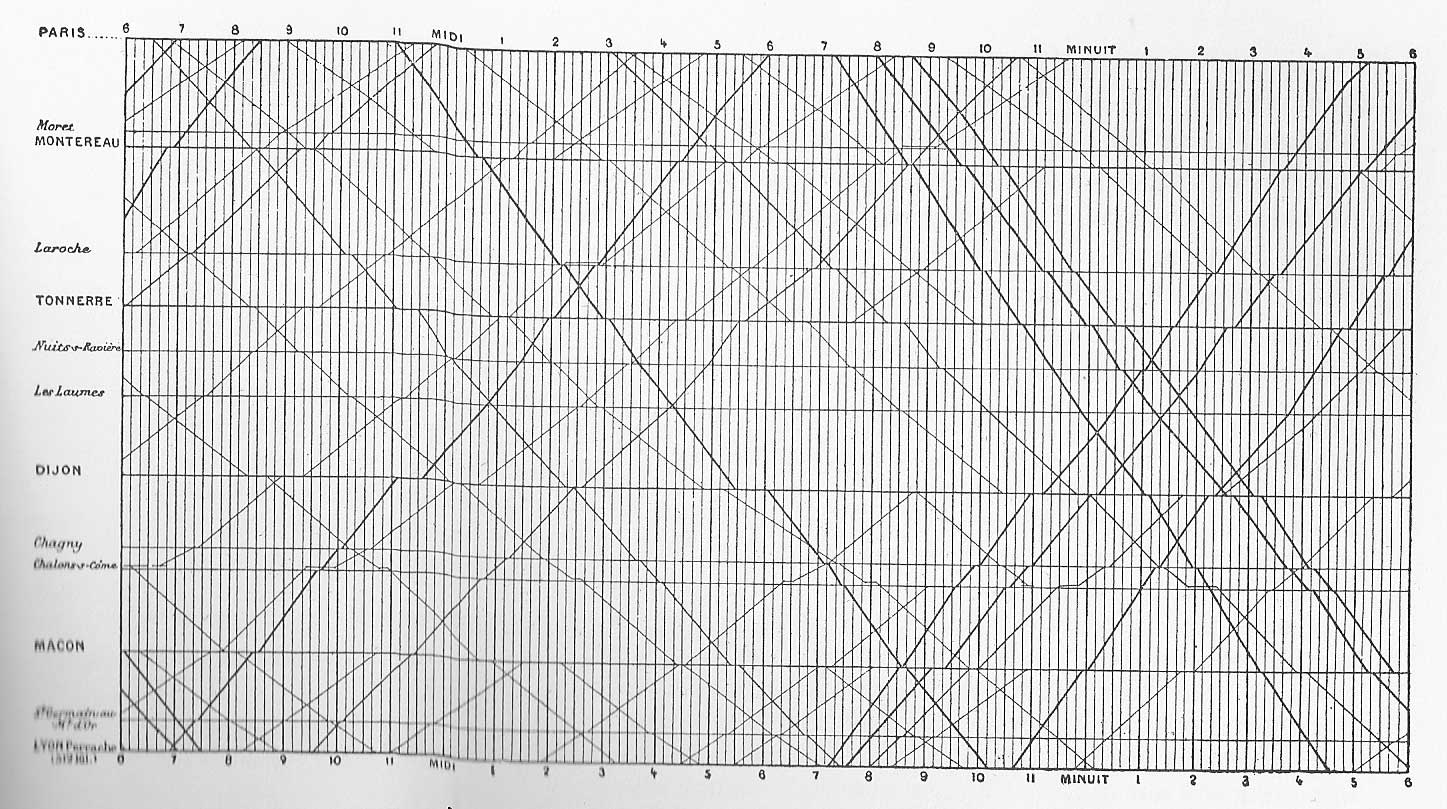
And here is a chart of Napoleon’s Moscow campaign. The thickness of the line is proportional to the number of men remaining, and the bottom line is the temperature, which tracks from right to left, as it follows the retreat:

They’re brilliant, simple, clean, and convey huge amounts of information.
Nussbaum is right when he says that this is a smart choice, although I think just emphasizes that the Administration thinks their stimulus problem is one of presentation rather than substance. Bad data can’t be fixed by good presentation, at least not honestly, and I wonder if and when Tufte will get frustrated with the lousy data he’s being asked to present. In fact, it may almost be worse if he succeeds. We’ve seen how poor the stimulus data is already, and superb presentation will only act as propaganda.
For an example of equally inventive data visualization, see here. (h/t: Powerline)
Plus ca Change…
Posted by Joshua Sharf in Stimulus, World's Fair 1939 on March 11th, 2010
From Life magazine, about the WPA pavilion at the 1939 New York World’s Fair:
Last week, as controversy continued to gather over the newly completed WPA building at the World’s Fair, the exhibit seemed destined to become the nation’s No. 1 “boondoggle.” Designed primarily to acquaint Fair visitors with the scope and efficiency of the WPA, the exhibit has thus far created the opposite impression. To build it, $250,000 was appropriated. By the time the Fair opened the pavilion was incomplete and had already cost $544,000 according to its engineers. Though characterized as a relief project, it was discovered thst on one day only 17.7% of the men engaged in building it were relief workers.
Logomania
Posted by Joshua Sharf in National Politics on February 25th, 2010
So by now, most of you have seen the new logo for the Missile Defense Agency:

Look familiar?

Which got me thinking.
Department of Energy:

State Department:

Department of Transportation:


Movies & Parliaments & CFCs, Oh My!
Posted by Joshua Sharf in Health Care, Movies, National Politics on December 24th, 2009
Boy, you don’t see that very often. TCM is usually the paragon of accuracy, but they just credited some actress named, “Celeste Holmes,” when they meant Celeste Holm. Yes, she’s been married 5 times, but not to anyone named Holmes. I’ve never seen them do anything like that before, especially with an actress who’s not only still alive, but still working.
It also turns out that, contrary to popular mythology, beagles do not like blueberries. At least one beagle doesn’t.
I’m the last person on this and several other planets to realize this, but the Internet is, quite simply, the most amazing tool ever devised by the mind of man. Thirty-fice years ago, my father took me to a movie, a cartoon. I remember exactly one thing about it: something standing on a keyboard, saying that it was going to commit suicide and “go to that big typewriter in the sky.” Now 35 years ago, when you got to the theater at 12:30 for an 11:45 showing, you walked in, sat through the last half, and then sat through the first half, eventually uttering the words, “this is where we came in,” and left. That scene, the one with the suicidal something standing on a typewriter, was where we came in. So it’s also where we left. So it’s also the only thing I remembered.
I won’t say it kept me up nights. Lots of other worries to do that. And B.I. that would have been the end of it. But I would google the phrase every once in a while, and maybe some keywords like, “typewriter movie cartoon.” Nothing. Until finally, something. Which something is available streaming on Netflix. So I watched until I got to the scene I remembered, shouted “Aha!” in joyous triumph. And then I said, “this is where I came in,” and left.
…
There’s been a lot of discussion about the un-repealable sections of the Senate’s Health Care Assimilation. Let’s be clear – there is no such thing as an un-repealable law. Parliaments can’t bind future parliaments, and Congresses can’t bind future Congresses. The Democrats are claiming that this is merely a routine alteration in Senate procedure, as opposed to Seante rules, but in either case, the courts are unlikely to intervene.
But there it is in black and white: any attempt to repeal the rationing panels will “not be in order.”
Not so fast there, Slots. When the Republicans have retaken both houses, presumably the Senate and House parliamentarians will rule that their repeal measures are out of order. The chair will so rule. Or the chair will rule the other way. One side will move to over-rule the chair. At that point, all hell will break loose, but a vote will be taken. If the Republicans try to overrule the chair, then the Dems will try to grind process to a halt to avoid a vote. If the Dems are ruled against, the chair had better be damn sure he has the votes before making the ruling.
As of 2005, the chair can be overruled by a majority vote:
Appealing Rulings of the Chair. By House tradition, the presiding officer’s rulings on points of order raised by Members are seldom appealed. As a result, the House has a relatively large and consistent body of precedents based on rulings of the chair. If the chair’s ruling is appealed, the full House decides by majority vote whether to sustain or overrule this ruling. Because this vote is viewed as a serious test of the chair’s authority, it is typically settled along party lines, with the majority sustaining the chair. In contrast to the Senate, there are only a few situations when the House’s presiding officer does not rule on points of order.
In the Senate, the presiding officer’s rulings on points of order raised by Senators are frequently appealed. The full Senate votes on whether to sustain or overrule the ruling. Under Rule XX, the presiding officer has the option of submitting any question of order to the full Senate for a majority vote decision. He is required to submit questions of order that raise constitutional issues, and those concerning the germaneness or relevancy of amendments to appropriations bills, to the full Senate. Senate votes on appealed rulings of the chair, and on points of order submitted to the full body, often turn on the political concerns of the moment rather than on established Senate practices and procedures. As a result, the Senate has a smaller and less consistent body of precedents than does the House. Yet, because the Senate usually operates informally, it is a more precedent- than rule-regulated institution.
There’s a scene in Barbara Tuchman’s, The Proud Tower, where the Speaker of the House forces a debate on the so-called, “silent quorum,” where the minority could prevent a quorum by just refusing to answer the roll. It’s transcendent political theater, with a Texas congressman whetting his knife on his boots, other representatives storming the podium, congressmen vocally denying their presence. In the end, Speaker Thomas Reed (R-Maine) had his way. If this bill passes with such a provision, I for one would feel cheated if I didn’t get to see a similar scene play out on C-SPAN.
This is why it is critical that Republicans not just wash back into office on a wave of popular anger of what the bums have done. They have to win with a mandate to roll this thing back. They have to go in having made it politically palatable to vote that way, and they have to tie Obama personally to this legislation, and keep tying him to it. The large jump in Rasmussen’s “strongly disapprove” rating for Obama was almost certainly a result of the first cloture vote. The Dems aren’t operating inside a Beltway Bubble, but in an underground steel-reinforced titanium Beltway Bunker. But if the Republicans don’t promise to undo the damage, it may well end the party within a few election cycles.
…
Now it’s the CFCs. Funny, but about 20 years ago, a friend of mine named Ron Bailey wrote a book called, Ecoscam. The one credible threat that the enviros were tossing around was CFCs and the ozone hole. We did ban CFCs, and while it’s take a while for the last of them to waft their way up to the upper atmosphere, there to interact with radiation and destroy ozone, by 2000, CFC levels had begun to decline. Along with the earth’s temperature.
I don’t know if Prof. Lu is correct. But I do know that the jokers over at CRU were making it up, and that NASA was covering for them. I’m not willing to pay Physics Reports $31 to see a paper I’m not qualified to review. But it’ll be interesting to see what the scientific reaction is. So far, it’s all been blogs and newspapers. Eventually, we’ll see whether or not the establishment has learned the right lessons from Climategate, or whether they try to pretend that this paper, along with their own malfeasance, never happened.
But At Least You Keep It If You Keep Making the Payments
Posted by Joshua Sharf in Economics, National Politics on November 25th, 2009
At least we don’t have New York’s or Connecticut’s problem. The New Jersey Nets and associated developers have apparently won the right to take someone else’s property for their own use. Yes, it has to pass through the hands of the State of New York first. But the State Supreme Court has rules that New York can declare Atlantic Yards blighted, pay off the owners at some price the state determines, and turn the land over to developers for a new arena for the New Jersey Nets, as part of a mixed-use commercial and residential development. (That prize of a franchise, by the way, has opened the season 0-153.)
Remarkably, the Court declared that this was an act of judicial restraint, arguing that it was bound by the definition of “blight,” which was completely under the control of the legislature. As with the property in Kelo, the development may not even go forward because of financing. Some parts of the project have already been delayed or canceled because of the economy. The bonds must be issued quickly in order to qualify for certain tax breaks. The article is silent on whether or not the property will be condemned and transferred before the necessary development bonds are issued.
I have no particular opinion on whether the development would be good or bad for Brooklyn. Certainly, it’s better to finance this sort of thing privately rather than publicly. The history of sports arenas and their surrounding neighborhoods is mixed, with football stadiums being about the worst, and shared basketball-hockey arenas doing the best. Coors Field helped revitalize Lodo here in Denver, and the MCI Center (now the Verizon Center) has been a boon for a truly blighted area, downtown Washington, DC.
What’s at issue here is the sanctity of personal property. Aside from the ideological obscenity of taking your property to give it to someone else for their financial benefit, there’s the overall legal and investment environment that’s created when people don’t really own property that they believe they own. That sort of uncertainty has got to limit people’s willingness to invest in their land. And of course, it almost always results in a transfer of property from the less-well-connected to favored groups.
One footnote: this is the same property that the City of New York, in the person of Robert Moses, refused to use eminent domain for in order to build a new stadium for the Dodgers.
More On That Stimulus Money
Posted by Joshua Sharf in Budget, Colorado Politics, National Politics, Stimulus on November 17th, 2009
So I thought, for just a moment, that I had figured out just how Colorado’s Congressional delegation got expanded to upwards of 64 districts. There are two parts to the report – who got the contract and where the work will actually be done. So for this contract, the work is done at Ft. Drum, NY’s CD-23. And here, there’s no Congressional District at all, I suppose. But, alas, it turns out that Colorado’s 23rd Congressional District isn’t mentioned at all on the list, so that can’t be it. It would have made sense, them confusing our Bill Owens for their Bill Owens, but no.
So looking at the list of recipients, I see where Nederland Refrigeration, Air Conditioning, and Heating Corporation received $91,595. I’m not even going to ask.
And about that $912 that the Teller County School District received, that was apparently part of a larger, $10,037 grant. The $912 was for infrastructure, but the project description mentions none of that:
No jobs were created. Funding is being used to assist current employees in obtainining credentialing and improving educational background. Employees are also being trained to communicate with two Hispanic families moving into the area.
So no jobs were created. Current employees are getting to go to enrichment programs, which I’m sure will no doubt raise their market value when they decide to move, and someday may help their young charges do better at school, but hardly counts as “stimulative.” Likewise the Rosetta Stone software they’re getting for the new families moving in. No reason at all to use the money teaching those families English, which is of far greater economic value in an English-speaking country, one would think.
Ah, the Stimulus, the gift that keeps on giving, although not quite in the way it was advertised. Go look at the lists yourself! It’s hours of good, clean fun!
Weep Not, Ben; Other Opportunities Abound
Posted by Joshua Sharf in Budget, Colorado Politics, National Politics, Stimulus on November 16th, 2009
Sadly, Rocky Mountain Alliance Blogger Ben DeGrow has declined the chance to run in Colorado’s 7th Congressional District. Maybe he’s angling for one of those jobs created in the Colorado 30th.
That’s right. At the bargain price of just of $1 million, the Federal Government has created or saved 14 jobs in CD-30. Of course, the additional 14 jobs created in CD-64 came for only $33,000. Of course, the folks down in Greenwood Village, who saw 650 jobs created, at a net loss of $111 million to that zip code, are positively steaming with jealousy. And I’m sure that the New Energy Economy will benefit from the loss of $60 million locally by the National Science Foundation. And, Teller County Schools, don’t spend all $912 in one place. Yeah, I’m talkin’ to you, Michelle.
Of course, we know this is all true, since Governor Ritter has signed a Statement of Transparency stating that he intends to ask for and spend the Stimulus money involved.
Maybe He Should Start With Freedom Here At Home
Posted by Joshua Sharf in National Politics on November 16th, 2009
According to the Wall Street Journal, President Obama in China argued in favor of Internet freedom, with arguments that should apply to all First Amendment freedoms:
Speaking to a selected group of Chinese students at the beginning of his first visit to China, Mr. Obama said that the free flow of information makes societies stronger and holds political leaders accountable. People in positions of power may bristle at criticism, he said, but open criticism “makes our democracy stronger, and it makes me a better leader because it forces me to hear opinions that I don’t want to hear.”
Mr. Obama’s words, however, likely reached few Chinese. In contrast to visits by his two predecessors, Bill Clinton and George W. Bush, Mr. Obama’s talk was not broadcast live on national television.
The Chinese typically respond to criticisms with charges of hypocrisy, and while I’m unsympathetic to them on that account, Americans might do well to pay attention to the charges this time. Consider that this President has:
- Proposed that the rest of the world adopt pre-emptive “notice and termination” rules for Internet content, and done so in a secret clause in a new international copyright treaty
- Used the bully pulpit to browbeat press critics, including Fox News, Rick Santelli, and others
- Shielded official political advisers from press scrutiny by appointing them as unvetted “czars”
- Proposed that citizens inform the White House of fishy “opinions I don’t want to hear” regarding health care
- Hinted broadly about “hitting back twice as hard” against administration critics
- Repeatedly told those critics to stop talking and that “the time for debate is over” – at the beginning of the legislative process
- Has first supported, now appears to be backing off, a UN resolution pushed by the Islamic Conference banning “blasphemy”
- Has appointed a “Diversity Czar” who openly admires Hugo Chavez’s approach to the media and wants to bring racial politics to the FCC
Administration apologists will argue that such examples only prove the President’s point – that a free press circumscribes presidential power. But even if that were his point – and I don’t think it was – it’s not as though the President has been supportive of such a press. Instead, he and his administration see it as an evil that needs to be suffered through and circumscribed, not a positive good.
As usual, universal principles are really about how they affect Obama: they make him hear opinions he doesn’t want to hear. That, of course, is only part of the value of a free press. The people have the right to petition the government, which would produce the same effect. Indeed, the open comment period that most federal bureaucracies have during their rule-making process produces the same effect, but it’s hardly the core of the First Amendment. Monarchies and autocracies throughout history have had mechanisms for wise rulers to take the temperature of their subjects and their various interest groups when forming policy.
No, freedom of speech is about letting people communicate with each other. It’s about organizing opposition and support in a pluralistic society, with a separation of powers and a federal system. It’s a key part of the process of self-government, where citizens debate each other about issues and policies and principles. And while it’s certainly a part of our elected leaders’ exercise of power, it’s much more often a check and a limitation on that power.
The President of a free people should know better.
UPDATE: Of course, I should have known better than to forget the process by which Congress has passed multi-thousand-page bills this year, in virtual secrecy, without decent public review of their content, and that in direct contravention to promised transparency. Free and open debate works best when it disseminates actual information, something that the Democratic Congressional leadership has striven mightily to prevent.
Sailing to Byzantium
Posted by Joshua Sharf in National Politics on October 30th, 2009
I’ve always been a sucker for the Byzantine Empire. I’ll write a more extensive review of the new book, Lost to the West, soon, but for the moment, I want to focus on one particular emperor, the last of the Macedonian Dynasty, and the last truly great emperor Byzantium produced, Basil II. Basil took power by overthrowing a regent who wanted the crown for himself, and by putting down rebellion by a couple of successful generals who had similar ideas. After the second rebellion, Basil met with its leader. The meeting is recorded by Michael Psellus, in his Chronographia:
After this Basil proceeded to question him, as a man accustomed to command, about his Empire, how it could be preserved free from dissension. Sclerus had an answer to this, although it was not the sort of advice one would expect from a general; in fact, it sounded more like a diabolical plot. ‘Cut down,’ he said, ‘the governors who become overproud. Let no generals on campaign have too many resources. Exhaust them [the aristocracy – ed.] with unjust exactions, to keep them busied with their own affairs. Admit no woman to the imperial councils. Be accessible to no one. Share with few your most intimate plans.’
First, let’s make the obligatory noises about how Obama’s no Byzantine Emperor. True enough. Imperial legitimacy came not from the people, but from the blade of a sword. And women’s relationship to society has – thankfully – changed somewhat since the 10th Century. But to power politics is power politics, and Sclerus’s advice boils down to this: suppress the institutions that might cause you trouble, and don’t let anyone figure out what you’re up to.
Unfortunately, I can’t remember the posting where I read it, but the author proposed that Obama runs his foreign policy through personal advisers and special envoys – often to the exclusion of the traditional military and foreign policy apparatus – to avoid sharing his overall vision with anyone else. That this doesn’t require a conspiracy, merely a clever plan by a good politician to avoid opposition to what would be unpopular ideas.
Hey, it’s happened before.
-
You are currently browsing the archives for the National Politics category.


