Archive for category PPC
PERA’s Resolute Optimism
Posted by Joshua Sharf in Colorado Politics, PERA, PPC on December 7th, 2012
PERA’s Board recently voted to retain its wildly optimistic expected rate of return of 8% over the next 30 years. The decision has the effect of reducing the unfunded liability twice – once through higher returns, and again because they mistakenly use the rate of return as the discount rate. Remarkably, PERA’s board made that decision even as pension plans all over the country are reducing their expected rates of return.
The latest is the Orange County Employees Retirement System, which called a special meeting for Thursday evening to lower its expected return from 7.75% to 7.25%. It follows CalPERS, CalSTRS, and about 40 others of the 126 public plans in the National Association of State Retirement Administrators’ Public Fund Survey.
The most direct parallel is the change made only Tuesday by the Pennsylvania Municipal Retirement System, which lowered its expected rate of return from 6% to 5.5%, starting January 1. PMRS’s returns closely track those of PERA, returning an annualized 0.5% less per year over the last 10 years than PERA:

That comes to an annualized rate of 5.3% over the last decade for PMRS, or just below their new rate of 5.5%. PERA’s barely done better, and 5.8%, but insists on retain an industry standard, and wildly unrealistic, 8% expected rate of return.
Note that PERA’s average rate of return is 6.9%, while its cumulative average return is 5.8%. Of course, you can’t spend average returns, you can only spend cumulative returns. Yet another reason for PERA to be more, rather than less, conservative.
On the other hand, it must be encouraging to see PERA’s resolute optimism at a time when so many other plans are losing heart.
PERA, Personally
Posted by Joshua Sharf in Colorado Politics, PERA, PPC on December 5th, 2012
One of the hardest things about discussing PERA’s liability is the sheer magnitude of the numbers involved. Twenty-five billion used to sound like a lot, until we started throwing around trillions. Forty billion, likely closer to the real number, sounds like it might be more, but it’s almost impossible to gauge how much more.
The chart below tries to show how PERA’s unfunded liability has grown in terms of our ability to pay it off. In 2000, PERA was nominally overfunded, meaning that all of its long-term liabilities were accounted for, and then some. In reality, this almost certainly wasn’t the case, but for the purposes of this post, we’ll just use PERA’s own current-dollar estimates of its unfunded liability.
Using BEA numbers for Colorado’s GDP, its total Personal Incomes, and its population, it’s a little easier to see the threatening direction this debt is taking. On a per-person basis, the unfunded liability now sits at just over $4000. That means that, to pay off the unfunded liability, it’s $4000 out of the earnings of the average Coloradoan. This includes those who are too old and too young to work, so for the average worker, the number is much higher. Four thousand dollars may not sound like a lot, but of course, it’s going to get worse – likely, much worse – before it starts to get better.
As a percentage of the state GDP and Personal Income, things are even more discouraging. PERA’s liability amounts to 8.15% of Colorado’s GDP, and nearly 10% of the total Personal Income. But this isn’t the only debt that the state, local, and district governments owe on your behalf, and it’s likely not the only debt you owe, either.
From 2004 to 2007, the ratios appeared to improve, but if you look closely, you’ll see that during a period of strong growth, the per-person dollar liability was flat, and the per-GDP and per-PI percentages barely moved. This strongly suggests that this is a liability that it’s going to be very hard to grow out of.
PERA will be quick to point out that you’re not going to be expected to cough up all of this money at once, and that they have a long-term, 30-year glide path to solvency. Any time any government program says it has a 30-year plan for solvency, you should stop listening and start moving your money someplace else. As we’ve noted before, PERA is significantly understating the size of the unfunded liability, both by overstating the rate of return and by misusing the discount rate. Moreover, mentally amortizing the liability over 30 years makes it that much easier to ignore until someone misses a payment, and the whole structure comes crashing down. I’m sure that San Bernadino and Stockton were using similarly comforting thoughts before they filed for Chapter 13.

Bennet to Head DSCC
Posted by Joshua Sharf in Colorado Politics, National Politics, PPC on December 4th, 2012
Word is that Sen. Michael Bennet will accept the position as the head of the Democratic Senatorial Campaign Committee (DSCC), reuniting there with his old chief of staff, Guy Cecil, who’s now the DSCC’s Executive Director. It’s tempting to conclude that the appointment is largely on the strength of the unexpectedly strong Democrat showing in this year’s Senate elections.
Cecil was credited with having created “the largest gender gap in the country,” here in Colorado, in 2010’s Senate elections. That gap helped ease Bennet over the finish line against Ken Buck, and was predicated on painting Buck as extreme on women’s reproductive issues, and then waiting for him to do something to justify the claim. Cecil never made any secret of the fact that his plan was to reproduce that strategy nationally in 2012, pointing to it in interviews back in early 2012 and at the DNC in September. Bennet himself claimed it would be the Democrats’ path to victory at a speech to the Colorado delegation at the DNC. It certainly appears to have been key to Democrats’ Senate victories on Election Day.
That said, this could end up being a trap for Cecil.
First, while Obama won Colorado this year, he did so without any noticeable gender gap. If anything, it appears that he won men here by 3 points, while tying Romney among women – a reverse gender gap. This was achieved in part by aggressive push-back from conservative women’s groups like My Purse Politics and the Colorado Women’s Alliance. It suggests that perhaps this is a difficult strategy to repeat. There are states that will have 2014 Senate elections that didn’t in 2012, but since this strategy was also adopted by the President’s re-election campaign, voters in those states will already have been exposed to it. The lack of first-time shock value, combined with a determined opposition message, could limit its success in 2014.
Perhaps as important, the 6th year of a 2-term presidency is historically terrible for the party controlling the White House. In 1958, the Democrats picked up an astonishing 16 seats, going from a 49-47 majority to a 65-35 lead, with the addition of Alaska and Hawaii to the union. In 1986, the Republicans lost the Senate, which they had held since the 1980 election of Ronald Reagan. In 2006, the Democrats picked up a net 6 seats (including two independents that caucused with them) to gain control. While the 1986 results could be seen as a regression to the middle for Republicans, with many marginal 1980 pickups reverting to form, the 2006 elections don’t confirm that as a pattern; the Democrats picked up 4 seats in 2000.
Both 1974 and 1998’s numbers were distorted as a result of impeachments; in 1974, the Democrats went from 56 to 60 seats, and in 1998 it was a wash, with no net gain for the Republicans. These results should serve as a reminder that impeachment is a political process much more than a legal one.
Demagoguing PERA
Posted by Joshua Sharf in Colorado Politics, PERA, PPC on December 3rd, 2012
Just in case anyone thought that the incoming Democrat majority in the Colorado legislature was planning to take a responsible approach to Colorado’s continuing PERA debacle – it has not yet reached the crisis stage – Speaker-to-be Mark Ferrandino has laid those fears to rest. Morningstar has published a report reiterating what anyone with any sense already knew, that PERA is not “fiscally sound,” with a funded ratio of 58%. PERA complains that that only accounts for the state division, and that including other divisions raises the fundedness to 60%. This is the equivalent of a terrible student trying to argue his grade up from an F- to an F.
Ferrandino, instead of understanding that promises are being made that simply cannot be kept, demagogues the issue, claiming that, “There are some who would like to use the economic downturn to take away people’s pensions.” I suppose it’s progress of a sort that he acknowledges that we’re still in an economic downturn, but where on God’s green earth does he think the money comes from to pay those pensions, if not from the retirement savings of the rest of the people in the state? Where is the fairness in using the force of law to place the pension of a 30-year-old government worker ahead of the average Coloradoan’s ability to provide for himself and his family?
Don’t expect much help from the Senate, either, where incoming Senate President John Morse has hired SEIU flack Kjersten Forseth to be his chief of staff.
As California collapses, Colorado has a golden opportunity to pick up businesses looking for more healthy homes. In 2010-11, the Denver metro area had the 7th-highest rate of in-migration from other parts of the country. Unfortunately, the state’s Democrats seem bound and determined to import not California’s prosperity, but its pauperizing policies instead.
The Higher Ed Bubble as a Cultural Opportunity
Posted by Joshua Sharf in Education, PPC on December 2nd, 2012
Welcome, Instapundit readers! And welcome, Transterrestials!
Over the last few years, talk of a Higher Education Bubble has grown. As the costs have skyrocketed and returns have dropped, both students and employers are increasingly questioning the value of what’s being taught.

Higher ed, as currently packaged, marketed, and sold, is increasingly being valued on the basis of past performance rather than underlying value, which is pretty much the investment definition of a bubble.
While some established colleges and universities are moving towards online offerings, Stuart Butler argues convincingly in the current National Affairs that the more likely development is new schools using new technology and models to provide a different, more relevant mix of skills:
In truth, a takeover scenario is less likely than an end run — in which new technological developments, and new educational institutions with very different business models, circumvent higher education’s established players. Today, competitors are exploring markets that are ill-served by the traditional model, such as working Americans who want to enhance their skills and lower-income potential students looking for much cheaper degrees. Meanwhile, rapid change in information technology is giving creative new entrants a growing technological edge — an essential precondition for transformative change.
The most obvious technological threat to the comfortable world of higher education is online education. Online learning changes the entire relationship between student and teacher; it enables information to be transferred, and student performance to be monitored, at a fraction of conventional costs. Often called “distance learning,” online education has the potential to completely upend today’s established universities.
Following the election, PJ Media made the case that restoring American values ultimately rests on cultural, rather than political solutions. This coming shakeup presents the perfect opportunity for conservatives to retake the liberal arts classroom, without the overhead of faculty battles, “going undercover,” or otherwise remaking the culture of a hostile academy. The model is much the same as when the right, beginning with Heritage, created a parallel system of think tanks to get conservative or free-market thought into the hands of policy-makers. Cultural conservatives and classical liberals can give themselves back the voice they’ve lost in undergraduate education, while beginning to undo the massive damage the Academic Left has done to students and the culture as a whole.
Jacques Barzun, who passed away recently, published a collection of essays in the late 80s, The Culture We Deserve. He discusses the baleful effects of handing over our culture to college liberal arts departments. The proper repository of culture is the people, and it is the proper job of education to transmit that culture from generation to generation. Instead, universities, beginning in the late 1800s, began to teach scholarship instead. Rather than experiencing the cultural canon, students were taught to analyze it in increasingly narrow and politicized terms. The purpose of “Hamlet” isn’t to serve as a template for the study of patriarchal roles in Tudor England, it’s to teach about the failure of thought as a substitute for action.
The liberal arts ought all to be pulling in the same direction to teach a common cultural literacy, understanding of each enhancing appreciation for the others. Barzun understands that historical knowledge is necessary to know the mindset of the artist. But chasing after the respectability of science, college history departments have increasingly forsaken broad historical themes for narrow, isolated problems, what he terms, “retrospective sociology.” Victor Davis Hanson observed the same thing, in the difference between how his Fresno State students read Thucydides, and how it was taught at Stanford:
Scholars and graduate students talk grandly of Thucydides ”the realist” whose bleak assessment of human nature was a valuable antithesis to romanticism. But this remote, literary language takes us far from the actual Thucydides, a hard-eyed pragmatist whose judgments derive from first-hand experience. As a working mother at Fresno put it, ”Thucydides might like Carter better, but he’d want Reagan dealing with the Russians.” Another student, an immigrant, agreed: ”Be trusting with someone else’s life — not mine.”
Liberal arts departments also began to teach more and more contemporary art and literature. So it’s no wonder that the culture has stagnated as it is deprived of the chance to be experienced on its own terms before being subjected to analysis. New art and literature has evolved to please critics and provide scholars layers of meaning, rather than to please audiences and ruminate on life. This line of thinking would lead Barzun to write From Dawn to Decadence, arguing that western culture had reached an impasse.
Though Barzun didn’t say so, this situation is tailor-made for the Left. With contemporary culture stagnating, and cultural literacy reduced to analysis, leftist political philosophy fills the vacuum. Allan Bloom decried this development in The Closing of the American Mind. It’s also true that the success of companies such as The Teaching Company show that working Americans know that they’ve missed out, and thirst for something to fill that gap. If for themselves, why not for their kids?
The opportunity for conservatives, with the creation of new institutions, is clear. Our view of how the liberal arts ought to work is the traditional view – as a set of studies to enhance and understand the human condition. We are aided by the fact that the reasoning and writing skills necessary for their mastery are in demand in the world.
While the shakeup provides an opportunity for conservatives, we shouldn’t overestimate the window available. Many of the most successful of the big-money, high-wealth donors to the Democrats have been Internet entrepreneurs. Many of those fortunes have been made in social media, and education, at its best, is an intensely social activity. First movers will be able help shape both expectations and will have a leg up on defining credentialing and certification standards.
Barzun closed From Dawn to Decadence with the hope that we could replace or reinvigorate the university, and revive our cultural creativity. With the right effort, conservatives could use the coming shakeup of higher education to do both.
Your New Finance Committee Chairman
Posted by Joshua Sharf in Colorado Politics, Finance, PPC on November 28th, 2012
With the Democrats retaking the State House of Representatives, the time has come for them to name new committees, and new committee chairmen and vice chairmen. Most of the designees make sense, at least from an expertise point of view. While I may disagree vehemently with Max Tyler on energy issues, his district includes NREL, and he’s made a point of being vocal on things like wind and solar subsidies.
However, I draw the line at the appointment of Lois Court, my own State Representative, to be the Chairman of the House Finance Committee. Court has spent most of her time agitating for the elimination of the Electoral College, opposing Voter ID, and trying to limit citizens’ petition rights. So State, Veterans, and Military Affairs, where she’s served for four years as a member, would seem to be a natural fit for her interests. (Full disclosure: I ran against Mrs. Court in 2008 and 2010 for the House seat.)
Instead, incoming Speaker Mark Ferrandino appointed a state rep whose main contribution to finance discussions has been to sue her own constituents, to seek the repeal of the Taxpayers’ Bill of Rights. She has historically found its spending and taxation limits to be antithetical to the idea of representative government. (Most of us see her opposition as a threat to the state’s solvency.) With the governor’s TBD Initiative coming up this year, it may signal an intention on the part of the Dems to wage war on TABOR more openly.
And then, there’s Representative Court’s fluency with arithmetic:
and
Hint: Carry the two. Three hundred twenty-five.
Ladies and Gentlemen, your new Finance Committee Chairman. The state’s in the very best of hands.
COPs, Cash Flows, and Taxes
Posted by Joshua Sharf in Colorado Politics, Finance, PPC, Taxes on November 28th, 2012
We’ve pointed out some of the abuses of Certificates of Participation by the Denver and Jefferson County School Districts. However, there are times when COPs are good. One good use of COPs is as a cash management tool. Municipal bonds are usually non-taxable, which means their yields are lower than Treasuries of an equal term, especially in longer-terms, say, 10 years and over. Since a municipality doesn’t pay income tax, it can lend at the higher Treasury rate, while borrowing at the lower municipal rate, assuming that its credit rating is good. (I don’t care if Illinois has 30 years of gold stashed away, I’m not lending them a dollar for a hamburger to tide them over until next Tuesday.) The municipality can make a little reliable money on the arbitrage.
In essence, this is a tax-shift. The Treasury isn’t collecting income taxes that bond holders would normally pay, so that tax money is, in effect, shifted to the municipality. It’s the reason that Treasury yields are higher in the first place.
Over the last couple of years, though, this hasn’t really been possible. Municipal rates have stayed pretty steady, while long-term Treasuries have dropped precipitously as a result of all the various Quantitative Easings by the Fed. This has deprived municipalities of a source of cash. So while the stimulus was essentially a massive shift of debt from the states and municipalities to the Federal government, the feds are taking it back, inch by inch, by taking away this tax shift that had been available to the lower levels of government.
I don’t think it’s coincidence that one of the tax loopholes being mentioned for closure is the municipal bond interest. The feds would like to make this tax shift permanent by pushing up municipal yields above Treasuries. Most of the focus has been on the fact that this would make borrowing more difficult and expensive for municipalities. But it would also close off this tax shift as well. Both these facts will have the effect of making states and municipalities more dependent on federal funds.
Certificates of Prevarication – Part II
Posted by Joshua Sharf in Budget, Colorado Politics, Denver, PERA, PPC on November 27th, 2012
Yesterday, I wrote about the Jefferson County School District’s use of Certificates of Participation to get around the State Constitution’s requirement for a public vote before issuing general obligation debt. I had forgotten that once upon a time, Denver Public Schools did almost exactly the same thing.
The scheme – used widely around the state, and even by the state, is for the district to set up a corporation and then lease its own property back from the corporation, with the lease payments matching bond payment due on debt floated by the corporation in the public debt markets. The debt isn’t exactly unsecured – the school buildings themselves serve as collateral. But there’s no separate revenue stream dedicated to the lease payments, which come instead out of general fund revenue, the very definition of general obligation indebtedness that the constitution seeks to limit.
In 2008, Denver Schools issued$750 million worth of both fixed- and floating-rate COPs, in order to recapitalize its own pension program, which had a $400 million funding gap. This was necessary for PERA to agree to absorb the DPS retirement system. While the ins and outs of the deal are beyond the scope of this post, suffice it to say that by 2010 the deal had become a key element in the Democratic US Senate primary between Andrew Romanoff and Michael Bennet, who had been Denver Schools Superintendent at the time of the COPs.
Our concern here isn’t whether or the the deal was well-structured on its own terms. It may well have been, and has, at any rate, since been refinanced on terms more favorable to the District. The point here is that Denver Public Schools, in order to facilitate turning over the unfunded portion of its own pension plan to the rest of the state, issued what is general obligation debt in all but name in order to cover a shortfall. That debt, issued without public approval, now accounts for 37.6%, or 3/8, of the school district’s entire long-term debt.
In the meantime, the burden of DPS’s unfunded pension liability has been neatly shifted onto the rest of the state. DPS may be required to step in with additional payments if an actuarial analysis shows that, in 30 years, the plan will be less sound than the rest of PERA. As of the 2011 CAFR, the plan’s fundedness had fallen from 88% to 81%, still the least-unhealthy PERA division by far. And the process of renegotiating what is likely to be, as with most public pensions, an unsustainable burden on the taxpayers, got much more complex with the addition of the state and PERA as explicit parties to the contract.
Jefferson County Schools Propose Retirement Plan Default
Posted by Joshua Sharf in Colorado Politics, PERA, PPC on November 25th, 2012
Welcome, Instapundit readers! While you’re here, take a look at posts on Certificates of Participation. Perhaps your state has something similar…
On Thursday, November 8, the Jefferson County School Board voted to ask teachers participating in its Supplemental Retirement Program to take a buyout for what would amount to about 64 cents on the dollar.
By following other public pension systems into what amounts to a default – albeit partial – JeffCo Public Schools join the parade of cautionary tales for those relying on the promises of public programs like PERA. As Glenn Reynolds of Instapundit is fond of reminding us, promises that cannot be kept, won’t.
History of the Plan
Quoting from a 2009 RFP for a plan financial advisor (emphasis added):
The Supplemental Retirement Plan was created in 1999 for employees who worked in full-time or job-share positions which were covered by an association. It was designed to replace a bonus-type program for retirees who met age and service requirements, with a tax-advantaged vehicle. Benefits are intended to supplement, not replace, PERA retirement benefits. Participation in the plan was immediately frozen upon its creation.
The District had originally committed to fund $90 million dollars toward a combination of pension plan benefits and sick and personal leave payouts at a rate of $9,000,000 per year for 10 years. However, budget cuts reduced the annual plan contributions and stretched out the plan’s original funding timetable. The plan has been underfunded since its creation. In 2007, the District purchased certificates of participation and deposited the funds into the plan for the purpose of meeting its stated funding obligations and has now exceeded its original funding commitment. Further contributions to the plan are not likely to be made. Subsequently, existing retirees and employees who met the full vesting requirements of 20 years of eligible service and age 55 were offered a one-time ability to have their benefits satisfied with a lump-sum payout at the plan’s stated discount rate. As a result, participant count, liabilities and assets have decreased in the plan and the overall funded status of the plan has improved. It is anticipated that at some point the plan will need to declare actuarial necessity and terminate or reduce plan benefits for non-vested participants. After the lump-sum payouts, the plan amended its investment policy to be more conservative, in an effort to protect the funding of benefits for existing retirees and vested participants.
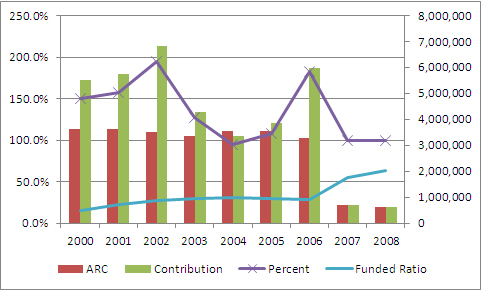
The plan wasn’t underfunded for lack of district contributions. According to the latest available plan financials, also from 2009, the district met or exceeded its annual contribution every year until 2009, with the exception of a slight shortfall in 2004. The combination of payouts and lower-than-necessary returns kept the plan funding under 32%, until the 2006 issuance of $37 million of Certificates of Participation (more about that in a coming post) reduced the outstanding obligations starting in 2007.
As of the 2009 report, the plan had $20.8 million in obligations, $7.4 million of which were unfunded.
Issues with Transparency
There appear to be a number of significant transparency issues with the way the plan has been handled.
The November 8 meeting itself raises issues of transparency and obligations of full disclosure to the public. The meeting discussion was held in a 45-minute executive session. Executive session is supposed to be reserved for legal advice, not for general discussion of motions before the Board. It is unthinkable that the Board received a 45-minute legal briefing, after which it proceeded directly to a vote.
Moreover, at least the topic of an executive session is required by law to be posted in advance of the meeting. Here’s the notice that was posted outside the Board’s meeting room the evening of November 8:
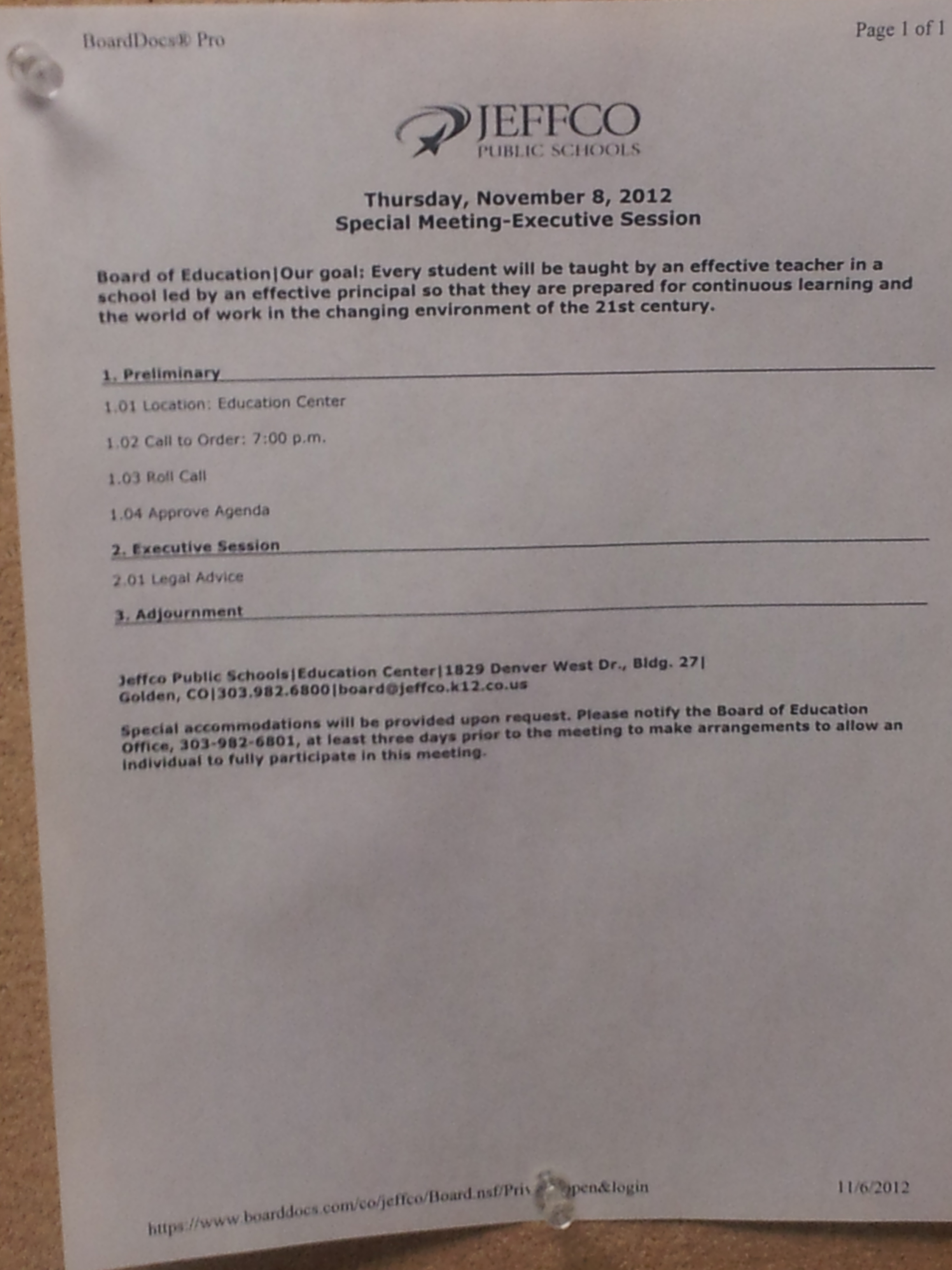
There is, evidently, case law to suggest that the recording of the Executive Session should therefore be made public, since the session – although not the vote – were conducted in violation of statute.
The most recent financials available online date from 2009, three years ago. Even in the absence of significant financial changes, plan financials from the most recent year should always be available.
Also note that the teachers were offered a buyout in 2006 – which the smart money, including current Superintendent Cindy Stevenson took – the 2009 statement RFP for a plan financial advisor all but admits that the plan will terminate and default on the remaining obligations at some point. Whether or not this likelihood was made clear to the teachers who chose to remain with the plan in 2006 is unclear. What it clear is that Stevenson, and possibly current Board member Jill Fellman, were made whole during the 2006 buyout offer, while other teachers were not.
UPDATE: According to the FY2011 Comprehensive Annual Financial Report, in 2011, the Board decided to terminate benefits for anyone who hadn’t reached the thresholds of age 50, and 20 years of service as of the end of the 2011 plan year, 8/31/2011. “The plan is still operational for active and deferred vested participants and beneficiaries in receipt of payment.” It is those members who will be asked to take a cut in their benefits. The district has also “determined that additional contributions for the foreseeable future would not be made to the Plan.” (Note 16, P. 72)
The funded ratio has fallen to 50.6%, and the unfunded liability as of August 31, 2010 is $8.8 million.
Correction: No vote was actually taken at the November meeting. (I left early because of the descent into executive session.) It is likely that there will be a vote at the December or January meeting. Stay Tuned.
Thanksgiving 2012
Posted by Joshua Sharf in History, PPC on November 22nd, 2012
Susie and I went to New England for a couple of weeks this summer. It’s a part of the country I had never really been to before, which meant that I probably tried to cram too much into the two weeks. Hey, you never know when you’re going to be back – maybe never. So what’s the point of driving from Cape Cod to Bah Hahbah, and not making a brief pit stop at Plymouth?
I grew up in Virginia, the son and grandson of Tidewaterites, so I got to see the Virginia pole of the colonial experience pretty extensively. Jamestown, Williamsburg, and Yorktown are all within a quick drive of each other, and we took advantage. But I had never been to the Massachusetts pole of the Axis of Colonial America, Plymouth. (Boston is sui generis, and could be the subject of a whole trip all by itself.)
You know the story. The Pilgrims land here in 1620…

…things don’t go so well for them, so the Indians step in, help out with food and local know-how, and everyone celebrates together.
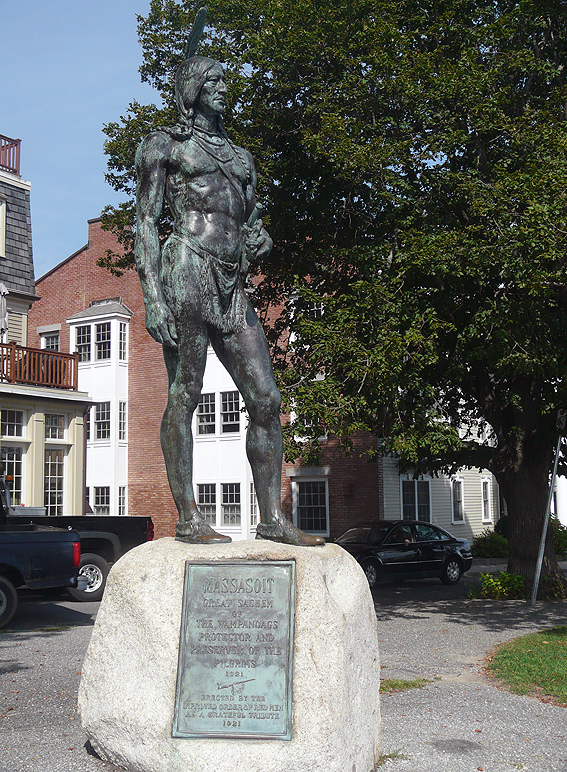
A few yards from Massasoit is this rather sour marker:
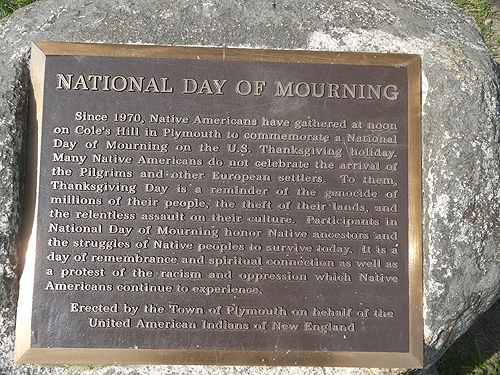
Hey, it’s a free country. This group of Indians want to come to Plymouth and mourn the fact that they ended up dealing with the English rather than the Spanish, I guess that’s their right, but it’s shame that the 1998 settlement had the city of Plymouth put up a plaque celebrating that.
This is where it started, the northern part at least, and it’s wrong that the city where it all started is coerced into turning the holiday into another excuse for an apology for success and constitutional government.
Even then, it’s only half the story. It turns out that while the Indians did make the difference that first couple of years, the colony was really failing because it was a socialist experiment. Once the colonists figured out that people work harder when they work for themselves, things really took off:
It’s wrong to say that America was founded by capitalists. In fact, America was founded by socialists who had the humility to learn from their initial mistakes and embrace freedom. One of the earliest and arguably most historically significant North American colonies was Plymouth Colony, founded in 1620 in what is now known as Plymouth, Massachusetts. As I’ve outlined in greater detail here before (Lessons From a Capitalist Thanksgiving), the original colony had written into its charter a system of communal property and labor. As William Bradford recorded in his Of Plymouth Plantation, a people who had formerly been known for their virtue and hard work became lazy and unproductive. Resources were squandered, vegetables were allowed to rot on the ground and mass starvation was the result. And where there is starvation, there is plague. After 2 1/2 years, the leaders of the colony decided to abandon their socialist mandate and create a system which honored private property. The colony survived and thrived and the abundance which resulted was what was celebrated at that iconic Thanksgiving feast.
Perhaps not surprisingly, I really had no idea about this part of the story until I read about it in the Wall Street Journal about 10-15 years ago. The story I heard was the one that essentially leads to the conclusions at top: the Indians saved the day, and other than the nice meal, have been regretting it ever since. The whole part about the communitarian experiment gone wrong – is there any kind that goes right? – somehow slipped everyone’s mind. It’s right there in Bradford’s journals, as Bowyer point out. Instead, we spent a couple of months rehearsing the class play, an adaptation of Witch of Blackbird Pond.
This is a shame not just because it passes up a chance to teach an obvious lesson about economics and human nature. It also misses a chance to point out the roots of our Constitution. (Honestly, everything before 1787 should be taught as a lead-up to the Constitution. There’s a reason they wrote what they did; it didn’t just come out of nowhere.) The colonies really were different in outlook. New York was founded as a commercial colony. Massachusetts wasn’t and the Puritan ethic echoes still. Federalism wasn’t just a matter of keeping the federal government in check, it was also a way of respecting different outlooks on life.
I’m not such a big fan of politicizing our national holidays. The point of them is that their national, not partisan or political. They’re supposed to be things that we all celebrate or commemorate together. (We’ll talk about Christmas some other time.)
So let’s remember and be thankful that, for the fact that, even with all the unfortunate changes over the last few years, we’re still living in the only country founded on an idea, and hope that over time, we can find our way back to it.
-
You are currently browsing the archives for the PPC category.


