Archive for category PPC
Ethanol and Natural Gas
Posted by Joshua Sharf in Business, Economics, Energy, PPC, Regulation on March 30th, 2011
UPDATE: And as if on cue, this morning, JJG, Barclays ETF on grains, is up almost 5% this morning. This is not just a generalized inflation play (meaning this isn’t just about the Fed printing dollars), since GLD and TBT (the bearish bet on the 10-year Treasury) are up, but only about 1%.
Much has been said about the contradictions between the energy policy that President Obama announced today, and how his government has behaved up until this point. But even taken on its own terms, today’s ethanol-and-natural-gas announcement contains enough internal contradictions to make it fall over like a basketball player with his shoes tied together.
The key point here is that ethanol already depends heavily on natural gas. Twice. Directly, as an ingredient in its production. But ethanol is made from corn, and corn – especially when planted in the same fields, year after year – requires a lot of fertilizer. And the key component in ammonia-based fertilizers like anhydrous ammonia, urea, and ammonium nitrate in nitrogen. From natural gas.
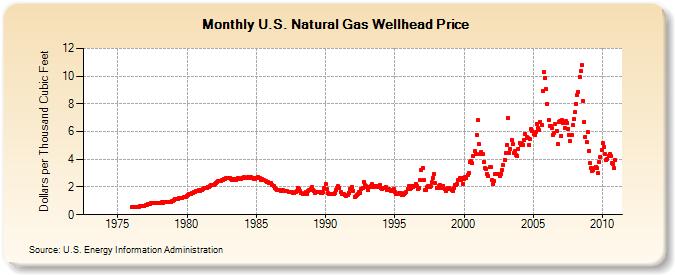
When I worked at the brokerage, one of the companies we covered was a fertilizer company (since bought out), based in the heart of the corn belt. We considered it an ethanol play, with the company remaining profitable as long as corn plantings increased and natural gas didn’t get too expensive. Again. Here’s the chart for the wellhead price of US natural gas:
In 2007, during the last burst, corn planting came at the expense of soybeans, which returns nitrogen to the soil. This meant a large increase in the amount of fertilizer necessary. For the last few years, soybean planting has returned to its long-term trendline, and increased corn production appears to have occurred at the expense of winter wheat, which uses a comparable amount of fertilizer:

Up until now, that’s meant that increased corn plantings, inadequate though they may be, haven’t in and of themselves driven up the price of natural gas. This year, however, soybean plantings may be down, as corn nears its postwar high, meaning additional natural gas demand.
All of this is happening even without Obama’s intervention to commandeer even more of our food for fuel. We already push 1/3 (yes, one third) of our corn harvest into ethanol plants rather than kitchen tables, which amounts to about 8% of the world supply of corn. Any additional ethanol subsidies will only make things worse.
Moreover, Obama’s plan does absolutely nothing to increase natural gas production. To do that, he seems satisfied to ride herd on oil and gas companies that already have more than enough incentive to increase production, if only our government would let them. (Sadly, Colorado, between Ken Salazar and Diana DeGette, is playing a disproportionate role in enforcing that dictate.) He does, however, propose all sorts of subsidies to encourage increased natural gas consumption, promising to drive the price up even farther.
To circle back to my original point, this is going to make ethanol unprofitable even with subsidies. Just for fun, I went back and looked at the gross profit margin for Green Plains (GPRE), a major ethanol producer, and compared it to the natural gas price six months earlier, for the last 8 quarters:

The correlation is an astounding -0.96, which is about as close to metaphysical certainty as you get in statistical analysis. Those who know something about statistics will say that the outlier increases the correlation, and they would be right. If we get rid of the outlier, the correlation is still -0.84, and the slope of the line only changes slightly. If the other points, the ones below 6.00 on the price scale, were clustered together, that would be a problem. But they lie on a nice line of their own.
Using a very rough model, using the company projections for unit sales over the next year, assuming that interest rates don’t rise and the company doesn’t take on any additional debt, the wellhead price of NG would have to rise to 6.8 to eliminate the company’s pre-tax earnings completely for the next year. That’s happened twice over last decade, and this administration’s policies will only make it more likely. Let that happen, or interest rates rise, or both, and see how fast Green Plains decides that it really does need those subsidies – and more – after all.
To the extent that ethanol production can increase, it will help drive up natural gas prices. To the extent that it can’t, its price will rise, and it will need compete for ever-more-scarce natural gas.
Even if ethanol weren’t already a colossal waste of money and resources, this plan couldn’t be designed any better to make things worse.
In this at least, Obama’s being consistent with the rest of his economic policies.
Ethanol Changes Tactics
Posted by Joshua Sharf in Economics, Energy, PPC on March 27th, 2011
The ethanol industry is changing tactics to keep those universally unpopular subsidies coming.
Today’s ethanol industry can prosper without government incentives, the founder of Green Plains Renewable Energy Inc. said Thursday.
Ethanol has become an integral part of the country’s energy picture, in demand not only from motorists but also from oil refiners who use it to boost the octane of the gasoline they produce, said Todd Becker, president and CEO of Omaha-based Green Plains.
The economics of the fuel industry, combined with new production technology, make ethanol 40 cents a gallon cheaper than gasoline, on average, Becker said. That gives ethanol producers like Green Plains a cost advantage that will outlast the government’s 45 cents-a-gallon tax credit for ethanol-blending companies.
The blenders’ tax credit eventually will end, he said, but should be followed temporarily by incentives that would increase demand for ethanol. Those incentives would encourage gas stations to install equipment to sell high-ethanol fuel and the auto industry to make and sell vehicles that use high-ethanol fuel.
If Mr. Becker thinks ethanol is profitable, then he should be able to borrow against those earnings to build the delivery infrastructure himself. If gas stations think that ethanol is profitable, they should be able to finance the dispensing equipment. If I think ethanol is profitable, I’ll lend it to them.
But if they can only make all this happen with government subsidies, then maybe it isn’t really all that profitable after all, and directing resources to it is just more of the massive misdirection of resources that has been part and parcel of trying to grow fuel rather than drill, mine, or capture it.
Bob Balink and Duncan Bremer Weigh In
Posted by Joshua Sharf in Colorado Politics, PPC, State GOP Chair on March 25th, 2011
Bob Balink, El Paso Treasurer and former El Paso County Clerk & Recorder, and Duncan Bremer, former El Paso County Commissioner, have weighed in with a precise tactical nuclear strike about what putting people like Jon Hotaling and Dudley Brown (more about him in a moment) in charge of the State Republican Party would mean, including a number of angles that, not surprisingly, I hadn’t considered.
Primaries don’t have to be divisive. The can make both the winner and loser stronger candidates, can generate interest, and can help the party define itself. But the sort of behavior that Hotaling et. al. engage in makes one wonder if there ought to be a maturity exam for graduating high school.
As for Mr. Brown, he’s also closely associated with Jon Hotaling. Well, birds of a feather.
I have my own experience with Dudley “Just Call Me ‘Zool'” Brown, one that is apparently not dissimilar from that of other candidates who didn’t return his questionnaire. With the same unerring instinct for alienating those who agree with him, Dudley decided to chime in on a completely unrelated FB thread to torpedo my own candidacy:
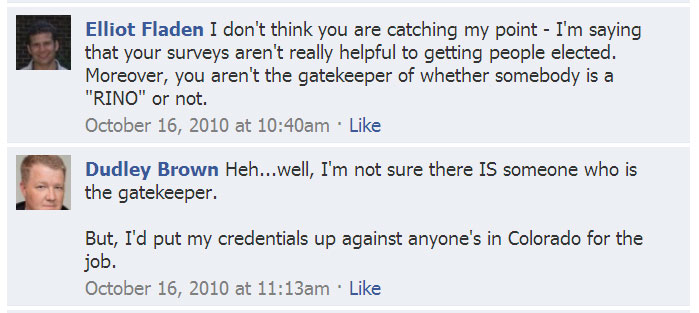
This was in the general election, fer cryin’ out loud. A number of friends – people who are actually familiar with my politics – jumped to my defense, of course, but I’m a big boy, and schoolyard taunts from people of Dudley’s stature don’t particularly bother me. But this sort of behavior – along with its entitlement mentality – transplanted to the Party HQ is going to start costing us elections.
Before we elect Ted Harvey State Chairman, it’s time for him to tell his posse to stay home.
Hotaling Letter a Fraud
Posted by Joshua Sharf in Colorado Politics, PPC, State GOP Chair on March 24th, 2011
Well, it turns out that being first isn’t always being right.
The letter sent out over Jon Hotaling’s name, using the PO Box address of the Colorado Christian Coalition in Denver turns out not to have been written by Jon Hotaling, but by someone playing an extraordinarily dirty game for relatively low stakes.
As mentioned before, the letter was received by a number of members of the State Central Committee, one of whom scanned the letter.
I suppose if you blog enough, this sort of thing is bound to happen, but that doesn’t really excuse it. Dirty politics is one thing, but this is fraudulent through and through, and it was through misfortune and over-eagerness that I got caught in it.
My apologies to Jon Hotaling directly, and to Ted Harvey, for having run with a story that was evidently calculated by someone to damage their reputations.
Since there’s no benefit to leaving a fraudulent letter posted on the net, I’ve removed the post, and posted Hotaling’s reply , and will embed it here when it’s done processing over at SlideShare.
Keep On Truckin’
Posted by Joshua Sharf in Business, Energy, PPC, Regulation, Transportation on March 21st, 2011
That was one of the less forgettable catch-phrases from the 70s, when the independent trucker seemed to embody what remained of the free spirit of America. The part, anyway, that was engaged in constructive work rather than the self-indulgent self-destructiveness that came to pass for independence during that decade.
In fact, trucking has become increasingly regulated over the years, so much so that the notion of the independent trucker, gamely staying awake to deliver his load, is a thing of the past. And with good reason. These are very large, very dangerous vehicles. They’re necessary, but they share the road with, and occasionally crush, passenger vehicles a fraction of their size and weight. As a result of making sure that drivers get a decent amount of rest, the number of fatalities involving heavy trucks, per 100 million miles traveled, was at 2.34 in 2005, down from 6.15 in 1979. More recent analyses have it falling even farther. And those same statistics show truck driver fatigue as a factor in only 1.7% of those crashes. The accident rates continue to decline.
So naturally, what we need is: more rest time!
That’s right. The government has proposed rules that will require longer rest times, fewer hours on the job, more frequent breaks. At first, this sounds like something truckers might like. Until you realize that it’s basically forced idleness, with little marginal benefit to the rest of us using the roads. Truckers hate sitting around. They have loads to deliver, and a forced 15-minute break is actually more stressful, because instead of taking the break when the need it, they’re just as likely to be sitting around watching the clock tick until they can get back on the road.
The company that I am currently contracting for, Werner Enterprises, ran a little experiment with one of their more seasoned drivers, asking him to work to the rule for a month to see what would happen. Turns out that idle trucks aren’t just the Devil’s workshop, they’re also expensive. Two-day trips stretched into three days, and his income, which is based on miles covered, dropped 6% year-over-year. Adopted nationwide, these standards would not only play havoc with the many businesses that use just-in-time inventory management, they would amount to a pay cut for the drivers they’re supposed to help. And in an industry that tends to face driver shortages in good times, anyway, it would require even more drivers, and even more trucks, with all of the overhead that implies, even before they drive their first mile.
This is not an industry that opposes regulation for opposition’s sake. They ended up supporting, for instance, the stricter rules against cell phone use. There are signs on many of the tables in the company cafeteria warning truckers against cell phone use, not on the grounds that if they get caught, they’ll lose their commercial license and have to hitchhike back home from Keokuk, but because it’s dangerous.
They object to this brilliant idea, cordoning off I-70 at certain hours, because it would greatly complicate route planning, on a fairly major truck thoroughfare. (C’mon guys, just widen the road, already.) In combination with the new rules, mandating stops where it might or might not be possible to stop, it would turn driving that stretch into a nightmare.
Colorado’s own Cory Gardner serves on the House Energy and Commerce Committee, which might be able to exercise some oversight here. (Although, so does Diana DeGette, who’s probably miffed that even after decades of trying, there are still trucks on the road at all.) Perhaps he can take a look at this.
Kibbutzim Go Private
Posted by Joshua Sharf in Economics, Israel, PPC on March 19th, 2011
Not much of a surprise, at this point, as noted by Claire Berlinski over at Ricochet:
Beit-Oren was founded as a die-hard socialist settlement in 1939. Predictably, it went bankrupt, because socialism doesn’t work. By the 1980s it had no means of subsistence, and the world’s ideological tides having turned, the larger kibbutz movement cut it off. In 1987 about half the population of the kibbutz decided to leave, an event known as the Beit Oren Incident.
In 1988, after an intense period of discussion and decision, the New Kibbutz was on its way with renewed strength and vigor, and many new members. The kibbutz’s financial situation improved, empty apartments were rented to new residents, the kitchen and dining room became an events hall, and various kibbutz enterprises recovered. In June 1995, the decision was taken to privatize services and individual income. This was to be the first in a series of privatizations. Within a short time after this decision, most kibbutz members expressed satisfaction with this arrangement.
As socialisms go, Kibbutzim were among its more humane manifestations. Unlike residents inmates of the Soviet bloc, people were free to go any time they wanted, and join the majority of Israel that was at least somewhat more capitalist. The country may have been conceived of and run by socialists, but actual kibbutzniks were always a small minority, and capitalism was a vital, if largely latent force in Israel from its beginnings.
In fact, as Sol Stern points out, Tel Aviv was a very capitalist enterprise from the beginning. And since Netanyahu, as Finance Minister, began privatizing large swatches of the economy, its entrepreneurial spirit has been given free rein.
So while it’s not surprising that Israelis are innovators when it comes to water, it’s at least a little ironic that a major Israeli venture capital firm, specializing in water projects, would be located in “Kibbutz” Lavi.
All this must be giving Haman fits.
The Long Recall
Posted by Joshua Sharf in History, PPC on March 16th, 2011
I discovered The Long Recall blog over at the American Interest site a couple of months ago, but only now am I getting around to posting on it. The folks there have decided to do a real-time, day-by-day blog of the Civil War, on its ongoing 150th Anniversary. It’s a brilliant idea, and so far, they’re pulling off what must be a great deal of unpaid work quite beautifully.
The effort seems to be led by Walter Russell Mead, and I’ll quote from his intro to the blog, but it’s worth reading the whole thing:
We will use a modern form to present the daily news: our Civil War aggregator that combines a short daily summary of the news along with links to articles that a well-informed Civil War-era reader would have wanted to read. Our goal is to allow readers today to get a feel for what it was like to experience the conflict in real time, to hear the many voices trying to make sense of the conflict, and to sift through sometimes confused and misleading news accounts to try to discern what was actually taking place.
…
The Long Recall will do its best to help 2010 readers understand the economic dimension of the conflict. At times this will involve us in something more active than simply linking to Civil War era news sources; we will provide commentary that helps the readers of today understand what yesterday’s news meant to intelligent readers of the day.
…
In The Long Recall, we will carry foreign news as it became available to American readers, not the day it actually happened. At times of crisis, as during the Trent Affair late in 1861, this uncertainty about foreign events was a major factor in American politics and policy. Because the US economy and financial markets were so dependent on London at this time, the uncertainty about foreign developments was also an important factor in the economic news….
Finally, a word on language and ‘political correctness.’ The United States has always been and remains a prudish society with strict limits about the kind of language that is allowed — and about the subjects that may be discussed. In the Civil War era, Americans were very strict about sexual matters — but when it came to race, they were extremely permissive. …words that could never be used today in polite discourse were routinely used in those days to describe different racial groups. Worse, racial humor and stereotypes were deeply embedded in the culture. Politicians and political writers frequently resorted to anecdotes and humor that would justifiably end careers today to score points with public audiences.
At The Long Recall, we have made the decision to link to Civil War era material without censoring or toning down racial language, images and ideas that modern readers (including, we must say, ourselves) find offensive. The use of such language and the prevalence of such ideas is too central to American life and culture at the time — and too vitally involved with attitudes toward the Civil War — to be edited away or softened down.
While I was born after April 1965, when the Centennial ended, I do remember this Peanuts cartoon from a book I had as a kid:
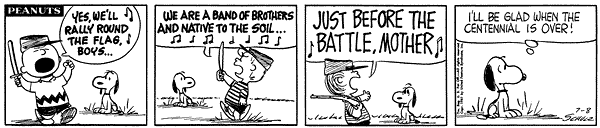
For some reason, the Sesquicentennial hasn’t attracted the same amount of publicity as the Centennial apparently did, when even kids reading comic strips could be expected to know about it, and possibly even recognize some of the songs. It’s probably a combination of a decline in cultural literacy, and a harrowing sensitivity about race. Or maybe the Civil War was just unlucky enough to have its 150th Anniversary start in a year when the Founders were hogging all the attention.
One has to admire the audacity of the authors to undertake such an effort, and the courage of their approach.
A Wind-Assisted “Win”
Posted by Joshua Sharf in Constitution, History, Labor, National Politics, PPC on March 15th, 2011
In track and field, when a runner has the wind at his back, and records he sets don’t count. Of course, in track, the win is still fair, because all the runners run under the same conditions. With the press, it’s always uphill and against the wind for Republicans and Tea Parties, downhill and wind-assisted for Democrats and unions.
In a previous post, I put up a little retrospective of some of the more troubling behavior by Wisconsin public servants, aided and abetted by college students, Organizing for America, and the DNC. I doubt whether even Mike Littwin would be able to claim this as a “win” if most of the country had seen these events as they were happening. The national media, which goes out of its way, if necessary, to make up stuff about Tea Partiers, was rigorously careful not to expose the American public to these scenes.
What are perceived as heavy-handed tactics often have a way of backfiring. (In Pennsylvania during the Constitutional ratification convention, for instance, dissenting members of the convention fled the scene to deny the convention a quorum, and two of them had to be hauled back bodily to Independence Hall to get the 2/3 necessary for business. This, along with the refusal of the press to publish speeches critical of the Constitution and the refusal of the convention’s official journal to record all the speeches, forced the Federalists to tread much more carefully in succeeding states, particularly Massachusetts, New York, and Virginia.)
But they don’t usually backfire when the targets are unsympathetic louts.
Just to pick on Mike a little, the last lines in his column suggest that the DC Democrats might find the inspiration and spine to make bold entitlement reform proposals from the events in Wisconsin. This makes no sense. In Wisconsin, the Democrats were defending the insupportable and unsustainable status quo. Failing to deal with entitlements, as the President has failed to do, would be more in keeping with that strategy.
The Denver City Council Wants Your Money
Posted by Joshua Sharf in Colorado Politics, Denver, Denver Mayor, PPC, Taxes on March 15th, 2011
Well, that shouldn’t be any surprise to anyone living in Denver over the last few years. But usually they have the decency to pretend that it’s for someone else. This time, the Denver City Council wants your money for themselves and the office some of them hope to occupy come May.
At last night’s City Council meeting, they voted themselves (10-3, the Denver Post article neglects to mention who the three were) a 6.6% pay raise, starting two years from now:
Denver is the only large city in Colorado that pays its council members a living wage — $78,173 a year, plus about $30,000 in benefits.
The raise would give the council members an annual salary of $83,332 by July 2014. The council president makes about $10,000 more.
The mayor’s salary will grow to $155,211 from its current $145,601. The salaries of both the clerk and recorder and the auditor would be $134,235, up from their current $125,924.
Right now, the seasonally unadjusted unemployment rate for Denver is 10.9%; a seasonal adjustment might bring that down to 10.4% or so. This is the highest that it’s been going all the way back to 1994, when the CDLE numbers begin.
In addition, Denver is looking at a $100,000,000 budget gap this year, slated to get worse over the next decade. To City Council chairman Chris Nevitt, this may only be “symbolic,” but it’s pretty clear what it’s symbolic of.
Ghosts of Constitutional Debates Past – Part IV
Posted by Joshua Sharf in Constitution, History, PPC on February 27th, 2011
Continuing to work my way through the Debates on the Constitution, at a languid pace, I came to this letter from James Madison to Thomas Jefferson. Jefferson was, at the time, Minister to France, so had no direct role in drafting the Constitution. Madison’s main concern in the letter is federalism, and the division of powers between the states and the national government. The letter serves as a reminder that the work of a committee, even a Constitutional Convention, is a work of compromise. In particular, these paragraphs:
It was generally agreed that the objects of the Union could not be secured by any system founded on the principle of a confederation of sovereign States. A voluntary of the federal law by all members, could never be hoped for. A compulsive one could evidently never be reduced to practice, and if it could, involved equal calamities to the innocent & the guilty, the necessity of a military force both obnoxious & dangerous, and in general, a scene resembling much more civil war, than the administration of a regular Government.
Hence was embraced the alternative of a Government which instead of operating, on the States, should operate without their intervention on the individuals composing them: and hence the change in principle and proportion of representation. (Emphasis added.)
This is critical, because it means that while the states would have a say in the federal government, in the form of the Senate and the Electoral College, the federal government would have no say in the selection of state officers, nor a direct veto on state legislation. (Both of these options were considered.) It also, I think, affects our reading of the Tenth Amendment, adding weight to the notion that individuals have standing to challenge federal attempts to overstep their bounds.
Right now, the Supreme Court is considering such a case:
Surveillance cameras captured Ms. Bond stealing an envelope from Ms. Haynes’s mailbox and stuffing potassium dichromate in her car’s muffler. That led to federal charges of stealing mail—and violating criminal statutes implementing the international Chemical Weapons Convention, which the U.S. ratified in 1997. Ms. Bond, who in 2007 was sentenced to six years imprisonment, appealed on grounds that Congress lacked authority to punish her for the chemical assaults.
In Philadelphia, the Third U.S. Circuit Court of Appeals denied Ms. Bond the right to raise that claim, ruling that only state officials had legal standing to assert a 10th Amendment violation of their authority. When Ms. Bond appealed to the Supreme Court, the Justice Department abandoned the Third Circuit’s decision, conceding individual defendants were entitled to argue that they were charged under laws exceeding congressional power.
For the record, keep your eye on another moving part here: whether treaties are permitted to override Constitutional protections. This could mean that even if the US were to sign a small arms treaty of some kind, provisions that violate our understanding of the 2nd Amendment might not apply here in the US. This isn’t to imply that signing or ratifying such a treaty would be a good idea, or that the Court would agree with me, just that the Court’s decision on this case might signal its current thought on the matter.
-
You are currently browsing the archives for the PPC category.


