Archive for category PPC
A Transfer on the Road to Serfdom
Posted by Joshua Sharf in Business, Economics, PPC on August 3rd, 2011
As an emblem of what Walter Russell Mead calls, “the Blue Social Model,” there’s almost no place Bluer than New York. So it seems fitting to pay homage to the home of the modern patronage state in a post devoted to transfer payments.
We all know that transfer payments – Welfare, Social Security, Medicare, Medicaid, Unemployment Benefits – have been growing at an unsustainable pace, and are the source of our long-term structural problems. We’re also aware that once a program acquires a sufficient constituency, it’s almost impossible to reduce, let alone do away with. Thus the concern when the top few percent of earners pay 40% of all income tax, and when half the country pays no income tax at all.
This dramatic Calculated Risk post about recession measures has gotten a number of people’s attention, but what struck me was the qualifier on the Personal Income chart: less transfer receipts. Transfer receipts don’t count towards GDP, with good reason, but they certainly subtract from the country’s capital available for investment or spending. They’re also the key, most public, most obvious way of obtaining a constituency for higher taxes and continued spending. We’re now reaching the point where almost $1 out of every $5 of personal income comes from transfer payments (the scale on the left is in $ billions):

You can see the large boost given as Medicare and Medicaid took hold in the late 60s and early half of the 70s. Through the 80s and 90s, the numbers continued to slope upwards, but a robust economy kept them largely between 12% and 14%, or between 1/7 and 1/8 of personal income. Then, with the financial crisis and the preceding recession, they went through the roof. For the first time, a boost in transfer payments was also accompanied by a year-over-year drop in aggregate personal income. It’s that spending percentage that Obama and the Democrats want to lock in as the floor for the economy.
Colorado has it a little better, or maybe is just lagging behind the rest of the country (the scale on the left is in $ millions) :
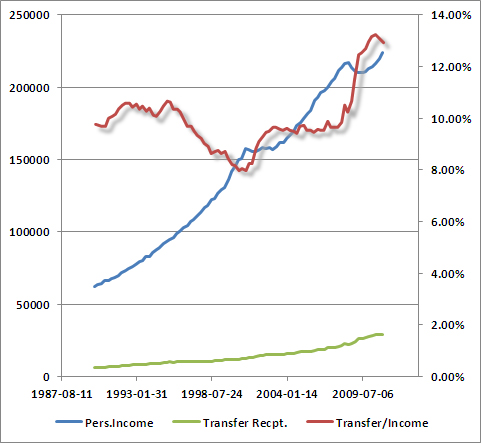
In the 90s, as Colorado recovered from the commodities bust and attractive tech talent from around the country, the percentage of income derived from transfer payments fell just barely above 8%. The recession of the early ’00s hit, and the slower growth of that decade, while real, was only enough to just balance the increase in transfers. Some of this was a result of Colorado’s generosity to its own citizens, as the legislature loosened rules for Medicaid. The state, of course, followed the rest of the country in a near-vertical climb in ’09.
The number is starting to decline gently as unemployment benefits run out, and incomes begin to slowly recover.
The chart, although the time scale is different from the one for the country as a whole, points out the main lesson of all this: growth is the only way out of this problem. It can’t be healthy for $13 of every $100 of personal income to come from an unearned government check. It’s even worse for the country as a whole. And the deepening dependency of more and more people is only going to make the political will necessary to break this cycle harder to find.
Green Still Costs Green
Posted by Joshua Sharf in Business, Economics, Energy, PPC, President 2012 on August 2nd, 2011
Regular readers know, my favorite left-of-center blogger is Walter Russell Mead, over at The American Interest. The reason Mead is so interesting is that, unlike the Paul Krugmans and Ezra Kleins of the world, he’s willing to challenge liberal shibboleths, recognizing that for liberalism to be more relevant, it needs to be more intellectually robust. At times he writes almost like a conservative, although he’s not. This morning is one of those posts:
Wal-Mart has hitched its wagon to the local food train, but not to save the planet. It’s the money. As Darrin Robbins, Wal-Mart’s senior manager for produce told the Wall Street Journal:
“We can get chili peppers from Florida all day long, but at the end of the day that is not necessarily the best model for us” … “I’m going to pay a higher price in Ohio for peppers, but if I don’t have to ship them halfway across the country to a store, it’s a better deal.”
It turns out that in the age of high gasoline and transportation costs, local produce is ultimately cheaper.
I’ve written before that Walmart is doing more for the planet than Greenpeace; this is just more proof. A ruthless focus on price and efficiency is the best way to reduce humanity’s environmental footprint.
I think his conclusion is right: companies dislike waste more than most Greenies do – it hurts the bottom line. Usually Greenies are wasting someone else’s time or money. This doesn’t mean that some companies wouldn’t willingly forgo all sorts of reasonable environmental protections if they could, although it’s worth noting that the worst environmental disasters of the last century were centrally planned by the Soviet, and this century’s are shaping up to be centrally planned by the Chinese.
Nevertheless, I think he misses a more subtle point. Those higher gasoline and transportation costs are real, and they are the result of governmental policies, usually pursued by Democrats specifically in order to drive up fuel prices. They’ll admit this during primaries. Wal-Mart is simply responding to incentives.
The problem, of course, is that “buy local,” unless is some specialty item, almost always means a lower standard of living. It makes you more dependent on a smaller base of supply, and decreases out-of-season availability. If the local crop fails, you still have to import the food from farther away, at the higher cost. I don’t have data to back this up, but it would also make sense that the availability of long-haul refrigerated units for produce would decline along with demand, which adds even more to the marginal cost of replacing a local supply gone missing.
The country always undergoes a series of local crop failures which go unnoticed by consumers. Now they’ll be more likely to notice those failures, and more likely to hear someone other numb-nut attributing it to your air conditioning, as well. So not only do we bear the cost of food, we also have to put up with the sermonizing.
Mead’s incredibly insightful about larger social and economic trends, so it’s a shame to see him missing a trick on this one.
One More Thought on the BBA
Posted by Joshua Sharf in PPC, President 2012 on July 29th, 2011
There are a couple of ways that, skillfully used, the BBA could actually end up helping the Republicans, at least in this first round.
First, it’s a bargaining chip. If the owners can give up an 18-game season that the players were never going to play, the Republicans may be willing to settle for a BBA vote (as opposed to passage), forcing the Dems to re-assert their Big Government bona fides.
More interestingly, if Boehner 2.1 (Boehner 2.0 with the BBA upgrade) passes the House with Democrat support, as seems likely, it’s going to make it harder for them to go back on that when it actually comes time to vote on the BBA. And if it gets stripped out in the Senate, you may end up with the spectacle of House Dems, having vote against 2.0, and then for 2.1, having to turn around and vote for 2.0 when it comes back around.
Regardless, the Republicans need to hold firm on the smaller cap increase number. The benefit of having this debate again – and possibly yet again – before the election, both political and policy-wise, are too integral to the overall strategy to roll over on.
Debt Markets React to Washington – Finally
Posted by Joshua Sharf in Business, PPC, President 2012 on July 29th, 2011
People have noted the failure to demand higher yields for treasuries, and concluded that the debt markets don’t believe there’s any problem with August 2, or 10, or any other date we care to mention. In fact, this was largely out of disbelief that Washington could fail to act.
In fact, this week, the debt markets have begun to react. Banks are beginning to pull money out of treasury-heavy money market funds, which in turn are selling treasuries and putting their money in banks. This has the effect of reducing the financial flexibility of each. The repo market – where financial institutions lend securities money to one another, using treasuries as collateral – is beginning to demand higher interest rates. Companies that don’t even like debt are issuing short-term commercial paper to make sure they have cash on hand. Let’s not turn this into panic – it’s not. But the markets are beginning to take prudent and overdue steps to protect themselves against a loss of liquidity in treasuries, even if it doesn’t mean technical default.
In the meantime, it appears that Speaker Boehner has agreed to a stricter Balanced Budget Amendment requirement for the 2nd round of cuts & debt limit increases – requiring passage rather than just a vote. I think this is a mistake.
There is every indication that Boehner Plan 2.0 was pretty close to the plan that he and Harry Reid presented to the President on Sunday, and which he indicated he would veto. But a close reading of the tea leaves also indicates that he was hoping that a strong enough statement against it would prevent him from actually having to make that decision. If he had signed it, it would have strengthened the conservative case for governance immensely.
Now, the House has probably made it more likely that they will end up voting on – and probably passing – some compromise between McConnell and Reid. That deal would, in fact, work towards marginalizing the Tea Party groups who have done so much to get us to this point.
I hope I’m wrong, and that the wording of the BBA is something that can get passed – it requires no presidential signature – and that the extra time we’re buying is put to good use making the case for it. Certainly Obama & the Democrats’ desire to run the federal budget on auto-pilot helps in that regard.
But if not, and if the 30 or so Republicans end up setting the stage for an exact repeat of this in 6 months, with no BBA in hand, they may well end up moving the debate to the left, rather than to the right.
One other point – I do think reasoned analyses such as McArdle’s, which show what will likely happen if we don’t raise the ceiling, without the histrionics, actually help our case down the road. If the markets do shudder a little bit, it should server as a spectre of what will actually happen, for real, when the debt markets finally decide to take that decision out of Washington’s hands altogether.
UPDATE: The Dollar-denominated Swiss Franc ETF, FXF, opened almost 2% higher this morning, and stayed there the whole day. I went back and looked, and since 2006, the daily percentage change has been bigger than this – in this direction – only 10 days, so this is definitely a multi-sigma event. One guess as to why it happened.
The Most Popular Man In Town
Posted by Joshua Sharf in PPC, President 2012 on July 28th, 2011
Is usually the backup quarterback. Right now, Rick Perry is polling extremely well. He’s played this skillfully so far, not letting himself be rushed, getting people to ask him to enter, and them building up a fundraising effort and making all the right contacts. (Personally, I like what I see so far; he’s turned what was a weak office into a strong one, and made Texas – Gen. Kearney notwithstanding – into where Galt’s Gulch would be located if Rand were writing today. This stops well short of an endorsement, I’d just like to see him have a chance to make his case.)
That said, we really don’t know how he’ll do on the big stage of a presidential race, or much about his governing style yet. He’s the backup quarterback, whose popularity largely reflects discontent with the starters. Time will tell if he’s Tom Brady or Bubby Brister,.
Obama’s Evergreen Goes Brown
Posted by Joshua Sharf in 2012 Presidential Race, Business, Economics, Finance, National Politics, PPC on July 28th, 2011
Barack Obama and Harry Reid may not be able to produce a spending plan, but at least they have their old campaign talking points from 2008 to fall back on.
With the Senate having failed to produce a budget in over 2 years, the President’s budget having succeeded in uniting Washington to a degree not seen since it was under threat of attack 150 years ago, and neither willing to commit a spending plan to paper, they can be relied on to Blame Bush!
The White House has put out a graphic purporting to show that – surprise! – 8 years under President Bush added more to the national debt than 2 years under President Obama. (They play with the numbers, by assuming that the cut in marginal tax rates didn’t stimulate growth, for instance.) That President Bush wasn’t exactly a fiscal conservative like FDR isn’t a secret to anyone. In its day, what was seen as recklessness spawned Porkbusters, the Tea Party in embryo.
But let me remind you of this chart, originally in the Washington Post:

It’s been updated by the Heritage Foundation:
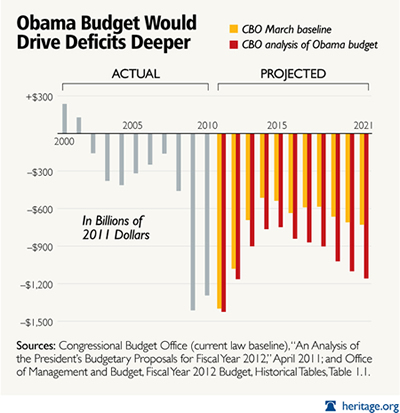
Much as Babe Ruth redefined baseball by showing what could be done when you try to hit home runs, so has Obama redefined deficit spending by showing what happens when you really put your heart and soul into it. You’ll notice, by the way, that the latter graph compares the CBO to itself, rather than to the White House budget, because, haha, there isn’t a White House budget.
Note also how the color bars in each graph look the same, only they’re shifted to the right by two years in the update. It’s evident that 2010 and 2011 haven’t worked out as planned. It’s no wonder that Tea Partiers don’t really believe in out-year cuts; the deficit reduction hasn’t occurred because Obama’s policies and those of Congressional Democrats have stifled economic growth, and because they’ve been happy to govern illegally, without a budget for two years, leaving federal spending essentially on auto-pilot.
The other argument you hear is that Paul Ryan’s budget made use of the same accounting trick that Harry Reid’s budget-avoidance bill does: counting savings from the Iraq and Afghanistan wars we won’t be fighting. But Ryan’s plan was an actual budget. There were always holes, but the difference between “will spend” and “would have spent” means a lot less when you’re drafting an actual plan, than the difference between “will spend” and “will take in.” Ryan applied that $1,000,000,000,000 to a headline.
Reid proposes to let the President spend it between now and Election Day 2012.
The Democrats won’t produce a budget because they can’t, only they don’t want you to know that until after the election. So much for them.
The Tea Party folks have a different complaint, namely that Boehner’s Plan doesn’t go far enough. I’d like to see more cuts, too. But the idea, as I recall, was to use the debt ceiling deadline as a means for forcing a debate, forcing changes to the spending that is current and planned. It was never realistic to run the entire federal government out of the House of Representatives.
To that extent, the plan has been wildly successful. It has exposed the Democrats as dangerously delusional about the state of our finances, whose only current idea is to soak you to ratify a massive increase in the scope of our economy directly controlled by the government. The Boehner Plan re-adjusts the baseline, keeps the debate on the front burner pretty much through the election, and does it without raising taxes. These are major victories, and they would not have been possible without the Tea Party. Period.
That said, this particular fight is one of many. Pushing too hard right now, bringing on a technical default, or, more likely, putting incredible discretionary power in the hands of a teenage president, won’t be Sherman marching through Georgia, it’ll be Napoleon marching to Moscow.
There is considerable frustration abroad that we can’t simply win this thing already. But politics isn’t about that. Regardless, we’ll have to keep watching, pushing, and prodding. There aren’t any final victories in politics, either over the other party or within your own. The best use of this battle is to pocket the gains, and use the process to help prepare the battlefield for the next fight.
Individuals Pay Corporate Taxes – Just Not Always The Consumer
Posted by Joshua Sharf in Business, Finance, PPC, Taxes on July 26th, 2011
Right now, our corporate tax structure makes no sense. It not only plays favorites, it drives many of the unfavored abroad. We have the highest corporate tax rate in the world, and the code is so riddled with exceptions, subsidies, and loopholes, disguised as “incentives,” that, as Megan McArdle put it, large companies basically have branch offices of the IRS on site to negotiate their tax bills.
So it makes sense that we should lower the corporate tax rate in exchange for cleaning the thing up.
It makes sense for all sorts of reasons, but not for one reason you often hear mentioned: that corporations just pass the increase along to consumers. They don’t. At least not always, because they can’t.
Who pays the tax is known as, “tax incidence,” and it depends on who has the fewest options. Economics recognizes something called, “elasticity.” Supply Elasticity is how much the supply changes depending on the price, and if you’ve been following along, you’ll know that Demand Elasticity is how much demand changes in response to price changes. Vacation rentals have a pretty high demand elasticity. Gasoline, on the other hand, has a fairly low demand elasticity: the price goes up, but you still have to get to work.
On the supply side, airline seats have a fairly low supply elasticity; once an airline has planes in inventory, they’re not likely to mothball them, at least not in the short run. Tobacco, on the other hand, has a pretty high supply elasticity: when the price falls, supply falls quickly to match.
(A word for the pedantic: elasticity is not constant. At very high or low price levels, we as consumers or producers may behave differently. You can only drive so much, even at $1 a gallon, lowering demand elasticity. Of course, at that price, there won’t be any refineries operating, either. Also, there’s the economist’s eternal escape hatch – the long-run and the short-run. It may be expensive for me to increase or limit supply, but give me enough time, and I’ll find a way.)
So what does this have to do with the tax on eggs in China?
If I’m the one with fewer choices, I’ll probably have to eat most of the tax. Suppose, for example, I make the Indispensible Widget. It’s easy for me to ramp up and ramp down production, but it’s a commodity you have to have, every day, all the time. This gives me, as a producer, pricing power, and it means that when our taxes get raised, we can pretty much – up to a point – pass that expense along to you. (Remember, even monopolies don’t have infinite pricing power, and even commodities producers have competition.) So in that case, yes, it’s the consumer who gets shafted.
Now, suppose I sell something else, something where the industry can’t readily reduce supply, but you have a lot a choice in whether or not buy. High-end vacation hotel rooms, for instance. I may be able to reduce some operating costs, but those costs are what make them luxury. And vacations are very price-sensitive. There may be some times when I can just tack on the tax, but if I’m trying to compete with your staycation, I probably won’t. My shareholders and employees will eat it.
Note that there’s a similar relationship at work with how shareholders and employees split their end of the deal, too. Labor, too, has supply and demand price elasticity. If your labor is a commodity, you may not get that raise this year, or may even get a pay cut or fired. If you have specialized skills, ownership may not be able to pass the tax along to you, either.
The point here is that while individuals always pay corporate taxes, those individuals may be consumers, employees, or owners, depending on the business. It’s not as simple as businesses just passing the cost on to their customers.
Why is this an argument for tax reform? Hayek’s Pretense of Knowledge. The government can’t really know, except in the coarsest way, what the tax incidence for the corporate income tax will be on a given industry. Subsidies may end up going to industries that don’t need them, or that can’t find a good place to invest them. They may reward employees, or not; they may help subsidize demand, or not. And what was true yesterday may well not be true tomorrow.
Ideally, we would simply ditch the corporate income tax altogether. Salaries and employment would rise, as would consumption, dividends, and investment, so the government would see a lot of that revenue come back immediately, and much more from growth.
But barring that, a flat rate, which instead of aiming for universal “fairness” accepts the fact that industries and businesses differ from one another, is the wisest course.
Thaddeus McCotter Declares
Posted by Joshua Sharf in PPC, President 2012 on July 4th, 2011
Thaddeus who? Thaddeus McCotter, a Republican congressman from Wayne County, Michigan, has declared his candidacy for the Presidency. He’s sharp, quick, and intelligent, and with a razor sharp and very dry wit. He has a keen sense of the threats facing the country today, and is unafraid to articulate them:
So I explain to my constituent, the person who employs me, and the person that I work for (applause), that the United States faces four great challenges: we face the social, political, and economic challenges of globalization, we face a world war against an evil enemy, we face the rise of the Communist Chinese superstate as a strategic threat and rival model of governance, and we face the question as to whether a nation built on self-evident truths can survive the erosion of those truths through moral relativism…
The Republican Party continues to have four goals: 1) we expand liberty and self-government, 2) we conserve our cherished institutions of faith, family, liberty, and country, 3) we empower the American people to achieve necessary constructive change, and 4) we defend America from her enemies and we support her allies.
In pursing these goals we have five fundamental principles: 1) Our liberty is from God, not the government, 2) our sovereignty is in our souls and hearts, not the soil or a scepter, 3) our security comes from strength, not surrender or appeasement, 4) our prosperity is from the private sector not the public sector, and 5) our truths are self-evident, not relative.
Where, you might ask, are the fiscal issues? McCotter has voted against the bailout, against raising taxes, against the “stimulus,” and in favor of the Ryan Budget Plan. He would probably answer, although I haven’t seen him do so, that addressing our fiscal crisis is something that a responsible government must do, but that it is not an external challenge. It is instead the result of long-running governmental malfeasance. Correcting it will put us in a better position to address our current challenges.
Some of you may know him from his appearances on Fox News’s Red Eye. It says a lot that he’s not only able to hold his own in such an unorthodox setting, but that he’s willing to put them on his official YouTube Channel. McCotter takes his politics seriously, but not himself, a rare characteristic in a politician:
McCotter will not win the nomination, but I’m glad to see him running. As with Michelle Bachmann, it’s, ah, open to question, as to whether a few terms in House is sufficient qualification to be President. But he’s an effective voice for traditional conservatism at a time when we desperately need such a voice.
He may also well be Ron Paul’s worst nightmare. Because we’ll finally have comic relief that’s both funny and substantive.
Unintended Consequences
Posted by Joshua Sharf in Labor, PPC on June 21st, 2011
Should the NLRB prevail in its attempt to tell Boeing where it can and cannot build new plants and direct new work, it will, in the end, only make things worse for places like Washington State, not only for South Carolina.
Obviously, South Carolina would suffer, and while my sympathies for them are somewhat limited at the moment, owing to the results of this evening’s College World Series game, the fact is their workers haven’t done anything wrong by agreeing to work for a lower wage as opposed to staying unemployed. Success by the NLRB will rob them of livelihoods, and likely force Boeing to swallow the loss and move the work overseas, to the extent possible.
Washington State would suffer, though, as well. The delays – possibly years of them – caused by this frivolous lawsuit, will give their competitors time to catch up and carve away pieces of market share, long-run sales which are extremely difficult to get back. This is especially true in a capital-intensive industry with a long product development cycle. The profits from the 787 sales would not only recoup Boeing’s investment in the plane, but fund development of their next generation of jets as well. The workers in Washington, counting on the work that would have gone to South Carolina, will find that work diminished, as well as the work in their existing shops.
Worse, while businesses that are already mired doing work in heavily-unionized states might have to shift work overseas, or fold altogether (the option of opening new plants in affordable states having been foreclosed), who in their right minds would start doing business in Washington if they didn’t have to?
Of course, this all falls under the rubric of Bastiat’s Seen and Unseen. What’s seen is the few jobs that will trudge, unhappily, back to Seattle. What’s unseen as all the jobs that will never materialize there in the first place.
Federalism and Individual Rights
Posted by Joshua Sharf in PPC on June 19th, 2011
In a decision released Friday, Bond v. United States, the US Supreme Court ruled that individuals charged in criminal cases have standing to challenge the constitutionality of federal laws on 10th Amendment grounds. The Court held that federalism, as described in the 10th Amendment, protects individual rights, not merely the states’ sovereignty.
Federalism secures the freedom of the individual. It allows States to respond, through theenactment of positive law, to the initiative of those who seek a voice in shaping the destiny of their own times without having to rely solely upon the political processes that control a remote central power. True, of course, these objects cannot be vindicated by the Judiciary in the absence of a proper case or controversy; but the individual liberty secured by federalism is not simply derivative of the rights of the States.
Federalism also protects the liberty of all persons within a State by ensuring that laws enacted in excess of delegated governmental power cannot direct or control their actions. See ibid. By denying any one government complete jurisdiction over all the concerns of public life, federalism protects the liberty of the individual from arbitrary power. When government acts in excess of its lawful powers, that liberty is at stake.
The limitations that federalism entails are not therefore a matter of rights belonging only to the States. States are not the sole intended beneficiaries of federalism. See New York, supra, at 181. An individual has a direct interest in objecting to laws that upset the constitutional balance between the National Government and the States when the enforcement of those laws causes injury that is concrete, particular, and redressable. Fidelity to principles of federalism is not for the States alone to vindicate.
Just as it is appropriate for an individual, in a proper case, to invoke separation-of-powers or checks-and-balances constraints, so too may a litigant, in a proper case, challenge a law as enacted in contravention of constitutional principles of federalism. That claim need not depend on the vicarious assertion of a State’s constitutional interests, even if a State’s constitutional interests are also implicated.
The government had also argued that the defendant could not invoke the state sovereignty argument, since she wasn’t a state. The Court ruled against the government on those grounds, as well. Meaning that an individual, with a legitimate case, can argue that a federal law is unconstitutional based on either state sovereignty grounds, or on enumerated powers grounds.
The Court was careful not to change the conditions under which someone had the standing to assert unconstitutionality. They have to be a party to a suit, or have suffered some specific harm. That remains unchanged:
An individual who challenges federal action on these grounds is, of course, subject to the Article III requirements, as well as prudential rules, applicable to all litigants and claims. Individuals have “no standing to complain simply that their Government is violating the law.” Allen v. Wright, 468 U. S. 737, 755 (1984). It is not enough that a litigant “suffers in some indefinite way in common with people generally.” Frothingham v. Mellon, 262 U. S. 447, 488 (1923) (decided with Massachusetts v. Mellon). If, in connection with the claim being asserted, a litigant who commences suit fails to show actual or imminent harm that is concrete and particular, fairly traceableto the conduct complained of, and likely to be redressed bya favorable decision, the Federal Judiciary cannot hear the claim. Lujan, 504 U. S., at 560–561. These requirements must be satisfied before an individual may assert a constitutional claim; and in some instances, the result may bethat a State is the only entity capable of demonstrating the requisite injury.
The Goldwater Institute has a number of cases and briefs pending (they single out arguments against the NLRB and Obamacare) that depend on 10th Amendment objections. While standing remains, as ever, an issue in litigation, at least the Court has given a clear directive that 10th Amendment right devolve to individuals on state sovereignty grounds, and not merely states.
-
You are currently browsing the archives for the PPC category.


