Archive for category Economics
Hope. But Not Change.
Posted by Joshua Sharf in Housing on December 30th, 2009
Hope, October 2005:
The keen interest of the media, and by extension, the public, in the future of house price growth in the United States centers on the question of whether there is a house price bubble nationally or regionally. Even among those who concede that a bubble per se may not be present, many worry that they may experience a decline in home prices in their metro area due to the very high and unsustainable rise in values over recent years in many parts of the United States. We examine this potential by forecasting the likely change in prices under three models – one that asserts a mean reversion correction on regional markets to return the national average gain in prices to the 50-year annual growth rate of 5 percent over the period 1998-2010; the second and third base future regional and national home price growth on economic fundamentals.
We also discuss recent findings by Chang, Cutts and Green (2005) and perform a simple extension of their work applied to 22 major cities. In all cases, we find the predicted worst-case outcomes to be much less dire than the “doomsday” predictions reported in the mainstream press and elsewhere.
Written by the then-Chief Economist, Frank Nothaft, and Deputy Chief Economist, Amy Crews Cutts, at Freddie Mac.
Last week, the current heads of Freddie Mac and Fannie Mae received news of 7-figure bonuses at the same time the government threw their corporations an unlimited lifeline. In fact, the government won’t even estimate how much money it’ll take to stabilize these companies. Talk about too big to fail.
If the company was making decisions based on those employees who were responsible for “primary and secondary mortgage market analysis and research, macroeconomic analysis and forecasting,” and who had, “published studies in academic journals and books on such topics as the economics of subprime lending,” then it’s easy to see where they went wrong.
It would be a good thing, then, if those economists had found other employment. Unfortunately, they haven’t (see end of page 2). That’s right. Four years after their tsunami detector found nothing to worry about, nothing to see here, please move along, and one year into the administration that was going to hold everyone accountable, the same economists are still there, turning out reports and advice.
I’ve commented before on the metaphysical impossibility of making the sorts of predictions that these economists were trying to make. But in this case, their catastrophic mistakes contributed mightily towards shaking the world financial system to its core. They stopped issuing commentary along with their tables of projections from August 2007 until April of 2009. Apparently they figured that if they couldn’t find something nice to say about the housing market, they’d better not say anything at all. Now it’s all back to recovery and bottoms and shrinking inventory.
It seems that working for Freddie Mac – either in management or research – really does mean never having to say you’re sorry.
But At Least You Keep It If You Keep Making the Payments
Posted by Joshua Sharf in Economics, National Politics on November 25th, 2009
At least we don’t have New York’s or Connecticut’s problem. The New Jersey Nets and associated developers have apparently won the right to take someone else’s property for their own use. Yes, it has to pass through the hands of the State of New York first. But the State Supreme Court has rules that New York can declare Atlantic Yards blighted, pay off the owners at some price the state determines, and turn the land over to developers for a new arena for the New Jersey Nets, as part of a mixed-use commercial and residential development. (That prize of a franchise, by the way, has opened the season 0-153.)
Remarkably, the Court declared that this was an act of judicial restraint, arguing that it was bound by the definition of “blight,” which was completely under the control of the legislature. As with the property in Kelo, the development may not even go forward because of financing. Some parts of the project have already been delayed or canceled because of the economy. The bonds must be issued quickly in order to qualify for certain tax breaks. The article is silent on whether or not the property will be condemned and transferred before the necessary development bonds are issued.
I have no particular opinion on whether the development would be good or bad for Brooklyn. Certainly, it’s better to finance this sort of thing privately rather than publicly. The history of sports arenas and their surrounding neighborhoods is mixed, with football stadiums being about the worst, and shared basketball-hockey arenas doing the best. Coors Field helped revitalize Lodo here in Denver, and the MCI Center (now the Verizon Center) has been a boon for a truly blighted area, downtown Washington, DC.
What’s at issue here is the sanctity of personal property. Aside from the ideological obscenity of taking your property to give it to someone else for their financial benefit, there’s the overall legal and investment environment that’s created when people don’t really own property that they believe they own. That sort of uncertainty has got to limit people’s willingness to invest in their land. And of course, it almost always results in a transfer of property from the less-well-connected to favored groups.
One footnote: this is the same property that the City of New York, in the person of Robert Moses, refused to use eminent domain for in order to build a new stadium for the Dodgers.
Mortgages in Colorado
Posted by Joshua Sharf in Colorado Politics, Economics, HD-6 2010 on November 25th, 2009
For a long time, we’ve been hearing about how the housing market in Colorado isn’t as bad as in the rest of the country, and there’s some truth to it. We’re routinely at or near the top of the Case-Shiller index, and foreclosures have tended to lag behind the rest of the country. But there may be some serious trouble on the horizon. According to a study in yesterday’s Wall Street Journal, almost 25% of US mortgages are underwater. That’s not 25% of homeowners, since those without mortgages by definition aren’t underwater, but it’s still a pretty serious number.
Colorado does not fare particularly well in this survey. While the national average is 23%, 19% of Colorado mortgages are underwater, good for 11th in the country. An additional 7.8% of Colorado’s mortgages are with 5% of being underwater, 2nd-worst in the country. With a loan-to-value ratio of 72%, Colorado is 9th-worst in the country. (The worst in that category is Harry Reid’s own Nevada with a staggering 114% loan-to-value ratio, 23 percentage points worse than 2nd-place Arizona.)
So obviously, Gov. Ritter, the legislature, and the state Supreme Court thing that the right thing to do is to raise property taxes on these homeowners who are already going to have cash flow problems.
The Very Expensive “New Energy Economy”
Posted by Joshua Sharf in Budget, Colorado Politics, Economics, Energy, Taxes on November 3rd, 2009
There are times when one wonders whether or not the writers for the Denver Post actually read the Denver Post. Then, there are times when one wonders whether is would make any difference if the did.
On October 14, the Post carried an AP story noting that the new German government, a coalition between the Christian Democrats – Mark Steyn’s right of left of right of center party – and the Free Democrats, who actually permit themselves the luxury of promoting free markets now and again, would be cutting Germany’s legendary solar subsidies, which the country had maintained for about two decades. Apprently, subsidizing expensive energy doesn’t look so good during a recession, and Germany is willing to forego the expensive green jobs that such industry creates:
Investors expected Germany to cut back on solar subsidies this year as the recession sapped demand and tightened government budgets, said Benedict Pang, an analyst with Caris and Company in San Francisco.
“During the downturn, the wheels started to come off” in Germany, Pang said. “A lot of solar companies have weaned themselves off of that market.”
…
Germany has guaranteed renewable energy generators fixed payments for the power they produce to encourage the production of solar panels and several of the world’s leading producers of the technology are based here.
A week and a half later, Bloomberg reported that the Germans had done just that:
Chancellor Angela Merkel’s new junior partner in government, the pro-business Free Democrats, approved a four-year coalition program that points Germany toward tax cuts and a reprieve for nuclear energy….
Separately, the government will seek talks with solar-energy industry on possible “adjustments” to avoid “excessive subsidies,” according to the coalition draft.
So naturally, it was a source of much rejoicing when the German company, SMA, no longer able to make money on its home turf, shifted production to Colorado, bringing with it its prize of 300 jobs, at a cost of a mere $12,000/job to the Colorado taxpayer.
Now, that’s not as much as the colossal $240,000 per job – plus the added cost of the actual electricity – that Germany’s worked itself up to. And the so-called “green jobs” trap has been largely responsible for the depth and intractability of Spain’s contractiion during the global recession. Of course, they’re paying about $600,000 a job, so we’ve still got a ways to go to match that.
These jobs are incredibly expensive, as Colorado is about to find out, and apparently don’t survive the end of subsidies.
Let’s just hope that those interim committees take note of why Colorado beat out other US states:
[Colorado Office of Economic Development and International Trade’s Pete] Roskop said other states were throwing more money for incentives at the company, but Colorado had lower costs for items such as corporate taxes and worker’s compensation insurance.
Then, there are the times when one wonders whether some people ever read the business pages at all.
State Unemployment “Stabilizes,” Maybe
Posted by Joshua Sharf in Colorado Politics, Economics on October 21st, 2009
The state unemployment numbers came out today, and the papers are all agog that that the unemployment rate is down to 7.0%. Now while that’s a lot better than the national rate of 9.8%, it’s also a little misleading. Almost all of the improvement came from a reduction in the labor force – people ceasing to look for work. While the number of people employed has stopped declining, the total labor force continues to fall:
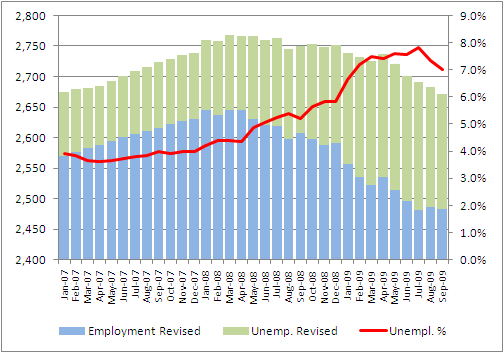
The employment graph doesn’t start at 0 in order to better show the trends. The red line is the unemployment rate, and it’s to the scale ont he right-hand side. A couple of things stand out. First off, the number of employed seems to have stabilized. But it also seemed to have stabilized at least twice before: in mid-to-late ’08 and in Spring of this year. We then got two large drop-offs. There’s no guarantee that we’ve hit bottom yet, although we all hope to God we have.
The other interesting thing is the unemployment rate from Spring of ’07 to Spring of ’08. It rose from about 3.5% to about 4.5%, even as the number of people employed was also rising, from about 2.56 million to almost 2.65 million. Note that the number of people looking was rising even faster. Which meant that at that point, even though we hadn’t felt the slowdown, new jobs weren’t being created fast enough to keep up with population growth. Now, the unemployment rate is dropping, even though it’s almost entirely due to people dropping out of the market. There’s considerably hidden labor inventory out there, and when it returns to the job hunt, the unemployment rate won’t be falling so quickly.
Note that these are all seasonally-adjusted numbers, too, so they already taking to account seasonal retail, summer jobs, and teachers’ summer vacations.
I’d also point out that here in Denver County, the seasonally-unadjusted were even worse, with the labor force dropping by over 3000, and the number of employed dropping by almost 2000. Whatever the job market looks like elsewhere, we’re not creating jobs locally.
Here’s a graph I’ve updated since April:
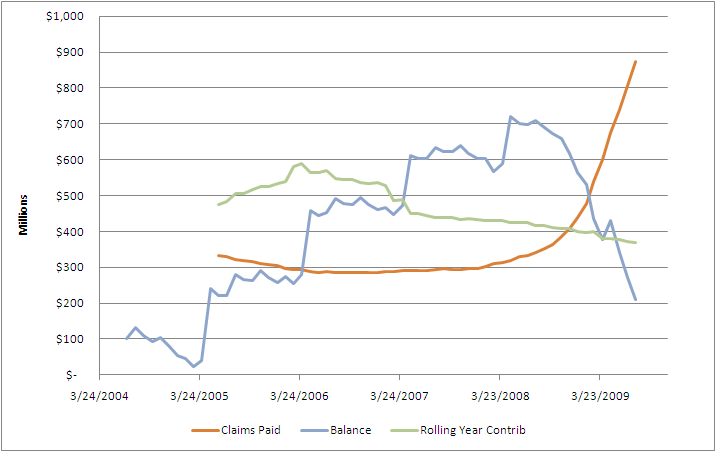
It’s the state Unemployment Insurance Fund, and it’s a mess. While we talk about PERA, and taxing Peter to pay for Paul’s rent-seeking appendectomy, the fund is in serious trouble. It got almost no seasonal bump from the May solvency assessment, the numebr of claims paid has been skyrocketing (red), and the rolling 12-month payments by business (green) have been sloping downward because they’re not employing as many people. The net result is a cliff-diving account balance (blue). We were told that the account actuarily sound, but it should have been obvious at the time that we were facing not-normal circumstances.
And it’s even worse than it looks. The feds kicked in an extra $127 million in exchange for SB 247 and more long-term commitments. Some of us pointed out at the time that borrowing short to go long wasn’t really matching obligations to receipts, but like the true addict it is, the state government saw the federal dollar signs and just couldn’t say no. Don’t hold your breath waiting for the Democrats in the legislature to admit they made a mistake.
Colorado Insurers Weight In – Finally
Posted by Joshua Sharf in Economics, Health Care on October 20th, 2009
Possibly too late, Colorado insurers are finally pointing out some of the economic fallacies inherent in the propose federal takeover of health care. Unfortunately, the insurers don’t go far enough in their condemnation. Fortunately, their opponents are simply reflexively trying to demonize them, and in the process, saying some really stupid things.
First, the insurers:
At issue are what insurance companies consider absurdly low penalties for people who choose not to buy health insurance.
Their concern: People will buy insurance only when they desperately need it, such as after they’re diagnosed with cancer or heart disease.
Healthy people might choose to pay the penalty, now proposed at a few hundred dollars per year, because it is far less expensive than buying insurance.
This is is true as far as it goes, but it’s not clear that even universal coverage would alleviate this problem. Still, the insurance companies have put their finger on a problem: if you’re not actually required to buy insurance until you’re sick, then that’s when you will buy insurance.
Naturally, this has led to howls on indignation from those defending the President’s and Congress’s proposals:
“They are assuming that people would game the system,” said Denise de Percin, executive director of the Colorado Consumer Health Initiative.
“They are looking at the worst-case scenario. People aren’t stupid — they are not going to pay a penalty and get nothing,” de Percin said. (emphasis added -ed.)
Guaranteed issue is, in and of itself, only part of the problem. Colorado has, in effect, a government guaranteed issue for a high-risk pool. The reason that this is unacceptable to those pushing reform is that by lumping the high-risk (or, already-established-risk) patients together, it creates a pool whose premiums are higher. They therefore argue for the concurrent requirement of “community rating.” which in effect pools the entire community – usually the state – together into one large pool where everyone gets charged the same amount. The various Democratic bills all contain some sort of community rating proposal as well.
In fact, we’ve already run this experiment in several states. The result is universally higher premiums, and it’s not hard to see why. Because now, as a healthy, premium-paying insured, I also need to cover the actual costs of people who waited until the diagnosis to get insurance, and the estimated costs of new people likely to enter the system who haven’t been diagnosed yet.
De Percin is right; people aren’t stupid, which is why they’d rather pay a penalty than pay for insurance they don’t need. They could take the difference and save it, invest it, or buy catastrophic insurance, which doesn’t qualify as “insurance” under the plan, even though it comes much closer to the ideal of insurance. The penalty is just the cost of participating in the system in the way they think is most to their benefit. The insurance companies’ argument, that the penalty for not playing has to be bigger than the overall cost of playing – is perfectly sound.
There are two fundamental flaws with how we think of insurance, and the way they interact is complicated by the fact that they’re mutually incompatible: 1) we think we’re spending other people’s money, and 2) we think of insurance as pre-paid medical expenses. One of these is a shell game, and the other is counter to the notion of insurance. The “guaranteed-issue/community-rating” combination just plays to the worst of both assumptions.
$691,000 Per Job
Posted by Joshua Sharf in Colorado Politics, Economics on October 16th, 2009
Although the Denver Post doesn’t do the math, that’s how much each job created in Colorado has cost the Federal Government, er, you.
$583 million in Recovery Act funds have flowed to 96 different companies, individuals and other entities such as housing authorities.
Though Colorado was ranked as the top job creator among states — given TeleTech’s hiring of 4,231 people to staff a series of call centers — only 379 of those employees worked in Englewood. The rest were scattered throughout the country, such as in London, Ky., and Ocala, Fla.
So, it’s not 4695 jobs, it’s 843 jobs here in Colorado, and that’s if we include the 379 that have since gone away from TeleTech.
$583 million spent, 843 jobs. Quite a deal you made for us there, Rep. DeGette and Sen. Bennet.
California vs. Texas – Exports
Posted by Joshua Sharf in Economics on October 12th, 2009
We all know that as California has failed, Texas has prospered. We all know that jobs and people are fleeing Paradise for Hell. We all know that it costs about 3 times as much to rent a truck from California as to make the return trip from Texas. What I haven’t seen is an analysis of the role that exports have played in this reversal.
In fact, Texas exports more that California does, and has since 2002:
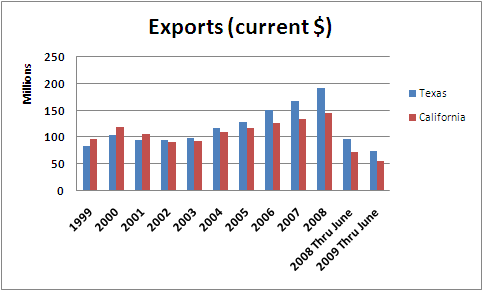
Both states have suffered from the global recession, but California on a percentage basis has suffered more, losing roughly 1/3 of its exports, while Texas has lost only about 25% of its exports year-to-date. The numbers will be at year’s end, but Texas won’t be nearly as bad off.
Some of this is accountable to a general growth in exports over the last decade, but to the extent that’s true, California hasn’t benefitted, and Texas has outperformed the rest of the country, even as its exports have outperformed the rest of its economy, while California’s have languished (watch out for the color switch):
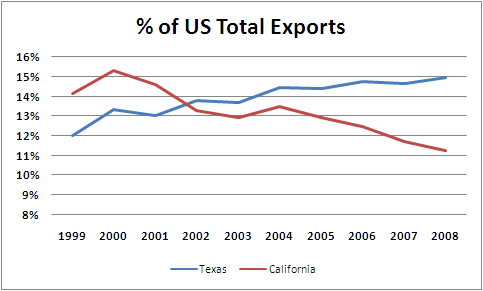
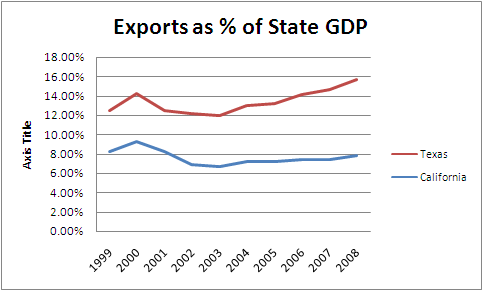
Now technically, tourism is an export, but this isn’t a result of Mexican day-visitors coming across the border for shopping and Six Flags. The biggest contributors to Texas’s export growth have been Chemical Manufactures, Petroleum and Coal Products (yes, exporting oil products), Machinery manufactures, and Computers and Electronics. Petro exports had multiplied 7x from 1999 to 2007, even before the 2008 run-up in oil prices. Over the same period, Chemical exports tripled, and Machinery exports grew by 150%.
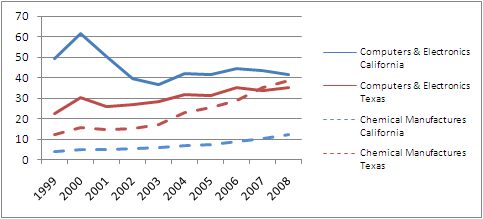
In the meantime, California’s Silicon Valley hardware exports suffered after the dot-com bubble burst in 2000, and have never recovered. In 1999, over 50% of California’s exports were Computers & Electronics. They now constitute just under 30%, down 16% in dollar terms from 1999, and almost 1/3 from their 2000 peak. The diversification in California’s exports should be a benefit, and may yet be. But the exports are going to have to actually grow and be competitive for the state to benefit.
Here’s the comparison between a couple of sectors of the two states’ exports over the period in questions:
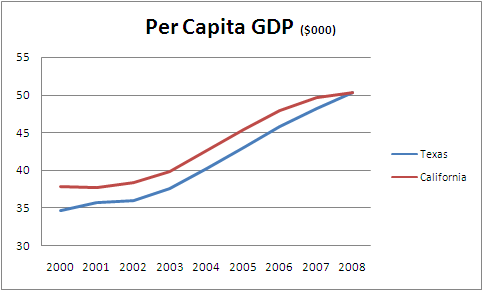
All of this might be moot if it were just a matter of underselling the competition and running sweatshops. But in fact, Texas’s GDP has been growing, and over the last decade, its per capita CDP has caught up with California:

All these numbers, by the way, are from the Census Bureau, which also operates an fantastic site for cruising a state’s export numbers.
Now before we go all gaga about this, and show how this proves that under current conditions, Americans can compete with anyone overseas, these numbers don’t show how much of Texas’s exports come from cannibalizing from the rest of the country. And a State Business Tax Climate ranked #11, compared with California’s #48, would indicate that some of these exporting businesses have relocated. Still, there’s no doubt that exports are a major – and under-reported, factor in Texas’s move past California as an economic engine.
Chinese Futures Markets
Posted by Joshua Sharf in China, Economics on October 12th, 2009
The Wall Street Journal reports this morning that China is seeking to upgrade and expand its commodities futures markets in order to influence commodities prices, arguing that on-shore exchanges will help increase market efficiencies:
Government officials say the country is positioning its futures markets to be major players in setting world prices for metal, energy and farm commodities. By letting the world know how much its companies and investors think goods are worth, China hopes to be less at the mercy of markets elsewhere.
But what’s more likely is that China wants to lure traders on shore in order to use its national bargaining power to obtain more favorable prices. It’s not until the very end that the reason to be suspicious is mentioned:
International futures-market benchmarking has been slow to shift to China from long-established exchanges like the New York and Chicago venues. Despite China’s huge volumes, its futures markets allow foreigners limited access. By contrast, the London Metal Exchange says 95% of its business emanates from overseas.
General Motors Co., Ford Motor Co. and Tyson Foods Inc. are some of the companies that use futures in the U.S. to protect themselves from volatility in commodity prices. Despite expanding production in China, and being technically eligible to hedge on China’s exchanges, all three say they haven’t used its futures markets.
Instead, the big footprints in China’s futures markets belong to state-owned groups, primarily commodity trader Cofco Corp. and Beijing’s secretive stockpiling agent, the State Bureau of Material Reserve. That makes the government both player and policy maker. (emphasis added)
Right. Which means that China, which has a classic mercantilist approach to economics – seeking to use national power for the benefit of its industries – will be able to set the trading rules to its own benefit. China has been practicing what can only be described as a neocolonialist policy all over the world in pursuit of cheap commodities. It has been, as the article notes, deploying its navy to protect shipping routes, discovering the colonial truth that far from trade following the flag, the flag necessarily follows trade.
In fact, as the first paragraph in the above quote points out, these are world markets, and there’s no reason that China can’t trade openly in accounts no matter where they’re located. In fact, the three companies mentioned in the second paragraph manufacture in China, and hedge on the US markets. One likely advantage of trading with a home field advantage is that its government players won’t have to reveal their moves the way they will in more tightly regulated London and New York.
One expects that eventually, with the trading markets established, the right to continue doing business on favorable terms will come with increasing conditions, one of which may be that a company has the hedge its local commodities exposure with Chinese futures. Given the compromises that companies make to do business in China in the first place, including rarely owning 50% of their own subsidiaries and seemingly deferring profits until the late 22nd Century, hedging on local markets will just be another in a long line.
The eventual effect of such a policy, if successful, would be to drive up commodity prices for the rest of the world while keeping them low for China, hampering competition, shutting down industries in competing countries, such as the US, while allowing China’s exports and domestic markets to develop. Such a strategy only works, of course, if there’s no comparably-sized competitor, which argues for countermeasures by the US, combined with more open trade with India (which has protectionist problems of its own).
In the long run, of course, such a strategy is doomed. The imbalances that it creates will inevitably provoke a reaction from the rest of the world, such as what Japan saw in the 1980s. Moreover, it’s not sustainable forever. Exports demand markets. China is aging, and is an unlikely autarky, which is why it’s seeking to use its political (and eventually militaryp) power to secure resources. But the long run can be very long, indeed, and the damage that China can inflict on us in pursuit of this policy can be great. Which, of course, may also be all part of the plan.
Denver’s Employment Not Quite So “Stabilized”
Posted by Joshua Sharf in Denver, Economics on September 22nd, 2009
Still catching up from Rosh Hashanah this weekend – it’s going to be that way for a few more weeks as the Holidays of Tishrei descend on us for another season.
So Colorado’s Executive Director of the Colorado Department of Labor and Employment pronounces it “encouraging” that Colorado gained 3100 jobs while shedding 15,200 workers. The unemployment rate will probably get worse again before it gets better, but mostly because people will re-enter the job market as things do improve.
But Denver’s job market, not so good. According to the release, the Denver-Aurora MSA accounted for more than the state’s net labor force loss, dropping 15,552 workers (and 6,400 jobs). The rest of the state gained 9500 jobs, and actually added a few hundred to the labor force. In fact, Denver-Boulder and Colorado Springs MSA were the only areas to lose significant jobs in August.
In related news, the city council will fail to ask citizens to re-direct Referendum A-I money to useful projects.
-
You are currently browsing the archives for the Economics category.


