Archive for category Economics
The Revolution Eats Its Own
Posted by Joshua Sharf in Business, China, Economics, PPC, Regulation on January 23rd, 2011
We may have to wait a little longer to start breaking China’s stranglehold on the world’s supply of rare earth metals. Something called the Western Watersheds Project has filed a lawsuit to derail a solar project in San Bernadino County, and that same lawsuit may have the effect of shutting down a spur from an existing gas pipeline that Molycorp will need to power its mine. The offended species? Tortoises.
Concerning Molycorp, Connor pointed to an 8.6-mile pipeline proposed to carry natural gas to Mountain Pass for power generation. The so-called Mountain Pass Lateral will, if allowed, carry gas from an existing line owned by Kern River Gas Transmission Line near the Ivanpah Solar Project. “The lateral will pass by the Ivanpah Power Plant, the area where the tortoises are to be relocated, Connor said. “They were given no consideration.”
George Kenline, San Bernardino County’s mining geologist, who issues mining permits and other relevant county permits, praises Molycorp’s new direction. Once a major polluter, Molycorp, he said, “It (Molycorp) decreases the amount of impact because it eliminated the evaporation ponds,” which were a major problem before and have been completely removed from the new project.
Ironies about, the most obvious of which is the attack on a solar project by an environmental group. But then, there’s the fact that the Watersheds Project is seeking to derail a mining operation that has completely changed the way in which is uses water, recycling almost all of its water and getting rid of evaporation ponds. As well as the fact that the rare earths are used extensively in high-power magnets in hybrid vehicles, electric vehicles, and wind turbines. Environmental groups, which enjoy specially-granted standing to file these sorts of suits, are now standing in the way of the kind of change they claim will save us all from catastrophe. Revolutions do eat their own, after all.
Molycorp may have the permits to operate the mine, but it can’t do so without natural gas. It’s further evidence that while a strategic stockpile of rare earths might be a good idea, the real solution is clearing away the regulatory underbrush that ties down useful projects in the first place.
In the meantime, engineers are trying to create high-power magnets that don’t use rare earths at all. This is equally big news in the longer-term, but for the moment, as in so many other similar efforts, the problem will be scaling the magnets up to useful sizes, which may take years. In the meantime, it would be nice to know that these new magnets are competitive in their own right, and not merely because the cost of their competition is being driven up by regulation.
We Could Start By Repealing ObamaCare
Posted by Joshua Sharf in Business, National Politics, PPC, Regulation, Stimulus, Taxes on January 18th, 2011
President Obama claims in this morning’s Wall Street Journal to want to reduce the regulatory burden on American business, and so has ordered a review:
This order requires that federal agencies ensure that regulations protect our safety, health and environment while promoting economic growth. And it orders a government-wide review of the rules already on the books to remove outdated regulations that stifle job creation and make our economy less competitive. It’s a review that will help bring order to regulations that have become a patchwork of overlapping rules, the result of tinkering by administrations and legislators of both parties and the influence of special interests in Washington over decades.
I can remember hearing this sort of thing from every President since Jimmy Carter. You’ll note that the government is now considerably larger, more restrictive, and more intrusive than it was 35 years ago. Their failure is, in part, explainable by the nature of bureaucracy. Agencies fight interminable turf wars, and any attempt to systematically get them to play well together is doomed to failure. The FCC, for instance, insists on trying to regulate the Internet even in the face of specific Supreme Court decisions denying them the authority. Imagine how much more combative they are when the only opponents are other bureaucrats.
Philip Howard in his classic, The Death of Common Sense, notes how the USDA requires floors in certain food operations to be clean, while OSHA requires them to be dry. Good luck with that one.
The EPA has become a mini super-government unto itself, its authority reinforced by the automatic standing that many professional environmental lobbying groups have to bring suit on behalf of, “the environment.” Aside from trying to limit our breathing, ot currently is preventing the Border Patrol from patrolling parts of the border, meaning it’s exercising control not only over every aspect of manufacturing, it’s arrogating the right to regulate other federal agencies.
The FDA has tried, and will no doubt try again, to use price as a measure for approving medicine. As the president professes to be worried about medical innovation.
Of course, regulation isn’t even the major retardant of economic growth – government spending is. Obamacare amounts to a gigantic increase in the percentage of GDP explicitly devoted to government spending. The so-called stimulus hasn’t even been spent yet, largely because the same government didn’t know that there was no such thing as a “shovel-ready” project.
Coming after a miserable electoral repudiation of his policies, Obama’s comments recall President Clinton’s 1995 State of the Union Address. Realizing that he wouldn’t be able to push through large pieces of legislation, he famously declared that “the era of big government is over,” and embarked on a program of increasing regulation. Obama realizes much the same thing, but also recognizes that it will take years for bureaucracies, new and old, to absorb their new powers under Health Care reform, financial regulatory reform, and his expansive readings of executive authority.
Either Obama realizes this, and knows that he can give the appearance of understanding the problem without really giving substantive ground, or he doesn’t really understand the problem.
The subhead on his oped reads, “If the FDA deems saccharin safe enough for coffee, then the EPA should not treat it as hazardous waste.” Maybe we can get him to do the same thing with carbon dioxide.
If the FDA deems saccharin safe enough for coffee, then the EPA should not treat it as hazardous waste.
Slipshod Reporting on Rare Earths & Solar
Posted by Joshua Sharf in Backbone Business, Business, Energy, PPC, Regulation on January 16th, 2011
The Denver Post this morning reports that a lack of rare earths may be inhibiting the domestic solar cell industry. How this is so, they never quite describe. There’s no calculation, for instance, of what percent of a solar panel’s production cost comes from rare earths. Possibly, this is because rare earths aren’t actually used in the production of solar cells. According to a DOE study on strategic materials, solar cells use indium, tellurium, gallium, and maybe soon, selenium, none of which is in the lathanide series of rare earths. A briefing by the Rare Earth Industry Trade Association on the importance of rare earths to green energy applications doesn’t mention solar at all.
By coincidence, the New York Times this morning ran a piece on why solar panel manufacturers are relocating to China, and it seems that the reason has nothing to do with rare earths, which aren’t mentioned at all, and everything to do with our willingness to take the place of Germany and Spain in directing massive subsidies to the panels’ production. And in spite of our increasing mandates on so-called renewable energy as a source of electricity, it’s also not clear that we’ll be willing to force utilities to pay the exorbitant rates necessary to make large solar arrays profitable.
That, not the absence of a local rare earth supply, is what’s threatening a domestic solar industry.
I Volunteer Cheri Jahn
Posted by Joshua Sharf in Budget, Colorado Politics, PPC, Regulation on January 16th, 2011
Governor Hickenlooper has deservedly won praise for his idea of a “regulatory impact statement” for new regulations. Such a statement would estimate the costs to business of new regulations, and be a good step towards an actual cost-benefit analysis of new rules. Legislative Council already does something similar in the form of fiscal notes to new legislation. (Such a statement would only really be of use if the processes for determining the costs were as open as the results; it might be all to easy for a bureaucracy to game the system, or for large businesses to underestimate the costs to smaller competitors.)
So it was particularly interesting to see the following statement in this weekend’s Denver Business Journal from State Senator Cheri Jahn:
“When legislation comes through, the very first thing I am going to look at is: How will it effect my business and my ability to operate and to expand and to maintain what I am doing.”
“And if it is going to hurt me, I am not going to support it.”
Leaving aside the furor that would erupt if a Republican were to have said this – maybe only Jahn can go to China, so to speak – the sentiment is fine one.
Sen. Jahn serves on the Business, Labor, and Technology Committee, which has a 4-3 Democrat majority. If she really wants to have the information necessary to make the calculation she claims to want to make, perhaps she could sponsor the legislation required to make this happen. If she can’t be persuaded to do that, perhaps Sen. Shawn Mitchell could get her to vote for it. If it were to pass committee 4-3, it would certainly Senate Democrats in a bind on a floor vote.
As for the House, in the past, Democrats have balked at even estimating the cost of new health insurance mandates. This year, they wouldn’t have the votes.
Breaking New Ground
Posted by Joshua Sharf in PPC, Property Rights, Regulation on December 31st, 2010
When Kenneth Feinberg was appointed to politicize oversee the BP restitution process, many of us were worried that even under the best of circumstances, the government was forfeiting confidence in the process to gain some expediency. Now, it turns out that Feinberg was worried, too:
House Republicans’ Platform – Economy
Posted by Joshua Sharf in Colorado Politics, Economics, HD-6 2010 on October 4th, 2010
Unlike the Jobs plank, which is focused on directly creating jobs, the Economy plank recognizes that in the long run (and even in the short-run), the best way to create jobs is to revitalize the economy as a whole. The private sector creates jobs, so let’s make it easier for markets to operate. Here’s how:
- Incentivize large-scale business investment in manufacturing, aerospace and other high-wage sectors by phasing out the Business Personal Property Tax.
This is, perhaps, the worst tax we have in the state, among the most destructive, and phasing it out – now, when the projected deficit is manageable – will let the economy grow to help fill the gaps in the out years. If the economy doesn’t grow, extracting more money from it for government isn’t going to be possible, anyway.
- Improve the state commitment to biotechnology and biosciences by building on a 2008 package that provided some $26 million assistance for Colorado start-up companies24 and research institutions seeking to commercialize new technology.
Yes, we saw this before, under Jobs. But it’s worth repeating: research doesn’t do any good unless it’s commercialized, and when it is, it helps bring down costs, save lives, and raise our standard of living, as well as provide the sorts of jobs that a well-educated state like Colorado, and a well-educated district like HD-6 can take advantage of.
- Revisit and revise the new oil and gas regulations that have contributed to a steeper decline for the natural gas industry in Colorado than in nearby states.
- Review Colorado’s regulatory environment, and support sensible expansion of Colorado’s coal production.
Not only does this take away direct jobs, it also derails indirect job creation. The legislature slapped a new, 2.9% tax on energy for industrial purposes, something that had never existed in the history of Colorado sales taxes. That tax will take an average of $2000 out of the pockets of employees in a Pueblo steel mill with a profit-sharing plan, according to the Denver Post. We have abundant energy resources here in the state, let’s make the best, environmentally-friendly use of them.
- Prioritize infrastructure investment which coordinates government and free enterprise initiatives to ensure a cutting edge multi-model transportation system — an essential component to a thriving economy.
OK, this is a little wordy. But infrastructure matters. I’m not a big fan of big, shiny, inflexible, expensive, and usually empty, commuter rail systems. But if we want to find a way to make commuter rail work, like it does with the Virginia Rail Express and the MARC trains around DC, let’s at least see if the tracks exist and some company is willing to bring in the rolling stock to give it a try.
There are also two suggestions for limiting health insurance and health care costs, which are creating an increasing burden on the state’s employers and individuals:
- Protect employers and consumers by enhancing Colorado’s protections against junk lawsuits.
- Require plaintiffs in medical malpractice suits to demonstrate a bona fide medical and legal issue before a lawsuit can proceed to the cost-intensive trial phase.
- Expand access to affordable health care choices by lifting restrictions on the purchase of health insurance across state lines
Prove that you have something really wrong, and don’t assume that bureaucrats in Colorado know more than bureaucrats everywhere else about what citizens need or want in insurance. In 2009, HB09-1256, which would have done just that, was killed by the current legislative majority. I’d add one thing more: a moratorium on new health insurance mandates without an analysis of how much they’ll cost consumers, and an analysis of how much existing mandates already add to our insurance bills. My opponent voted to kill such a bill, HB10-1154, in the most recent session, showing a deep lack of understanding about the avaialbility of free lunches.
You can tie down an economy through a thousand little strings, like Gulliver at the hands of the Lilliputians, or you can find a way to free it by starting to cut those strings. I think it’s clear which course is the more productive.
House Republicans’ Platform – Jobs
Posted by Joshua Sharf in Budget, Colorado Politics, Economics, HD-6 2010, PERA on September 27th, 2010
One of my biggest concerns regarding the impending state House elections was that we, as a party, might end up running without much of a platform beyond, “We’re not them.” Now, this year, “We’re not them” probably would be enough to get us the six seats we needed for the majority. But it’s not really much of a governing mandate. Had this happened, we’d have been running the risk of repeating the same mistake we’ve just lived through with the Democrats, who took a “We’re not Bush” vote to be a mandate to remake the country into Sweden, and are now looking at their worst electoral performance in generations.
You’ll note that I’m using the pluperfect subjunctive, which means that this didn’t happen. Today, the House Republicans issued a four-part governance plan, dealing with Fiscal Issues, Jobs, the Economy, and PERA. I’ll be rolling these out over the next couple of days, along with my own commentary on them. Let’s start with the one that’s the most important to Coloradoans – Jobs
Everyone knows the numbers: we’ve lost 160,000 jobs since the beginning of 2008. Our state unemployment rate hit 8% in 2010, double from three years earlier. The only way we’re going to get those jobs back is to create incentives for business, and by growing the private sector. There are no easy fixes here, but Colorado can make use of its world-class research facilities, and it can draw on its tremendously well-educated workforce. There are also long-term strategies, and short-term jump-starts.
- Incentivize large-scale business investment in manufacturing, aerospace and other high-wage sectors by revisiting the Business Personal Property Tax.
It’s important to do this this year, when the deficit is relatively low (“relatively,” in this case, meaning a couple hundred million dollars), to give the jobs time to materialize, so that they’ll be around when the federal money disappears in 2011-2012.
- Constructing and maintaining a cutting edge multi-modal transportation system is essential to a thriving economy. Policymakers must create an infrastructure strategy for the state, seeking lower cost solutions and opportunities for public-private partnerships.
Not such a big fan of “multi-modal,” as it usually means, “expensive, inflexible, under-used rail.” But it could also mean, “flexible, privately-operated buses and cars.” This could mean privately-operated toll roads, which have worked extremely well in other places.
- Improve the state commitment to biotechnology and biosciences by building on a 2008 package that provided some $26 million assistance for Colorado start-up companies8 and research institutions seeking to commercialize new technology.
- Work with Colorado’s universities in technology transfer opportunities, to create new Colorado jobs and companies. Identify reasonable solutions to obstacles which stop cooperation between academic research institutions and free enterprise.
I’d include “nano-tech,” which will change the world, in this list, but that’s a quibble. Productizing this stuff is really the name of the game; it lowers costs, raises our standard of living, creates both fabrication and design jobs, meaning it can employ both skilled workers and PhDs. It creates the potential to raise our exports from the state, which haven’t kept pace with those from other states. In the best-case, it can turn Colorado into another Silicon Valley-type operation, assuming it can find and attract venture capital for these operations.
The co-location of research, industry, and capital is fundamental to truly inventive entrepreneurship, and while it won’t create large-scale employment tomorrow, it’s the kind of thing that will bring back the economy. I’m delighted to see the prospective House leadership embracing it.
Inflation and Gold
Posted by Joshua Sharf in Economics, Finance on April 18th, 2010
Gold fanatics are of the opinion that the gold markets are predicting a massive run-up in inflation. Their policy responses run from abandoning the Fed, to establishing competing currencies, to establishing gold as legal tender for debts, and are not mutually exclusive. The problem is, the debt markets tell another story.
Since 2003, the US Treasury has offered 10-year TIPS, Treasury Inflation-Protected Securities, bills whose coupons is linked to inflation. At a fairly simplistic level, but an internally consistent one, you can subtract the TIPS rate from the nominal 10-year Treasury rate to see how the markets are pricing 10-year inflation:
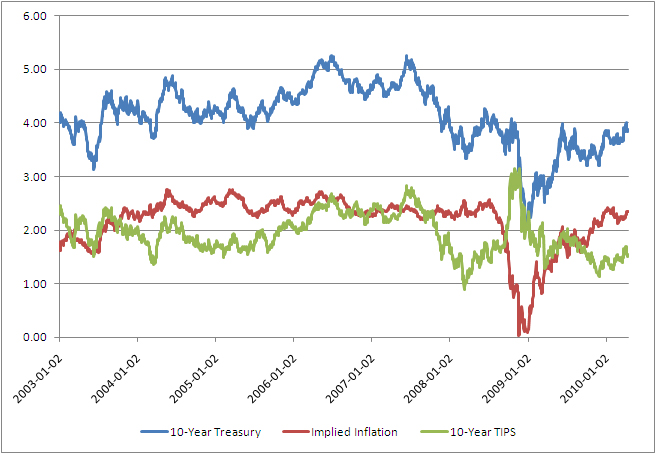
As you can see, from mid 2003 until late 2008, the market pretty consistently priced inflation at about 2.5%, and that’s about where it was most of the time. Then, in late 2008, the world came to and end, and with the 2nd Great Contraction, the TIPS rate jumped up to the nominal rate, indicating that inflation was the least of anyone’s concern. The last 16 months have seen a gradual return to historical averages for inflation. But even as nominal rates have risen, the TIPS rates have kept pace, and the current implied inflation, 2.33% is at or slightly below historical averages.
Compare this to gold over the last few decades. Here’s just over 40 years’ worth of gold price info: the current price, the CPI-adjusted price, and the CPI (1982=100):
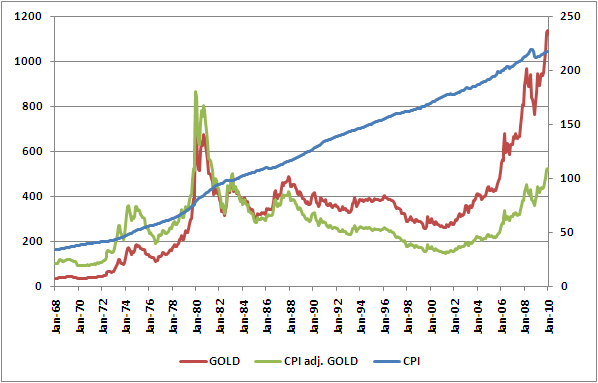
So much for gold as an infallible inflation hedge. From 1983, prices march inexorably upwards, but I’ll wait until 2010 for the real price of gold to come back. The quadrupling of gold’s real price from 1970 to 1975 doesn’t seem justified by the CPI, and while there’s a definite bump in the CPI in 1980, again, it doesn’t seem to justify gold’s move from $200 to $800. Then, even as there’s another little bump in 1990, gold prices continue down.
Gold is a commodity, with its own price dynamic. Fear can drive up the price, and people move to safety. But gold can also be its own bubble, with inflation being the justification rather than the cause. Like any other commodity, there’s supply and demand. Gold bugs tend to focus on demand. But…
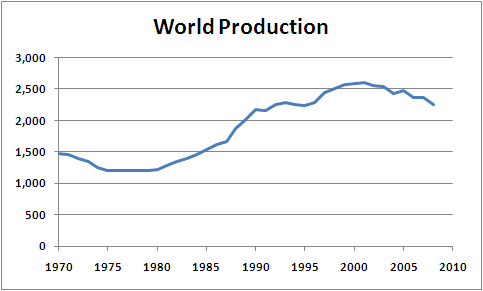
This is the world production of gold according to the USGS. Now, we’ve seen declines in the production of gold before, so perhaps this isn’t “Peak Gold.” In the early 1970s, coinciding with the run-up in prices from ’72-’75. After 1980, production picks up in response to the bubble, and continues to rise until 1990 or so. And then, from 1996 until 2010, production and price are almost inverse to each other.
If this is Peak Gold, if new veins aren’t as productive, and worldwide production will continue to fall, then that goes a long way towards explaining the recent run-up.
This doesn’t mean that inflation won’t happen, or that all’s right with the world. The massive pile-up in federal debt is the sort of thing monetary catastrophe is made of. And once a loss of confidence occurs, it usually happens more swiftly than imagined, even by most who expect it. The credit markets can, and do, miss signals. Perhaps they’re pricing in a higher likelihood of either default or punitive tax rates to make up for the unbearable entitlements we’ve loaded onto ourselves. Or perhaps, more ominously, they’re just not looking beyond the next couple of years, and since we can’t predict when the bottom falls out, there’s no point in trying.
But gold bugs can’t pick and choose signals, and right now, the credit markets just aren’t signaling, “Weimar 1923.” A comprehensive theory has to encompass all the data. The simplest answer is that the run-up in gold isn’t very much about inflation, but about simple supply and demand, with supply falling as much as demand picking up.
Lipstick On a Pig
Posted by Joshua Sharf in Design, Economics, Stimulus on March 23rd, 2010
Bruce Nussbaum over at BusinessWeek reports that the Obama Administration has hired Edward Tufte, probably the most innovative data design guy around, to help explain the stimulus spending:
“I will be serving on the Recovery Independent Advisory Panel. This Panel advises The Recovery Accountability and Transparency Board, whose job is to track and explain $787 billion in recovery stimulus funds.”
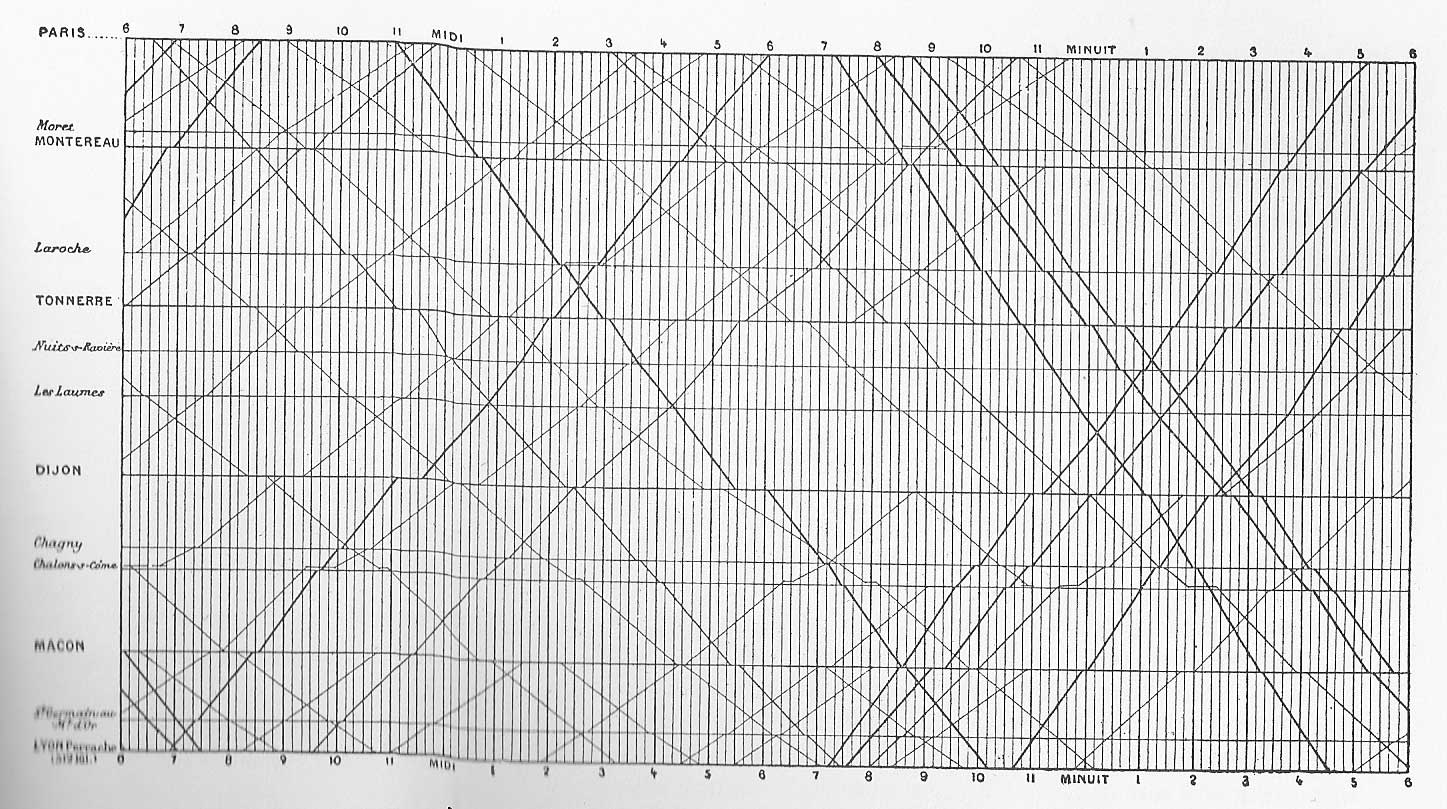
Make no mistake. Tufte is brilliant. He didn’t invent either one of these graphs, but he popularized them in his book, The Visual Display of Quantitative Information. In both cases, click to enlarge.
Here is a Paris train timetable:
And here is a chart of Napoleon’s Moscow campaign. The thickness of the line is proportional to the number of men remaining, and the bottom line is the temperature, which tracks from right to left, as it follows the retreat:

They’re brilliant, simple, clean, and convey huge amounts of information.
Nussbaum is right when he says that this is a smart choice, although I think just emphasizes that the Administration thinks their stimulus problem is one of presentation rather than substance. Bad data can’t be fixed by good presentation, at least not honestly, and I wonder if and when Tufte will get frustrated with the lousy data he’s being asked to present. In fact, it may almost be worse if he succeeds. We’ve seen how poor the stimulus data is already, and superb presentation will only act as propaganda.
For an example of equally inventive data visualization, see here. (h/t: Powerline)
In Other News, Chavez Nationalizes Unsupported Objects For Falling
Posted by Joshua Sharf in Economics on January 18th, 2010
Via the Wall Street Journal:
President Hugo Chavez ordered Sunday the seizure of a French-owned retail chain on accusations that it raised prices after Venezuela devalued the currency by half.
“Until when are we going to allow this to happen?” Mr. Chavez asked during his Sunday television program in reference to the alleged price hike by Almacenes Exito SA, headquartered in Colombia and controlled by French retailer Casino Guichard-Perrachon S.A.
The Venezuelan leader said that new law may need to be approved to carry out the nationalization. “I’m waiting for the new law to begin the expropriation process,” he said. “There’s no going back,” he added.
Almacenes Exito saw some of its stores closed this week by government authorities on accusations that it was increasing prices regardless of Mr. Chavez’s orders that retailers were not to adjust prices after he devalued the currency to 4.3 bolivars per dollar from the previous rate of 2.15 bolivars.
When inflation kicks in here, no doubt we’ll be hearing about Ford’s morally unacceptable price-gouging, too. Not to mention blaming the banks for high interest rates.
-
You are currently browsing the archives for the Economics category.


