Archive for category Colorado Politics
We’re #7!
Posted by Joshua Sharf in Colorado Politics, PPC on June 12th, 2011
Which is sort of good news. Except that a couple of years ago, we were #2.
I’m talking about the Mercatus Center’s Freedom Index. If you think you see a pattern in that map, by the way, your eyes are not deceiving you. Blue states tend to be darker, red states tend to be lighter; the authors provide a few charts correlating liberal/progressive vote share with the different measures they use that comprise the index. Since the index lags events by two years, we still have a couple more years of all-Democrat rule to go, so things are likely to get worse for the Centennial State before they get better.
So, for the record, here’s how Colorado has fared in the 2009 and 2011 surveys:
| 2009 | 2011 | |||
| Rating | Rank | Rating | Rank | |
| Fiscal Policy | 0.21 | 5 | 0.176 | 5 |
| Regulatory Policy | 0.12 | 11 | 0.039 | 25 |
| Economic Freedom | 0.337 | 3 | 0.215 | 10 |
| Personal Freedom | 0.084 | 16 | 0.088 | 8 |
The authors have a pie chart in the back of the report showing how much weight they gave to the individual issues comprising each index.
It’s not hard to see where Colorado’s fallen down, and where it’s held up. Fiscal policy has been restrained by TABOR, and by a peculiarity that assigns greater freedom to greater revenue decentralization. In Colorado’s case, that may be a bit deceptive, as the state still mandates a fair amount of local spending. On the other hand, they do take a hard look at debt/personal income, and Colorado’s definitely headed in the wrong direction there. (The state, localities, and special districts – I’m lookin’ at you, FASTER – have all been violators here on that score.) In fact, spending as a percentage of personal income did increase over the two years covered, but the index was held in check by lower government employment as a percentage of the total workforce. When the survey comes out for 2009-2010, those trends are certain to reverse.
Personal freedom has seen both gains and offsetting losses, and you can see that the rank there improved more by comparison than by actual objective improvements. Reductions in alcohol taxes were offset by increased local restrictions on guns, but other than that, little changed from 2007 to 2009.
The authors blame the passage of a minimum wage law for much of the Regulatory Policy decline – and that really has fallen in absolute terms. Looking at the actual data, it appears that stricter worker’s compensation requirements, along with a higher percentage of workers being covered, is responsible for the rest of the decline in labor freedom. Health freedom also declined as a result of greater requirements placed on the small group market and increased mandates on policies.
The authors admit to a certain amount of subjectivity in their metrics. They use a lot of parametric tests (1 = by land, 2 = by sea, etc.), and some of the cutoffs are judgments calls. But there’s no reason to think they’re gaming their own system, looking for inconvenient cutoffs that would disadvantage some states while helping others. And there’s certainly no reason to think they’re trying to rein in Colorado’s previously stellar rankings.
Also, remember that Mercatus could fairly be characterized as an economic-based, libertarian-minded center. They tend to see public policy more as an economic measure than a social one, leading them to reflexively oppose so-called “victimless crimes,” and count, for instance, mandatory legal residency checks as an impingement on freedom, where others might see them as the price of maintaining a level of order and civility in society.
Still, it’s dismaying to see Colorado slipping in these rankings, especially when the slippage is due almost entirely to increased fiscal irresponsibility and increased regulatory burdens, practically designed to discourage job creation. If the states are the laboratories of democracy, Colorado’s recent experiments have produced some pretty decisive results.
Not Keeping Pace
Posted by Joshua Sharf in Colorado Politics, PPC on June 3rd, 2011
Back in October 2009, I wrote a piece examining the state of Colorado’s Unemployment Insurance Fund, and concluded that making long-term changes in eligibility in return for some short-term federal crack cocaine cash was a terrible trade. There was a graph showing where our unemployment insurance fund was headed at the time, even before federal aid, and I use that term advisedly:
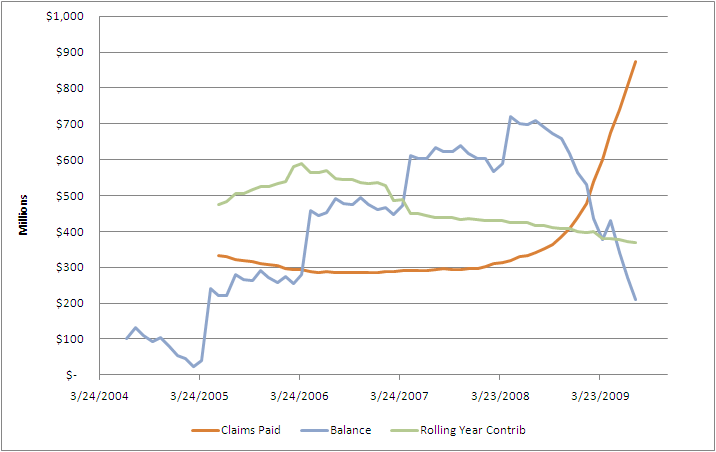
The “Claims Paid” is a rolling 12-month total, as are the contributions. Well, here’s that graph now:
Colorado Unemployment Insurance Fund
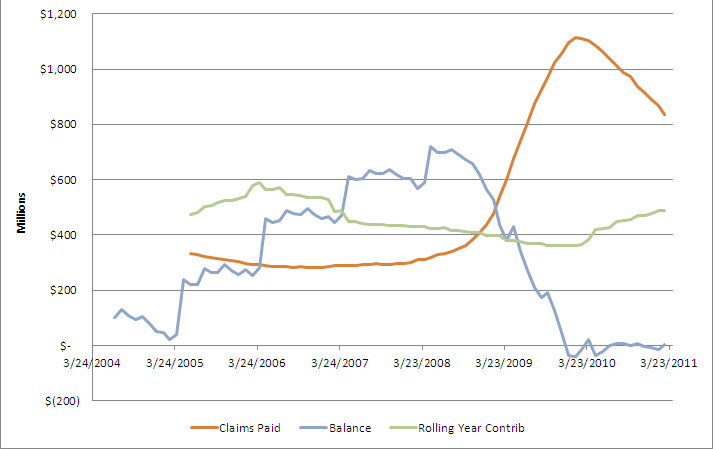
As you can see, the federal “aid” didn’t arrest the decline, it didn’t even hide the decline. At the beginning of 2010, Colorado’s bank balance hit $0.00, went past that, and had stayed there ever since. That $127 million that was so valuable and necessary funded the system for about 5 1/2 weeks at the peak of claims, about 8 weeks now.
These changes weren’t just an extension of benefits. Those extensions were supposed to be picked up by the feds. No, the $127 MM was in return for structural changes designed to permanently increase eligibility. Part of the justification for the increase was Mark Zandi’s claim that unemployment insurance payments had one of the highest multipliers of all forms of intervention. But it’s been pointed out that Zandi never explained how he got to that number, and the models used have never been subjected to outside scrutiny. Moody’s is no piker, but if policymakers are going to use their results, their models need to be subject to the same scrutiny that we give to global warming data. Cough.
The business contribution line, you’ll notice, has been rising. Well, that’s not because so many more people are employed now in Colorado than used to be. It’s because every May, CDLE is allowed to levy additional assessments on business when the fund falls below a certain level. Given that levels are those for a reservoir in Death Valley, the fund right now will meet any insolvency test you care to invent.
So now, when the federal government begins charging Colorado interest for the money loaned for the further benefits extensions, and when levels remain elevated at least in part because the terms for qualifying are more generous, Colorado is back asking (in the sense that the Stasi “asked” you not to make that joke, please) for even more money from businesses.
Ironically, the House sponsor of this financial wizardry was the man who now wants you to send him to Washington for more of the same – Rep. Sal Pace. Someone from our enterprising media, someone who does this sort of thing for a living, really ought to ask him about this, dontcha think?
Be Careful What You Wish For
Posted by Joshua Sharf in Colorado Politics, PPC on May 31st, 2011
Back in 2009, the Colorado legislature decided they had had it with citizen oversight. They passed HB09-1326, which, among other things:
- People who successfully challenge the validity of signatures in court could sue sponsors of the measure to recover attorney’s fee.
- Circulators who collect more than 100 signatures are required to go through a government-sponsored training procedure before they are allowed to collect additional signatures legally
Most damagingly, people can sue for attorneys’ fees even if they don’t invalidate enough signatures to get the measure disqualified, and they can hold sponsors of the initiative personally liable for these damages. Jon Caldara, the victim of such a lawsuit, has argued that these rules, and the risk they entail, constitute such a high bar to participation in the process that they effectively kill it.
Comes “Great Education Colorado Action is the political arm of Great Education Colorado, a group that urges more spending on education,” (gee, I wonder where their funding comes from?), and a ballot measure to “temporarily” raise state sales and income taxes to pay for education. (For the moment, let’s skip over the merits of the measure, except to note that money is fungible, and anyone who thinks this money is going to make it to the classroom without taking a detour through teachers unions and pension funds will also probably be surprised by the headlines, immediately upon ratification, that claim that the schools are still short of cash.)
Their innovation here isn’t the proposal, that’s old hat. Their innovation is in how they propose to gather signatures:
So supporters are trying a strategy that uses social network websites to ask people to sign the petitions. Supporters have set up a website that allows people to download petitions and then volunteer to gather signatures.
The kit includes instructions on how to gather 50 signatures to fill each petition and even how to properly staple the pages. It instructs volunteers to seek out a notary after gathering the signatures and then to return the signed petitions to supporters in Denver.Every petition must bear an individual number, and the website where they can be downloaded assigns each one a unique number.
Some see this as a highly creative way to gather signatures on the cheap. I see it as a way to limit the teachers unions’ liability, while still exposing them to real risks. The circulators are under even less control than usual, will be prone to making mistakes, and all the liability for the costs involved in hunting in this target-rich environment will fall to GEC. Moreover, there’s no way of stopping individuals from collecting more than 100 signatures. In fact, there will be considerable incentive for person A to gather, say, 150 signatures, and have persons B and C sign for 50 each, which is, of course, fraudulent.
Great Education Colorado may think it’s got a really cool idea here. I hope someone’s willing to hold them to the same inane standards that the left has tried to foist on the rest of us.
Also, just to add to the schdenfreude, note that suddenly, to the Denver Post, which has spent years agitating against the initiative process, “The hurdle to get an initiative on the ballot isn’t small.” Keep that in mind the next time they editorialize about how easy the initiative process is. Apparently, small is in the eye of the petitioner.
Contempt of Constituents
Posted by Joshua Sharf in Budget, Colorado Politics, Economics, PPC on May 30th, 2011
Looking at the events of the last couple of weeks, it’s difficult to escape the conclusion that certain public officials in Colorado hold their constituents in contempt for the sin of not handing over their pocketbooks.
Legislative Democrats, with the cooperation of too many Republicans, have gone along with efforts to water down the state’s initiative process. And now, for refusing to go along with these plans, the people having spoken, must be punished.
In 2008, they turned down Referendum O, which would have allowed opponents of ballot measures to focus their efforts on any one Congressional district. And they turned down Amendment 59, which would have lined the teachers unions’ pension plans by gutting TABOR.
This session, the Democrats failed to pass out of the Senate SCR-001, which would have created a hybrid Constitutional amendment-recision process that was clearly too complex for its stated goals.
Now, they have resorted to suing their own constituents in federal court, claiming that the Colorado Constitution is unconstitutional. The legal precedent here is clear. The courts have long held that the US Constitutional requirement for a “republican form of government” is non-justiciable, meaning that it’s a matter for the legislature and the people to decide. The most recent case, in 1912, upheld a state’s citizen initiative process against the very claim they seek to revive.
Remember, for “progressives,” it’s always Three Minutes to Wilson.
This effort is really a matter of politics, not of litigation, and that the plaintiffs are seeking a platform at taxpayers’ expense to make their case against TABOR.
(Let’s be clear: this is a Democrat initiative, and shame to the few officeholding Republicans who’ve given them cover to call it “bipartisan.” The big names are representatives of the “former” variety, and of the total list of 12, only 6 hold elected office, at the school board or city council level, most of which are nominally non-partisan.)
We’ve also heard that back in 2009-2010, the Colorado Springs City Manager at the time, Penny Culbreth-Graft, had instructed the city’s PR office to intentionally undermine its image, in the national media if need be, to browbeat the citizenry into voting for higher taxes. I’m sure the folks tasked with luring tourists, students, and businesses to the area were thrilled with this.
So think about this: in the last two weeks, we’ve seen public officials sue their citizens, and undermine the name of their own city. Why on earth should these people be trusted with more of our money?
More Pension Risk
Posted by Joshua Sharf in Budget, Business, Colorado Politics, Economics, Finance, PERA, PPC on May 29th, 2011
Last week, the Wall Street Journal reported that pensions are moving more money back into hedge funds:
Also, pension officials are using the historically strong returns of hedge funds to justify a rosier future outlook for their investment returns. By generating more gains from their investments, pension funds can avoid the politically unpalatable position of having to raise more money via higher taxes or bigger contributions from employees or reducing benefits for the current or future retirees.
The Fire & Police Pension Association of Colorado, which manages roughly $3.5 billion, now has 11% of its portfolio allocated to hedge funds after having no cash invested in these funds at the start of the year.
…
While pensions have been investing in private equity and what are called alternative investments for many years, hedge funds have represented a smaller part of their portfolio. The average hedge-fund allocation among public pensions has increased to 6.8% this year, from 6.5% for 2010 and 3.6% in 2007, according to data-tracker Preqin. (Emphasis added.)
PERA’s own investments in hedge funds are unclear from the latest data, but if the “Other of Other” category is representative, it could be about 10% of their holdings.
This may be good in the short run. There’s no doubt that some of these funds have done well, being able to hedge some of their risk away and focus on capturing industry or sector returns. But there are some serious dangers here, and they are complicated by the problems already noted with pension accounting.
First, there’s no such thing as risk-free alpha. Remember, the market tries to match risk with return. If someone is selling an investment with 10% return and the risk associated with equities, beware. Because if that were possible over the long run, enough people would pull money from equities and pile it into this mythical investment, so the returns would match. Either that, or there’s hidden risk in there that justifies the extra return.
Either way, in the long run, the funds are taking on more risk, or will have the additional return arbitraged away as more people invest in these strategies. Also, if many of the funds are using the same strategy, it may be difficult for them to execute trades that actually allow them to limit risk, as they may all be trying to sell overperformers, or buy hedges, at the same time.
Another threat to pension funds is in the bolded sentence above. Managers are not only using these returns to justify higher projected returns. What goes unstated is that they’ll also use them to justify the higher discount rates, that make their pensions look better-funded than they are. It’s a perfect example of the perverse accounting incentives built into fund management.
Last, these strategies are not necessarily transparent, making it difficult for independent auditors to even assess the risk that these pensions are taking on.
I’m all for finding ways to hedge away risk, and there’s no reason that pension funds can’t participate in some of those techniques. I’m skeptical that, in the absence of fixing the underlying problems, this approach is going to do any more than paper over problems, yet again.
PERA’s Portfolio Allocations
Posted by Joshua Sharf in Budget, Colorado Politics, PERA, PPC on May 23rd, 2011
In yesterday’s Denver Post, PERA’s Chief Investment Officer, Jennifer Paquetteis, responded to an op-ed by investment professional Blaine Rollins (“Hope Is Not An Investment Strategy“) that detailed the risk that PERA has taken on:
PERA has instead relied on solid investment strategies created under the direction of the board of trustees with the help of highly experienced staff and consultants. PERA’s investment strategies match its mission, with an investment horizon of decades and a focus on maintaining the stability of the fund.
…
These investment returns allow PERA to provide reasonable benefits for public servants without placing an excessive burden on taxpayers.
In a previous post, I noted that as a whole, US government pensions had shifted to taking on more risk over time. Interestingly, this does not appear to be the case with PERA:
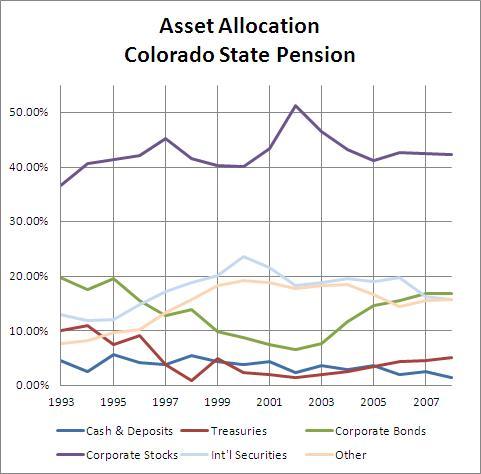
Seeing that stocks, as they appreciated in 2002, were becoming a disproportionately large share of the portfolio, managers shifted those investments to corporate bonds, which tend to have lower yields, but generally assume less risk. They have also – albeit slowly – grown the proportion of their investment in Treasuries. While I believe that PERA’s overall investment mix still has entirely too much risk built in, it is hard to argue that they have gone around chasing higher yields, or allowed their asset allocation to get out of whack when one class outperformed the others.
The problem is, Ms. Paquetteis’s conclusions don’t necessarily follow from her premises, especially over the long term. Paquetteis’s response only addresses whether or not PERA is following reasonable portfolio diversification techniques. It fails to address the underlying problems with those techniques: the large unfunded liability, the added year-to-year risk associated with needing larger and larger returns, and the faulty accounting standards that not only permit, but actively encourage taking on that extra risk.
Nothing New? Tell That To Everyone Else
Posted by Joshua Sharf in Israel, PPC, President 2012, War on Islamism on May 22nd, 2011
Political apologists for President Obama didn’t waste much time in claiming that his Thursday speech didn’t really say anything new about the Arab-Israeli conflict.
Too bad that none of the principal actors in the region are behaving that way.
We all know about the…tepid…joint appearance by Prime Minister Netanyahu and President Obama Friday. It came after a scheduled 30 minute meeting went for over two hours, leaving lunch and aides steaming outside the room.
Then, today, the Palestinians:
Following Obama’s Middle East speech on Thursday, in which he said that a future Palestinian State should be based on the 1967 lines with mutually agreed upon land swaps, PA President Mahmoud Abbas called an emergency meeting of the PA leadership to discuss the new developments. Erekat said that the meeting could take place on Tuesday or Wednesday after Abbas, who is currently in Jordan meeting with King Abdullah, completes consultations with Arab leaders and the Arab League.
PLO Executive Committee member Hana Amira was quoted by Israel Radio on Sunday as saying that the Palestinians would cancel plans to go to the UN with a unilateral declaration of statehood in September if Israel would agree to negotiations based on the 1967 lines and freeze all building in West Bank settlements and east Jerusalem for a period of three months.
Right. The Palestinians decided to call an emergency meeting over “nothing new.” Evidently, the simultaneous translation into Democrat missed a few things.
Note also the timing and the demand. The three month building halt in Jerusalem – remember, that’s something the Palestinians had never called for before Obama did – is timed to end in September, when the UN vote could happen, anyway. The Palestinians can seize the opportunity to look amenable, continue to both obstruct and purse the UN option, and still call for a vote in September. If you argue that, well, that’s nothing new, you’re right. Except that that diplomatic angle relies on the rest of the world believing differently.
The Palestinians may be about to find out what Israelis and Jews should have discovered in 2008 – there’s an expiration date on everything Barack Obama says, everything – and on the Middle East, it can be as little as 24 hours. In the meantime, Netanyahu is already saying that the tiff was exaggerated, and Obama is already hedging and filling, at least a little, in his interview with the BBC, and I strongly suspect there will be more of the same in about 15 minutes (unless the President is late to his own speech again) to AIPAC.
Either the President really thought he was being pro-Israel, and had to have it explained to him why he wasn’t, or else he knew exactly what he was saying, and was surprised by the political blowback, especially among Jewish Democrat donors and fundraisers, who can probably still bring in more early money than Ramallah phone banks. In either case, it’s a continuation of the amateur hour that characterizes this administration’s foreign policy, 3AM or not.
A Test For Governor Daniels
Posted by Joshua Sharf in PPC, President 2012 on May 13th, 2011
In a decision guaranteed to bring outraged barons all over America to the defense of their castles, the Indiana Supreme Court has ruled, in the course of one week, that 1) you don’t have the right to block a policeman from entering your home without a warrant, and 2) they don’t need to knock to serve the warrant. (Moat, Mr. President? Did someone say, “moat?”)
In a 3-2 decision, Justice Steven David writing for the court said if a police officer wants to enter a home for any reason or no reason at all, a homeowner cannot do anything to block the officer’s entry.
…
This is the second major Indiana Supreme Court ruling this week involving police entry into a home.
On Tuesday, the court said police serving a warrant may enter a home without knocking if officers decide circumstances justify it. Prior to that ruling, police serving a warrant would have to obtain a judge’s permission to enter without knocking.
This is what happens when you peel legal education free from Blackstone, Maine, Marshall, and Story. I’m not even an attorney, but I’ve been to Runnymede and seen the Magna Carta monument there, and I can tell you that it’s going to take some Olympic-worthy mental gymnastics to turn overturning 800 years of English Common law precedent into solemn respect for stare decisis.
Now, we all remember when President Obama decided to use the State of the Union Address not only to berate the Supreme Court justices in attendance over the Citizens United ruling, but to encourage the Democrat members of Congress to rise in thunderous applause, surrounding those justices with their own reprimand.
This case should provide an opportunity for a prospective President Mitch Daniels to find a statesmanlike way to rectify this situation without sending out the landed gentry to hold their swords to the Indiana justices’ necks.
He does have some options.
Redistricting East
Posted by Joshua Sharf in Colorado Politics, PPC, Redistricting on May 13th, 2011
The Omaha World-Herald this morning reports on Nebraska’s redistricting debate, mostly centering around the Omaha district, the only one that could possibly elect a Democrat Congressman:
State Sen. Scott Lautenbaugh, the main architect of the GOP map, denied that politics played a role, saying he never looked at voter registration numbers. He said his main focus was on keeping the major cities of Sarpy County whole.
His map does that.
…
State Sen. Heath Mello, a Democrat from South Omaha, said his map tried to maintain as much of the current district as possible. He also said he believes eastern Sarpy County — with its urban feel — has more in common with Omaha.
Mello also denied that he took voter registration numbers into consideration when he drew the map.
“My plan is trying to keep the district looking the same as it is,” Mello said.
The debate is taking place almost entirely in the context of keeping communities of interest whole and similar to the rest of the district they’ll be a part of. I can even believe that neither senator (welcome to Nebraska’s unicam, where all legislators are senators) looked at the registration numbers, but only because they didn’t have to. Any politician assigned the task would know which parts of which counties are home ground and which are hostile territory.
The debate on the Democrat side the other night took place almost entirely in terms of “competitiveness,” which as Sen. Lundberg pointed out, really does mean gerrymandering. The Republicans eventually forced the Democrats to at least acknowledge the presence of other considerations, like communities of interest (or community of interests, if you’re Sen. Carroll), but that was after the Dems had decided to commit legicide on their own bill.
Nebraska is different in that it’s more heavily tilted to one party, and the population centers are fewer in number. Nevertheless, the Dems would love to find a way to capture CD-2 if they could, and Nebraska’s electoral votes are also based on how congressional districts vote, so it’s not as though nobody cares.
Redistricting, to adapt a phrase from Milton Friedman, is everywhere, at all times, a partisan process. But there’s no reason that the parties can’t at least deal with how the districts will affect policy, rather than just elections.
Democrats Debate for Republicans
Posted by Joshua Sharf in Colorado Politics, Denver Mayor, PPC on May 10th, 2011
This should be interesting.
Tomorrow evening, May 11, from 7:00 – 8:30, at Denver West High School, Mayoral runoff candidates Chris Romer and Michael Hancock will square off in a debate sponsored by Denver County Republicans.
Even though Republicans constitute about 1/6 of Denver’s registered voters, Democrats in the nominally non-partisan races tend to ignore them. Not this year. With such a close race, and with neither candidate having a clear, obvious appeal to Republicans, neither candidate can afford to take any votes for granted. Thus, this debate. Chuck Plunkett of the Denver Post will MC the event, and KHOW’s Caplis and Silverman will moderate. The Denver GOP has solicited questions from the public.
The major concerns will surely be about the city budget deficit, taxes, and how the city can encourage job creation and businesses to relocate to Denver. Given Hancock’s involvement in the Montbello school reforms, and Romer’s State Senate activity on the medical marijuana issue, those may also come into play.
What is particularly interesting is that these are both liberal Democrats, yet they’ll be subjected to an evening of questions from the Republican & small-l libertarian points of view. They’re likely not used to getting that on a sustained basis, and while they can’t afford to pander (especially given that plenty of non-Republicans will be watching and hearing quotes from the debate), neither can they afford to be seen blowing off a significant opposing world view.
No doubt each will start off by acknowledging their differences with the crowd, but hoping to show that he’s open-minded, willing to listen, etc. How they frame those positions, and whether or not either shows frustration with questions that routinely challenge his political philosophy will be fascinating to see.
The debate is free and open to the public, and should be very informative.
-
You are currently browsing the archives for the Colorado Politics category.


