Archive for category PPC
Maps
Posted by Joshua Sharf in Colorado Politics, PPC, Redistricting on May 4th, 2011
So the Colorado Republicans have produced a compromise map in an effort to avoid a crapshoot showdown in the courts. Given that there are a fair number of Republican-appointed judges out there now – not the case in 2001 – the chances of winning are perhaps higher. But you essentially give up control over the process when you send it to litigation, and politicians would always rather negotiate solution than have one imposed.
The Republican map tweaks things a little here and there from their original map, but it still looks pretty much like the current set of districts. It adheres to constitutional and statutory principles for districts (keeping together communities of interest, Denver, the Western Slope and the Eastern Plains), it assumes that various parts of the state will have the chance to elect representative who actually live there.
The Democrat map, of course, does none of these things. Competitiveness is a goal I actually agree with, but by law, it can’t override those existing requirements. Moreover, as has been pointed out, portions of every district in the state would lie within sight of DIA. If you thought that Denver thought the rest of the state was in orbit around it before, well, a fortieri.
Unfortunately, the map’s politics, in the battle for public opinion, will get a boost from Colorado’s geography. (That the Denver Post will be giving it a helping hand goes without saying.)
A few weeks ago, there was an article online (which I can’t find any more) that talked about do-it-yourself redistricting software. One group of New York Democrats had fun trying to figure out a way to get a state full of Democrat-majority or -plurality districts. They were able to do it by essentially carving the state up into ribbons, with every district getting a little piece of the Democrat-heavy New York City & Suburbs, enough to wipe out or neutralize the Republican-friendly upstate areas. If “gerrymander” comes from “salamander,” this was a whole maelstrom of ’em. You couldn’t push through a map like that, and nobody was really interested in trying.
The Colorado Democrats’ map just doesn’t look that threatening. Denver is located closer to the middle of the state than NYC is. We don’t have 30+ representatives, we have 7. And since the one rule the Democrats obeyed – by coincidence, no doubt – was to keep Denver intact, they only had to get 6 districts to work out. The result is something that, while radical surgery compared to what we had before, doesn’t look all that bad if you’re starting out fresh. In the game of “let’s see how much we can get away with,” this much have come as a delightful surprise.
So in what’s left of negotiations (and there’s always room for a special legislative session; earn that $30,000, guys), and what may come down to a court battle, the Republicans have that to overcome. They need to continue to pound away that while you might not think Grand Junction has much in common with Pueblo, it’s got more in common with it than it does with Boulder. They need to remind people that while DIA is a world-class airport, keeping the ATC guys awake by letting them play “how many Congressional districts can we see today?” from the tower isn’t actually a statutory requirement.
I agree with some others that the Rs look more statesmanlike in presenting a compromise map. They also have the luxury of being able to compromise. It’s not clear that the Dems’ maps can actually change that much without the whole plan falling apart. Now they need to keep at it, and not buckle under the pressure to meet an artificial deadline.
Worthwhile Canadian Initiative
Posted by Joshua Sharf in PPC on May 3rd, 2011
That was the winner in Michael Kinsley’s legendary “Most Boring Headline” contest. Tonight, it refers to the Canadian election results, where, for the first time since 1988, the electorate has returned an outright Conservative majority. Prime Minister Stephen Harper has governed with a minority, in coalition with the New Democrat Party, since 2006, but he will finally get a chance to govern with a majority of about 10 seats on his own.
Harper led the breakaway conservative-populist Reform party, based on the plains and his own province of Alberta, back into an Alliance with and eventually a reunification with the Conservative Party. The result has been a Tory party to the left of American Republicans, but to the right of where the Tories had been for the better part of two decades. On issues most of interest to Americans, he seems to be a relative free-trader, a strong supporter of the War on Terror, and a very strong and vocal supporter of Israel. Brian Mulroney was often compared to Reagan, largely because he won 211 (!), no really, (!), seats in 1984, the year of Reagan’s cakewalk over Walter “Mr. Warmth” Mondale. But in reality, Mulroney was more establishment, more like Eisenhower, where Harper is more like Canadian Reagan.
The story of the election was the rise of the NDP as the opposition party, benefitting mightily when both the separatist Bloc Quebecois and the “natural governing party (cough),” the Liberals, both folded like cheap suits. BQ went from 45+ seats in Quebec to 4 (all those seats went to the NDP), and the Liberals turned in their worst showing in history, getting less than 20% of the vote and about 35 seats in Parliament. Evidently, the NDP wasn’t hurt much by last-minute revelations that its leader, “Premature” Jack Layton, had been found some years earlier, in flagrante, by the police, at a whorehouse massage parlor.
The Day After
Posted by Joshua Sharf in 2012 Presidential Race, National Politics, PPC, War on Islamism on May 2nd, 2011
It goes without saying that it’s a very good thing. It isn’t VE-Day or VJ-Day, and Americans have enough sense not to treat it as such, but it’s worth one night’s jubilation. This day resolution was a long time coming, and Americans have the right to blow off a little steam. This is, after all, what closure looks like.
Although Obama didn’t plan or execute the operation, he did have to give the Go order, and failure of the operation could have been catastrophic. He had to burn some of the few remaining bridges we have with our nominal “ally” Pakistan, which seems to be drifting into China’s orbit, further heightening the risk.
But then, we’re faced with the Left’s desire to turn this into a partisan victory, almost even before the President made his remarks.
Is it really? Maybe not.
While Obama called former President Bush to tell him the news, he failed to even recognize his efforts in all but the most oblique terms. It continues a pattern of smallness and narcissism that have characterized this President. My friends on the right, who made fun of the birthers by demanding Osama’s Long-Form Death Certificate, showed more class than Obama.
One moment of clarity and gutsiness doesn’t in itself reverse over 2 years of fecklessness, and both our allies and our enemies know it. This should be a moment to seize the initiative in various theaters of operation, but it does not appear that Obama will do so. Instead, it now looks as though last week’s national security personnel moves are designed to retreat from the battlefield and press others to do so. (If not, we’ll soon see some serious pressure on Assad & Syria. If so, look for talk of “rapidly-closing windows of opportunity” for Israel to make concessions.)
The temptation to use bin Laden’s execution as an excuse to leave Afghanistan now, a leaning echoed in some isolationist quarters last night, must be great. But to jump to that conclusion would be to trivialize a major civilizational conflict into a south Asian version of the Hatfields and McCoys.
There was little if any indication in his speech of the context of the broader struggle, as one against radical or political Islam (as opposed to Islam as a personal religion); rather it was solely about alQaeda. The threat of jihad from the Muslim Brotherhood, and from Iran and its various catspaws went unmentioned or even unhinted-at. Does anyone believe that Obama better understands or is now more willing to confront those threats or the murderous ideology behind them?
Indeed, our treatment of bin Laden’s body more than suggests not. While we all had a good time thinking of the uses to which it could be put, most of us (I hope) were joking about torch relays, carnival dunk tanks, and heads-on-a-pike. As solutions go, burial at sea wasn’t a bad one. It was sufficiently but not overly disdainful, and deprives followers of a shrine. (It reminds me of Churchill’s legendary telegraphic response when told that his mother-in-law had died: “Autopsy, Cremate, Bury at Sea. Leave Nothing to Chance.”)
But the need to announce that we were following Islamic law in disposing of the body is of a piece with having our soldiers in Guantanamo handle the Koran only with clean white gloves. It’s one thing to be respectful of the religious sensibilities of our friends, or even neutrals; quite another to give our enemies reason to believe that we acquiesce to their place for us in their murderous ideology.
You can only do that if you’re not really convinced that you’re up against a murderous ideology. Iran only wants regional hegemony, and Ahmedinejad isn’t suicidal. The Muslim Brotherhood and al Qaeda never got along, so the MB isn’t a threat. (See the reaction of their spawn, Hamas, to bin Laden’s execution.) It recycles all the comfortable complacencies of the Cold War, and it’s as wrong now as it was then.
It would be foolish to say that nothing’s changed, but it would be equally mistaken to think that too much has. Today’s markets are a fine example. They opened higher on the news, and quickly reverted to form on actual fundamentals. The fundamentals of the enemy we face haven’t changed. The fundamentals of the economy haven’t changed.
The 2012 elections are still worth holding. The poll numbers of George HW Bush right after Gulf War I, and George W Bush after capturing Saddam, were both quite high before subsequent events brought them back down to earth. As Crash Davis said, “The moment’s over.”
This week, many Americans, most of them not college students, will fill their cars with $4 gasoline and drive 10 miles out of their way to a Sam’s Club in a struggle to stay within budget. The risk of stagflation is quite real, and the President seems no more serious about dealing with the long-term fiscal threats to the country than he is about dealing with our external enemies.
If bin Laden’s execution is the beginning of a new seriousness, more than an opportunity to pose, well then good. If it’s merely an opportunity to withdraw from the field while looking good, to claim a victory when our enemy doesn’t feel beaten, then it’s no good at all.
With a President who still seems intellectually and emotionally committed to American decline, I’m not optimistic.
Bin Laden Dead
Posted by Joshua Sharf in PPC, War on Islamism on May 1st, 2011
Osama bin Laden is dead. Of course, this doesn’t end the War on Islamism, there are more practitioners out there, but it is a signal victory for which all of us, as Americans, are grateful.
Given that we got the news on May Day, I think in future years, we should co-opt the communist holiday and dance around May Poles with replicas of bin Laden’s on them. As for what to do with the actual body, I’m open to suggestions. Personally, I think putting it in a clear plastic box and sending it on tour of the country where it can be used for carnival dunk-tanks is probably too dignified a disposition.
Public Pensions and Risk
Posted by Joshua Sharf in Budget, Colorado Politics, PERA, PPC on April 29th, 2011
In a couple of previous posts, I’ve discussed the folly of using a loophole in public pension accounting to increase the discount rate by taking on added risk. Naturally, that fear would be more justified if it turned out that public pensions were doing that. Herewith, the evidence.
The Census Bureau does an annual survey of the state of public pensions, although they tend to take their sweet time posting the data. (The most recent data available was for FY2008.) Since the time when online records begin, in 1993, until 2008, you can see some obvious trends in public pension funds’ asset allocation:

The proportion in US stocks had risen almost 5 percentage points, from 34% to 39%, and the amount in safer, but really boring Treasuries has dropped from almost 20% to just under 5%. You can see where the poor years for stocks in 2007 and 2008 took back some of their gains, but inasmuch as the fund managers should have been rebalancing, this hardly vindicates them.
The fund managers have also been risking more of their money; cash and liquid securities dropped from about 7.5% to under 3%, although that could be for a number of reasons. The pension operations could be efficient, for instance, or the managers may have had better actuarial data at their disposal. In what looks like a gap in the Census survey questionnaire, “Other” is up significantly, from 5% in 1994 to 13% in 2008. Anything that’s 1/8 of your investment portfolio shouldn’t really be lumped together as “Other.”
And since its introduction as a separate category in 2002, Foreign Investments (not shown) have risen from 12% to about 15%. That’s probably a result of both better returns and increased investment.
I also want to emphasize that this is aggregate data for State & Local pensions across the US, not just for PERA. CalPers may well distort the data, and some plans, like DERP, are around 90% funded and suffered very little in the stock downturn in terms of fundedness.
In any event, what is clear is that the instruments best-suited to stable, long-term returns (at least up until now), US Treasuries have either been sold off or allowed to mature, with the funds being put into US stocks and some other, almost certainly riskier, categories.
There’s a lot more data over at the Census site, including some state-only data over the last 3 years that also has actuarials associated with it, so I’m hoping to make some time to dig into that, as well, but as usual, no promises.
Keeping the Higher Ed Bubble Inflated
Posted by Joshua Sharf in Budget, Education, PPC on April 28th, 2011
UPDATE: I am advised that this was the closest vote in 20 years on a tuition increase: 5-4. I don’t have the names of those who had the courage to vote No, but kudos to them for doing so. Even though Regents are elected, it’s relatively easy for them to roll over to an appointed administration on tuition votes, especially given the (at least perceived) centrality of higher education to opportunity for advancement.
The CU Regents have approved a 9.3% tuition increase for in-state students, and a 3% increase for out-of-state students. No doubt it’ll take special scientific instruments to measure the time that elapsed between this announcement and certain legislators’ bemoaning the fact that we “don’t fund higher ed.” But higher ed, even here in Colorado, has done a pretty terrible job of accounting exactly what it is we’re supposed to be funding.
The core mission of the university is the education of students, culminating in a degree that is supposed to represent the mastery of the material. It is almost impossible to get a straight answer as to what that actually costs. Go to the CU website, and you’ll be provided with a wealth of information about their sources of funding. Detailed information about spending is almost impossible to find.
Petraeus-Panetta Pavane Pensees
Posted by Joshua Sharf in 2012 Presidential Race, Defense, National Politics, PPC on April 27th, 2011
My first reaction is that this is good for Obama, politically, bad for Afghanistan, as good for defense as can be expected, and bad for Petraeus. (The CIA being impervious to reform, hardly rates a good-bad mention.)
Bad for Petraeus: He probably was exhausted after close to 10 years in the field, but he should have been JCS Chief. True, working in counter-insurgency requires a lot of facility with operational intelligence, so it’s not completely a fish out of water. But the CIA does much more well-hedged intelligence “analysis,” most of it bad, than it does actual intelligence-gathering and use. Petraeus has directed the war in two theaters, and deserves a chance to apply what he’s learned to the military as a whole. It’s hard to escape the thought that Obama is sidelining someone he’s afraid of politically, even though Petraeus has repeatedly disavowed political ambition. That’s why it’s
Good for Obama Politically: He can put a purported rival in a position to fail (who was the last actually successful DCI?), keep him from speaking with authority as he spends energy navigating a bureaucratic and political jungle. Panetta will probably be at home (enough) in Defense, and will be on the President’s side there.
Good for Defense: At least in terms of not having an empty suit or someone likely to wreck the place or take on unnecessary fights. Panetta’s not a fool, but he was in over his head at CIA. His job will be to manage the Carter-like hollowing-out of DoD, which Obama’s successor will have to fix. But he’s unlikely to roll over completely, and will at least bring an outsider’s eye to the job.
Let The Narrative Define The Candidate
Posted by Joshua Sharf in 2012 Presidential Race, Colorado Politics, National Politics, PPC on April 27th, 2011
Very quickly, the flagship Ricochet podcast has joined my favorite weekly listening. A couple of weeks ago, Pat Caddell was the guest, and as usual, the pragmatic, tell-it-like-he-sees it Democrat pollster was a font of helpful advice for Republicans, all of which is worth listening to. This particular bit stuck out: he suggested that the Republicans need to settle on a narrative first, and then the proper candidate will rise to the narrative. It’s an interesting thought, and one worth considering.
His strategic advice is predicated on the notion – facts, really – that time is shorter than we think, and that the narrative for the election will be set this year, not next. I think he’s probably right on this. People’s opinions on Obama – and presidential re-elections are always first about the incumbent – are already being cemented, and the cement is starting to cure. You see it in the “who do you trust more on X issue?” polling, on the right-track/wrong-track question, on a general atmosphere of incompetence and disconnect.
The Dems and the MSM (but I repeat myself) will try their hardest to shape the narrative this year to their advantage. You see this in the stepped-up union activity, the attempt to frame the budget fight. How both Wisconsin and the debt ceiling/budget fight play out, along with the continuing court battles over Obamacare (are you listening, Rep Stephens?) will be major factors in how these impressions solidify. The specific issues, and the framing of those issues as “budget-cutting” vs. “growth-enhancing,” as an example, will also make a huge difference. And even if we don’t know what particular economic or foreign policy details will be on people’s minds in 2012, the right narrative can absorb a wide variety of specifics and surprises.
By deciding on the narrative first, we determine the basis on which we’ll fight the election, we set out priorities and a vision of what’s right and wrong for the country, and where we want to lead it and see it led.
Everybody Likes A Good Discount
Posted by Joshua Sharf in Budget, Colorado Politics, Economics, Finance, PERA, PPC on April 24th, 2011
So with all the discussion about PERA, one key aspect of pension accounting hasn’t yet been mentioned: the discount rate. Now before you go all accounting-comatose on me, understand how important this is. Because with all the talk of how underfunded PERA is, it’s actually even more underfunded than you think.
Basically, if you have an obligation to meet, the discount rate is the rate you use to see how much money you need to have now in order to meet that obligation. So if you’re going to have to make good on a $100,000 obligation 10 years from now, and you use a 4.5% discount rate, you need to have about $65,000 now. If you use an 8% discount rate, you only need about $46,000.
Of course, the discount rate isn’t arbitrary. It represents a concept. The discount rate is the required rate of return, the return that an investor in that project requires, given the level of risk that he’s taking on.
The problem here, and how this relates to PERA (and many, many other public pensions), is that PERA is using the wrong discount rate. Instead of using the 4.5% discount rate, they’re using the 8% discount rate, which makes them look even less underfunded than they are.
PERA – Why 8% Isn’t 8%
Posted by Joshua Sharf in Budget, Colorado Politics, PERA, PPC on April 22nd, 2011
State Treasurer Walker Stapleton has been on the hustings, touting the need for PERA reform. His oped in the Denver Post a little while ago pointed out that the fund’s actuaries assume an 8% return on investments. If we don’t do something about the underfunding, Stapleton noted, we’ll be forced to take on more risk to try to reach the fund’s investment goals.
Now, PERA’s been criticized for assuming an 8% return, but that’s not really the problem. Eight percent is, in fact, the average annual return on US stocks since about 1870, according to data collected by Robert Shiller, he of the half-eponymous Case-Shiller Housing Index. The problem is, the standard deviation – the range within which about 5/8 of the returns actually fall – is 18%:
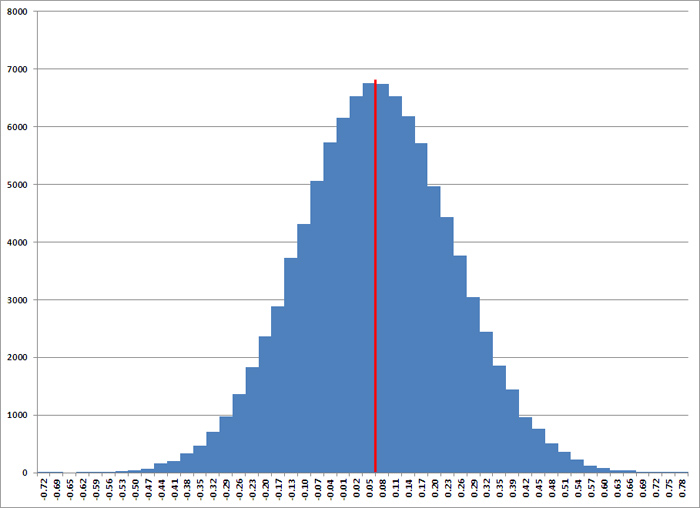
Which means that a lot of the time – almost one-third – you’re getting negative returns. For Backbone Business, I worked up a little scenario where you’re starting with $100,000, paying out certain portion each year, getting 8% return a year on your balance, and you come out even. But what should be apparent is that there are lots of scenarios that get you 8% average return, but force you to pay out more than you’re getting in the early years, and you never make up the difference. Here are some very basic scenarios:

And the graphs of the balances:

-
You are currently browsing the archives for the PPC category.


