Archive for category Colorado Politics
The Very Expensive “New Energy Economy”
Posted by Joshua Sharf in Budget, Colorado Politics, Economics, Energy, Taxes on November 3rd, 2009
There are times when one wonders whether or not the writers for the Denver Post actually read the Denver Post. Then, there are times when one wonders whether is would make any difference if the did.
On October 14, the Post carried an AP story noting that the new German government, a coalition between the Christian Democrats – Mark Steyn’s right of left of right of center party – and the Free Democrats, who actually permit themselves the luxury of promoting free markets now and again, would be cutting Germany’s legendary solar subsidies, which the country had maintained for about two decades. Apprently, subsidizing expensive energy doesn’t look so good during a recession, and Germany is willing to forego the expensive green jobs that such industry creates:
Investors expected Germany to cut back on solar subsidies this year as the recession sapped demand and tightened government budgets, said Benedict Pang, an analyst with Caris and Company in San Francisco.
“During the downturn, the wheels started to come off” in Germany, Pang said. “A lot of solar companies have weaned themselves off of that market.”
…
Germany has guaranteed renewable energy generators fixed payments for the power they produce to encourage the production of solar panels and several of the world’s leading producers of the technology are based here.
A week and a half later, Bloomberg reported that the Germans had done just that:
Chancellor Angela Merkel’s new junior partner in government, the pro-business Free Democrats, approved a four-year coalition program that points Germany toward tax cuts and a reprieve for nuclear energy….
Separately, the government will seek talks with solar-energy industry on possible “adjustments” to avoid “excessive subsidies,” according to the coalition draft.
So naturally, it was a source of much rejoicing when the German company, SMA, no longer able to make money on its home turf, shifted production to Colorado, bringing with it its prize of 300 jobs, at a cost of a mere $12,000/job to the Colorado taxpayer.
Now, that’s not as much as the colossal $240,000 per job – plus the added cost of the actual electricity – that Germany’s worked itself up to. And the so-called “green jobs” trap has been largely responsible for the depth and intractability of Spain’s contractiion during the global recession. Of course, they’re paying about $600,000 a job, so we’ve still got a ways to go to match that.
These jobs are incredibly expensive, as Colorado is about to find out, and apparently don’t survive the end of subsidies.
Let’s just hope that those interim committees take note of why Colorado beat out other US states:
[Colorado Office of Economic Development and International Trade’s Pete] Roskop said other states were throwing more money for incentives at the company, but Colorado had lower costs for items such as corporate taxes and worker’s compensation insurance.
Then, there are the times when one wonders whether some people ever read the business pages at all.
Diversity
Posted by Joshua Sharf in Colorado Politics, HD-6 2010 on October 28th, 2009

Denver Republicans and the Hispanic Community
Posted by Joshua Sharf in Colorado Politics on October 28th, 2009
The Virginia GOP’s ability to adapt is one reason it’s getting ready to mop the floor with the Virginia Democrats in less than a week. If the Colorado party is going to do the same, it’s going to have to…do the same. Which is one reason that it’s cool to see the party attracting the Hispanic community.
Right now, the Denver party’s 2nd Vice Chairman is Frank Tijerina, and I learned just last night that Edgar Antillon is running in HD-35 this cycle. Add to that recently announced Robert Ramirez in Westminster’s HD-29, and it’s clear that the party will have a more Hispanic face in the future. Frank’s is high-powered, and I look forward to working with him here in Denver.
Edgar was actually pretty funny, stepping up to the platform and starting his speech in Spanish, only to interrupt himself, with “Just kidding.” Brought everyone up short with a good laugh. I’m not a fan of identity politics per se, but Edgar’s running as a Republican who also is Hispanic, not as a Hispanic who happens to be a Republican, and that really makes all the difference.
State Unemployment “Stabilizes,” Maybe
Posted by Joshua Sharf in Colorado Politics, Economics on October 21st, 2009
The state unemployment numbers came out today, and the papers are all agog that that the unemployment rate is down to 7.0%. Now while that’s a lot better than the national rate of 9.8%, it’s also a little misleading. Almost all of the improvement came from a reduction in the labor force – people ceasing to look for work. While the number of people employed has stopped declining, the total labor force continues to fall:
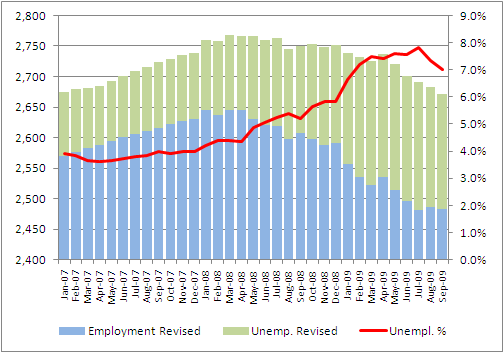
The employment graph doesn’t start at 0 in order to better show the trends. The red line is the unemployment rate, and it’s to the scale ont he right-hand side. A couple of things stand out. First off, the number of employed seems to have stabilized. But it also seemed to have stabilized at least twice before: in mid-to-late ’08 and in Spring of this year. We then got two large drop-offs. There’s no guarantee that we’ve hit bottom yet, although we all hope to God we have.
The other interesting thing is the unemployment rate from Spring of ’07 to Spring of ’08. It rose from about 3.5% to about 4.5%, even as the number of people employed was also rising, from about 2.56 million to almost 2.65 million. Note that the number of people looking was rising even faster. Which meant that at that point, even though we hadn’t felt the slowdown, new jobs weren’t being created fast enough to keep up with population growth. Now, the unemployment rate is dropping, even though it’s almost entirely due to people dropping out of the market. There’s considerably hidden labor inventory out there, and when it returns to the job hunt, the unemployment rate won’t be falling so quickly.
Note that these are all seasonally-adjusted numbers, too, so they already taking to account seasonal retail, summer jobs, and teachers’ summer vacations.
I’d also point out that here in Denver County, the seasonally-unadjusted were even worse, with the labor force dropping by over 3000, and the number of employed dropping by almost 2000. Whatever the job market looks like elsewhere, we’re not creating jobs locally.
Here’s a graph I’ve updated since April:
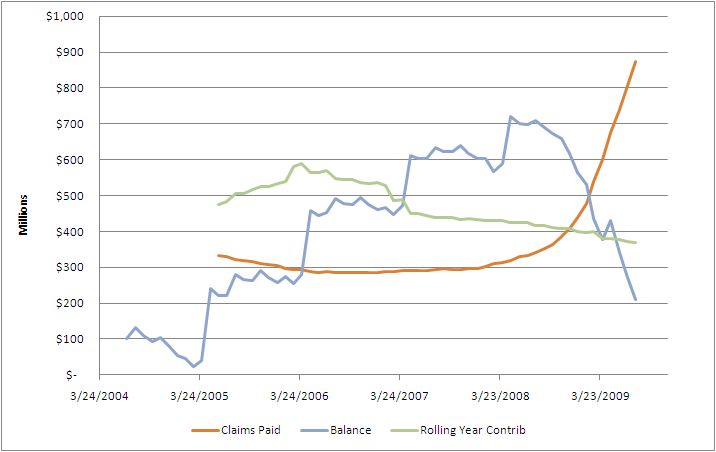
It’s the state Unemployment Insurance Fund, and it’s a mess. While we talk about PERA, and taxing Peter to pay for Paul’s rent-seeking appendectomy, the fund is in serious trouble. It got almost no seasonal bump from the May solvency assessment, the numebr of claims paid has been skyrocketing (red), and the rolling 12-month payments by business (green) have been sloping downward because they’re not employing as many people. The net result is a cliff-diving account balance (blue). We were told that the account actuarily sound, but it should have been obvious at the time that we were facing not-normal circumstances.
And it’s even worse than it looks. The feds kicked in an extra $127 million in exchange for SB 247 and more long-term commitments. Some of us pointed out at the time that borrowing short to go long wasn’t really matching obligations to receipts, but like the true addict it is, the state government saw the federal dollar signs and just couldn’t say no. Don’t hold your breath waiting for the Democrats in the legislature to admit they made a mistake.
Billions Short on Bureaucrats’ Wish List
Posted by Joshua Sharf in Budget, Colorado Politics on October 16th, 2009
That’s really how this morning’s Denver Post story should read:
The state would need an additional $8.5 billion per year in revenue to provide the level of services Coloradans want, a commission looking into the state’s long-term budget problems was told Thursday. That’s bigger than the $7.5 billion general fund, the state’s largest pot of money that funds most operating needs. Even to reach a “middle” level of services, the state would need an additional $2 billion a year, members of the Long-Term Fiscal Stability Commission were told.
So how to we know this? Who measure what Colorado really wants? Why, the department heads:
Those estimates come from legislative analysts who added up the amounts that officials from various state agencies said would be needed to reach the level of services that Coloradans want. (emphasis added -ed)
How the department heads determined “what Coloradoans want” is left the the readers’ imagination, but I’m guessing that the result more closely tracks what Colorado’s department heads want. I’m also guessing that not too many of them came back with a report saying that they really could manage with less. Whenever you ask a government department head how much he needs, the answer is, inevitably, “more.”
Note, by the way, that the $2 billion is still considerably larger than the decrease in tax revenue the government has had to deal with in this recession, and that a $8.5 billion increase would essentially double the size of state government. That size, by the way, has been relatively static at about 8% of state GDP for over a decade.
Democrats on the committee naturally took up the legislative committee’s description of this wish list as, “what the people think they want.”
Perhaps most disgraceful of all was Rollie Heath’s suggestion to circumvent little things like democracy:
More controversial was his proposal to ask voters in 2010 to allow a 23-member commission appointed by the Legislature, governor and Colorado Supreme Court to examine constitutional spending requirements and limitations like the Taxpayer’s Bill of Rights and Amendment 23. That group would have the power then to refer any proposed changes to the 2012 ballot without needing to get legislative approval or collect voter signatures and would be exempt from a state law requiring all ballot measures be limited to just a single subject, Heath proposed.
This is bizarre on many levels, not least the complete abdication of legislative responsibility, as well as an admission of the futility and uselessness of the commission that Heath is chairing at the moment. The inclusion of representatives from the Supreme Court on a policy-making body would, I suppose, just formalize an inappropriate role they’ve increasingly taken on in recent years.
So here you have it. Even as your salaries and job options are shrinking, the legislative Democrats are trying to find new ways to raise your taxes, to pay for their wish list, without having to take responsibility for it.
$691,000 Per Job
Posted by Joshua Sharf in Colorado Politics, Economics on October 16th, 2009
Although the Denver Post doesn’t do the math, that’s how much each job created in Colorado has cost the Federal Government, er, you.
$583 million in Recovery Act funds have flowed to 96 different companies, individuals and other entities such as housing authorities.
Though Colorado was ranked as the top job creator among states — given TeleTech’s hiring of 4,231 people to staff a series of call centers — only 379 of those employees worked in Englewood. The rest were scattered throughout the country, such as in London, Ky., and Ocala, Fla.
So, it’s not 4695 jobs, it’s 843 jobs here in Colorado, and that’s if we include the 379 that have since gone away from TeleTech.
$583 million spent, 843 jobs. Quite a deal you made for us there, Rep. DeGette and Sen. Bennet.
Legislative Council Predicts…
Posted by Joshua Sharf in Budget, Colorado Politics on October 2nd, 2009
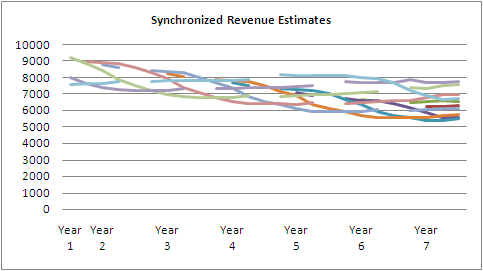
Every three months, the Legislative Council comes out with a report saying that the state budget is in even worse shape than we thought it was. And with every report, we’re told how Legislative Council keeps missing because of the unprecedented speed and size of the change. Fortunately, we can go back and see how well the LC has done in the past. I don’t think I’ve seen the data presented this way before, but apologies if someone has done so.
The LC makes predictions up to 5 years out (although their latest report only goes through the FY2011-12), so here’s a rolling graph of the predictions of General Fund revenue (in $M) since March of 2000. The numbers are not net of TABOR, meaning they do not account for the TABOR limits, so it’s purely an estimate of gross revenues. The gaps represent reports that the LC has not posted on their site:
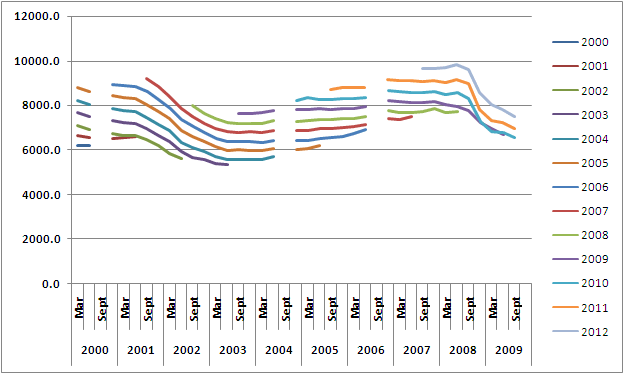
So the first thing you notice is that, no matter what the current conditions, LC almost always predicts a rising income curve even though that generally doesn’t reliably happen. In fact, it’s not just a rising income curve, it’s a almost always a constantly rising income curve. It looks like those pictures you used to draw in 1st grade, taking all the different-colored crayons or chalk or markers and running them along the page in unison. The current year estimates represent reality, but after that, LC assumes more robust growth rate that declines slightly towards Year 5.
Why? To put it simply, they have no idea what the actual economic growth rate is going to be, so they fake it. And it’s responsible for their consistent over-statement of future revenues throughout the decade.
The other thing you notice is that the recession of 2001-2002 took a pretty hefty toll on state revenues, and that it caught the LC completely by surprise. If it hadn’t, they wouldn’t have had to adjust their predictions so radically. In fact, the decline in dollar amounts is pretty close to the decline in the 2007-2009 recession, although the falloff wasn’t as fast.
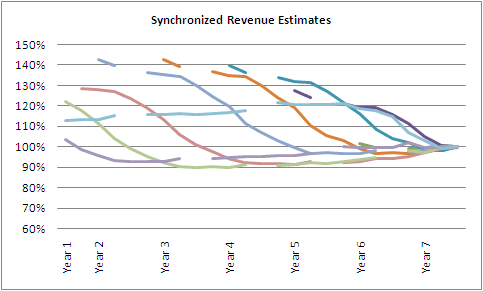
Another way of looking at this is on a percentage basis of the eventual revenue:
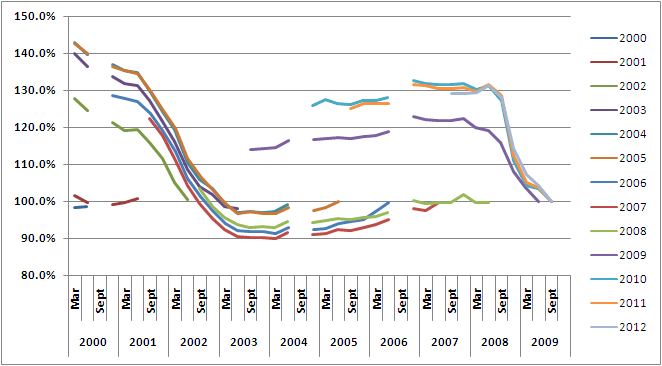
On this basis, the 2001 recession was every bit as bad – if not worse – for state revenues as the current one has been so far, it just took longer for the forecasts to fall. Remember, it was this recession, and the resulting drop in state revenues, that convinced the public to pass Referendum C. More on that in a moment.
The pattern of overestimating revenues and then mildly over-correcting is even more obvious if you synchronize the estimates at their endpoints. (The budget year ends in June, but the preliminary revenue numbers aren’t available until September, so 6 year projections stretch over 7 calendar years.)
Some of this might be understandable if the secular trends were of declining revenues, but it hasn’t been:
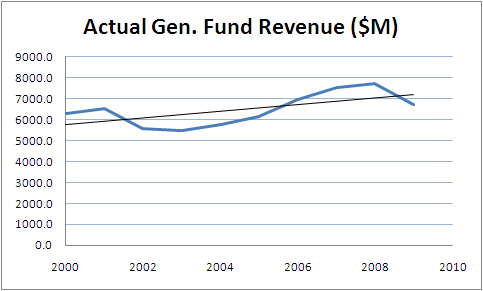
Which means that even in a era when the general trend has been upwards, the Legislative Council has overwhelmingly overestimated upcoming revenue. Again, this is almost certainly a result of using a plug-in number for economic growth during the out years. This is standard practice – we used to do something similar all the time when modeling companies’ top lines – but we weren’t responsible for their budgets. It clearly shows the dangers of actually relying on these predictions for budgeting and for policy-making. Certainly it contributed to the over-confidence that led to Amendment 23, and the same overconfidence that has led the legislature to spend every last non-existent dime of Referendum C monies.
Now about that. Proponents of TABOR, among whom I count myself, have often argued that TABOR’s limitations helped limit the damage from the 2001-2002 recession. Is this true? Well, probably, but it didn’t prevent the damage altogether, otherwise there would have been no cry for Referendum C. Nevertheless, by looking at the revenue estimates for one year, and comparing them with the TABOR-revenue estimates, we can see that the raw numbers varied much more than the TABOR-adjusted estimates. We use 2005 because it’s one year for which we have a full
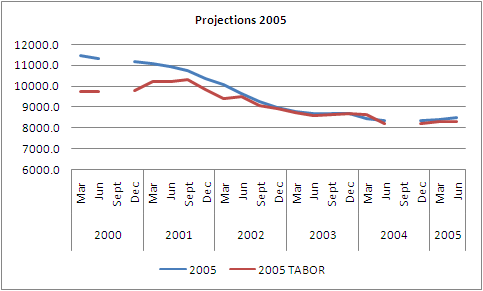
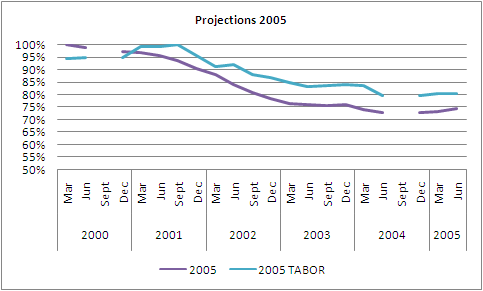
As you can seen, the raw revenue estimates fell to as low as 72% of the original estimate, finishing up at 75%, while the revenues including TABOR refunds stabilized at 80% of the original. Someone doing budgeting even a year out would have had to cut an additional 8% from programs had they used the raw numbers, as we do under Referendum C, compared to someone who had limited himself to TABOR-adjusted revenues. This isn’t exactly Armageddon, but it ain’t chicken feed, either. Given the howls of pain that come from even modest cuts in government programs, the 8% surely must be counted significant.
None of this is intended to beat up of Legislative Council. They’re being asked to do an impossible job, and appear to be doing it much better and with more integrity than the governor’s office is. But to repeat – it indicated the foolishness of relying on long-term estimates for actual budgeting, and makes a case for the sort of conservatism that TABOR forces upon the legislature.
Notes From the Senate Race
Posted by Joshua Sharf in Colorado Politics, Senate 2010 on September 27th, 2009
A couple of notes on the race for the Republican nomination. First of all, despite the headline – and the weight of the party’s senior ex-officeholders – former Lt. Gov. Norton did win the straw poll, but did not “clobber” her opponents. Mrs. Norton will no doubt point out that she hadn’t had much time to organize for the straw poll, and yet still came out first. Her opponents will note that this should have been, in many ways, her natural constituency, the old-line party activists, and that she got barely 1/3 of the vote. So while her assumed fundraising prowess still makes her the odds-on favorite, it appears that this race has some room yet to run, and that she’ll have to earn it.
Evidence that she knows that came Thursday night at a meeting of the R Block Party, a group of mostly Arapahoe County- and Centennial-based activists. While there was some grumbling that she didn’t stick around for questions, the mere fact that she showed up indicates that she understands she’ll have to court the new activists that last year’s elections generated, and can’t simply rely on the old guard to dominate the caucuses they way they have in the past. (For the record, the only candidate for Senate or Governor who didn’t show up or send a representative was…Scott McInnis.)
For the moment, the favorite of the new activists still seems to be Ryan Frazier, who performed well at Wednesday’s Liberty on the Rocks South Metro, and seemed to have a lot of fans at the R Block Party as well. Still, Norton’s bearing and presence seemed more senatorial; whether that bears up under tough questioning remains to be seen.
‘Bama Bigfoot
Posted by Joshua Sharf in Colorado Politics, Senate 2010 on September 18th, 2009
It’s good to know that it’s not only Republicans who are dealing with out-of-staters eager to pick winners:
President Barack Obama endorsed U.S. Sen. Michael Bennet today, throwing the force of the White House into a Democratic primary battle that officially is just over a day old.
…
The direct endorsement of a president still enormously popular among progressive voters is perhaps the biggest hammer that national Democrats can bring to Bennet’s primary battle against former Colorado House Speaker Andrew Romanoff, and they wasted no time in wielding it.
Does this make sense? Only if it works. Rumors had abounded that Romanoff had about $1.5 million (roughly 0.0001% of Obama’s deficit spending) ready to come on board, and to make him immediately competitive. Certainly Romanoff wasn’t going to be able to run to Bennet’s left, but the endorsement of The Big Leftie himself probably gives Bennet some room to move to the center if he has to. Of course, the primary is 11 months from now, and who know what Obama’s endorsement will be worth by then.
House Votes to Defund ACORN; DeGette, Polis Dissent
Posted by Joshua Sharf in Colorado Politics on September 17th, 2009
Despite the opposition of Representatives DeGette and Polis, the US House has just voted to defund ACORN, on an amendment to a student aid bill. The amendment passed, and the bill has now passed out of the House, as amended. The bill doesn’t seem to have been introduced yet in the Senate, so including the defunding there would seem to be an easy matter, if the Democrats choose to do so.
UPDATE: Reader Patrick Gibbs reports that Representative DeGette’s office claims that, ”
her response for voting “no” was because she “regularly votes no when a tactic like this is used to slip in unrelated rules into a particular bill”. In other words, since it was part of the “Sudent Aid and Fiscal Responsibility Act”, it was a procedural tactic and on principal she is “… Read Moreagainst” doing that (not necissarly on the merits of the bill). This, even though she said she is in favor of the SAaFR Act and in favor of holding ACORN accountable.
If this were he true motive, one would expect to see her signed on as a co-sponsor on HR 3571, the Republican bill to defund ACORN. Needless to say, she has not.
-
You are currently browsing the archives for the Colorado Politics category.


