Archive for category Colorado Politics
Pension Legislation in Congress
Posted by Joshua Sharf in Budget, Colorado Politics, PERA, PPC on May 9th, 2011
Kudos to State Treasurer Walker Stapleton for testifying before Congress in favor of H.R. 567, Rep. Devin Nunes‘s Public Employee Transparency Act, which would require states to use reasonable rates of return when calculating the financials for their pension plans, and would also require that they use proper discount rates based on US Treasuries, rather than their rates of return, when reporting their level of fundedness.
States would be able to continue reporting under the old standards, if they chose (and would likely continue doing so anyway), but would be required to issue a second set of numbers using proper accounting standards. States that failed to do so would no longer be able to issue tax-exempt municipal debt, forcing them to use pay higher interest rates and making borrowing more difficult. While the Wall Street Journal is reporting that Congress may yank that exemption altogether, blunting the effect of Nunes’s bill, I rather doubt that would pass the House this year.
For those interested in a fine synopsis of the state pension mess we’re in nationally, I can’t do better than to recommend Josh Barro’s piece in National Affairs, “Dodging the Pension Disaster,” which lays out the problems and potential solutions as clearly as I’ve seen anywhere:
First, pension reforms should include all benefits that will be accrued in the future, not just benefits that will be accrued by new hires. As mentioned earlier, most states are limiting their pension reforms to new employees only — which means they are likely dooming their reforms to failure….
Second, serious pension-reform plans should abandon the defined-benefit model. Three states — Michigan, Alaska, and Utah — have enacted reforms that will move many employees to defined-contribution retirement plans, or at least to sharply modified defined-benefit plans that shift most investment risk away from taxpayers. In most states, however, pension reform has been a matter of tinkering: increasing employee contributions, adjusting benefit formulas, raising retirement ages, and so on….
Third, states should consider voluntary buyouts of existing pension benefits. The two reform principles outlined above address only the costs of pension benefits going forward; they do not help resolve the very real problems associated with states’ existing pension liabilities — those that were incurred by governments as payment for labor that employees provided in the past. Here, there are no easy policy maneuvers: Short of defaulting on these debts, the only way states can eliminate unfunded pension liabilities is to fund them.
That last would be hard for Colorado to consider, as the State Constitution prohibits issuing general obligation debt, but it remains an option for other states.
We should be under no illusions that Harry Reid of Chuck Schumer would even allow Nunes’s bill to come up for a vote in the Senate. But as we know, putting these things out there in the form of legislation is critical to getting actual reform in the long run. And in this case, the long run is shorter than we think.
Maps
Posted by Joshua Sharf in Colorado Politics, PPC, Redistricting on May 4th, 2011
So the Colorado Republicans have produced a compromise map in an effort to avoid a crapshoot showdown in the courts. Given that there are a fair number of Republican-appointed judges out there now – not the case in 2001 – the chances of winning are perhaps higher. But you essentially give up control over the process when you send it to litigation, and politicians would always rather negotiate solution than have one imposed.
The Republican map tweaks things a little here and there from their original map, but it still looks pretty much like the current set of districts. It adheres to constitutional and statutory principles for districts (keeping together communities of interest, Denver, the Western Slope and the Eastern Plains), it assumes that various parts of the state will have the chance to elect representative who actually live there.
The Democrat map, of course, does none of these things. Competitiveness is a goal I actually agree with, but by law, it can’t override those existing requirements. Moreover, as has been pointed out, portions of every district in the state would lie within sight of DIA. If you thought that Denver thought the rest of the state was in orbit around it before, well, a fortieri.
Unfortunately, the map’s politics, in the battle for public opinion, will get a boost from Colorado’s geography. (That the Denver Post will be giving it a helping hand goes without saying.)
A few weeks ago, there was an article online (which I can’t find any more) that talked about do-it-yourself redistricting software. One group of New York Democrats had fun trying to figure out a way to get a state full of Democrat-majority or -plurality districts. They were able to do it by essentially carving the state up into ribbons, with every district getting a little piece of the Democrat-heavy New York City & Suburbs, enough to wipe out or neutralize the Republican-friendly upstate areas. If “gerrymander” comes from “salamander,” this was a whole maelstrom of ’em. You couldn’t push through a map like that, and nobody was really interested in trying.
The Colorado Democrats’ map just doesn’t look that threatening. Denver is located closer to the middle of the state than NYC is. We don’t have 30+ representatives, we have 7. And since the one rule the Democrats obeyed – by coincidence, no doubt – was to keep Denver intact, they only had to get 6 districts to work out. The result is something that, while radical surgery compared to what we had before, doesn’t look all that bad if you’re starting out fresh. In the game of “let’s see how much we can get away with,” this much have come as a delightful surprise.
So in what’s left of negotiations (and there’s always room for a special legislative session; earn that $30,000, guys), and what may come down to a court battle, the Republicans have that to overcome. They need to continue to pound away that while you might not think Grand Junction has much in common with Pueblo, it’s got more in common with it than it does with Boulder. They need to remind people that while DIA is a world-class airport, keeping the ATC guys awake by letting them play “how many Congressional districts can we see today?” from the tower isn’t actually a statutory requirement.
I agree with some others that the Rs look more statesmanlike in presenting a compromise map. They also have the luxury of being able to compromise. It’s not clear that the Dems’ maps can actually change that much without the whole plan falling apart. Now they need to keep at it, and not buckle under the pressure to meet an artificial deadline.
Public Pensions and Risk
Posted by Joshua Sharf in Budget, Colorado Politics, PERA, PPC on April 29th, 2011
In a couple of previous posts, I’ve discussed the folly of using a loophole in public pension accounting to increase the discount rate by taking on added risk. Naturally, that fear would be more justified if it turned out that public pensions were doing that. Herewith, the evidence.
The Census Bureau does an annual survey of the state of public pensions, although they tend to take their sweet time posting the data. (The most recent data available was for FY2008.) Since the time when online records begin, in 1993, until 2008, you can see some obvious trends in public pension funds’ asset allocation:

The proportion in US stocks had risen almost 5 percentage points, from 34% to 39%, and the amount in safer, but really boring Treasuries has dropped from almost 20% to just under 5%. You can see where the poor years for stocks in 2007 and 2008 took back some of their gains, but inasmuch as the fund managers should have been rebalancing, this hardly vindicates them.
The fund managers have also been risking more of their money; cash and liquid securities dropped from about 7.5% to under 3%, although that could be for a number of reasons. The pension operations could be efficient, for instance, or the managers may have had better actuarial data at their disposal. In what looks like a gap in the Census survey questionnaire, “Other” is up significantly, from 5% in 1994 to 13% in 2008. Anything that’s 1/8 of your investment portfolio shouldn’t really be lumped together as “Other.”
And since its introduction as a separate category in 2002, Foreign Investments (not shown) have risen from 12% to about 15%. That’s probably a result of both better returns and increased investment.
I also want to emphasize that this is aggregate data for State & Local pensions across the US, not just for PERA. CalPers may well distort the data, and some plans, like DERP, are around 90% funded and suffered very little in the stock downturn in terms of fundedness.
In any event, what is clear is that the instruments best-suited to stable, long-term returns (at least up until now), US Treasuries have either been sold off or allowed to mature, with the funds being put into US stocks and some other, almost certainly riskier, categories.
There’s a lot more data over at the Census site, including some state-only data over the last 3 years that also has actuarials associated with it, so I’m hoping to make some time to dig into that, as well, but as usual, no promises.
Keeping the Higher Ed Bubble Inflated
Posted by Joshua Sharf in Budget, Education, PPC on April 28th, 2011
UPDATE: I am advised that this was the closest vote in 20 years on a tuition increase: 5-4. I don’t have the names of those who had the courage to vote No, but kudos to them for doing so. Even though Regents are elected, it’s relatively easy for them to roll over to an appointed administration on tuition votes, especially given the (at least perceived) centrality of higher education to opportunity for advancement.
The CU Regents have approved a 9.3% tuition increase for in-state students, and a 3% increase for out-of-state students. No doubt it’ll take special scientific instruments to measure the time that elapsed between this announcement and certain legislators’ bemoaning the fact that we “don’t fund higher ed.” But higher ed, even here in Colorado, has done a pretty terrible job of accounting exactly what it is we’re supposed to be funding.
The core mission of the university is the education of students, culminating in a degree that is supposed to represent the mastery of the material. It is almost impossible to get a straight answer as to what that actually costs. Go to the CU website, and you’ll be provided with a wealth of information about their sources of funding. Detailed information about spending is almost impossible to find.
Let The Narrative Define The Candidate
Posted by Joshua Sharf in 2012 Presidential Race, Colorado Politics, National Politics, PPC on April 27th, 2011
Very quickly, the flagship Ricochet podcast has joined my favorite weekly listening. A couple of weeks ago, Pat Caddell was the guest, and as usual, the pragmatic, tell-it-like-he-sees it Democrat pollster was a font of helpful advice for Republicans, all of which is worth listening to. This particular bit stuck out: he suggested that the Republicans need to settle on a narrative first, and then the proper candidate will rise to the narrative. It’s an interesting thought, and one worth considering.
His strategic advice is predicated on the notion – facts, really – that time is shorter than we think, and that the narrative for the election will be set this year, not next. I think he’s probably right on this. People’s opinions on Obama – and presidential re-elections are always first about the incumbent – are already being cemented, and the cement is starting to cure. You see it in the “who do you trust more on X issue?” polling, on the right-track/wrong-track question, on a general atmosphere of incompetence and disconnect.
The Dems and the MSM (but I repeat myself) will try their hardest to shape the narrative this year to their advantage. You see this in the stepped-up union activity, the attempt to frame the budget fight. How both Wisconsin and the debt ceiling/budget fight play out, along with the continuing court battles over Obamacare (are you listening, Rep Stephens?) will be major factors in how these impressions solidify. The specific issues, and the framing of those issues as “budget-cutting” vs. “growth-enhancing,” as an example, will also make a huge difference. And even if we don’t know what particular economic or foreign policy details will be on people’s minds in 2012, the right narrative can absorb a wide variety of specifics and surprises.
By deciding on the narrative first, we determine the basis on which we’ll fight the election, we set out priorities and a vision of what’s right and wrong for the country, and where we want to lead it and see it led.
Everybody Likes A Good Discount
Posted by Joshua Sharf in Budget, Colorado Politics, Economics, Finance, PERA, PPC on April 24th, 2011
So with all the discussion about PERA, one key aspect of pension accounting hasn’t yet been mentioned: the discount rate. Now before you go all accounting-comatose on me, understand how important this is. Because with all the talk of how underfunded PERA is, it’s actually even more underfunded than you think.
Basically, if you have an obligation to meet, the discount rate is the rate you use to see how much money you need to have now in order to meet that obligation. So if you’re going to have to make good on a $100,000 obligation 10 years from now, and you use a 4.5% discount rate, you need to have about $65,000 now. If you use an 8% discount rate, you only need about $46,000.
Of course, the discount rate isn’t arbitrary. It represents a concept. The discount rate is the required rate of return, the return that an investor in that project requires, given the level of risk that he’s taking on.
The problem here, and how this relates to PERA (and many, many other public pensions), is that PERA is using the wrong discount rate. Instead of using the 4.5% discount rate, they’re using the 8% discount rate, which makes them look even less underfunded than they are.
PERA – Why 8% Isn’t 8%
Posted by Joshua Sharf in Budget, Colorado Politics, PERA, PPC on April 22nd, 2011
State Treasurer Walker Stapleton has been on the hustings, touting the need for PERA reform. His oped in the Denver Post a little while ago pointed out that the fund’s actuaries assume an 8% return on investments. If we don’t do something about the underfunding, Stapleton noted, we’ll be forced to take on more risk to try to reach the fund’s investment goals.
Now, PERA’s been criticized for assuming an 8% return, but that’s not really the problem. Eight percent is, in fact, the average annual return on US stocks since about 1870, according to data collected by Robert Shiller, he of the half-eponymous Case-Shiller Housing Index. The problem is, the standard deviation – the range within which about 5/8 of the returns actually fall – is 18%:
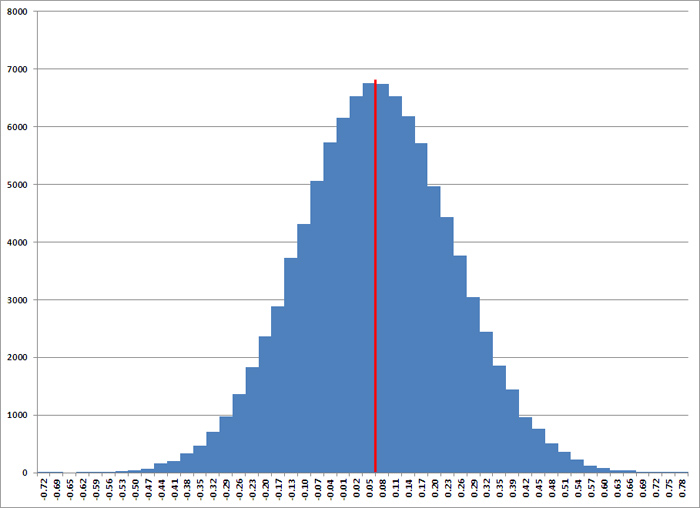
Which means that a lot of the time – almost one-third – you’re getting negative returns. For Backbone Business, I worked up a little scenario where you’re starting with $100,000, paying out certain portion each year, getting 8% return a year on your balance, and you come out even. But what should be apparent is that there are lots of scenarios that get you 8% average return, but force you to pay out more than you’re getting in the early years, and you never make up the difference. Here are some very basic scenarios:

And the graphs of the balances:

Circular Logic on Gov’t Pensions
Posted by Joshua Sharf in Budget, Colorado Politics, Economics, PERA, PPC on April 5th, 2011
In this morning’s Denver Post editorial, explaining why government employees should only temporarily be asked to take more partial responsibility for their own retirement, comes this remarkable claim:
But it shouldn’t be a long-term fix. Shifting the makeup of the pension funds could adversely affect the financial soundness of PERA.
That’s because employee and employer contributions are treated differently. The money that employees put in the system goes with them if they leave the system. If the fund mix gets too out of whack, it could be a financial problem.
This is a classic example of thinking inside the fiscal box they’ve put the rest of us in. These pensions – the ones in question – are defined benefit plans. As has been pointed out in a number of places this morning, Colorado is uncommonly generous with the percentage of an employee’s income it tries to replace in pensions.
At a minimum, shouldn’t that obligation be either contingent on the employee leaving his money with the plan? If not, if they have the right to take that money with them, then ought not the pension plan’s obligation be reduced, proportional to the amount funded by the employee? If it’s the employee’s money, then, well, it’s the employee’s money, and if they want to be responsible for investing half of their retirement money on their own, then they should live with the consequences of that. It certainly doesn’t make any sense for the plan to have to shoulder more of the burden for an employee who leaves before retirement.
The real problem here is that it’s a defined obligation plan in the first place, and that it’s less than fully-funded. If the plan were fully-funded, if every dollar of future obligation were already invested for, then this wouldn’t be a problem. It’s complicated by the fact that none of these plans is fully-funded, so all of them rely on current contributions to pay current obligations, rather than socking that money away under the account for the individual.
It’s a result of lousy accounting having had a meet cute with lousy political incentives starting about 10 years ago. It’s no longer sustainable, and eventually we’re going to have to convert all of these plans over to defined benefit plans. If we can’t do that in one fell swoop, we can at least start by having public employees permanently assume a greater responsibility for their own retirement.
Bob Balink and Duncan Bremer Weigh In
Posted by Joshua Sharf in Colorado Politics, PPC, State GOP Chair on March 25th, 2011
Bob Balink, El Paso Treasurer and former El Paso County Clerk & Recorder, and Duncan Bremer, former El Paso County Commissioner, have weighed in with a precise tactical nuclear strike about what putting people like Jon Hotaling and Dudley Brown (more about him in a moment) in charge of the State Republican Party would mean, including a number of angles that, not surprisingly, I hadn’t considered.
Primaries don’t have to be divisive. The can make both the winner and loser stronger candidates, can generate interest, and can help the party define itself. But the sort of behavior that Hotaling et. al. engage in makes one wonder if there ought to be a maturity exam for graduating high school.
As for Mr. Brown, he’s also closely associated with Jon Hotaling. Well, birds of a feather.
I have my own experience with Dudley “Just Call Me ‘Zool'” Brown, one that is apparently not dissimilar from that of other candidates who didn’t return his questionnaire. With the same unerring instinct for alienating those who agree with him, Dudley decided to chime in on a completely unrelated FB thread to torpedo my own candidacy:
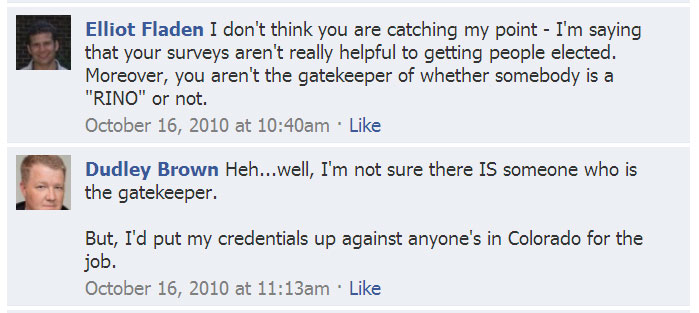
This was in the general election, fer cryin’ out loud. A number of friends – people who are actually familiar with my politics – jumped to my defense, of course, but I’m a big boy, and schoolyard taunts from people of Dudley’s stature don’t particularly bother me. But this sort of behavior – along with its entitlement mentality – transplanted to the Party HQ is going to start costing us elections.
Before we elect Ted Harvey State Chairman, it’s time for him to tell his posse to stay home.
Hotaling Letter a Fraud
Posted by Joshua Sharf in Colorado Politics, PPC, State GOP Chair on March 24th, 2011
Well, it turns out that being first isn’t always being right.
The letter sent out over Jon Hotaling’s name, using the PO Box address of the Colorado Christian Coalition in Denver turns out not to have been written by Jon Hotaling, but by someone playing an extraordinarily dirty game for relatively low stakes.
As mentioned before, the letter was received by a number of members of the State Central Committee, one of whom scanned the letter.
I suppose if you blog enough, this sort of thing is bound to happen, but that doesn’t really excuse it. Dirty politics is one thing, but this is fraudulent through and through, and it was through misfortune and over-eagerness that I got caught in it.
My apologies to Jon Hotaling directly, and to Ted Harvey, for having run with a story that was evidently calculated by someone to damage their reputations.
Since there’s no benefit to leaving a fraudulent letter posted on the net, I’ve removed the post, and posted Hotaling’s reply , and will embed it here when it’s done processing over at SlideShare.
-
You are currently browsing the archives for the Colorado Politics category.


