Archive for category Colorado Politics

A Zombie Bill For Zombie Voters

The Denver Post is reporting that the Colorado Senate Democrats, determined to send mail ballots out to Zombie voters (voters listed as, “inactive, failed to vote”), have found a Zombie  bill for their purposes.  The bill is all the more troubling since the Democrats have blocked virtually all efforts to clean up the voter rolls, ensuring that ballots will be sent out to valid addresses and ineligible or dead voters.

Here’s how they did it.  Watch closely.

First, the players.  The Republicans control the House 33-32.  The Democrats control the Senate, 20-15.  House Bill 1267 would have shortened the window for early voting.  It was passed by the House, and killed by a Senate Committee, 3-2, on a party-line vote.  Senate Bill 109 would send out mail ballots to inactive voters, and it passed the Senate, but was killed in the House Committee on a party-line vote.  However, in the House, it had a Republican sponsor, Rep. Don Coram, which means that had it not been killed in committee, it might well have passed on the House floor.

So the Democrats in the Senate Committee moved to reconsider HB-1267, resurrect the bill, in effect, so they could amend it with the substance of SB-109, the Zombie Voter Bill.  Once passed by the Senate, the re-animated HB-1267, with the form of the old bill but the substance of the new one, would return not to a House committee, but to the House floor, where it would be voted on.  This would at least put Rep. Coram in the uncomfortable position of having to choose between voting against a bill whose substance he had previously supported, or voting for it, an becoming the only Republican to support the Zombie Bill for Zombie Voters.

Last year, when the Senate Democrats began playing these sorts of games, with Senate President Brandon Shaffer killing bills by committee inaction, Republicans essentially shut down the body until they relented.  And that doesn’t even include the spectacle of the Democrats filibustering their own Congressional redistricting map.

A Republican House leadership committed to playing hardball probably has many more choices that I can think of, but two immediately come to mind.  The House Speaker has considerably leeway in when to schedule floor votes.  If Coram is willing to avoid voting for procedural matters, he can probably avoid voting on the substantive matter.

Second, what’s sauce for the goose is sauce for the gander.  House Republicans in committee could do the same thing with any Democrat bill they killed, including SB-109, and replace its language with a favored, popular, but Democrat-hostile bill such as HB-1111, the bill the Senate Democrats just killed to have a statewide referendum on voter photo ID.  This would send that bill back to a floor debate and vote by the entire Senate, where it might not pass, but would put the Democrats in the position of airing their flimsy, fraud-friendly arguments in a more visible forum.


No Comments

Amazon Tax Bites The Dust

In 2010, the Democrats in Colorado, in violation of the state Taxpayers Bill of Rights, passed a variety of tax increases known as the Dirty Dozen.  The state’s highly politicized Supreme Court gave the tax increases a pass around TABOR’s requirement for a citizen vote, but the federal courts are frequently a different matter, and so it has proved with one of the measures, the so-called, “Amazon Tax.”  That tax applied the state sales tax to sales by Amazon affiliates in the state, on the dubious proposition that the presence of a person who either owns a website (which could be hosted anywhere in the world) or who sells web ads constitutes a significant physical presence in the state.

Now, a federal court has decided that the tax violates the US Constitution:

On Friday, the federal court in Denver declared the 2.9 percent tax on purchases unconstitutional on the ground it was tilted unfairly against out-of-state retailers, and that it put an undue burden on retailers to either collect the tax owed by consumers or report consumer purchases to the state.

Judge Robert Blackburn’s ruling noted the legal language of the tax didn’t distinguish between in-state and out-of-state businesses, but the practical effect of the tax did.

“I conclude that the veil provided by the words … is too thin to support the conclusion that the Act and the Regulations regulate in-state and out-of-state retailers even-handedly,” Blackburn wrote.

The court applied what is known as the “negative Commerce Clause,” the notion that if regulation of interstate commerce is explicitly delegated to the Federal government, then it cannot be exercised by state governments.  As Ramesh Ponnuru says in his review of Michael Greve’s The Upside-Down Constitution

Chief among the Court’s stratagems was its deployment of what has come to be known as the “dormant” or “negative” commerce clause: the inference that since the Constitution vests Congress with the power to regulate commerce among the states, it denies that power to states. That inference has long been controversial, not least among originalists, but Greve points out that without it the states would have at hand a ready means to circumvent the specific prohibitions on them that the Constitution spells out.

Ponnuru also notes that, “Several provisions of the Constitution block state governments from taxing economic activity outside their borders.”  Greve makes the case that since the 30s, courts have increasingly presumed that states can regulation out-of-state commerce, rather than placing the burden of proof on the states.  Today’s ruling is a small step back in the other direction.

Now, it remains to be seen if Amazon will restore its Colorado affiliates.

UPDATE: On the likelihood of an appeal, someone involved in the fight against the original measure comments:

The judge ruled that the state had violated the US constitution in two seperate and distinct ways- by violating the dormant commerce clause in discriminating against out of state retailers, and in imposing an undue burden on out of state retailers with the reporting requirements in the bill. Highly unlikely the state would appeal, as they would have to overcome both violations.

Attorney General John Suthers declined to defend the State on this case (which is his prerogative) and the Department of Revenue had to hire their own legal counsel. As such, it would have to be the Governor/ED of the Dept of Revenue that would decide to appeal. Hickenlooper was almost convinced last year to support the repeal bill after the judge had granted a temporary injunction. That failed when the State Senate killed off a bunch of Republican bills in the last few days of the session. Just don’t see Hick taking up this fight – remember this all happened under former Governor Bill Ritter, mainly as a ploy to raise a few dollars to ballance the budget. With the preliminary injunction, the state has never collected a dime on this law. The permanent injunction doesnt mean the state will lose any revenue they counted on-they just simply won’t be able to gain revenue they didnt plan on.

, ,

No Comments

The Kochs Respond

As President Obama’s campaign sees fit to attack private citizens for voicing their opinions, those private citizens have seen fit to respond.  Please read the whole thing.

Mr. Jim Messina
Campaign Manager
Obama for America

Dear Mr. Messina:

Because every American has the right to take part in the public discourse on matters that affect the future of our country, I feel compelled to respond directly about a fundraising letter you sent out on February 24 denouncing Koch. It is both surprising and disappointing that the President would allow his re-election team to send such an irresponsible and misleading letter to his supporters.

For example, it is false that our “business model is to make millions by jacking up prices at the pump.” Our business vision begins and ends with value creation — real, long-term value for customers and for society. We own no gasoline stations and the part of our business you allude to, oil and gas refining, actually lowers the price of gasoline by increasing supply. Either you simply misunderstand the way commodities markets work or you are misleading your supporters and the rest of the American people.

Contrary to your assertion that we have “committed $200 million to try to destroy President Obama,” we have stated publicly and repeatedly since last November that we have never made any such claim or pledge. It is hard to imagine that the campaign is unaware of our publicly stated position on that point. Similarly, Americans for Prosperity is not simply “funded by the Koch brothers,” as you state — rather it has tens of thousands of members and contributors from across the country and from all walks of life. Further, our opposition to this President’s policies is not based on partisan politics but on principles. Charles Koch and David Koch have been outspoken advocates of the free-market for over 50 years and they have consistently opposed policies that frustrate or subvert free markets, regardless of whether a Democrat or a Republican was President.
Read the rest of this entry »

No Comments

Chronicles of Crony Capitalism

So far, the LightSquared story has mostly been written as one of the FCC favoring a politically-connected company at the expense of its competition, and that favoritism having resulted in nothing but waste.  See, for example, today’s Coffee and Markets podcast on the subject. Their related links (Documents: LightSquared shaping up as the FCC’s Solyndra and Documents show Obama’s FCC used regulatory muscle to destroy LightSquared’s competition) pretty much give the outline.  It’s a simple story, and one that fits in neatly with an overarching narrative, as they like to say, of political money buying regulatory help.

As usual, the story is more complicated than that.  And as usual, the full story makes things look even worse.

The Wall Street Journal ran a story discussing just how badly the FCC had tied itself up in knots over this.  First, they declared a looming bandwidth shortage, and then quickly auctioned off additional spectrum, spectrum that happened to lie near to that used for GPS.  This was done years ago, and Falcone and his people no doubt assumed that the FCC wouldn’t be selling spectrum that couldn’t be developed.  Having gotten the favor, they then were surprised when the FCC didn’t turn around and tell the GPS people that this was coming, and that they should shield their equipment – technically well within their capability.  Having failed to do that, they now have to argue that there’s no spectrum shortage, after all.

Even assuming that the FCC wasn’t out to clear the field for LightSquared, they failed badly in their regulatory duty here.  The FCC has complete control over this stuff.  They can decide how, where, and when spectrum gets exploited, and by whom.  Either there is or isn’t, was or wasn’t, a spectrum shortage that will imperil future growth.  Either the spectrum neighboring the GPS wavelengths is or isn’t usable.  Either the burden of preventing interference lies with LightSquared (or whoever buys this tainted real estate from them), or it lies with the GPS companies.

Either the FCC didn’t know how it was planning to resolve this issues, or didn’t care.  Or else, it knuckled under to a multi-million dollar lobbying campaign, in which case, what’s the point of claiming “independent” regulatory agencies are any good at all?  If the FCC was throwing around its weight to help LightSquared, all these regulatory conflicts become even worse, leading other investors to throw their money after an investment the FCC must have known was headed for an iceberg.

The other example comes from the Department of Transportation:

Transportation Secretary Ray LaHood announced a $54.6 million loan to Kansas City Southern Railway Company (KCSR) for the purchase of 30 new General Electric ES44AC locomotives. These diesel-electric locomotives, built in Erie, Pennsylvania, will help KCSR meet increasing economic demand, and are more energy-efficient and produce significantly less carbon emissions than the locomotives they are replacing.

That’s nice.  Railroads have had a very nice couple of years, and with the absence of KeystoneXL, are likely to have even more business, at least in the short term. Kansas Southern has a $7.8 billion market cap.  It’s already carrying $1.6 billion in debt.  Its quarterly depreciation expense is almost $50 million, or just about the size of the loan.  Its operating cash flow was $170 million last quarter, and it showed a net income of $300 million.  And it’s not as though GE is going to file for bankruptcy protection if it doesn’t get a $50 million order.

This from the same administration who reflexively defends a perfectly reasonable accounting change (see The Death of LIFO) by attacking oil companies, rather than by defending the change on its own merits.

The problem with both of these stories is that the finance is bound up inextricably with the politics.  Analysts work by examining the underlying economic return, and to the extent that there are regulatory issues, they ought at least to be predictable or bounded.  Companies getting regulatory benefits they can’t use, or subsidies they don’t need, don’t do anything to help create real wealth.

, ,

No Comments

Dan Santorum?

Those of us who suffered through 2010’s Colorado Republican gubernatorial campaign travesty should have learned some lessons.   So far, the national presidential nominating process is making me regret that Colorado is a trend-setter.

A similar dynamic – discontent with a front-runner, seen as hostile – or at best indifferent – to the Tea Party, and seen as hand-picked by an entitled establishment too timid to settle on actual conservatives to carry the party’s banner.  Both men, who seemed conservative enough in earlier incarnations, are had their bona fides questioned later.  In both cases, the criticism may be somewhat unfair, but it’s also led to a lack of enthusiasm for that candidate, and fueled talk of third-party runs, even before the nomination has been decided.

McInnis seemed to spurn Tea Party support, and then was victimized by a chiron during a national TV interview; likewise, Romney, while not going out of his way to the extent that Huntsman did, has also seemed to be relying on monetary advantages and strategic support of current and former office-holders in key states.

As a result, many Colorado Republicans decided to teach McInnis a lesson on the way to the nomination, only to find that the lesson they taught him left the party with a man who had no business being the nominee, and a party apparatus that was nevertheless honor-bound to support him – if only minimally – in the general election campaign.  (To be fair, many of us held Tancredo’s self-positioning for a 3rd-party run prior to the primary to be subverting rather than honoring his own party’s nominating process.)

Likewise, I believe that many, but by no means all, of those voting for Gingrich or Santorum are doing so in order to teach Romney or the party establishment a lesson, or to stretch out the process as long as practicable, perhaps even thinking it will lead to a brokered convention.  February was supposed to be Romney’s month, with a series of caucuses and primaries in states friendly to him.  Instead, he’s faltered, and Santorum has given conservatives reason to look to him as the last remaining credible”Not Romney.”  I’m not certain that they all actually want to see Santorum on the podium in Tampa accepting the party’s nomination in August.  But that’s where we could end up.

There are obvious significant differences between the campaigns.  Santorum is a two-term US Senator who knows something about fundraising and running a campaign; Dan Maes was not, and did not.  However badly he might do in the general election – and I think he would do very badly – nobody thinks he’s going to walk away with 11% of the vote.  However much Ron Paul may dream of a 3rd-party run, he’s nowhere near as attractive a candidate as Tancredo was to desperate Republicans in 2010.  It doesn’t look as though Romney’s put himself in a position to be torpedoed by members of his own party holding a grudge.  And of course, the gubernatorial nomination was a one-day primary; there was no opportunity to rethink the decision.

But even as more and more people assume that the Republican sold as the most electable will be the eventual nominee, much as people even on primary night assumed that McInnis would pull out a win, Obama’s re-elect numbers on Intrade keep rising.

The Republicans need this election to be a referendum on Obama; in both 2010 and so far in 2012, the nominating process has been a referendum on the front-runner.  Thus far, the Romney campaign has serially been able to create a series of successful one-on-one contests with other candidates.  He’s done so with the help of a national media that was McCain’s base until he became the nominee.  Some conservatives and libertarian-minded Republicans have been all too willing to chew up Mitt’s challengers from the right as not conservative, and now find themselves without a champion.  And the candidates themselves were better at making the case against each other or against Romney than they were at showing how they’d make the case against Obama.

At my own caucus, I closed the discussion by asking people to vote for whom they actually wanted to see as the nominee.  Not to vote as a protest against Romney, or to send a message, or as some cathartic gesture, but to vote for the man they actually wanted to see represent the party in the election.  I did this, reminding people of the consequences of playing games with their vote, which is how we ended up with Dan Maes as our nominee, and John Hickenlooper as governor.

None of which is to suggest that anyone abandon their candidate for the sake of an artificial “unity.”  If you want one of the three others still standing to be the party’s nominee, or believe that he better represents the party, there’s no sense in not supporting him.  But if you mainly believe that Romney needs sharpening or the establishment needs its nose bloodied, you’re playing a very dangerous game.

We’ve seen that movie before, and it ends badly.

, , ,

No Comments

Legislating (Not) By The Numbers

Thursday’s discussion of the proposed in-state tuition for children of illegal immigrants in the Jewish Community Relations Council (where I represent the Denver Academy of Torah as a school), provided an object lesson in the difference between government and the real world.

This bill differs from prior years’ efforts in that it creates a third category of student rates.  Currently, there is Out of State, which is supposed to be priced higher than the cost of educating the student and in-state with the COFF subsidy, which is supposed to be less than the educational cost.  The third category would be “In-state without the COFF subsidy,” which would supposedly be, Goldilocks-style, exactly the cost of educating the student.  In this way, claim SB12-015’s advocates, the new law would cost neither the university nor the taxpayer.

The problem is that this claim is completely unverifiable.

The legislature has been trying for years to get the University of Colorado to tell it how much it costs to deliver a bachelors degree-quality education to a student, without result.  The university either can’t or won’t calculate and divulge that number.  While it’s true that there’s no immediate outlay from the state treasury, there’s simply no way to guarantee that the bill won’t end up as a net cost to the state’s already-strapped public universities.

The bill pretends to get to the “at-cost” number programatically, rather than through actual accounting. The program numbers can’t be any better than guesses.  At the state capitol, this is what passes for reality.

Whatever one thinks of the politics and the wisdom of passing such a bill – and there are strong arguments on both sides – it’s clear that the proponents’ arithmetical arguments don’t add up.

No Comments

Sigh. Romney.

Michael Barone, that walking encyclopedia of American political history, has often made the comparison between the development of the Tea Party and the entry of the peaceniks into American political life:

Both movements represent a surge in political activity by hundreds of thousands, even millions, of previously uninvolved citizens.

Both movements focused on what are undeniably central, not peripheral, political issues: war and peace, the size and scope of government.

Both movements initially proclaimed themselves nonpartisan or bipartisan, but quickly channeled their efforts into one political party — the peace movement in the Democratic party, the tea-party movement in the Republican party.

But new movements prove troublesome for the political pros, and nowhere more than in the most problematic part of our political system, the presidential nominating process. (Is it just a coincidence that this is the one part of the system not mentioned at all in the Constitution?)

Peaceniks and tea partiers naturally want nominees who are true to their vision. They are ready to support newcomers and little-vetted challengers over veteran incumbents who have voted the wrong way on issues they care about.

But the things that make candidates attractive to movements can also make them unattractive to independent voters.

The Democrats struggled with this in the 1968, 1972, and 1976 cycles. The old-timers pushed through the accomplished Hubert Humphrey over the diffident Eugene McCarthy in 1968, but they lost to George McGovern in 1972. He was a more serious candidate than is generally remembered, but he did lose 49 states to Richard Nixon.

The anti-war movement didn’t get started in earnest until 1967, and Lyndon Johnson didn’t declare his intention not to run again until early 1968. The lateness of the primary calendar made it possible for Bobby Kennedy to declare late, and their paucity made it possible for the party elders to anoint Humphrey regardless of those votes. By 1972, the McGovernites had taken over the levers of power, opened up the primaries, and made most of them proportional. This insured a longer primary campaign, and did nothing to prevent a credentials fight over the Illinois delegation at the Convention. In the event, McGovern was nominated with fewer than 60% of the delegates, and defeated with less than 38% of the vote. The military defeatism and the electoral defeats helped usher the Scoop Jackson Democrats out of the party and, eventually, Ronald Reagan into the White House. The Democrats would elect the center-left but feckless Carter, and the decidedly un-peacenik DLC founder Bill Clinton, and it wouldn’t be until 2008 that they elected Obama in an encore of the first anti-war movement.

The Tea Party, while nascent in 2007, didn’t really gather steam until early 2009, almost four years ahead of the next Presidential election, and the Republicans in 2012 have likewise done away with early winner-take-all primaries. So it probably sits somewhere between anti-War 1968 and isolationist 1972. The Establishment is weakened, but  not dead yet. If nominating Romney would be more like 1968, giving Gingrich the nod would look a lot more like 1972.

Of course, as Mark Twain said, history doesn’t repeat, but it does rhyme. Republicans not being Democrats, should Romney be the nominee, he likely won’t have to accept the nomination in the middle of police putting down riots from disgruntled Tea Party members. It’s unlikely that large cuts in spending will lead many Republicans into a socialist Exodus.

The similarities are alarming enough. Just as Humprhey’s defeat helped discredit the old liberalism, so a Romney defeat – or even a Romney presidency – could finish the job of discrediting vanilla conservatism that George W. Bush started, and open the door for a 1972-like candidacy by a Rand Paul-like figure. I don’t think I’m unduly cynical when I say that that very hope has led some in the libertarian wing of the party to campaign against Daniels, Perry, or Pawlenty as “not conservative,” or “not presidential,” while being willing to go along with a Romney nomination. (They’ll be disappointed. That so many in the Tea Party have cast their lot with Gingrich rather than the catastrophically irresponsible Ron Paul is actually a healthy sign that the word “conservative” will not be re-branded to mean “libertarian.”)

Republicans are looking for a conservative who is both ideologically grounded and a practical politician. While that may have been on offer earlier in the process, it’s not now, with the nomination fight now looking like that Star Trek episode where Kirk divides into two separate personalities, one nice but passive, the other more aggressive and less principled.

Romney’s problem is that even if you consider his public persona to be authentic, he seems rather timid for a man who built his career risking capital at the gaming tables of private equity. A early Marco Rubio endorser, he has Chris Christie’s support, but campaigns like Charlie Crist. His reaction to individual Social Security accounts as fiscally irresponsible confirms his image as narrowly technocratic. He campaigns as the safe, sane, sober, responsible alternative to both Gingrich and Obama, and it may well be that the American people want safe, sane, sober, and responsible after the drama of the last four years, even if it does represent a lost opportunity to do more.

Those who caricature Gingrich’s appeal as mere media-hatred, though, miss the point. Such an appeal, while superficial, isn’t just limited to Republicans; ask Ronald Reagan and George H.W. Bush. Showing backbone in clear, simple terms is not nothing, although it’s not enough.  And it seems to give way to an opportunism of its own at inconvenient moments.

I’m not sure that Gingrich would lead to a 1964-type down-ticket meltdown. At the beginning of 1972, Nixon’s Gallup approval ratings were well over 50%, and stayed there until the onset of Watergate. Obama has nowhere near that level of public support, and an impending Presidential defeat would let Senate and House Republicans campaign all the more effectively as a check on Obama’s power. In 1972, the Democrats picked up a net 2 seats in the Senate, and lost only 13 seats of a 255-seat pre-election caucus in the House. Johnson’s approvals touched 80% when his party went from 258 to 295 seats in the House, and from 64 to 66 seats in the Senate. Even a Gingrich candidacy wouldn’t result in that kind of wipeout, although it would probably cost us a shot at the Senate.

Sadly, that might be enough. Unlike the Democrats, we can’t afford to wander in the political wilderness for another couple of decades. If Obama were re-elected, and we failed to retake the Senate, Obamacare would be permanently enshrined into law, and the American citizen transformed into a subject. Obama is willing to use executive power up to and beyond the fullest extent permissible by law. Congress’s best means of asserting its part of the check-and-balance system is the power of the purse. But Senate Democrats have deprived Congress of that power, putting government spending on auto-pilot by not even bringing a budget up for a vote. So failing to take the Senate would put all the burden back on the House Republicans to find a credible way to threaten – and if need be, go through with – a government shutdown, without committing political suicide in the process.

If nominating Romney is enough to help us carry the Senate, even if it isn’t enough to get us back to the White House, it will put the party in a position of strength to challenge him, especially given the Senate partisan profile up for re-election in 2014.

This isn’t a matter of giving in to the Establishment.  If there were no other credible choices, if this were 2008, post-Colorado, and I were left with a meaningless vote, that would be one thing.  But there’s nothing the matter with concluding that while the party Establishment was too quick to line up behind Romney in the first place, I can make my own choice to support him now, for my own reasons, at a time when my vote – fortunately – still matters.  It’s called deciding, and that’s a very different thing from having something decided for you.

To this extent, Barone’s final paragraph is instructive: “Tea partiers will grouse if Romney is nominated. But maybe they need patience and perseverance. One lesson of history is that a movement can reshape a party. Another is that it takes time.”

,

No Comments

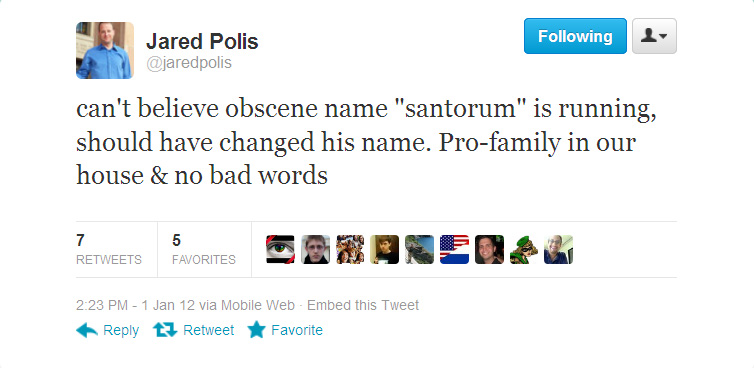
Jared Polis, Keepin’ It Classy

It’s one thing for Dan Savage to keep his long-running campaign to associate social conservative Senator Rick Santorum’s name with something foul.  (Google it yourself, if you’re that interested.)  It’s something else again for a sitting Congressman to join in the “fun,” now that Sen. Santorum’s campaign is showing heretofore undetected signs of life.

In all likelihood, we’ll see either silence, or an insincere non-apology of the “if I offended anyone” genre, combined with much behind-the-scenes juvenile snickers at which the Left excels.


No Comments

Unilateral Disarmament

Among the products of 2011’s Great Reapportionment Debacle has been a claim by State Representative Amy Stephens that Democrats on the Reapportionment Commission have been particularly aggressive in targeting Republican women legislators, combining their districts with others represented by sitting Republicans.

Her comments have produced a fair amount of tut-tutting and cluck-clucking, not from the Left, when too much protest doth be expected, but from fellow Republicans, concerned that such claims are unbecoming a party priding itself on a meritocratic approach to politics, as opposed to one driven by race and gender demographics.

I dissent.

Indeed, properly done, such a complaint is not merely smart politics, it’s all the smarter for having the added virtue of being true.

Politics being what it is, meaning that life and people being what they are, hypocrisy is among the easiest charges to level against any opponent claiming to have standards.  It’s one rhetorical advantage that Democrats have always had over Republicans.  Nobody understood this better than the Democrats’ current Pamphleteer of Record, Saul Alinsky, who included in his toolkit making the opposition live by its own rules.

It’s not necessary for you to believe in those rules for the criticism to be valid.  A friend of mine, who frankly has no interest in the Constitution beyond the bludgeons of the Establishment Clause and the Equal Protection Clause, has no problem pointing out (sometimes fallaciously) where this or that Republican isn’t much of an originalist. The criticism has two purposes – it dispirits Republicans who have to compromise from time to time, and it advances the subtext that maybe originalism isn’t all that important, after all.

The Democrat coalition has for years consisted substantially of balkanized interest groups, seeking to officially balkanize both American politics and society.  Pointing out that in practice, the political activities of that party does not serve the interests of women (in this case), or other groups, is unlikely to faze the professional victims, but may give their alleged constituents pause to consider.

Indeed, making use of the fact that such a coalition is ultimately a zero-sum game is the surest way to fracture it.  Democrats are especially threatened by prominent conservatives who are either not white or not men.  Even if one believes that the Democrats on the Apportionment Commission were motivated more by the chance to take out leadership than to target prominent Republican women, the fact that so many of the Republican leadership are also women sends a message of its own that Democrats would rather not confront.

Many conservatives are still upset with Rep. Stephens over the state-run Health Insurance Exchanges and her intemperate response to their objections.  Indeed, almost a year on, added information about Obamacare has highlighted and validated just about every one of those objections.  I’m not in Rep. Stephens’s old or new district, and she was personally very supportive of both my runs for office.  But she’s a big girl, and can take of herself.

My worry is that, by a too-vociferous insistence that those on our side not only agree with us, but agree with us for exactly the right reasons, and using exactly the words we would use, we’re going to end up robbing ourselves of effective rhetorical weaponry.  Arguments that work amongst ourselves may not be so successful out in the wide world of independents and thoughtful Democrats.  And arguments that peel away pieces of their coalition may be less persuasive among conservatives.  There’s more than one way to skin an interest group.

Slings and arrows are part of politics and political discourse, even within your own camp.

No Comments

Hear That Whistle Blowin’?

It’s not very loud just yet. But if you bend down, ear to the rails, you can hear the ever-so-quiet singing of a train in the distance.

It’s the Hillary Special, and it’s scheduled to pull into 1600 Pennsylvania Ave., on January 21st, 2013.

The engine has always been there, in the railyard, getting refitted and cleaned and tuned up. Bill took it out for its paces a few weeks ago with the comments about Obama’s handling of the economy. Then, of course, came his book, with its false choice between drowning government and crony capitalism.

And now come the test runs, starting with the Wall Street Journal op-ed and the write-in campaign.

The train’s route was made clear by Pat Caddell, in last Friday’s appearance on the Ricochet Podcast. Caddell, along with liberal-but-not-insane pundit partner Douglas Schoen, explained in last week’s Wall Street Journal why Obama had to step aside for Hillary, for the good of the country, and the good of the Democratic Party, not necessarily in that order.

While some read this as desperation and wishful thinking, I’m more inclined to see it as the launching of Hillary’s 2012 exploratory committee. It tests the waters while not committing her to anything, indeed, while not tying her to any possible disloyalty at all.

Caddell’s & Schoen’s idea, in a nutshell, is that Obama can’t win re-election in such a way as to allow him to govern. That in order to win, he’ll have to poison the political environment so thoroughly that cooperation with the Republicans will be impossible, and that the country simply can’t afford that right now. If he loses, he’ll lose whatever gains he’s made for the Left with him. So for Caddell & Schoen, an Obama candidacy is a lose-lose situation.

Worse, Obama is simply giving up on large swatches of the Democrat coalition, in particular working class whites. He’s offered nothing substantial to labor, only the procedural, and is willing at every turn to sacrifice jobs and the economy to the elite green ideologues. (This is a Democrat talking, by the way, not me.)

Hillary, on the other hand, has shrewdly used her tenure at the State Department to build up her own stature as the actual adult in the party, as opposed to the aspirational adult – also known as an adolescent – currently occupying the White House. She’s been disciplined in sticking to foreign policy, keeping her mouth shut about everything else. Even Bill has, according to Caddell, mostly kept his mouth shut.

If in 2000, the country was suffering from Clinton fatigue, it’s now going through some nostalgia for the 90s. Unlike the Bush years, we were (mostly) at peace. Unlike the Obama years, we were prosperous, with a president who seemed to understand the importance of that fact.

Less odious to the center than Obama, Hillary could win with a positive campaign, or at least one without the overt slash-and-burn strategy that Obama is committed to. Once in office, she may be able to cut a grand spending-and-taxing bargain with the Republicans, where Obama has no hope of doing so. Merely by winning, she’ll be able to preserve the key elements of Obamacare, seen by the Left as this generation’s Progressive Great Wave.

Caddell & Schoen remember how, in 1968, when Johnson won only 58% of the vote in New Hampshire, he decided that he didn’t have the stomach for a long primary campaign, even though he stood an excellent shot at re-election against Nixon. He stepped aside in favor of Hubert Humphrey, who might well have won had Johnson stopped bombing Vietnam a couple of weeks sooner. The appeal to Obama’s sense of duty to persuade him to make the same choice.

More than that, they’ll appeal to the same sense of not wanting to fight for renomination. Caddell & Schoen are now trying to get one or several large Democrat donors to run a Hillary Write-In Campaign in New Hampshire. They believe that were she to win a significant percentage of the vote, it might really shake up the race on the Democrat side.

Since it wouldn’t be controlled by or connected to Hillary (wink, wink), Obama couldn’t really tell her to shut it down. Were he to be too forceful, it could allow her to resign and actually run against him, which is the last thing he wants.

I have to admit, I was a little disappointed at the lack of close questioning by the Ricochet gang. A number of Caddell’s assertions were dubious at best, and yet went relatively unchallenged. Obama has abandoned labor on the high-profile projects like Keystone XL. But he’s practically turned the NLRB into an arm of the AFL-CIO. The NLRB itself, as an end-run around the loss of a quorum to conduct business, threatens to invest its general counsel with an unheard amount of unreviewable authority and power.

Bill, as we’ve seen, has not been very quiet of late, complaining about Obama’s handling of the economy. Caddell also claims that Hillary is the only thing keeping Obama’s National Security Advisor in check with respect to Israel, but in fact, we don’t really know what Hillary’s person opinions about Israel are, and there’s plenty of reason to think they’re not particularly friendly. I believe Caddell makes that claim because it appeals to a clearly disaffected part of the Democrat base that remembers, as do most Israelis, Bill as a friend of that state.

Similarly, Caddell appeals to what the Democrat Party once was, but no longer is, when he tosses out with obvious disgust, but does not elaborate on, the notion that Obama will seek to circumvent a hostile Congress by ruling by executive fiat. True enough, but worthy of fuller examination, playing as it does to our fears of a truly imperial Presidency.

Thus, the outlines of the prospective Clinton 2012 campaign. The reality is, of course, is that Hillary would not govern as a centrist. She would likely be a more effective salesman for the old, unimaginative Blue Social Model policies that doom us to Europe’s fiscal fate, however.

That clickety clack that promises to take us back will, instead, leave us all – Obama included – singing the blues in the night.

,

No Comments