|
|
« November 2005 |
Main
| January 2006 »
December 30, 2005
Newspaper Economics
Here's another reason the Washington Post is threatened by Bill Roggio:
Newspapers are seeking blacker ink next year by raising advertising rates. But with growing competition from new media for both advertisers and readers, it will be a tough sell.
...
Rate increases may be difficult to pull off as a two-decade slump in newspaper circulation appears to be worsening. Circulation -- a key metric for setting advertising rates -- fell 2.6% on average at daily newspapers in the sixth-month period ending Sept. 30, a bigger drop than any comparable sixth-month period since 1991, according to the Audit Bureau of Circulations. Many younger people have failed to pick up the habit of reading papers and a lot of older readers are switching to reading the news online or catching it on 24-hour news channels.
Only a newspaper could figure that it could raise the price of a commodity with declining value.
December 29, 2005
Nothing New at the NSA
It's not as though the NSA hasn't been listening to Americans' international phone calls for a long time.
I just finished buying a car, and just about every salesman I dealt with was ex-military. One of them, trying to warm up, got to talking about his rotation out at the NSA. He recounted in some detail a conversation between an overseas soldier and his stateside wife, and then how they left the circuit open, and heard the wife invite her boyfriend over.
This was, I note, a couple of days before the Times printed the details of the currently-controversial program.
Mr. Pot, Please Meet Mr. Kettle
The Wall Street Journal today reports on the effectiveness that independent conservative groups are showing in influencing the national debate over the war, especially in reminding people that Saddam did at one point have WMDs, and that he did have an ongoing relationship with al Qaeda in particular, and a sponsorship of terrorism in general.
The focus of the article is Move America Forward. If the group were merely operating with White House indifference, that would be enough. The Administration's refusal to stand by obvious pre-war facts make MAF look more Catholic than the Pope.
Naturally, the Left's response is to try to misuse the law to shut down debate.
Liberals question how the group has maintained its status as a tax-exempt nonprofit organization, which requires strict nonpartisanship, given the anti-Democratic tone of its campaigns. The group's Web site, www.moveamericaforward.org, for example, attacks the current chairman of the Democratic National Committee, referring to "Howard Dean types who only see a future of failure for this country."
"When you have people participating in partisan activities with nonprofit dollars, that's really something the IRS needs to look at," says Tom Matzzie, the Washington director of the liberal advocacy group MoveOn.org, another frequent target for Move America Forward's rhetoric. "An organization with a shady tax status participating in partisan activities and saying things that aren't true is a rogue element in American politics."
When asked about using IRS rules or FBI files to shut down political opposition, "We could do that," said Mr. Matzzie, "but that would be wrong, that's for sure." No, I made that part up. At least. I think I did.
December 25, 2005
Credibility
I just saw an ad for some NBA video game or gaming system, that tries to show how realistic it is by focusing on the sweat on Shaq's neck at the free-throw line.
Then they go and throw it all away by having him make the free throw.
Fact-Checking the DenPo
This isn't exactly media bias so much as media sloppiness. Really simple things that imply that the paper's editors and fact-checkers are either non-existent or very overpaid.
Let's begin with "insider trading." According to the Post,
Insider trading is a term that encompasses any stock transaction by a company's management, board or significant shareholder. What makes it illegal is if those insiders trade on key information not publicly available.
Well, this is sort of right. The problem is that insider trading encomapsses anyone trading on non-public information, not just the corporate bigwigs. It means that you, yes you, are at risk, if the company CEO gives you a heads-up, and you trade on that information, even if you don't work for the company. The "insider trading" reports that are filed with the SEC are restricted to senior management and major shareholders, which may have confused the reporter. But since this was in an article about alleged criminal activity at Qwest, so the relevant part was the insider information, not the status of the trader.
The relevant New Year's Resolution suggests itself.
December 24, 2005
Christmas Time Is Here, By Golly...
Disapproval would be folly. Along with the obligatory denunciations of excessive materialism and trivialization. (This notwithstanding. Jonathan, really.)
There's a point where people think that the Commercialization of Christmas started, and that it's always about 10 years before they started thinking about it. I remember reading Peanuts comics in the 70s, with Linus & Charlie Brown complaining about it. But Tom Lehrer sang about it in the 60s. Stan Freberg satirized it in the 50s. (Hat Tip: Music You (Possibly) Won't Hear Anywhere Else)
Ah, well, the 50s were the Organization Man and the 60s were decadent, so what could you expect? Now, the 40s, there was an earnest decade. Really? White Christmas? Meet Me in St. Louis? It's a Wonderful Life? They may be all about community and family, but not much about religion. Go read through the whole set of Dickens's Christmas Stories, and tell me where religion shows up. ("God Bless Us, Everyone" could as well be Thanksgiving, if the English had Thanksgiving.)
The Puritans banned celebrating Christmas because they thought the celebrations were frivolous.
Ah, I hear you cry, easy to say this about someone else's holiday. What if it were you own? Well, it is. People know about dreydles & latkes but forget about the confrontation with Greek culture. Next year's Purim slogan should be "Putting the 'Haman' back in '
The problem isn't that Christmas (or any of the other holidays) are trivialized, but that they're infantilized. Tha we substitute the form for the content doesn't make the form irrelevant. It's one thing to get trapped by the things we do to celebrate, but it's still ok to enjoy them.
December 23, 2005
Happy Holidays
Gotcha.
Happy Chanukah and Merry Christmas to everyone! For once, the movie theaters won't be crowded Saturday night.
Tom Daschle, Strict Constructionist
And legislative historian, too:
As Senate majority leader at the time, I helped negotiate that law with the White House counsel's office over two harried days. I can state categorically that the subject of warrantless wiretaps of American citizens never came up. I did not and never would have supported giving authority to the president for such wiretaps. I am also confident that the 98 senators who voted in favor of authorization of force against al Qaeda did not believe that they were also voting for warrantless domestic surveillance.
Warrentless. But not domestic, and not surveillance.
Senatitis Comes Early...
... to Colorado's former Attorney General:
"The president could have gotten permission (for wiretaps) from the FISA court," Salazar said Monday, noting the secret federal court was establish for intelligence purposes. "There is a court procedure for this. It's a very important question whether the president has broken any laws in ordering this surveillance and the American public needs to know the truth."
Salazar sent a letter to Specter, chairman of the Senate Judiciary Committee, on Monday, saying the FISA legislation allowing secret surveillance and searches requires FISA court approval.
"The administration's reported assertion that it did not do so because it was inconvenient to do so at least arguably constitutes a violation of federal law that should be investigated by Congress," he wrote.
On the radio, I also heard a radio snippet of him saying that he didn't know of any legal precedent or statute under which such surveillance would be legal, which is a much stronger statement. Also a much more ignorant one.
Now, this comment came a couple of days ago. But at the very least, it implies a need to issue pronouncements on subjects where the Senator hasn't got a clue yet. I know he claims to be a supporter of the Patriot Act, possibly a holdover from his selective law-and-order days here in Denver. But he's also an attorney, has attorneys on staff, and could at least do a little background research before opening his mouth.
Even if it's only reading this and this. Waiting for the latter would have delayed the Senator's Olympian comments for all of one day, although he would have missed the Sunday papers, to be sure.
December 22, 2005
...And In With the New

Hey, when you've been on everything paved, there's only one way to get to new places.
Despite the name, there are certain limitations. For instance, I think it's actually named for the amount of gas it uses. And with the soft top, I'll not only hear my radio but most other cars' as well.
But this particular model has an extra 15" of space, and a longer wheelbase. It feels a little more SUV-like, a lot smoother ride, but it still handles like a Jeep.
Lat year, on a lark, I bought a series of books on 4WD drives out west, looking for ones that the Contour could handle. Now, I just need to tough it out until Spring. Or, head over into Utah....
Out With the Old...
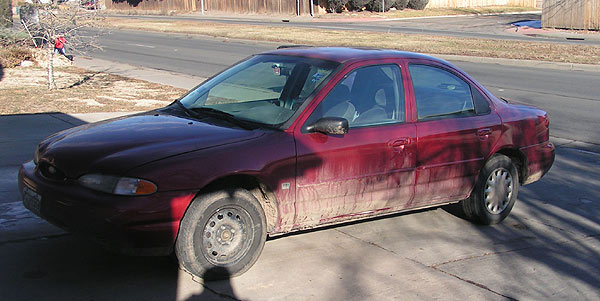
It lasted me 8+ years and 128,000 miles, almost all of it with me behind the wheel. It took me to the Pacific Northwest and back, and to California and back. It took me all over Utah and Nevada and New Mexico and Wyoming. It especially took me all over Colorado, and probably drove on just about everything in the state that was paved and west of the Divide. And a fair amount that wasn't paved, including Boreas Pass, Buffalo Pass, Black Sage Pass, and Cordova Pass.
The trunk held a ton. In addition to me, it hauled tools and a dog and skach and drywall - lots of drywall - and wood and shelving and rocks and dirt and yucca and hens 'n' chicks. The trunk still had pine needles from the skach and the roof had dents from the drywall and wood, enough that two dealers had to be reassured that I hadn't rolled the thing.
It had idiosyncrasies, like passenger's side front window that had a tendency to go off the rails, and require a manual override to finish rolling up. Towards the end, things had started to go wrong, and keeping it repaired would have cost the equivalent of car payments. I had hoped to keep it going for another year or so, even on life support, but in the end, I asked a little too much of it.
So it was a good car, not a great car. But for a very long time, it was my car.
Juror #4530 - Denver District Court
Appearance Date: Tuesday, January 17, 2006.
Great. Just great.
December 21, 2005
Radio Daze
Councilman Elbra Wedgeworth has way too much time on her hands. And apparently, the leaders of the Denver Black and Hispanic Chambers of Commerce are seeing a slow holiday season, too. They also seem to have confused CBS with NPR.
All three met with CBS radio in Denver to protest a format change:
Wedgeworth; Wil Alston, vice president of the Colorado Black Chamber of Commerce; and Jeffrey Campos, president and CEO of the Denver Hispanic Chamber of Commerce, met with Don Howe, senior vice president for CBS Radio in Denver. They emphasized to Howe the station's importance in the Latino and African-American communities.
Central to the meeting was the sudden demise Thursday of the area's only rhythm-and-blues outlet, axed after six years on air.
...
Independently, Urban Spectrum, a newspaper published in the Five Points neighborhood, launched a campaign Tuesday to let station management "know there is a voice out there they have turned their back on. They have a mandate to serve the public, and no one asked the public before switching."
Actually, they asked the public every day, and the public yawned. This was the only station in town with this format, they had no competition for this niche, and they still couldn't drum up enough listeners to pay the freight.
A few years ago, when KVOD, a commercial station and the only classical station in Denver, folded, CPR took over the call letters (although not the frequency), and began a 24-hour classical station. Maybe the aggrieved parties need to ask CPR to start sharing time on their classical network, but they need to stop playing program director with someone else's revenue stream.
UPDATE: I wrote this late last night, and clearly wasn't thinking. The Hispanic & Black Chambers of Commerce? Have they no advertisers?
Great Teams Aren't Always Great
Since Sunday, when the Bolts beat the Colts in Indy, people have been asking whether or not Indianapolis needs to be worried. Are they suddenly vulnerable?
No.
As a Redskin fan during the first Gibbs Administration, er, era, I got to see a couple of truly great teams up close, every week. The 1983 team never got its due, because Riggo's Rangers swaggered into the Super Bowl like they didn't have to practice, and got their heads handed to them by the Raiders.
But the 1991 team was special. They went 14-2, and if they had needed that last game in Philly, they would have won it. Even they lost one meaningful game, to the Cowboys in Week 12. Michael Irvin was open all day against the legendary Darrell Green, and the next year, the Cowboy dynasty would begin. They Cowboys were good, they just weren't ready yet, and the Skins were a buzzsaw.
The game everyone forgets is a 16-13 overtime win against woeful Houston at RFK. The only reason they got a chance to win in overtime was that Houston missed an extra point in the last minutes of regulation. It was a close scare at home against a lousy team. And not a single playoff game was in doubt.
Now, the one difference between those Skins and these Colts is that Gibbs's teams had won before. As in, won Super Bowls. But the quarterback was average (he'd fold like a cheap suit the next year when the offensive line was held together with duct tape). The receivers were old. And a lot of the linebacking corps and offensive backfield hadn't been on the 1988 team that won. They picked it up from the veterans. It shows the durability of a winning corporate culture, and subsequent years have show how hard one is to build.
So yes, Indianapolis can beat themselves, but they're still the class of the league.
Open-Source Capitalism
One of the more amazing things about business in this country is how open it is. Most, but not all, traded companies will willingly talk to you about their annual reports, explain their footnotes, discuss strategy. Listen in to a few conference calls of Fortune 500 companies, and you'll see what I mean. When I needed an explanation of some inventory number from a large company for a school project, I simply called the investor relations number on the website, and one of the accountants spent about 15 minutes with me on it.
Now, most companies won't reveal trade secrets. And some companies' management don't like to talk the press, but frequently that's just because they don't see a need to play a public relations game. But those are rare and can only get away with it as long as they make money and stay out of jail.
It makes the dereliction of analysts who clearly couldn't comprehend Enron's business model all the more unforgivable.
December 20, 2005
Sledgehammer to a Fly
A District Judge today ruled that a Dover, Pa. school board decision to require students to hear a short statement raising doubts about Darwin and suggesting intelligent design as an alternative is unconstitutional. I'm no fan of ID, but there are a lot of things not quite right about this.
First, note that, since the school board instituted the policy,
... all eight of the school board incumbents who favored teaching intelligent design were defeated in an election in November by candidates who opposed including it in the curriculum.
The political system seems capable of handling these things without judicial intervention.
Moreover, the ruling took 139 pages. Now, I'm sure the judge wanted to be thorough, but in my experience, when it takes 139 pages to explain your reasoning, your reasoning lacks clarity.
Look, I don't think ID qualifies as science; there's more than a whiff of theology in any deus ex machina, and ID certainly posits a deus operating ex the machina of the physical world. Still, it's a notion that many religions could subscribe to, so it hardly sounds like a Constitutionally-prohibited establishment of religion.
Moreover, I'm afraid that it could be too easily extended to other questions. Right now, physics can tell us why the something that there is looks the way it does. Physics can't tell us why there's something instead of nothing, and probably never will. Would a teach who asks that question, and then points out that philosophers as far back as Aristotle considered it a proof of God's existence be violating the Constitution?
I'm not sure what arguments were presented to the judge, and it's possible that he felt obliged to rule on a constitutuional issue, but constitutionality is supposed to be a last resort, and it seems to me there were lots of other outs here before getting to that.
Disappointed
One of the reasons that the wiretap story has gotten so much attention is the initial and ongoing NYT and WaPo characterization of it as "domestic spying." Since the phone calls were all international, this is perhaps 50% true and certainly 95% misleading.
Among those most disappointed must the the Air America folks. For a while there, they had hope that someone might actually be listening.
Gasket Case
So, when I was up in the mountains for Thanksgiving, I got the car onto some snow. While I was looking for a good place to turn around and get off the snow, it got stuck. In the process of rocking it back and forth, all in low gear, of course, I overheated the engine, blowing off about half the antifreeze.
Now I had thought about just leaving the car there to tow, but it was Friday afternoon, snow was predicted for the weekend, and I was fairly sure that if I didn't get the thing out of there now, I wouldn't see it again until the retreating glacier disgorged it in May.
So, it was 30 miles in high gear and coasting back to Basalt, which apparently managed to fry the head gasket.
The old car was good to me, although it had almost 130K on it, and things were starting to break. But it's been a long, slow, frustrating funeral, and both it and I deserve better.
The last time I bought a new car, it was fairly simple. I had had three Ford Escorts in a row, and wanted to move up, to the Contour. (The Sebring convertible was out of my price range, and I wanted something new, not used.) I decided I wanted last year's model, but new, with a power option package, and a stick. I called a Ford dealership in the area, they located the one such car left between the Mississippi and the Continental Divide, and - lucky me! - it was on south Broadway. I looked up the invoice price of the car and options in Edmunds, added a couple of hundred dollars, and that was that.
This time, I had two possible models in mind, the Jeep Wrangler and the Subaru Outback. Very different cars, but both with good off-road capability and each with certain advantages. Thus far, I've test-driven 7 cars at 5 different dealerships, with one more left to go. Since used cars are on the menu this time, I've spent more time on the Net doing research than I thought humanly possible.
While some of the dealerships seem staffed by normal people, others display that schizophrenia which the manager and the salesman blame on each other. I have been invited down to take a long test-drive, only to be told that they wanted to run credit first. I have been quoted a number, only to be told that it was just an example. I've had a Nissan dealer tell me that he had no way of finding out the sale date of the Jeep he wanted to sell me. (Hey, bud, ever heard of CarFax?) A couple of dealerships have treated me well, showing me their invoices, and another let me take a Wrangler home overnight. But I gotta tell you, it's a real mixed bag.
I'm finally down to three cars, and if I don't hear back from the owner of that last one, I'm down to two.
I cannot tell you how happy I will be when this is over.
December 18, 2005
Carnival of the Capitalists
Coyote Blog has it this week, with a new sponsor.
Should Law Schools Require Legal History?
Probably. It appears that students do study certain landmark cases in their specialized classes. And yet, there's little if any sense of the overall development of American law. With over half the curriculum given over to electives, there's plenty of room to add in a few more required courses. She mentioned that while DU does have an elective legal history course, it was taught at the undergraduate level, with little if any legal analysis required.
I was talking with a law-student friend of mine yesterday, not particularly conservative, and she remarked that after having actually read Roe, she was surprised to find just what a lousy opinion it was, especially compared to earlier opinions, and that she'd be perfectly happy overturning it and starting from scratch.
Imagine the effect of such a course on the bulk of law students, and then ask why such a course isn't required.
Hell Of a Way to Run an Airport
Apparently, government isn't any better at running an airport than it is at running a railroad. Commercial or passenger. If you remember, Conrail was formed as a government-run railroad after it kept so many failing lines on life-support that the whole northeast corridor part of the industry collapsed.
It seems that the Denver City Council decided to just skip the whole "regulating-into-bankruptcy" phase of the process, and go straight to owning and running Denver International Airport itself. Now, while it's considering relaxing purchasing and hiring rules, there's only a hint of a whisper of a suggestion that they might think about beginning to study actually creating a private airport authority. Don't hold your breath.
The most offensive aspect of the city's management is probably its minority set-asides for airport concessions. Which is why Wilma Webb, wife of former mayor Wellington Webb, who clearly needs the help, has an interest in a shop there.
The most damaging aspect though, is probably its continued favoritism to United Airlines. If there were a way of assessing it, United could count the city's goodwill on its balance sheet. And hometown airline Frontier would have to write it up as a liability.
The latest example comes in the form of a deal to let United transfer $184 million in debt to DIA in return for - well, it's hard to say what, exactly. Here's what the Rocky lists as the benefits to DIA:
• Connections: The carrier commits to increasing the level of passengers connecting through DIA to 7.5 million in 2006, 7.6 million in 2007 and 7.7 million in 2008 through 2025. That would lead to an estimated $9 million in additional annual concession and passenger fee revenues for DIA.
• Concourse A: United will fly a minimum of four flights a day through 2025 from each of its six gates in Concourse A, which the carrier uses for its Ted service. United said it currently is exceeding that threshold.
• Concourse B: The airline will shelve plans for a new regional jet facility on Concourse B, saving DIA $2 million annually in construction and other costs.
So United is promising more connecting flights to DIA, with a whopping 2.7% in the first 2 years, and no growth promised thereafter. It's also promising to meet a minimum it says it's already meeting. The only potentially attractive feature here is that the airline is letting the airport off the hook for a regional jet facility, for United, that the airport had agreed to pay for. Yes, those sharp businessmen over at City Hall had agreed to pay for more gates for an airline that was already in bankruptcy.
The cancellation has got to come as a disappointment to Phelps Program Management, but as a relief to just about everyone else. Phelps had the thankless job of rescuing the baggage system from ignominy, and may have reduced costs, but otherwise, the system still isn't working properly. The company's web page for the project shows baggage ramps and carts, but no baggage, so at least they can't be accused of false advertising.
Contrast this with the way DIA is planning to expand for Frontier:
One possible solution: revive Frontier's planned expansion of Concourse A. The carrier delayed the project - initially estimated at nearly $80 million - last year because of industry turmoil and the uncertain future of its bankrupt rival United. In that scenario, Frontier and other carriers would repay DIA for the expansion through rent and other fees.
Frontier's not in dire straits, but they're being artificially constrained from expanding, and it may very well keep them from making their most efficient use of their new debt issue. More ironically, the regional jet facility was supposed to be part of a plan to free up a few gates here, a few gates there, for Frontier, but apparently, that's fallen through now, as well.
I know this is just howling into the wind, but guys, how about a private airport authority, and a gate auction.
Just a thought.
UPDATE: It occurs to me that the one weak point in the Southwest conference call to announce their new Denver service was the CEO's confidence that something could be worked out regarding expansion plans. They must be just thrilled with this announcement.
An announcement that United considers so critical to their plans, that creates such important future obligations on their part, that they didn't even issue a press release on it.
December 16, 2005
The Governor Boots Immigration, Too
Governor Owens, trying to get back into the graces of the free-market conservatives whom he abandoned in his rush to raise taxes last year, has now endorsed the idea of a privately-run guest-worker program for the US. The image that comes to mind is that of a plane, having lost hydraulics, trying to steer using engine power, and wildly overcorrecting back and forth.
I'm as free-market a conservative as they come, but even I can see that this is, to be blunt, a horrible idea.
To be fair, this isn't the fox guarding the henhouse. This is the fox being given the keys to the henhouse while the owner goes out recruiting more foxes. Business doesn't want the laws we have now enforced. Their entire incentive is to keep the borders as open as possible. I have no doubt that business could devise a plan that was easy-to-implement. Also easy-to-outlive, outrun, evade, avoid, duplicate, deceive, and corrupt.
Once it became clear that some guy with a box of green paper and a Xerox machine was handing out tickets in Tijuana, the government would have to step in, anyway, and not merely to create its own system, but to ferociously prosecute anyone who had come within a hundred miles of the border, er, system, set up privately.
About the only benefit I can see is that it's given Joan Fitz-Gerald a chance to prove what a fool she is:
Senate President Joan Fitz- Gerald, D-Jefferson County, said the plan appears to favor big business and wealthier undocumented immigrants who can afford to return to their country and go through the process.
This is a woman who clearly has all the skills necessary to serve in a legislature. Her class-warfare instincts are so well-honed that they even extend to dividing up one of her party's core constituencies into haves and have-nots. Or in this case, haves and don't-needs.
She even manages to accept the frankly bizarre notion that anyone already here illegally from Guatemala or Ramadi is going to cheerfully stroll back across the border and literally, not figuratively, stand in line. Suppose he's denied re-entry, especially now that physical border control is supposed to be more effective? Why take the risk dealing honestly with a system that's proven itself with decades of ineptitude?
Admittedly, the Democrats are worse. They're happy to sandbag business with the responsibility of proving that an applicant is here legally, above and beyond checking Social Security numbers, which apparently the government can't certify the integrity of any more. But they only want to shut off the private carrot. Schools, hospitals, public services of all kinds would remain available, across an effective open border. The net result is a system where illegals can freely come across in search of government benefits without even the promise of work. This doesn't merely bankrupt us financially, it imports all the worst aspects of the world the migrants are trying to esacpe.
Whatever border control is, it's primarily a sovereignty issue. We can choose to have an open policy, as we did for many decades, or a closed policy, as we did for many decades after that. But we can't credibly have any policy unless we can control, document, and potentially deport the people coming across. Fobbing off administrative responsibility onto a group whose interests lie entirely in the other direction makes no sense at all.
December 15, 2005
Mother of Presidents
A new Rasmussen poll has recently-departed Virginia Governor Mark Warner leading current Senator George Allen 49% - 44%. This basically reflects the same margin that Warner-protege Tim Kaine had over Allen-protege Jerry Kilgore in this fall's Governor's election. Still, both men remain very popular, with Allen all but assured of re-election in '06. (If Allen's keeping Dick Wadhams around, it can only be for some other reason. Cough.) For Virginians, at any rate, this is a choice between two good candidates, rather than a lesser-of-two-evils.
Some of Warner's lead may come from the fact that Allen hasn't been governor for 8 years, and more and more people think of him as a senator first. Senators do not make good Presidental candidates, largely because of the nature of the institution. But Allen was a governor first, and has stated on a number of occasions that he prefers executive office to legislative. (It's the same advantage Hillary has, although she's got more of an Imperial mentality, I think.)
I've thought for a while that Hillary's greatest challenge will come from a centrist Democratic governor, someone who doesn't owe her anything and who can carry some southern states. Warner may be the guy. Alllen has national clout from his successful management of last year's Senate races. It's probably too much to hope for that Virginia would produce both nominees, but it sure would make for a fun campaign.
Is That Taxis or Taxes?
Exhibit A of what happens when the government gets too involved in "regulation" should be the taxi system in just about any major city. For some reason, taxis are considered a "utility." This leads to spectacles like the Public Utilities Commission keeping fares too low when gas prices are high, and then raising fares after gas has fallen again. While Denver has avoided the sort of corruption that has led to drivers using medallions to stop bullets in places like New York, we still don't actually get the benefits of competition.
I completely understand the need for a city to maintain certain minimum standards in catering to its guests. There's probably no quicker way to lose convention business that for word to get around that the driver didn't even charge the rats for sharing the ride. But there's a perfectly good way to achieve safety and cleanliness while still allowing prices and supply to find their natural levels.
License fees, rather than securing a spot in an artificially-limited supply chain, could pay for inspections. In theory, there's no limit as to how many cabs could operate, but of course, there's a point where drivers couldn't find enough fares to stay in business. Virginia has just such an inspection system for private, non-commercial cars.
Price-signalling would be a little more difficult, but there's no reason why a taxi couldn't have its fares printed on the side of the cab, or on little cards inside the airport. Even now, cabbies are pretty good at estimating fares given a destination. A company that maintained higher standard or had extra perks, like in-car wifi, could charge more, while a company that didn't charge enough to cover its maintenance costs would quickly be put out of business by inspections.
There is a risk of sort of a Gresham's Law of cabs here, where the line could get clogged by too-expensive cabs that couldn't find fares. if a cop can wander up and down the line telling me that I can't wait to pick someone up, they can make cabs circle the same way. They won't like burning the extra gas, and that's the point.
There's no question that fares for normal, run-of-the-mill rides would tend towards the same price, with very little variation. But that price would better-reflect market realities rather than trailing them, and it would also allow for some innovation in services without having to hire a limo.
Cash Bar Mitzvah
The Washington Post article on bar mitzvahs that only a Congressman could love really struck a nerve. Sure, it's all fun and games to rent out Wings over the Rockies for Yoni Tidi to do his patented recreation of the Entebbe rescue operation. But there's something fundamentally misdirected about celebrating the onset of adult moral responsibility with Peter Pan-like wish-fulfillment.
In fact, we've been here before. The reason that Jewish funerals use simple pine caskets is to spare the feelings of the poor who could barely scrape together enough for one, while the wealthy were spending money on oak sarcophagi. A similar thing has happened recenly in the Orthodox community, where weddings were turning into family potlatches, with social pressure forcing families to spend more than they had to keep up appearances.
In the spirit of school uniforms, a number of rabbis have since written letters forbidding overdoing it at weddings. In the case of the bar mitzvahs, though, it's unlikely that the offenders are paying attention. Still, with so many real community needs going unmet (East Denver's mikvah, for instance, is closed, pending enough funds to buy a new roof; yes, this is a shameless bleg, and anything at all you feel moved to contribute is greatly appreciated), spending $100K to boost a kid's popularity is warped.
Nobody ever said you can't buy friends, but 50 Cent seems a poor substitute for real community.
UPDATE: Welcome Hugh Hewitt readers. See, now there's a mensch...
RMA Fitness Day
Jared's not the only one working out. For the last month+, I've been downstairs each morning on the stationary bike. I figure if the bike only needs one tire, I don't need any, and I'm fixin' to get rid of mine. Starting at 20 minutes each morning, I'm adding 5 minutes each week, so this week, I've been riding for 40 minutes a day. The goal is to get up to an hour a day.
So far, the results have been less-than-spectacular; I'm down about four pounds, but that'll speed up as I spend more time burning fat. Last fall, a year ago, I did the same routine, and managed to drop about 20 pounds before some mysterious but persistent stomach-and-flu thing put an end to my routine. But having lost the weight before, I'm pretty confident I can do it again.
Having the bike downstairs is very convenient, and probably cuts the time investment down by 30 minutes, which can be better-spent pedaling. But it's also pretty darn boring, and morning AM radio in this town is also pretty terrible. Laura Ingraham doesn't even know how to be decent to callers who agree with her; those who disagree average about four words. Local sportstalk is consistent with what I know about it elsewhere - it exists to fire coaches and players. Air America has some entertainment value, until you realize that the people calling in probably believe what they're saying, at which point I start looking around to see what it would take to turn the basement into a survival area.
The best answer is probably Teaching Company classical music or history lectures, which demand just the right level of engagement. I've got the American Literature series, but to get anything at all out of those, you need to read the books, and the point here is to make use of down time, not to let it colonize the rest of my day, so for the moment, it looks like I'll be ordering another set.
December 13, 2005
Day By Day By Ramadi
The good news: a top al-Qaeda terrorist has been arrested in Ramadi, apparently turned in by the locals. So while there's more reason for optimism, there's also reason for caution.
But let's go back a couple of weeks, to the beginning of December. At that time, there was sort of a town-meeting, organized by US forces but supposed to be representative of city. The Post reports that during the meeting, gunmen, presumably al-Qaeda, were firing mortars at the meeting and shots in the street.
They also report that many of the attendees were referring to themselves by their former ranks in Hussein's military. Now when an old Confederate soldier refers to himself as "Colonel" at an 1890s barbecue, it's pretty harmless, but there's a lot of evidence that a lot of these guys really mean it.
If Buckley is right, and the insurgency is a combination of al-Qaeda and Baathists, it may be the Baathists who turned them in, or encouraged people to do so. It may also be that people in this tribal society are tired enough of the al-Qaeda-type shooting up the joint that they're looking to the Baathists to maintain order after we're gone from Anbar.
If that's true, the Baathists will have secured a political base by keeping order - exactly the situation we're looking to avoid. Never mind that for now, they're participating in the process. To me, that suggests that they (along with that Man of the People, al-Sadr) have just figured out the way to keep us happy and to get us out is to run in the elections. One of the great lessons of the 20th Century is how easy it is for totalitarians to hijack the democratic process, gain key ministries, and then overthrow the whole thing by force.
Keep your eye on the ball.
December 12, 2005
Snowy Days and Mondays
When I was a kid in Fairfax County, Virginia, just outside of DC, we used to joke about snow days. In February of 1978, we got something like 3 feet of snow, and it shut the schools down for a week. The county was clearly unprepared for this sort of thing, although at the time, we all figured that it was the start of the long-heralded Next Ice Age. From then on, school officials were so spooked they would cancel school or shorten the day on the flimsiest of pretexts, sometimes even on the prediction of snow.
That was then. In today's Wall Street Journal, Susan Cass writes:
What's the deal with snow days in the South? As a fairly new Virginian, moving here last year from Boston, I have been amazed at the locals' reaction to small amounts of snow.
On Friday, our 8-year-old daughter Daniella came bounding into our room at 6:30 a.m., announcing that it was snowing and asking if school was canceled. A quick look out the window revealed about two inches of snow on the ground, with light flurries in the air, so I quickly dashed her hopes. Nice try, I said, but you're going to school. Silly me! When I checked the Web site, I was shocked. The county had closed all the schools for the day. I wondered if maybe they knew something I didn't about a looming blizzard, but as the sun rose on a glorious, cool day, and the snow started melting, I was left with the question: This is a snow day?
A few days earlier, the county had delayed school for two hours because it was too cold for the kids to stand at the bus stop. It was around 30 degrees. Above zero. In December.
Not that this was the reason, but what I didn't know at age 11 was the fear that some newly-minted bureaucrat, from, say, Warren, Ohio, to pick a place at random, who couldn't drive a snowmobile on a snowpack, would find himself taking a turn a little too fast and plow into the side of a bus. DC traffic is a perfect metaphor for the local monopoly. Local drivers - mostly immigrants, really - do just fine as long as conditions are benign. Then, even before the first flakes hit, their senses desert them. Drivers who've never seen a turn signal before in their lives panic at the first sight of yellow, and the city descends into chaos and gridlock. One local radio station used to run fake ads for stores called "Bread, Milk, and Toilet Paper," which were only open when snow was predicted.
Some People (like the RIAA) Never Learn
The Recording Industry Association of America has made a long career out of opposing new ways to market its product. It didn't like tape, or 8-track tape (no loss there), or DAT, or taping off the radio; it really didn't like CDs, and we've seen their recent reaction to Napster. Reproducibility is their enemy; digital their nemesis-until-death. Not only has this been foolish, it's usually been a losing battle. Bringing criminal charges against the occasional downloader is just liable to make people more eager to avoid paying the companies in the first place.
Now, they're at it again, this time with satellite radio (subscription required). I don't subscribe to XM or Sirius, but apparently, they're now offering the equivalent of subscribe-pods, which let users record and store songs, delete ones they don't like, and then even replay them in "shuffle" mode. Two caveats: users can't transfer the songs to other media, and they have to keep subscribing to the service to keep listening to their downloaded music.
The RIAA is all in a tizzy, claiming that this is recording of songs, and that since their royalty rates are lower for broadcast or streaming than for purchase, they're getting cheated. My guess is that they're not fully valuing that ongoing revenue stream. Remember, I have to keep paying that monthly fee to listen to what I've downloaded.
I don't think XM and Sirius are even arguing on principle here (although they're certainly arguing about higher royalty fees):
XM's new device, the Nexus, won't be out until early next year, but analysts expect strong sales. The Nexus has many similar functions to the Sirius receiver, and also allows users to purchase better-quality recordings of the songs they like through a partnership with Napster Inc. If the listener purchases a song individually, it can be transferred to other devices such as computers.
There. The satellite companies are treating purchase differently from download. If they're in a partnership with Napster, then the record labels will certainly see the purchase royalties from those sales.
The RIAA's traditional obstreperousness is becomes even more evident when you look at their further objections:
Though portable, the new receivers must be placed in a docking station to receive satellite-radio signals -- one more reason that record labels tag them as recording devices. They also can store music from sources other than satellite-radio broadcasts; for example, users can move playlists from their computers to the new players, though they can't transfer music captured from the radio to other devices.
The new receivers need to be plugged in to receive signal, so that makes them even more of a recorder. Only under the RIAA's twisted logic would a black hole that can receive but not broadcast, and which needs to be at a docking station to work, be more of a threat than a simple digital recorder.
The Weekly Carnival
Hevel Havelim, or however they spell it, is up over at Whispering Soul, and SamaBlog's got the weekly econorama. Check them both out.
Eurosclerosis Made Easy
Political Calculations, without doubt one of the coolest number-crunching blogs around, updates that study comparing US and EU living standards, treating each EU country as though it were a state. In summary: T.R. Reid must be very disappointed.
December 8, 2005
Dilbert's Blog
Scott Adams has a blog. As himself, not in character. Sometimes he's serious, usually when he's talking about humor.
Sometimes, he's hysterically funny.
Welcome to C-C-Colorful C-C-Colorado
I don't normally blog about the weather, for the same reason I don't blog about the traffic. I chose to live here, and both of them are a vast improvement over DC, whence I came. But still...
Apparently, the producers of The Lion, The Witch, and the Wardrobe have arranged, as part of an "Always Winter, Never Hannukah" ad campaign, to turn Colorado into a meat locker. As I write this, it's minus, as in "not plus," three degrees outside. The garage has morphed from a convenient refrigerator into a walk-in freezer, which, if I were a butcher, would shorten my commute considerably, but as it is, it's just turning the olive oil into a paste.
The only good thing about it is that the wind has died down. For some reason, the world-class urban planners out here put a small, general aviation airport opposite a gap in the foothills. The same people who invented carb heat to counter the Venturi Effect when it comes to icing engines apparently forgot to tell the civil engineers, and the resulting 90 MPH gusts ripped a small plane out of its tie-down.
The week before that, the clouds that had been hovering, Mordor-like, over the mountains, finally broke loose and gave us a few inches of snow, which wouldn't normally be a big deal, because it would have melted by now. In this case, the winds piled it up and the cold have kept it around as a reminder of how nice global warming can be.
Though as compared to fires, landslides, hurricanes, tornadoes, earthquakes, floods, and stampeding buffalo, it's pretty mild stuff. And hey, it's a dry cold.
December 7, 2005
Dean: Bush as Nixon
Vietnam managed to consume two presidencies - Lyndon Johnson's through failure to win, and Richard Nixon's through his own paranoia. Ironically, President Nixon and General Creighton Abrams had a winning strategy, but the Left still manages to think of Vietnam as Nixon's war. That's how they want you to think of it, too.
Earlier, I posted that the Democrats seem to think they can recreate their short-lived success in 1974 by turning President Bush into President Nixon. Howard Dean's infamous radio interview with WOAI seals the deal.
First, there's the quote about troops levels. No, not the Democrats' "plan" to redeploy (remember when they ridiculed Ronald Reagan for "redeploying" troops off the coast of Lebanon?). The talk about troops killed. Reuters and even ClearChannel itself have quoted Dean as saying:
"I've seen this before in my life. This is the same situation we had in Vietnam. Everybody then kept saying, 'just another year, just stay the course, we'll have a victory.' Well, we didn't have a victory, and this policy cost the lives of an additional 25,000 troops because we were too stubborn to recognize what was happening."
Well, not exactly. WOAI has an MP3 of the interview, and what they present as one quote is actually two with a little surgery:
I remember going through this in Vietnam, and everybody kept saying, "yeah, just another year, we're going to have a victory." Well, we didn't have a victory then, and it cost us 25,000 more American troops because people were too stubborn to be truthful about what was happening.
...
I've seen this before in my life, and it cost us 25,000 brave American soldiers in Vietnam and I don't want to go down that road again.
Now, when I was growing up, quotations marks actually meant that you were, well, quoting someone, as in, transcribing the words that actually came out of his mouth. Apparently, to ClearChannel or Reuters, quotation marks are an excuse to redact and comment. This conflation has caused a great deal of confusion. By starting with the beginning of the second quote, they've led most radio producers to air the second quote. When people go to the story, they think that Reuters just made up the "additional" part out of whole cloth. In the first quote, Dean does in fact say "25,000 more American troops."
But the misquote itself is still wrong. The way Reuters "quotes" Dean, he's saying that we were "too stubborn to recognize what was happening," meaning that we were misleading ourselves. In fact, Dean is quite clearly saying that Nixon then and Bush now were and are "too stubborn to tell the truth," that they are deliberately misleading us.
Then, there's the matter of where the number 25,000 came from. In fact, about 58,000 Americans died in Vietnam. Dean's starting to count casualties when Nixon took office. Even then, Dean gets it wrong by 25%; about 20,000 American troops died after Johnson left office. That's true even if you put Nixon in the White House while Kerry wasn't in Cambodia collecting magic hats.
This becomes clear from Dean's answer to the first question put to him, about prewar intelligence:
What's happening now, oddly enough, there are so many parallels to the Vietnam era, it's a little scary. And we see, uh, what we see is very much like what was going on in Watergate. The Watergate burglary, for example, happened before the election but the President wasn't forced to resign until afterwards because there was so much additional information.
Turns out there's a lot of good evidence that the President didn't tell the truth, uh, when he was asking Congress to give him the power to go to war, un, and, uh, but a lot of that didn't come up until after the election was over, so I think that what the President's finding now is that now that the election is over and the sort of "he said, she said" nature of the discussion is gone that there's a whole big body of evidence that suggests that the President was not truthful with the American people and that's pretty convincing evidence and that's why it's all coming back up again now.
Are the Democrats trying to lay the groundwork for impeachment? Quite possibly. Remember, it was only the honorable actions of Republicans like Howard Baker that made Nixon's impeachment possible. By repeating, first as stray thought, then as suggestion, now as established fact, the notion that BUSH LIED!!!!!, the Democrats hope to make it impossible for Republicans to stand up and say otherwise.
By ignoring this part of Dean's comments, Reuters and ClearChannel do another service to Dean. They make it appear that the suibstance of his remarks was focused on the Democrats' evolving "plan" to take credit for Pentagon strategy. So when the White House reacts to the comments as a whole, the headline writers respond with "White House Brutally Attacks Dean's Constructive Criticism of War's Progress." It lets Dean operate under the radar, getting in punches all over the country, building a case for impeachment, but throwing the flag on the retaliation.
December 6, 2005
Yoffie and the Holocaust
In his recent peroration to the biennial Reform convention in Houston, Rabbi Eric Yoffie, spiritual guiding light mentioned the Holocaust twice. Once to condemn fellow Jews, the other time to condemn believing Christians. Unfortunately, he got it wrong both times.
Here are the two quotes:
We cannot forget that when Hitler came to power in 1933, one of the first things that he did was ban gay organizations. And today, we cannot feel anything but rage when we hear about gay men and women, some on the front lines, being hounded out of our armed services.
...
The settler leaders and their Rabbis fomented civil rebellion, urged soldiers to disobey orders, and profaned the Holocaust by making despicable comparisons between Nazi expulsions and actions of the Israeli government. The pain of the evicted could not, in any way, excuse or justify such outrages.
So in one case, vicarious pain on behalf of those willfully violating the law is sufficient to invoke Hitler, while in the other case, being forced to turn your house over to rapacious jackals is just another day at the office. It brings to mind Mel Brooks's definitions of comedy and tragedy: Tragedy is when I slip on a banana peel; Comedy is when you fall down an open manhole and die.
But the double standard really has to play second fiddle to politicized historical revisionism of the worst sort. In fact, Yoffie has invoked the Holocaust where it's grossly inappropriate, and twisted the words of his opponents (or at least focused on the exceptions) to shut off a debate he thinks he's won.
I have no sympathy for rabbis who were encouraging mutiny; any society, and especially one under constant threat of extinction, can only hold together if people put up with decisions they don't like. And in the end, that's pretty much what everyone did. There was a fair amount of civil disobedience, but surely old Leftie Yoffie can remember his own student protest days. Going limp and getting carried off to the wagon by the Establishment Lackeys is hardly an "outrage" by his standards.
Yoffie's sin here his one of the definite article: "the settler leaders and their Rabbis..." I remember about 20 years ago, when someone asked Wynton Marsalis about jazz's relative obscurity, and he remarked that it was because "the Jews" controlled the media. A cousin of mine pointed out that while "Jews" might indicate bad taste, "the Jews," in implicating us all, indicated bad manners.
The same sleight of tongue is at work here. Almost all the references I heard to the Holocaust compared Gaza to Europe - Judenrein to Judenrein - and lamented the fact that this time Jews themselves were acting as the moving company. I remember pointing out myself the fact that any decent, civilized neighbors would settle for sovereignty without expulsion. And truth be told, it's hardly an original observation that a great deal of Arab propaganda over the last few years has looked more and more like Der Sturmer. All of which adds up to perhaps less than a historical repetition but a great deal more than a rhyme. Rabbi Yoffie's outrage seems to be somewhat misdirected.
And here we come to his other Holocaust observation, the one that really does debase the currency. Paul Johnson, in Modern Times, describes the anti-Semitism of a British "thinker" particularly influential in pre-War Germany:
[Houston Stewart] Chamberlain, whom Hitler was to visit on his deathbed to kiss his hands in 1927, argued that God flourished in the German and the Devil in the Jewish race, the polarities of Good and Evil. The Teutons had inherited Greek aristocratic ideals and Roman love of justice and added their own heorism and fortitude. Thus it was their role to fight and destroy the only other race, the Jews, which had an equal purity and will to power. So the Jew was not a figure of low comedy but a mortal, implacable enemy: the Germans should wrest all the power of modern technology and industry from the Jews, in order to destroy them totally.
Leave aside the evident absurdity of comparing this mindset with the evangelical attitude towards homosexuals. (Again, I remind you that a couple of dozen Kansans in search of adventure hardly counts as a world-historic movement.) By invoking the comparison with Hitler, and all its Holocaust overtures, Yoffie is effectivel,y demoting Jews to Just Another Group that Hitler Didn't Like, You Know, Like Gays.
In fact, there was from the beginning something special about Hitler's attitudes towards Jews. Gays may have been subhuman, but they didn't pose the threat of world domination. Neither did Gypsies. And when modern-day evangelicals suggest that maybe they don't want to redefine the basic social unit, and don't want to be subsidizing health insurance for long-term committed partners, either, that's not the same thing as clamoring to take the Zyklon-B canisters out of mothballs.
Most evangelicals I know are of the hate-the-sin-but-love-the-sinner attitude on the issue, in any case, and in 21st Century America, even that's too much for most people. Contrast that with 1920s Germany, where the Germans were pre-occupied with the "Jewish Problem" to a far greater degree even than the French were worried about the German Problem.
Yoffie can get away with this sort of double-talk, of course, because the ADL and other groups have spent the last 60 years arguing that Jews aren't special and that anti-Semitism as Chinese laundry jokes gone bad. It's led to everyone with a grievance invoking the Holocaust as what happens when you let things get out of hand. No, the Armenian genocide by the Turks, or the Hutus and the Tutsis are what happens when things get out of hand. There's no ideology or world-ending world view at work there, just generations of hatred and maybe a little fertile farmland.
But the Jews occupied a special place in the Holocaust, however inconvenient that may be for the Reform movement's Chief Social Activist, and trying to substitute gays for Jews and James Dobson for Adolf Hitler is a repugnant act of self-betrayal.
On a par with failing to recognize real anti-Semitism when it shows up and burns synagogues.
December 5, 2005
Morphosis
Not usually a big Charlie Rose fan. He's a little unctuous, and a little too fond of Our Worst Ex-President, but I needed some background noise while coding, so I flipped it on today.
Turned out he was interviewing an architect, a guy from this firm (warning: Flash Player Required; don't worry, it's safe).
This is interesting stuff. Unlike Liebeskind, each project looks different, although there's definitedly a "style," and he doesn't seem allergic to right angles. Gets a spot over on the "design" section to the left...
Ah Well, At Least I Got the Last Word
The Denver Post runs a brief profile of Jim Paine, proprietor of PirateBallerina, bane of Ward Churchill and his would-be protectors. I think Hughes overplays Paine's desire for privacy a little, since he has done email interviews with a number of bloggers, but on the whole, the piece is fair enough. Yours truly is quoted at the end, taking reporters to task for not doing their jobs.
What caught my eye was a some bellyaching from one of the professors who resigned from the academic committee investigating Churchill:
Paine had accused Johansen of being prone to "mutual back-scratching" because Churchill once endorsed a book he edited....
Johansen, who teaches journalism, said in an e-mail that Paine's gotchas are baseless and that he walked away from the committee because of what he saw as a nasty media environment surrounding the Churchill story, he said.
"Some in the Denver media seem to have surrendered their critical faculties to the bloggers," he said. "Paine steps up, rings his little bell and the dogs come running - or so it seems. From the outside, the level of hysteria is almost comical. As for myself, I wondered what has become of a sense of simple decency. ... A blog can be a democratizing influence, for sure, but so is a lynch mob."
I suppose some of this is the difference between teaching journalism and practicing it. If there was a record to be set straight, I'm pretty sure Johansen would have been given plenty of ink to do it. And you'd think that of all people, a professor of journalism would know how to get his side of the story into the papers. If he were really that upset, and really concerned with the integrity of the place, he could have made his case while still on the committee, or ridden it out.
But some of it is also the academic coccoon talking. Most of us without tenure consider oursevles to be "on the outside" of academia. Only light distorted by the thick glass separating college and the real world could persuade Johansen that he was on the outside looking in. After all, much of academia grandfathered out its critical faculties long ago, preferring orthodox, uncritical ones.
December 4, 2005
"Scoop" Lieberman
Sen. Henry "Scoop" Jackson was every Cold War Republican's favorite Democrat. Jackson managed to get the One Great Issue of the day - the struggle against the Soviets - right, while being a prominent member of the party that got it catastrophically wrong. It's primarily for this reason that Sen. Joseph Lieberman has been compared to him. Even as the names have changed (well, most of the names, anyway), and his party gets this war wrong, too, Sen. Lieberman, almost alone has been reliable on the war.
The problem is, Jackson't legacy was decidedly two-sided. His common sense seemed to stop at the water's edge, especially where oil was concerned. Jackson spent most of the 1970s helping to ensure gas lines, odd-even license plate days, and the election of Ronald Reagan. Jackson introduced the price-control legislation in 1973, and then in 1975, when President Ford tried to get it repealed, his response, according to David Frum in The 70s:
By proposing decontrol, Jackson said, Ford was "working hand in hand with the major oil companies to push the price of oil up and up and up."
And the New York Times reported that in April 1979, Scoop was there to oppose Jimmy Carter's(!) Nixon-in-China moment, when he finally phased out controls.
Turns out Joe Lieberman shares this - trait - with Jackson. Lieberman has co-sponsored no fewers than four windfall profits bills (SR 1631, S Amdt 451, S Amdt 2587, and S Amdt 2626), and one price control bill (S Amdt 2612, proposed by Washington Senator Maria Cantwell, who ran on her business experience). (Hat Tip: George Will)
Lieberman has his eye closely on oil, and realizes that China and the US are liable to end up at war over it unless something is done. (What he doesn't seem to realize is that that's probably ok with China. They think they're playing the role of the US to our Japan circa 1940.) But he seems to think that the way to handle it is to let China sign what amount to very long-term futures deals, while removing exploration incentive for our own companies.
Lieberman's right on one Big Thing, but he's following his party's tradition a little too closely on another.
December 2, 2005
American Jews & Israel: A Vicious Circle
Over at the American Thinker, Clarice Feldman has noticed a disturbing trend - the re-emergence of the so-called "dual loyalty" accusation, the myth that American Jews are appendages of the Israeli Foreign Ministry first, Americans second. (That this myth has been perpetrated by Citizens of the State Department and Citizens of the World, whose own loyalty might be questioned, is ironic if not surprising.)
At the same time, the Israel Project has commissioned a survey which finds that American Jews, while strongly supportive of Israel, don't spend a lot of time actually defending it in conversation.
No doubt, some of this reticence comes from wanting to avoid arguments with non-Jewish co-workers and friends, many of whom have been fed a on steady diet of the Crescent News Network. At the same time, I can remember growing up being confronted with the dual-loyalty question, and having to find an answer. So there's some reason to believe that many American Jews, even if they don't doubt their own loyalties, don't want to push the question for fear of having it doubted by others.
This silence lets hostile Muslim-American and Arab-American groups have it both ways. Their existential opposition to Israel is overwhelmingly more monolithic and intractable than is American Jewish support for Israel. But the repetition of the Bie Lie of Jewish Dual Loyalty makes it possible for the LA-area leader of CAIR - a group whose loyalty lies solely with Islam and not at all with America - to accuse Frank Gaffney of being in the pay of the Israeli government on the air. Gaffney's more than able to defend himself, but many more of us are not.
The problem is that by lying low, we don't reverse the problem but reinforce it. After all, if your opponent is silent on a question, the most natural thing in the world is to assume that they're hiding something. When Jews do support Israel, their arguments are immediately suspect because of who they are. In effect, failing to support Israel now makes it much harder to do so later, when that support may be even more critical. After all, what happens if a democratic Lebanon and a democratic Iraq still find themselves opposing Israel? You'd better have serious arguments ready, and you'd better have an audience willing to take them seriously.
Right now, evangelical Christians are among the most vocal and strongest supporters of Israel. In fact, this support, while welcome, may be allowing some Jews to duck their responsibilities to hone arguments and engage in debate. After all, the obvious answer to the dual-loyalty charge is twofold: 1) there are Jews who don't support Israel much, and 2) there are non-Jews who do. But ultimately this is not their fight. It saddens and perplexes the evangelicals I know when it turns out that Jews don't automatically rise to defend Israel. Americans will eventually tire of fighting for someone who won't take risks for themselves, no matter the eschatological consequences.
This is still a reversible problem. And the best way to reverse it is for American Jews to have confidence in the rightness of Israel's cause, and to be willing to defend it when necessary.
The Time Warp Continues
For the AP, there's never a lost opportunity to turn Iraq into Vietnam. Now, Saddam's WMDs are the same thing as the Gulf of Tonkin, only worse:
WASHINGTON - A spy-agency analysis released Thursday contends a second attack on U.S. ships in the Gulf of Tonkin never happened, casting further doubt on the leading rationale for escalation of the Vietnam War.
Much as faulty U.S. intelligence preceded the invasion of Iraq, the mishandling of intercepted communications 40 years earlier is blamed in the National Security Agency paper for giving President Johnson carte blanche in the conflict.
There's more than one parallel here, and it goes to the blinders the AP is wearing when it reports on either war. The idea that America was going to go to war over the Gulf of Tonkin alone is absurd. Unless there was a much more serious threat, like the notion that Communists were going to overrun southeast Asia (which they did), a couple of bullet holes in the side of a ship weren't going to goad this country into a 10-year, 500,000-man commitment half a world away.
Lkewise, the AP assumes that the sole rationale for invading Iraq was WMDs. In fact, the administration made a much broader case for war, including known cooperation with al Qaeda (although not on September 11), known support of terrorism, plotting to subvert and eventually repeal sanctions, and that little matter of shooting at our planes.
In fact, this is part of a deliberate leftist strategy to turn Iraq into Vietnam, winning the war on the ground while undermining it at home.
"The parallels between the faulty intelligence on Tonkin Gulf and the manipulated intelligence used to justify the Iraq war make it all the more worthwhile to re-examine the events of August 1964 in light of new evidence," said researcher John Prados.
Prados is a specialist on the Gulf of Tonkin at George Washington University's National Security Archive, which is not affiliated with the National Security Agency, and which pressed for release of the documents through Freedom of Information requests and other means.
Prados has done a fair amount of historical research on Vietnam, which I'm certainly not qualified to judge. I will, however, point to this article in which he claims that the Winter Soldier Dog & Pony Show hasn't been discredited.
More importantly, Prados has been peddling the "manipulated intelligence" line for some time now, with several articles and a book out on the subject. He obviously believes that focusing attention of the Gulf of Tonkin right now is a good way to further embed the Iraq=Vietnam meme in the public mind.
At the same time, Prados isn't completely nuts. He does have some useful questions about the nature of the Iraqi resistance - he believes, plausible enough, that the insurgency is really a diverse set of guerilla groups with the common goal of defeating us.
Still, when a guy has a vested interest in pushing historical parallels to his current conspiracy theory, which just also happens to be the subject of his not-so-bestselling book, you'd expect the reporter to point those out.
Unless he's antiwar. And unless it's the AP.
December 1, 2005
Kadima Platform Emerges
Like a bad penny, Shimon Peres just won't go away. Even though he has quit the Labor Party, he would join any new Sharon government as "senior minister in charge of peace talks with the Palestinians and developing the Galilee and Negev regions." Showing a dangerous ignorance of recent history, "Responding to charges that Peres would scare right-of-center away voters from Kadima, a Sharon associate said, 'Peres has joined us, not the other way around, and he has to accept our platform.'"
This is the man who set about undermining the foreign policy of a government he belonged to.
Then again, maybe it's not an ignorance of history, but part of an emerging platform for Sharon's new Kadima party. Consider the following:
Meir Sheetrit, the Transportation Minister and Likud veteran who has joined Prime Minister Ariel Sharon's new Kadima party, believes that not a "single additional house" should be built in Judea and Samaria because the "true Zionism of tomorrow" is to settle the Galilee and the Negev.
...
He indicated that he thought it would be "fair enough" were Israel to permanently control the 5%-10% of the West Bank covered by the major settlement blocs.
But "from my point of view," Sheetrit stressed in the interview, "People who want to build homes should build only in Israel. Build in the Negev and the Galilee. I think that the true Zionism of tomorrow is not to build a single additional house in Judea and Samaria. Only in the Galilee and the Negev."
In my view, this begins to form the core of a dangerously delusional foreign policy for Israel - the adoption of the notion that the Palestinians and the EU will let Israel move "Forward" (the English translation of "Kadima") in peace, and focus on its internal growth.
In fact, the EU has already recently been making troubling noises about Jerusalem. Perhaps Sharon is hoping that sufficient Israeli resolve will result in the EU pressuring the Palestinians to accept "facts on the ground." I wouldn't hold my breath.
Memo to ABC: Be Afraid, Be Very Afraid
You know, if you're going to make a movie about the Pope's life, even if it's a cheap, cliche-ridden, movie-of-the-week, you should at least try to get someone to play the Pope who looks like the Pope.
Name That Tree
The Corner and the permanently blogless Dennis Prager have spent some time on this today, and if you happened to hear "Joshua from Denver" call in to the show, then, yes, that was me, and you can stop reading now.
Prager was spending a great deal of time decrying the progressive (and Progressive) renaming of the Christmas Tree to the Holiday Tree. His ire was centered on what he saw as an attack on Christianity among the mendacious, and excessive sensitivity on the part of the immature. Right on both counts.
My object, however, was different. As an Orthodox Jew, my concern is with building and perpetuating a cohesive and resilient Jewish community. The rationale for renaming Christmas Trees to Holiday Trees is that "Christmas" is exclusive, whereas "holiday" is inclusive. Personally, it just makes me want to be more reclusive, but that's another matter. So the question is, what exactly are the revisionists including?
What do you think? They're trying to include Hannukah. But I don't want Hannukah included. Hannukah doesn't have anything to do with trees, except perhaps burning them for the fire to make the latkes. Trees have no place in Hannukah, just as Christmas has no place in Judaism. This is the kind of syncretist nonsense that can only serve to undermine, dilute, and corrupt my holiday, and it reveals a leftist hostility not merely to Christianity, but to religion as a whole.
Christmas in the public square is fine, as long as it doesn't try to include me.
|

Power, Faith, and Fantasy

Six Days of War

An Army of Davids

Learning to Read Midrash

Size Matters

Deals From Hell

A War Like No Other

Winning

A Civil War

Supreme Command

The (Mis)Behavior of Markets

The Wisdom of Crowds

Inventing Money

When Genius Failed

Blink: The Power of Thinking Without Thinking

Back in Action : An American Soldier's Story of Courage, Faith and Fortitude

How Would You Move Mt. Fuji?

Good to Great

Built to Last

Financial Fine Print

The Day the Universe Changed

Blog

The Multiple Identities of the Middle-East

The Case for Democracy

A Better War: The Unexamined Victories and Final Tragedy of America's Last Years in Vietnam

The Italians

Zakhor: Jewish History and Jewish Memory

Beyond the Verse: Talmudic Readings and Lectures

Reading Levinas/Reading Talmud
|