Archive for category PPC
Greek Tragedy Headed For a Finnish?
Posted by Joshua Sharf in Economics, PPC on August 24th, 2011
Remember the first guy in line at that beautiful ol’ Bailey Building and Loan? The guy who wants every last penny of his account out, so he can put it under his mattress?
Well, George Bailey is Greece and that guy is Finland.
The Finns, as a condition of a loaning Greece more money, wants hard collateral, and the Greeks were perfectly willing to cut this side-deal, to the chagrin of the Dutch, the Austrians, and a host of other lending countries who are now expecting the same treatment.
The other Euro-lenders need to approve any Finnish collateral, and they don’t seem in a mood to do so, which the Finnish government surely had to have known when it struck the deal. There’s at least some evidence that it was reached more for internal Finnish political consumption than anything else.
Now, it’s not entirely clear what form the collateral can take. More Greek debt is probably not going to cut it, so whether it’s buildings or islands or the new Ferrari or ticket revenue at the Parthenon or on option on the Elgin Marbles upon their prospective return, we don’t really know what the Finns thought they were getting as collateral. If it turns out to be some dedicated revenue stream, they’ve turned themselves into tax farmers for the Finns, and made the Finns the senior debtholders.
That’s what the rest of the European lenders are worried about. They’re worried that once the Finns get paid off, there won’t be enough to go around for the rest of them, so some of the other countries are refusing to sign off on that deal unless they also get, ah, assurances.
With the added doubt about Europe being able to arrive at a deal, Greek-German spreads have jumped up today. But as with the US debt ceiling debate, the liquidity problem pales in comparison to the solvency problem. The fact that the Dutch, Austrians, Germans, and Slovians (Slovakia and Slovenia) are all against it isn’t just a signal that they don’t want Finland rocking the boat. Isn’t it also an indication that they money isn’t there? Not just today, but for the duration of the restructure?
At this point, the complaints seem to be more along the lines of fairness rather than structural soundness of the loan. The one exception is the Austrians, who proposed an inverse relationship between loan and collateral. But even then, reassuring the small countries that they’ll get theirs, while the large countries recognize implicitly that they’re not any better off with guarantees, isn’t exactly reassuring.
Nevertheless, the reaction is telling. Right now, George Bailey is asking that nice old lady how much she can get along with, and praying that she doesn’t just name her account balance.
The Curious Incuriousness of the Denver Post
Posted by Joshua Sharf in PPC, War on Islamism on August 19th, 2011
This morning, in a series leading up to the 10th Anniversary of the September 11 attacks, the Denver Post begins a series on Muslims in America, with an article profiling some prominent members of the Denver Muslim community. Yours truly makes a cameo appearance, in the profile discussing a well-publicized 2008 primary race for the State House. Mrs. Barakat-Sinclair’s offenses against civility and the truth extend far beyond what was noted in the article, and include denying on air that the Hamas Charter called for the destruction of Israel, and the claim in a Jordanian newspaper interview that American support for Israel is a result of Jews like Rupert Murdoch (sic) investing in the media. More recently, she claimed in a Syrian newspaper interview that Syria’s troubles were the result of a neo-con plot to destroy the Arab world in order to make the neighborhood safe for Israel. There’s a reason she lost that primary 71-29, and it’s because I wasn’t the only one to take notice of her history.
But it was the first profile that really caught my attention. It’s of one Imam Ibrahim Kazerooni, a local Iraqi Shiite imam, who emigrated from Iraq to Iran to study in madrassah, thence to London, and finally to Denver. The article focuses on his interfaith, ecumenical efforts. It ignores a more sinister side of the Imam, one that emerges when he his talking to Muslim audiences.
While in London, Kazerooni delivered a religious address celebrating the anniversary of the Iranian Revolution. Yes, the one in 1979. At such speeches, it’s not unusual to, essentially, deliver an address previously given by a highly-regarded religious leader. Kazerooni chose to do so, and the speech he chose was by a Mullah named Mezbah Yazdi. Mezbah Yazdi is the spiritual advisor to one Mahmud Ahmedinejad.
That Kazerooni was chosen to give a talk of this nature says something about the status he acquired in London’s Shiite community during his stay there. That he chose to relay the words of someone like Mezbah Yazdi says something about his beliefs and opinions. You can download and listen to the entire talk here.
More recently, Kazerooni gave a talk at a Dearborn, Michigan religious center, where he encouraged Muslims to “infiltrate” (his word, not mine) the academy, in order to prevent the Koran getting the same rough treatment that the Bible has at the hands of academics. After the obligatory blessings, he began the talk with the following:
Permit me to begin, with a celebratory note. It is rare – this is primarily offered to our Lebanese friends in particular here, and through them to the entire Lebanese population, also to other friends – it is very rare in these days that one feels to elated, that sees the new dawn, the possible new dawn, of a new political system in Lebanon. I pray that soon we will congratulate each other on multiple successes that come out of that part of the world. This is – after many obstalces that were put in this process – the harder they tried, the more they failed.
As this talk was just after the introduction of the Hezbollah Virus into the actual government of Lebanon, and his words leave little room for doubt as to where he stands on that particular development. The video has been taken down since I first found it, but I’ve uploaded the first part of it here (Kazerooni begins to talk around 7:50).
This is not guilt by association – always dangerous when one is dealing with a relatively small community. These are the words of the actors themselves, when they thought nobody outside was listening. And with the exception of the Dearborn video, they’re not particularly difficult to find.
That the Denver Post chose either not to research, not to find, or not to print, is unfortunately, all too typical of the media’s coverage of Islam. If the paper is really interested in promoting a debate on Muslims’ role in American society, they do neither the vast majority Muslims of goodwill, nor American society, nor that debate, any service by failing to do their homework.
UPDATE: The video appears snakebit. It’s in working order, but it’s taking too long to upload to the server, so I’ll have to take care of that this evening when I get home.
UPDATE: The videos are loaded, and here they are. While it might be informative to watch the first part of the first video, Kazerooni makes his appearance at 7:50, and begins speaking in English at about 9:00 or so.
Podcast: Play in new window | Download
Bad News on the Colorado Jobs Front
Posted by Joshua Sharf in Business, Colorado Politics, Economics, PPC on August 19th, 2011
Colorado continues to shed workers and jobs, according to the latest release from the Bureau of Labor Statistics. On a seasonally-adjusted basis, Colorado’s unemployment rate held steady at 8.5%, but only because fewer people were looking for work.
| Labor Force | Employed | Unemployed | ||||||
|---|---|---|---|---|---|---|---|---|
| July 2010 | June 2011 | July 2011 | July 2010 | June 2011 | July 2011 | July 2010 | June 2011 | July 2011 |
| 2,682.8 | 2,682.0 | 2,674.4 | 2,446.2 | 2,453.2 | 2,447.9 | 236.6 | 228.8 | 226.5 |
| -8.4 | -7.6 | Change | 1.7 | -5.3 | Change | -10.1 | -2.3 | Change |
Since July of last year, we have 8400 fewer people in the labor force, and the number employed has barely budged. The number of unemployed has fallen roughly 10,000, but almost all of that is a result of people leaving the state or giving up. In the last month alone, the labor force shrank by 7600, and we lost 5300 jobs.
In the meantime, the average duration of unemployment has shot past 40 weeks:

This isn’t just lost income. It’s skills and connects that have gone stale, knowledge of their own market that has become outdated, and declining confidence that things will get better anytime soon.
The long-term unemployment is mostly among men, and mostly among less-educated, and those two classes increasingly overlap. Keep this sort of thing going long enough – and it doesn’t take too terribly long to become self-reinforcing – and we’re liable to have a lot of cities looking like last week’s London sometime before 2020.
Farmaggedon?
Posted by Joshua Sharf in Business, China, Economics, PPC on August 18th, 2011
Who says real estate’s been a bad investment over the last few years? Not if you’re buying midwestern farmland.
The Chicago Fed puts out a quarterly survey of farmland prices, and this past quarter, prices were up 17%, year-over-year. Here’s what the chart looks like since 1964:
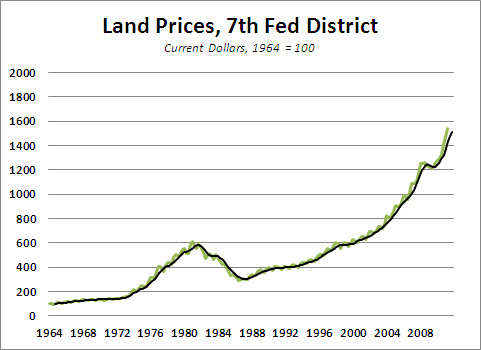
A couple of words on how this chart was derived. The Fed’s survey only lists quarter-to-quarter and year-over-year changes, not the raw number, and the data for download is only the year-over-year change, rounded to the nearest percentage point. So I had to work backward, getting the last four quarter-to-quarter changes, and then backing out the annual changes for each year. As a result, I can’t tell whether there’s an actual seasonality to land prices (which wouldn’t surprise me) or that annual dip is a result of some small variation in a recent year, that gets carried backwards (which also wouldn’t surprise me). Thus the prominence of the 1-year moving average.
You can see the bubble starting around 1976, popping in 1981, and taking until about 1986 to return to the trend line. Those of you hoping to recoup your recent residential real estate losses – sorry.
You also see the line take a nice bend upwards about 2002 or so, hits a little hiccup in 2008, and then resumes the trend. There are a few reasons for this: consolidations of small family farms into large operations plays a role, as do the expanding suburbs. Unike houses, they can’t build more farmland. Recently, you can add to that better-fed Chinese, who are buying lots of American corn to feed their soon-to-be mooshu pork.
All of which goes to explain why it’s a terrible idea to be sending about 1/3 of our corn crop to ethanol. Farmers may like them, the ethanol industry couldn’t survive without them, but the demand subsidies – the requirements that a certain percentage of our fuel come from ethanol – are clearly helping to drive up the price of corn, and the price of the means of production of that corn, and its sometime substitute, soybeans.
(As mentioned before, it also drives up the price of natural gas, needed for the fertilizer that soil-depleting corn needs, in order to grow year after year on the same plot of soil.)
People borrow to buy farmland, too. The interest rates on farmland loans have been trending downward for a long time, and have been mostly under 6% for the last 10 years.
Suffice it to say, this is not going to end well.
Waterloo II
Posted by Joshua Sharf in PPC, President 2012 on August 15th, 2011
I’ll have some further thoughts about tonight’s first contact between enemy forces in Waterloo, but for now, here’s the raw sound of Gov. Perry and Rep. Bachmann. I thought Perry spoke well, got a little lost during the Q&A, but finished well. And I thought Bachmann connected well with people, showed why she’s such an effective advocate, and also finished strong. While Perry arrived early to work the crowd, Bachmann waited, and made a bit of a grand entrance, which meant she had to deal with more crowd noise, which was exacerbated by the fact that they left the house lights on during her talk.
| Perry Speech | |
| Perry Q&A | |
| Bachmann Speech |


Podcast: Play in new window | Download
Waterloo
Posted by Joshua Sharf in PPC, President 2012 on August 14th, 2011
For this evening, Waterloo, IA is the center of the Republican political universe. It wouldn’t have been 2 weeks ago, but this happens to Iowa towns with some regularity, so they handle it well. The Black Hawk County Republicans have done a nice job handling the plague of locusts reporters who have descended on the place. All I wanted was a good sound location for the recorder. What I got was a microphone feed. I’ll post the sound from Perry and Bachmann (cast listed in order of appearance) later this evening.
I’ve spoken to a couple of Iowans here, and while that’s not necessarily a representative sample, there does seem to be some open-mindedness about things. One Romney supporter from 2008 is undecided this year. Another older fellow, unhappy with the caucus system because is makes it difficult for seniors to participate, is planning to support Perry.
I’ll stay away from the usual bromides about Iowa politics and the press. Everything you’ve heard it true. But if Perry is half as good a retail politician as he appears to be at first glance, he’ll do well in February.
Dystopia And Its Discontents
Posted by Joshua Sharf in PPC on August 14th, 2011
Walter Russell Mead posts this morning (“To Boldly Go Where Lots Have Gone Before”) about a new science fiction anthology of environmentalist cautionary tales:
The weak link in McKibben’s strategy is that like many greens he still seems to be trying to scare the public so badly that it will overlook the many obvious and frequently fatal flaws in the hodgepodge of dubious policy ideas the green movement floats.
It’s all been done before, better, and it failed.
Science fiction writers used to focus on the horrors of nuclear war and frightened the willies out of readers for many decades. Public worry much more intense than anything the greens can gin up never got the nuclear disarmament movement over the hump — not because nuclear war isn’t bad, or because people weren’t scared, but because the nuclear disarmament movement’s policy ideas emanated from the same cloud-cuckoo-land that the green fantasies do.
(Some would say that the enviros have been spinning fiction since at least An Inconvenient Truth, but I think we need to credit the difference between outright propaganda and literary pretense. That’s when it’s done well. To see how it’s done badly, let Kevin Costner be your guide – for nuclear apocalypse, there’s The Postman, and for Noah II, there’s Waterworld. The preaching obliterates whatever story there is.)
Mead then goes on to mention two classics of the genre: A Canticle for Liebowitz and On the Beach. And I think he misses, or at least doesn’t discuss, why those books were successful even as they failed to produce daisies from nuclear bombs.
That reason comes from the title of his post. Gene Roddenberry got NBC studio execs to understand Star Trek by pitching it as Wagon Train to the stars. He understood that while the trappings of the show were the 25th Century, it really had to be about 20th Century men. You can’t tell little morality tales every week if the characters’ morality is alien to your own.
A Canticle for Liebowitz wasn’t just about the devastation of nuclear war. It was really about both the resilience of humanity and its fatal flaws. Miller set it in a monastery to give it a religious cast, but those notions – human beings’ simultaneous collective strength and weakness – are timeless. How do you rebuild a civilization? Where do you start? And can any system of morality impose enough control on our demons to keep us from, in Miller’s words, “kicking it apart again and again because it’s not perfect?”
Likewise, On the Beach can really be read as a sort of Ecclesiastes for humankind as a whole: if we all die, if humanity someday is fated to end, what is the point of its existence? The end doesn’t have to come by our own hands, although that makes it tragic rather than merely pathetic. What makes the story compelling isn’t just the end of the world: it’s how people respond to its inevitability. To that extent, the very end of the book, the banner outside the church reading that There’s Still Time To Repent, comes off a little heavy-handed, one of the book’s few false notes.
The risk, of course, is in taking any of this too literally. You don’t read dystopian fiction or see dystopian movies for survival tips, personal or civilizational. You read it for the story. If they do that well, then the stories will be entertaining, and that’s all that matters. If they don’t, well, there’s always straight-to-digital.
Post-Debate Thoughts
Posted by Joshua Sharf in Colorado Politics, PPC, President 2012 on August 11th, 2011
Romney won. Mostly by not losing. He bobbed, weaved, occasionally answered a question, and looked like an adult doing it. But he didn’t do anything to put people at ease, and still hasn’t shown that he can either take a punch or deliver one.
Everyone else looked, well, sort of 2nd tier. Rick Santorum did the politician’s version of an Arnold Horshack impersonation, complaining twice about not getting enough airtime. Bachmann answered a number of tough questions well, but gave back a lot of what she won when she pleaded to be allowed to keep talking past the doorbell. The one thing she did well was deal with Pawlenty. The governor has a perfectly good line of attack and just can’t make it work. It fell to Rick Santorum of all people, to point out that Ron Paul (who all but said, “Come Home, America,” to the cheers of his fans and the boos of everyone else) and Bachmann want to lead the country, but couldn’t even lead their party during the debt ceiling debate. Herman Cain, a smart man, didn’t come across that way tonight. Gingrich came across as the least-canned, most genuine, and thoughtful of the candidates, which at this point, along with $3.58, will get him a grande latte at the flagship Starbucks in Seattle.
So Romney won. And Rick Perry also won.
Make no mistake, the questions were tough, by all the panelists. In fact, someone pointed out that Fox & the Examiner had, in the course of 90 minutes, asked more tough questions of the Republican candidates than the whole MSM has of Barack Obama in the entirety of his candidacy and presidency. Conservatives are bound and determine not to repeat the liberal mistake of softballing their own guys, only to see them fail for lack of vetting once they get into office.
That said, Pat Caddell made a telling point on the Fox News ringside webcast – this was a political class debate, with a political class schedule of topics, wasting way too much time on ancillary topics and ancillary candidates. We got Tim Pawlenty getting into a spitting match with Michelle Bachmann. We got Rick Santorum pointing out the utter idiocy of Ron Paul’s foreign policy, while a former ambassador to China barely got to discuss foreign policy at all. We got an entire segment on gay marriage and abortion.
The country has serious, serious economic, fiscal, and monetary issues, and not only did the moderators wait until the very end to get to jobs, none of the candidates took over the debate and forced the issue. No wonder there’s no passion for any of the candidates who has a chance to win.
On Wisconsin
Posted by Joshua Sharf in PPC, President 2012 on August 10th, 2011
On, Wisconsin! On, Wisconsin!
Champion of the right
“Forward”, our motto,
God will give thee might!
It’s hard to overstate the importance of yesterday’s wins in the Wisconsin recall elections. Needing to break even to retake control of the State Senate, the unions and their Democrat subsidiary fell short, winning only two six recalls. And while it’s hard to see what else they could have done to unseat Luther Olson, the Rs were within on 25-year-old secretary of making it 5-1. Apparently, all the union boots on the ground and national organization, along with $32,000,000, will get them a cup of coffee. Maybe a t-shirt.
Make no mistake, this was a coordinated asault on a national scale. The Democrats picked the seats they’d contest. They picked the folks who would contest them. In the case of the Fred Clark – Luther Olson race, they picked This American Life to highlight the race and do an not-too-subtle job on Gov. Scott Walker. Early in the evening, the Democrat state chair was quoted as saying that, while it would be close, his team had “done what they had to do.”
And it wasn’t enough.
Wisconsin isn’t the upper-midwest Massachussets that some Republicans would like to paint it as. The districts where Republicans won flipped back and forth between George W. Bush and Obama. Russ Feingold, today’s lefty savior against Scott Walker, only barely won re-election in 1998, not a banner year for Republicans. Tommy Thompson was elected Governor four times (although it’s not unusual for states to elect governors of opposing parties, while remaining consistent in the composition of the state legislature; look at Colorado from 1962 – 2002). In 2002, Ed Thompson, Tommy’s brother, running on the Libertarian ticket, took 10% of the vote, thus delivering the office to the Democrat Jim Doyle with only 45% of the vote, the ideal election outcome for Libertarians.
The Republicans lost control of the state legislature in the 70s,and the Dems’ high-water mark came in the 1976 Presidential Election. With Carter barely carrying the state, the Dems racked up a 66-33 majority in the House, and a 23-10 majority in the Senate. But the Republicans were never uncompetitive, and by the 90s had clawed their way back to parity in the State Senate, and had retaken the House. In fact, 2009-2010 was the first legislative session with a Democrat House majority since 1993. The Republicans had held a 19-14 Senate majority as recently as the 1995-96 legislature.
Still up until 2010, the birthplace of both the Republican Party and the most welcoming host of the political virus known as the Progressive Movement had a definite leftward tilt. There’s a reason that “Fightin’ Bob” LaFollette is one of the few Republicans my history textbooks looked on with favor. For much of the time in the 1920s and 30s, the main opposition party to usually-lopsided Republican majorities wasn’t the Dems, it was the Progressives, with a few Socialists thrown in for good measure:
| Senate | House | ||||||||
|---|---|---|---|---|---|---|---|---|---|
| Year | Democrat | Republican | Prog. | Socialist | Democrat | Republican | Prog. | Socialist | |
| 1919 | 2 | 27 | – | 4 | 5 | 79 | – | 16 | |
| 1921 | 2 | 27 | – | 4 | 2 | 92 | – | 6 | |
| 1923 | – | 30 | – | 3 | 1 | 89 | – | 10 | |
| 1925 | – | 30 | – | 3 | 1 | 92 | – | 7 | |
| 1927 | – | 31 | – | 2 | 3 | 89 | – | 8 | |
| 1929 | – | 31 | – | 2 | 6 | 90 | – | 3 | |
| 1931 | 1 | 30 | – | 2 | 2 | 89 | – | 9 | |
| 1933 | 9 | 23 | – | 1 | 59 | 13 | 24 | 3 | |
| 1935 | 13 | 6 | 14 | – | 35 | 17 | 45 | 3 | |
| 1937 | 9 | 8 | 16 | – | 31 | 21 | 46 | 2 | |
| 1939 | 6 | 16 | 11 | – | 15 | 53 | 32 | – | |
| 1941 | 3 | 24 | 6 | – | 15 | 60 | 25 | – | |
| 1943 | 4 | 23 | 6 | – | 14 | 73 | 13 | – | |
| 1945 | 6 | 22 | 5 | – | 19 | 75 | 6 | – | |
Source: Wisconsin Legislative Blue Book
NPR’s This American Life did an extended story on the political discord in Wisconsin. The gist of it was that everybody got along just swimingly, Democrats and Republicans, dogs and cats, until Scott Walker forced – forced, I tell you! – them to pick sides, and then the body politic was rent in half. The storyline probably is true. The lefty press and the lefty Dems were perfectly happy to rhapsodize about Wisconsin’s benign political culture, where everyone was friends, as long as they more or less got their way. But when actual conservatives were elected – as in, got more votes than the other guy – and decided that this actually meant they should be implementing policies they had espoused during the campaign, well, that was just too much.
Which means that last night’s victory – and next week’s possible extensions – weren’t just a ratification of party labels. They were a conscious vote in favor of policies that the new government has pursued.
The unions weren’t just counting on a history of Wisconsinites voting Democrat. They were counting on a deep-seated political culture that has always leaned decisively to the left. The specific districts they targeted had favored Republicans in 2010, but had only narrowly supported George W. Bush in 2000 and 2004, and had voted for Obama in 2008. That they didn’t return to form says that Wisconsinites – at least those voting last night, are still willing to give their conservative experiment more time, and that the Democrats haven’t given them any reason not to.
UPDATE: Seth Mandel over at Commentary argues that the Wisconsin Republicans should learn to be less aggressive in their agenda. I couldn’t disagree more strongly. This gives the opposition an unearned victory. He uses as his counterexample Chris Christie who, in a far less friendly environment, was able to get legislative Dems to sign on to the fiscal aspect of his plan, without trying to defang the unions. Christie may have accomplished all he could under the circumstances, but it’s not as though he won’t have to face all that public money in his re-election campaign. Scott Walker’s legislative majority survived to see his approach vindicated in finance, and given at least cautious approval by the electorate. The fact that this was, by and large, your money, your tax money, financing the opposition made the candle worth the game.
What the Republicans, in particular the national party, needs to learn, is to go on the offensive, or at least be nimble enough to fight defensively. The fact that the Dems had the initiative from the beginning meant they could pick the most congenial battleground they could imagine. Why on earth was the RNC caught flat-footed? Why on earth was there no concerted effort by the national party to get various state parties involved in making phone calls? Here in Colorado, we managed to provide a certain amount of help, but it’s quite clear that this was, like most other out-of-state efforts, on our own initiative, and mostly from the bottom-up. There’s no excuse for that sort of thing, no matter what’s going on at the Capitol or in the presidential nominating process.
All Your Energy Belong To Us
Posted by Joshua Sharf in Energy, PPC on August 4th, 2011
Thirty-four years. It was a third of a century ago today, that the Department of Energy was born:
Prior to 1973, the United States had no coherent energy policy. Instead, a number of smaller agencies, often working independently of one another, handled different aspects of the nation’s energy needs. In the early years of the Atomic Age, for example, the military assumed responsibility for all nuclear-related issues.
…
The Nixon administration responded [to the 1973 Arab oil embargo – ed.] with Project Independence and the creation of the Federal Energy Office, the former intended to give the United States total energy independence by 1980 and the latter to manage a national energy policy. The energy program grew incrementally under the Nixon and Ford administrations, but remained diffuse.
Jimmy Carter had acquired a technical background in nuclear propulsion as an engineering officer in the Navy. When he took office in 1977, he proposed creating a Cabinet-level überagency that would consolidate everything energy-related — research, exploration, conservation, production and disposal — under its authority. The Energy Department would also be responsible for setting the national energy agenda and assuring nuclear safety.
Congress passed the act, and Carter signed it Aug. 4. The Department of Energy began operating Oct. 1, 1977.
Government programs have much shorter gestation periods and much longer lifespans than the humans who comprise them.
But just look at the results! For the last 34 years, we’ve had a coherent energy policy! That this policy appears to have been designed by monkeys trying to write Shakespeare, and has done to the country approximately what the chimps would do to the typewriters after a few minutes is beside the point. It’s a policy! It’s coherent!
(And what came before, only set the stage. Like most of Nixon’s forays into economic policy, Project Independence achieved all of its goals, and then some! Oh, wait.)
I particularly like the part about assuring nuclear safety. Two years later, Three Mile Island imitated “art.” It doesn’t actually say anything about ensuring the availability of nuclear power. That would have to wait for deregulation, according to a new study from UC Berkeley’s Haas School of Business.
Wow. Seems like only yesterday that gas cost $0.50.
-
You are currently browsing the archives for the PPC category.


