Archive for category PPC
Recess!
Posted by Joshua Sharf in 2012 Presidential Race, National Politics, PPC on January 5th, 2012
Certainly my favorite part of the school day. For presidents trying to make appointments to administrative posts, not so much. While presidents have always been able to make temporary appointments while the Senate is in recess, there has been a recent gentlemen’s agreement that presidents won’t make such appointments during Senate recesses of less than three days. This allowed the Senate to declare interim “non-working” sessions to technically avoid recess for that length of time.
Republicans are now – yet again – learning the value of gentlemen’s agreements with Democrats, President Obama making four recess appointments yesterday despite disagreement about whether or not the Senate is actually in recess. (Much has been made of then-Senator Obama’s opposition to recess appointments, but a change of position on the limits of executive power was to be expected once he became President. Such institutional tension is part of the Constitution.)
That these appointments substantially shift the balance of power to the executive and away from Congress is clear. Some have been suggesting that impeachment may be the only way to deal with this, and I have to admit that, despite my reluctance to throw that term around, that was my initial reaction, as well. However, with a little more research and reflection, I consider that route to be extremely unlikely for a number of reasons.
First, over at the Volokh Conspiracy, John Elwood argues that the appointments are actually constitutional. His claim is that even if the Senate is not in technical recess, it is in functional recess, as it has denied itself the ability to provide the constitutionally required advice & consent. It would be unthinkable to impeach either a President or his appointees if there’s been no crime committed.
However, Elwood points out that the matter has not been adjudicated by the courts, and any regulatory actions taken by the appointees could be challenged on the basis that they didn’t have the right to hold the office. These are high-profile offices, which will provide ample opportunities for such challenges. Whether or not the courts will go further, and remove the appointees from their offices, or simply invalidate their acts and require repeated and persistent challenges to a regulatory authority could also determine whether or not the maneuver will succeed in spite of being found illegal.
The act establishing the consumer protection office also provides room for a statutory challenge short of a constitutional one – it explicitly requires Senate approval before the Secretary of the Treasury can transfer authority to him. Courts traditionally prefer to make decisions on statutory bases rather than constitutional ones where possible.
So much for the legal considerations. The politics of the situation also militates against impeachment, even assuming a timely and clear court decision that the appointments were unconstitutional. First, Fast and Furious provides far better grounds for impeachment against underlings like Attorney General Holder. Starting with the abuses of power there makes much more sense. Second, in an election year, unless there is a clear an undeniable abuse of power and criminal behavior, it will be almost impossible to persuade the public that impeachment proceedings are anything other than political.
The political and legislative overhead involved in something as momentous as impeachment is huge. To pass articles of impeachment out of the House, knowing that they will be inevitably rejected by Senate Democrats determined to defend the administration at almost any cost is to invite a repeat of the public’s judgment on the 1998 Clinton impeachment. Worse, repeated impeachments – even talking too freely about impeachment – risks devaluing it.
Ultimately, the political calculations by the President are probably even more important to him than the legal ones. In the matter of the financial regulators, loud and ineffectual opposition to the appointment will simply reinforce his public position as Defender of the Little Guy Against Wall Street, in a year when his re-election strategy will be to rename Mitt Romney, “Wall Street.”
Moreover, it’s a preview of coming attractions in 2012, and Obama’s second term, should he win one – his determination to use executive powers to their fullest, in the absence of effective Congressional opposition. The Democrats have already shown their willingness to govern without a budget for years on end, and thereby prevent Congress from exercising oversight through the power of the purse. They’ve also shown the political skill to frame the debate in narrow enough terms to make Republican opposition to that seem “obstructionist.” That’s really what’s at stake here.
Jared Polis, Keepin’ It Classy
Posted by Joshua Sharf in Colorado Politics, PPC, President 2012 on January 1st, 2012
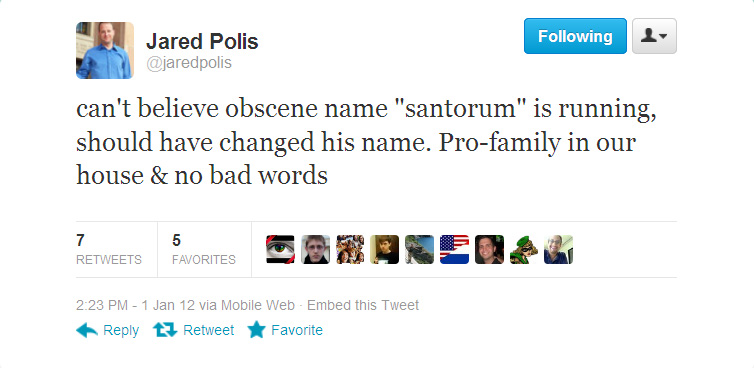 It’s one thing for Dan Savage to keep his long-running campaign to associate social conservative Senator Rick Santorum’s name with something foul. (Google it yourself, if you’re that interested.) It’s something else again for a sitting Congressman to join in the “fun,” now that Sen. Santorum’s campaign is showing heretofore undetected signs of life.
In all likelihood, we’ll see either silence, or an insincere non-apology of the “if I offended anyone” genre, combined with much behind-the-scenes juvenile snickers at which the Left excels.
Unilateral Disarmament
Posted by Joshua Sharf in Colorado Politics, PPC, Redistricting on December 5th, 2011
Among the products of 2011’s Great Reapportionment Debacle has been a claim by State Representative Amy Stephens that Democrats on the Reapportionment Commission have been particularly aggressive in targeting Republican women legislators, combining their districts with others represented by sitting Republicans.
Her comments have produced a fair amount of tut-tutting and cluck-clucking, not from the Left, when too much protest doth be expected, but from fellow Republicans, concerned that such claims are unbecoming a party priding itself on a meritocratic approach to politics, as opposed to one driven by race and gender demographics.
I dissent.
Indeed, properly done, such a complaint is not merely smart politics, it’s all the smarter for having the added virtue of being true.
Politics being what it is, meaning that life and people being what they are, hypocrisy is among the easiest charges to level against any opponent claiming to have standards. It’s one rhetorical advantage that Democrats have always had over Republicans. Nobody understood this better than the Democrats’ current Pamphleteer of Record, Saul Alinsky, who included in his toolkit making the opposition live by its own rules.
It’s not necessary for you to believe in those rules for the criticism to be valid. A friend of mine, who frankly has no interest in the Constitution beyond the bludgeons of the Establishment Clause and the Equal Protection Clause, has no problem pointing out (sometimes fallaciously) where this or that Republican isn’t much of an originalist. The criticism has two purposes – it dispirits Republicans who have to compromise from time to time, and it advances the subtext that maybe originalism isn’t all that important, after all.
The Democrat coalition has for years consisted substantially of balkanized interest groups, seeking to officially balkanize both American politics and society. Pointing out that in practice, the political activities of that party does not serve the interests of women (in this case), or other groups, is unlikely to faze the professional victims, but may give their alleged constituents pause to consider.
Indeed, making use of the fact that such a coalition is ultimately a zero-sum game is the surest way to fracture it. Democrats are especially threatened by prominent conservatives who are either not white or not men. Even if one believes that the Democrats on the Apportionment Commission were motivated more by the chance to take out leadership than to target prominent Republican women, the fact that so many of the Republican leadership are also women sends a message of its own that Democrats would rather not confront.
Many conservatives are still upset with Rep. Stephens over the state-run Health Insurance Exchanges and her intemperate response to their objections. Indeed, almost a year on, added information about Obamacare has highlighted and validated just about every one of those objections. I’m not in Rep. Stephens’s old or new district, and she was personally very supportive of both my runs for office. But she’s a big girl, and can take of herself.
My worry is that, by a too-vociferous insistence that those on our side not only agree with us, but agree with us for exactly the right reasons, and using exactly the words we would use, we’re going to end up robbing ourselves of effective rhetorical weaponry. Arguments that work amongst ourselves may not be so successful out in the wide world of independents and thoughtful Democrats. And arguments that peel away pieces of their coalition may be less persuasive among conservatives. There’s more than one way to skin an interest group.
Slings and arrows are part of politics and political discourse, even within your own camp.
Hear That Whistle Blowin’?
Posted by Joshua Sharf in Colorado Politics, Economics, PPC, President 2012 on November 30th, 2011
It’s not very loud just yet. But if you bend down, ear to the rails, you can hear the ever-so-quiet singing of a train in the distance.
It’s the Hillary Special, and it’s scheduled to pull into 1600 Pennsylvania Ave., on January 21st, 2013.
The engine has always been there, in the railyard, getting refitted and cleaned and tuned up. Bill took it out for its paces a few weeks ago with the comments about Obama’s handling of the economy. Then, of course, came his book, with its false choice between drowning government and crony capitalism.
And now come the test runs, starting with the Wall Street Journal op-ed and the write-in campaign.
The train’s route was made clear by Pat Caddell, in last Friday’s appearance on the Ricochet Podcast. Caddell, along with liberal-but-not-insane pundit partner Douglas Schoen, explained in last week’s Wall Street Journal why Obama had to step aside for Hillary, for the good of the country, and the good of the Democratic Party, not necessarily in that order.
While some read this as desperation and wishful thinking, I’m more inclined to see it as the launching of Hillary’s 2012 exploratory committee. It tests the waters while not committing her to anything, indeed, while not tying her to any possible disloyalty at all.
Caddell’s & Schoen’s idea, in a nutshell, is that Obama can’t win re-election in such a way as to allow him to govern. That in order to win, he’ll have to poison the political environment so thoroughly that cooperation with the Republicans will be impossible, and that the country simply can’t afford that right now. If he loses, he’ll lose whatever gains he’s made for the Left with him. So for Caddell & Schoen, an Obama candidacy is a lose-lose situation.
Worse, Obama is simply giving up on large swatches of the Democrat coalition, in particular working class whites. He’s offered nothing substantial to labor, only the procedural, and is willing at every turn to sacrifice jobs and the economy to the elite green ideologues. (This is a Democrat talking, by the way, not me.)
Hillary, on the other hand, has shrewdly used her tenure at the State Department to build up her own stature as the actual adult in the party, as opposed to the aspirational adult – also known as an adolescent – currently occupying the White House. She’s been disciplined in sticking to foreign policy, keeping her mouth shut about everything else. Even Bill has, according to Caddell, mostly kept his mouth shut.
If in 2000, the country was suffering from Clinton fatigue, it’s now going through some nostalgia for the 90s. Unlike the Bush years, we were (mostly) at peace. Unlike the Obama years, we were prosperous, with a president who seemed to understand the importance of that fact.
Less odious to the center than Obama, Hillary could win with a positive campaign, or at least one without the overt slash-and-burn strategy that Obama is committed to. Once in office, she may be able to cut a grand spending-and-taxing bargain with the Republicans, where Obama has no hope of doing so. Merely by winning, she’ll be able to preserve the key elements of Obamacare, seen by the Left as this generation’s Progressive Great Wave.
Caddell & Schoen remember how, in 1968, when Johnson won only 58% of the vote in New Hampshire, he decided that he didn’t have the stomach for a long primary campaign, even though he stood an excellent shot at re-election against Nixon. He stepped aside in favor of Hubert Humphrey, who might well have won had Johnson stopped bombing Vietnam a couple of weeks sooner. The appeal to Obama’s sense of duty to persuade him to make the same choice.
More than that, they’ll appeal to the same sense of not wanting to fight for renomination. Caddell & Schoen are now trying to get one or several large Democrat donors to run a Hillary Write-In Campaign in New Hampshire. They believe that were she to win a significant percentage of the vote, it might really shake up the race on the Democrat side.
Since it wouldn’t be controlled by or connected to Hillary (wink, wink), Obama couldn’t really tell her to shut it down. Were he to be too forceful, it could allow her to resign and actually run against him, which is the last thing he wants.
I have to admit, I was a little disappointed at the lack of close questioning by the Ricochet gang. A number of Caddell’s assertions were dubious at best, and yet went relatively unchallenged. Obama has abandoned labor on the high-profile projects like Keystone XL. But he’s practically turned the NLRB into an arm of the AFL-CIO. The NLRB itself, as an end-run around the loss of a quorum to conduct business, threatens to invest its general counsel with an unheard amount of unreviewable authority and power.
Bill, as we’ve seen, has not been very quiet of late, complaining about Obama’s handling of the economy. Caddell also claims that Hillary is the only thing keeping Obama’s National Security Advisor in check with respect to Israel, but in fact, we don’t really know what Hillary’s person opinions about Israel are, and there’s plenty of reason to think they’re not particularly friendly. I believe Caddell makes that claim because it appeals to a clearly disaffected part of the Democrat base that remembers, as do most Israelis, Bill as a friend of that state.
Similarly, Caddell appeals to what the Democrat Party once was, but no longer is, when he tosses out with obvious disgust, but does not elaborate on, the notion that Obama will seek to circumvent a hostile Congress by ruling by executive fiat. True enough, but worthy of fuller examination, playing as it does to our fears of a truly imperial Presidency.
Thus, the outlines of the prospective Clinton 2012 campaign. The reality is, of course, is that Hillary would not govern as a centrist. She would likely be a more effective salesman for the old, unimaginative Blue Social Model policies that doom us to Europe’s fiscal fate, however.
That clickety clack that promises to take us back will, instead, leave us all – Obama included – singing the blues in the night.
Sun Sets On Solar
Posted by Joshua Sharf in Business, Energy, PPC on November 15th, 2011
Chinese solar manufacturers, heavily subsidized by the Chinese government though they are, are not completely immune from the laws of economics. Faced with falling demand, falling prices, and growing inventories, they’re cutting production. The follows on the heels of a number of high-profile failures of solar manufacturers here in the states.
True that the Chinese government, in its relentless mercantilism, was, and is, subsidizing solar heavily enough that three of their companies may survive the shakeout, whereas it’s possible none of ours will. But in fact, they were just responding to a market that largely existed because of European and American solar subsidies in the first place. The collapse of solar prices isn’t about new manufacturing techniques (yet), it’s about Europeans realizing that not only is the energy more than they can afford, so are the jobs, and they’re mostly going overseas, anyway.
The irony is that we’re still being told that we need to “invest” in solar because the Chinese are committed to it, and that must validate the idea. It turns out that the Chinese were only invested in it because they figured to have us as their high-priced customers. Not only were we funding both sides in the solar arms race, we were using the result to justify nonsense subsidies like Solyndra and LightSquared. It’s like one of those experiments where the monkey reacts to itself in the mirror. Only in this case, it was more like Lucy and Harpo pretending to fool each other.
Colorado, under former Governer Bill Ritter, began to pursue a “New Energy Economy,” chasing and subsidizing alternative energy companies, hoping to lure them to the state. Ritter was elected in 2006, and the financial meltdown and succeeding recession created revenue shortfalls that limited the damage he could do. The latest brouhaha over missing funds at the Governor’s Energy Office hasn’t done their cause any good, either.
The ideologues won’t be swayed, of course, but perhaps many of the more pragmatic politicians can be persuaded that these are bad bets for governments to be making.
President Golf Calls You Lazy – Again
Posted by Joshua Sharf in Business, Economics, PPC, Regulation on November 14th, 2011
In what was called a “scripted conversation” with Boeing’s CEO James McNerney, Jr., President Obama reprised his Malaise Moment of a few weeks ago, and said, “We’ve been a little bit lazy, I think, over the last couple of decades,” which resulted in the 2009 dropoff in Foreign Direct Investment in the United States.
I have to admit that my first reaction was that I was too busy to be bothered with replying. But, as the saying goes, sharks gotta swim and bats gotta fly.
Taken at face value, I don’t have any idea what the hell he was talking about. Worse, I don’t think he does, either. Certainly even a cursory examination of the facts would reinforce the conclusion that Obama’s grasp of recent economic history isn’t any better than his grasp of mid-century diplomatic history.
Below is a quarterly graph of foreign direct investment in the United States, starting in 1980. The series starts in 1960, but it roughly zero from then until 1980, owing to the fact that the US, generating the lion’s share of the world’s wealth, was relying on exports more than FDI for growth:

You can see a couple of patterns here. First, FDI accelerates through the business cycle, as expected. As the economy picks up steam, it generates interest abroad and confidence in investors looking for growth. Second, over the last “couple of decades,” FDI has grown through each business cycle, if you discount the dot-com bubble evident in the very late 90s. Third, when the US economy goes into recession, foreigners stop investing here, until they see some evidence of a bounce-back. All of these patterns clearly apply to the most recent recession, and the current economy.
Of course, we all knew this was bunk, anyway. National accounts must balance, and the only way we can finance our trade deficit is through FDI in our economy. If we find ourselves unable to generate enough wealth, or attract enough investment, to import the things we want, that’s indeed an indictment of our ability to compete, but it likely has much more to do with government policy and regulation than with the work ethic of most Americans.
Obama’s statement that this pattern existed over “the last couple of decades,” is, I think, an attempt to include Bill Clinton’s presidency in his criticism, a back-handed return volley to Clinton’s oblique criticisms of Obama’s economic policies. It’s more than just his routine scolding of his fellow citizens, it also contains a domestic partisan political component, as well. One wants to resist the temptation to overstate the electoral consequences of such tension. But it may be that the President’s famously thin skin is once again getting the better of his judgment.
At this rate, maybe his staff should just use that XtraNorml animation engine for any future “scripted conversations.”
Notes on the State of Virginia
Posted by Joshua Sharf in PPC on November 9th, 2011
Coming as I do from Virginia, I like to keep an eye on the politics of the old country. Virginia is one of the few states to hold its elections in odd-numbered years. As a result, their elections are often seen as better bellwethers than the Congressional mid-terms. (This is a little odd, inasmuch as, in the last 11 gubernatorial elections, Virginians have voted against the party in the White House. Virginia governors can’t succeed themselves, but they can run again after sitting it out, and Mills Godwin holds the distinction of being both the last Democrat elected under a Democratic President, and the last Republican elected governor under a Republican President.)
This year, the Republicans entered the post-2010 Census elections with 58 seats in the House of Burgess- er, Delegate, and 18 seats in the State Senate. Holding the governorship meant that they needed only one seat to regain control of the State Senate.
The results show the perils and power of redistricting. Unlike in Colorado, state legislative redistricting is done by the legislature itself. With a split legislature, the Senate and House agreed to draw their own maps for their own chamber, and to abide by the other house’s map. So the Senate Democrats and House Republicans, essentially, got to draw the maps for the Senate and House, respectively.
The Republicans ended up taking an astonishing 67 seats in the House, but they could only manage a 20-20 tie in the Senate. That’s good enough for control, but the Republican Lt. Governor will be spending a lot of time up at the state capitol building over the next two years.
These results mask the utter collapse of the Democrat party in the Old Dominion. Though they’ll never say so, the Democrats made a strategic decision to sacrifice the House to try to hold onto the Senate. Of seven Senate races decided by less than 10%, the Democrats won five, and came within half a percentage point of a sixth. In the House, they lost all six.
Statewide, the Democrats received an aggregate 34% of the vote in the House, and just under 40% of the vote in the Senate. The Republicans out-polled the Democrats roughly 3-2, and still ended up with only a tie. Democrats didn’t even bother to run in 12 of the 40 Senate districts. (Republicans vacated the field in only four.) In the House, it’s even worse. Republicans didn’t compete in 27 districts, but Democrats only ran in 54 districts. Put another way, the Republicans could have lost in almost every contested race, and still won control of the House.
This may be a mixed blessing for the Republicans. As Colorado House Republicans have found out over the last year, governing with a majority of one vote is often worse than being in the minority; in effect, you don’t have working control of the body. You can kill and pass lots of stuff in committee, but when it gets to the floor, the minority can almost always count on standing together in opposition, while they need only pick off the squishiest member of your caucus on any given vote. The net result for Virginia may be that the Republicans are perceived as having full governing authority, while not necessarily having full governing power.
For 2012, though, it’s probably very good news for Republicans. I can’t imagine President Obama carrying the state, and even a popular ex-governor like Tim Kaine will be facing a daunting structural deficit (something Democrats are excellent at creating).
Wahoowah.
Field Work at DU
Posted by Joshua Sharf in Colorado Politics, PPC on November 8th, 2011
I didn’t do the field work. I was the field work.
For the last several years, I’ve been lucky enough to be invited to be the Conservative for Inspection by the Students at Prof. Christina Foust’s class on Anarcism and Conservatism. It’s always a terrific experience, being able to put conservative ideas in front of a set of students who probably don’t hear them very often on campus. And Prof. Foust, despite admitting to being left-of-center, has been unfailingly gracious, has always let the discussion go where it may.
This year was no different, although instead of me responding to questions and expounding on conservative solutions to the world’s problems, we tried to get the students more involved, asking them to explain their questions, come up with their own answers, and show how rhetoric is used to frame an issue by one side or another. Many of the students who take the course are prospective business students for some reason, so they tend to be focused on economic & business questions, and we did indeed spend a fair amount of time on those. But when we took up the question of taxing & spending, I took the opportunity to reframe it as one of government power, in a way that readers of this blog will be familiar with. It was, I hope, a small revelation for them. As was the emphasis on federalism and the role of the states as laboratories of democracy.
One student asked an interesting question about what they, as individuals, could do to help out with regards to the economy. I decided to take an economic rather than a political attitude towards the question. Alluding to Arnold Kling’s analogy of the Great Recalculation, as opposed to the Hydraulic Model of the economy, I suggested that 1) they should make themselves as appealing to potential employers as possible, and 2) they should think about starting businesses of their own. Both are necessary, as our economy adapts, and we struggle to figure out what goods and services people are willing to pay for.
At the end of the class, we took up the question of higher education, and how their time at the school would affect their lives. With most of them being business majors, I thought it was a good opportunity to mention the value that the much-derided humanities could have in their lives later on. Although I was a physics and math major, I took a number of history courses in school. I was graduating in 1987, and I had every reason to believe that my career would be spent fighting the Soviet Union. My ability to do that, to maintain perspective on that great struggle, and to stay grounded in it, would be enhanced by a greater understanding of world and European history. Even after I changed careers, I found that my most rewarding moments in b-school and as an equities research analyst were when I saw how understanding business, and understanding human nature and how the world works, are really one in the same.
The key element, I think, is that they need to take the classic authors on their own terms, not the politically-charged and ethnic- and gender- and all-too-abstract ways that many professors would try to present them. Immediately after the class, I happened to pick up a copy of the September 2001 Journal of Political Science, just to see what people were writing about before the world changed. There was an article about “Thucydides as Constructivist.” It’s a shame I didn’t look at it immediately before the class, because it’s exactly the kind of thing I would have advised the students to avoid, as utterly irrelevant to the historical lessons they should be getting from the History. Thucydides is writing a history of a war that actually happened, between two states and two ways of governing, and it’s important not to lose sight of the story he’s telling. The biases we should care about stem from his own political and military involvement in that war, not from some backward-projected modern critical categories.
Last week, the guests had been anarchists, so I took advantage of the home field advantage to compare (unfavorably) the OWS protestors with the Tea Party, in particular to show how the rhetoric being used by the Occupation is deliberately aimed so as to confuse the differences between the two. Hey, these kids are going to be making decisions someday; best that they know right from wrong.
First Thing, Let’s Crash All The Banks
Posted by Joshua Sharf in Business, Finance, PPC on October 31st, 2011
The latest idea from MoveOn.org and their friends and OWS is to withdraw all their money from the “Wall Street Banks,” and to move it to smaller, community banks and credit unions on November 5th. If such a move were to take place on the scale they’d like, it would be a deliberately created bank run on the largest financial institutions in the country. They seem to have gotten the scheme from some Ron Paul supporters, who are at a minimum mildly ticked off that OWS and MoveOn are claiming credit for it.
They may claim that this is a small, symbolic action, but that doesn’t excuse it. Small, symbolic actions are unlikely to have any actual effect on large institutions, and fanatics don’t propose such actions hoping for them to be merely symbolic.
We can all be grateful that this won’t amount to a hill of beans in this crazy world, but this is still a terrible idea, one whose ineffectualness doesn’t absolve it of its fundamental irresponsibility. You might expect this sort of thing from MoveOn, but the Ron Paul people fancy that they understand how banks work, and that turning all of Wall Street into the Fidelity Fiduciary Bank wouldn’t be the soundest financial strategy. Bringing Wells Fargo crashing down isn’t any better an idea now than it was 3 years ago, and it’s liable to take a bunch of smaller, “safer” community banks with it.
The basic premise of the exercise is flawed. It’s certainly true that the balance sheets of some of the larger banks are in worse shape than many smaller, community banks. And it’s equally true that Too Big to Fail probably means Too Big (to borrow a phrase from Instapundit), and that any bank Too Big To Fail should probably be broken up into smaller entities. And when smaller banks fail, they fail less catastrophically.
Ironically, the website for the Move Your Money Project features a scene from “It’s a Wonderful Life,” the bank run scene, on a building and loan that, if you remember, came within $2 and the goodwill of a couple of neighbors of failing.
Smaller banks do fail, almost 300 between 2009 and 2010, and 86 so far this year. The MYMP site will cheerfully direct you to a smaller bank or credit union, one which stands a good chance of operating under some sort of enforcement action from the Office of Thrift Supervision, the Office of the Controller of the Currency, the Fed, or the FDIC.
Ultimately, this isn’t about “sending a message” to Wall Street, or making your money safer. It’s about visceral hatred of banks and bankers, and a failure to appreciate the role that finance plays in a healthy capitalist system.
Yaron Brook, who runs the Ayn Rand institute and is nobody’s idea of a Keynesian squish, has the appropriate response:
Efficiency Without Regulation
Posted by Joshua Sharf in Business, Economics, Energy, PPC, Regulation on October 27th, 2011
As many of you know, I’m completing a year’s sojourn here in Omaha, the midwestern town with a decidedly western sensibility. (Don’t believe me? Check out the River City Rodeo sometime.)
I’ve been doing web development for Werner Enterprises, one of the country’s larger trucking firms, but having dabbled in finance, I also always take a peek at the quarterly earnings reports. They almost always include a line like the following:
We continued to effectively manage the impact of higher fuel costs by improving our fuel miles per gallon… We are controlling truck idling; optimizing the speed, weight and specifications of our equipment; and implementing fuel enhancing equipment changes to our fleet.
How good are they at it? Turns out, they’re pretty good. Below is a graph of the national average diesel price vs. the company’s reported (or calculated) fuel cost per mile:

At first, you’ll see that the fuel cost grows faster than the fuel price. Some of this is a result of EPA emission regulations, which made the newer engines less fuel-efficient. As they newer engines were gradually introduced to the fleet, they affected overall operating costs. (In fact, at least one of the 10Qs from that era notes that Werner was able to command a premium when re-selling its older, hand-me-down tractors to other carriers.)
Over time, the company has managed to implement certain fuel-saving practices and patent aerodynamic designs that have cut fuel costs. The diesel price curve (courtesy of the US Energy Information Administration) look a lot like the curve leading up to 2008, but the cost per mile has dropped below it. For comparison, in Q3 2006 and Q3 2010, diesel was a little over $2.90/gallon, but Werner’s fuel cost per mile was 17% lower. That represents just under 4% of operating revenues, which is slightly enormous in this business.
They’ve done this even as the rise of intermodal has limited trip length:

Shorter trip lengths are associated with lower fuel efficiency; they involve more stops and starts, more idle time, and a higher percentage of time spent off of the interstates. So the cost containment has happened in spite of this.
It’s also happened despite the fact that class 8 trucks have no CAFE standards at all (although class 8 truckers probably have cafe standards of their own, mostly involving coffee & pie).
If anything, as we’ve seen, the government has made fuel efficiency more difficult by choosing emissions control over it. This choice may or may not be justified; that isn’t the point. The point is that, left to fend for themselves, with the government having made policy decisions that placed other priorities above fuel efficiency, trucking companies have been able to improve their own processes, and to demand better mileage from their suppliers.
More than that, it’s a little “I, Pencil” microcosm. These decisions are the result of a long chain of cost-benefit calculations stretching from engine manufacturer to trucker through customer to consumer. Each of these relationships has its own set of elasticities of supply and demand, which affect how much of the fuel cost can be pushed downstream. The amount that can’t be passed on to each customer provides the incentive for fuel economy.
It also provides the ceiling for how much each is willing to pay for it. Including the engine manufacturer. The government could probably demand higher fuel efficiency out of tractor engines, and the result would be greater inefficiency overall, because the cost of producing that engine would be greater than the system is currently willing to pay.
You could justify those expenses as externalities, say, the national security cost of keeping the Saudi pipeline safe and operating. But then you’re stuck arguing that the political & regulatory systems are as efficient in balancing interests as the economy is in balancing costs, which I think is, at best, an unproven assumption.
Note: Naturally, the opinions expressed here are entirely my own, and do not in any way represent Werner.
-
You are currently browsing the archives for the PPC category.


