Archive for category PPC
Daily Glimpse February 20, 2012
Posted by Joshua Sharf in PPC on February 20th, 2012
Daily Links From Glimpse From a Height
- More Maximalist Executive Muscle-Flexing
The SEC is apparently forcing corporate boards to vote on the “significant policy issue” that is Net Neutrality, despite the FCC’s lack of legal cover to even make it an official policy. The DC Circuit Court unanimously ruled that the FCC didn’t have the authority to enact Net Neutrality, but it went ahead and did […]
- More e-Textbooks
Competition for Apple’s e-textbook creation software; platforms that offer more collaboration. With unit production costs falling to zero, we’ll see how much of the cost is in the initial production (and how much more inefficiency can be wrung out of that), and how much is in the monopoly positioning of professors and university presses.
- Consequences For Thee…
The new Silicon Valley. Wealthy enough to insulate itself from the consequences of its leftism: High-tech firms once concerned themselves with many of the same things as other manufacturing companies. They worried about electricity rates, obtrusive environmental legislation, high housing prices, and dysfunctional public education. Many naturally supported Republicans, or business-oriented Democrats. But as tech […]
- Nice Little School You Got There…
…Shame if anything happened to it. The mayor of Providence, R.I., on Wednesday announced a deal with Johnson & Wales University under which the institution would more than triple its voluntary payments to the financially struggling city, to at least $958,000 a year, the Associated Press reported. The deal is subject to City Council approval. […]
- Another Reason Not To Take the Ninth Circuit Seriously
This time, on same-sex marriage, from Baseball Crank (Dan McLaughlin): Tradition, history, culture, social recognition: these things were good enough, not only for Justice Douglas in 1965, but for the Ninth Circuit panel majority itself in its own discussion of the reasons why the term “marriage” matters and has value – yet they suddenly become […]
- Higher Ed Bubble Correction
In Indian B-Schools: The Indian management education sector grew so wildly when demand was rampant (today there are 3,900 management schools with close to 3.5 lakh seats) that supply overshot demand by a long straw. And now comes the fallout. In a dramatic, though not entirely unexpected, development, as many as 65 business management colleges […]
- Coriolanus
A difficult tale, well-told: In his directorial debut, Fiennes takes a strong story and brings out its potential creating with a strong script and solid performances. Noteworthy in particular are Fiennes and Redgrave, a woman who seems to be speaking to the audience itself when she seeks to compel her son to change alliances. This […]
- Redefining Religious Activity
From Rabbi Meir Soloveichik: What I wish to focus on this morning is the exemption to the new insurance policy requirements that the administration did carve out from the outset: to wit, exempting from the new insurance policy obligations religious organizations that do not employ or serve members of other faiths. From this exemption carved […]
Guest-Hosting Backbone Radio this Sunday, February 19
Posted by Joshua Sharf in PPC, Radio on February 15th, 2012
On this Sunday’s action-packed edition of Backbone Radio, we’ll be hearing from David Goldman, who blogs pseudonymously as Spengler at PJMedia and for the Asia Times, on his book How Civilizations Die,and events in Egypt and Iran as they unfold.


We’ll speak with Independence Institute education expert Ben DeGrow about a legislative attempt to open up the teachers’ contract negotiations up to public scrutiny.
- Independence Institute brief Ben wrote last year about the subject (PDF)
- Recent Ed Is Watching post on the current debate
Following up on a Backbone Business segment from a year ago, we’ll look at a local programmer who’s brought Google’s smartphone payment software to its knees, and what that means for you.
- Joshua Rubin’s blog post explaining his discovery. Not for the technically faint of heart. (follow him on Twitter at @joshuarubin)
- Coverage from the American Banker
Dr. Zuhdi Jasser, founder of the American Islamic Forum for Democracy, and tireless defender of American exceptionalism against political Islam, will join us to discuss Somali pirates, Syrian tragedy, and a controversy surrounding the NYPD and his film, “The Third Jihad.”
- Powerline on Somali Americans and al Shabaab
- The Clarion Fund responds to the NYPD brass on The Third Jihad
- Zuhdi Jasser responds on The Third Jihad
- CAIR’s funding
- CAIR – Unindicted Co-Conspirator in the Holy Land Foundation Trial
In our third hour, we’ll be joined by James Bennett, who’ll discuss how Europe’s distresses may be England’s – and the Anglosphere’s – opportunity.

- Daniel Hannan on India and the Anglosphere
- Joel Kotkin on why the UK doesn’t need the EU
- Open Europe on Labour support for Devolution
And we’ll preview an upcoming Centennial Institute policy conference on Media and the 2012 Elections with Institute founder and director John Andrews.
In-between, we’ll make time as always to discuss some of the issues of the week.
Please join us this Sunday evening from 5 – 8 PM, on 710 KNUS Denver, and 1460 KZNT Colorado Spring for Backbone Radio.
This Chart Still Needs a Campaign To Speak For It
Posted by Joshua Sharf in 2012 Presidential Race, Economics, National Politics, PPC on February 14th, 2012
A few weeks ago, AEI linked to this Wall Street Journal chart:

The post was titled, “Romney’s Economic Case In One Chart,” and it should be. But charts don’t speak for themselves; they need to be explained. In an age where pollsters routinely judge presidential prospects by the responses to the question, “Understands the problems of ordinary Americans,” it’s not enough to talk in abstract terms about getting the economy moving again, or screaming “Liberty!” at increasingly shrill pitches. It’s not even enough to say that the ever-growing gap between the dark red line and the light red line represents wealth. People need to be reminded why charts like this matter to them.
I see millions of families trying to live on incomes so meager that the pall of family disaster hangs over them day by day.
I see millions whose daily lives in city and on farm continue under conditions labeled indecent by a so-called polite society half a century ago.
I see millions denied education, recreation, and the opportunity to better their lot and the lot of their children.
I see millions lacking the means to buy the products of farm and factory and by their poverty denying work and productiveness to many other millions.
I see one-third of a nation ill-housed, ill-clad, ill-nourished.
But it is not in despair that I paint you that picture. I paint it for you in hope—because the nation, seeing and understanding the injustice in it, proposes to paint it out.
Eighty years of wealth accumulation later, we are not anywhere near so desperate. But a large portion of this still applies, and it wouldn’t be too hard to translate it into modern terms.
That gap represents houses unbought, vacations untaken, memories not made. It represents retirements not taken, or undertaken with too little money. It represents families living closer to the edge of disaster, and thus closer to the trap of government assistance, since they can save less. It represents education and training not gotten, success not earned.
Stasis is not starvation, but it is no less empty for all that, and it will, as Europe has shown, accelerate over time. In a country when men and women pride themselves on being masters of their own destiny, it should be possible to explain what being at the mercy of hostile forces means.
The good news is that we know it’s possible, and that the man who made it work was one of the rare 20th Century patrician Presidents.
The bad news is that those words were spoken at his Second Inaugural, as he prepared to deepen and strengthen all the wrong solutions.
Dan Santorum?
Posted by Joshua Sharf in 2012 Presidential Race, Colorado Politics, Governor 2010, National Politics, PPC, President 2012 on February 14th, 2012
Those of us who suffered through 2010’s Colorado Republican gubernatorial campaign travesty should have learned some lessons. So far, the national presidential nominating process is making me regret that Colorado is a trend-setter.
A similar dynamic – discontent with a front-runner, seen as hostile – or at best indifferent – to the Tea Party, and seen as hand-picked by an entitled establishment too timid to settle on actual conservatives to carry the party’s banner. Both men, who seemed conservative enough in earlier incarnations, are had their bona fides questioned later. In both cases, the criticism may be somewhat unfair, but it’s also led to a lack of enthusiasm for that candidate, and fueled talk of third-party runs, even before the nomination has been decided.
McInnis seemed to spurn Tea Party support, and then was victimized by a chiron during a national TV interview; likewise, Romney, while not going out of his way to the extent that Huntsman did, has also seemed to be relying on monetary advantages and strategic support of current and former office-holders in key states.
As a result, many Colorado Republicans decided to teach McInnis a lesson on the way to the nomination, only to find that the lesson they taught him left the party with a man who had no business being the nominee, and a party apparatus that was nevertheless honor-bound to support him – if only minimally – in the general election campaign. (To be fair, many of us held Tancredo’s self-positioning for a 3rd-party run prior to the primary to be subverting rather than honoring his own party’s nominating process.)
Likewise, I believe that many, but by no means all, of those voting for Gingrich or Santorum are doing so in order to teach Romney or the party establishment a lesson, or to stretch out the process as long as practicable, perhaps even thinking it will lead to a brokered convention. February was supposed to be Romney’s month, with a series of caucuses and primaries in states friendly to him. Instead, he’s faltered, and Santorum has given conservatives reason to look to him as the last remaining credible”Not Romney.” I’m not certain that they all actually want to see Santorum on the podium in Tampa accepting the party’s nomination in August. But that’s where we could end up.
There are obvious significant differences between the campaigns. Santorum is a two-term US Senator who knows something about fundraising and running a campaign; Dan Maes was not, and did not. However badly he might do in the general election – and I think he would do very badly – nobody thinks he’s going to walk away with 11% of the vote. However much Ron Paul may dream of a 3rd-party run, he’s nowhere near as attractive a candidate as Tancredo was to desperate Republicans in 2010. It doesn’t look as though Romney’s put himself in a position to be torpedoed by members of his own party holding a grudge. And of course, the gubernatorial nomination was a one-day primary; there was no opportunity to rethink the decision.
But even as more and more people assume that the Republican sold as the most electable will be the eventual nominee, much as people even on primary night assumed that McInnis would pull out a win, Obama’s re-elect numbers on Intrade keep rising.
The Republicans need this election to be a referendum on Obama; in both 2010 and so far in 2012, the nominating process has been a referendum on the front-runner. Thus far, the Romney campaign has serially been able to create a series of successful one-on-one contests with other candidates. He’s done so with the help of a national media that was McCain’s base until he became the nominee. Some conservatives and libertarian-minded Republicans have been all too willing to chew up Mitt’s challengers from the right as not conservative, and now find themselves without a champion. And the candidates themselves were better at making the case against each other or against Romney than they were at showing how they’d make the case against Obama.
At my own caucus, I closed the discussion by asking people to vote for whom they actually wanted to see as the nominee. Not to vote as a protest against Romney, or to send a message, or as some cathartic gesture, but to vote for the man they actually wanted to see represent the party in the election. I did this, reminding people of the consequences of playing games with their vote, which is how we ended up with Dan Maes as our nominee, and John Hickenlooper as governor.
None of which is to suggest that anyone abandon their candidate for the sake of an artificial “unity.” If you want one of the three others still standing to be the party’s nominee, or believe that he better represents the party, there’s no sense in not supporting him. But if you mainly believe that Romney needs sharpening or the establishment needs its nose bloodied, you’re playing a very dangerous game.
We’ve seen that movie before, and it ends badly.
Legislating (Not) By The Numbers
Posted by Joshua Sharf in Budget, Colorado Politics, Education, Immigration, PPC on February 12th, 2012
Thursday’s discussion of the proposed in-state tuition for children of illegal immigrants in the Jewish Community Relations Council (where I represent the Denver Academy of Torah as a school), provided an object lesson in the difference between government and the real world.
This bill differs from prior years’ efforts in that it creates a third category of student rates. Currently, there is Out of State, which is supposed to be priced higher than the cost of educating the student and in-state with the COFF subsidy, which is supposed to be less than the educational cost. The third category would be “In-state without the COFF subsidy,” which would supposedly be, Goldilocks-style, exactly the cost of educating the student. In this way, claim SB12-015’s advocates, the new law would cost neither the university nor the taxpayer.
The problem is that this claim is completely unverifiable.
The legislature has been trying for years to get the University of Colorado to tell it how much it costs to deliver a bachelors degree-quality education to a student, without result. The university either can’t or won’t calculate and divulge that number. While it’s true that there’s no immediate outlay from the state treasury, there’s simply no way to guarantee that the bill won’t end up as a net cost to the state’s already-strapped public universities.
The bill pretends to get to the “at-cost” number programatically, rather than through actual accounting. The program numbers can’t be any better than guesses. At the state capitol, this is what passes for reality.
Whatever one thinks of the politics and the wisdom of passing such a bill – and there are strong arguments on both sides – it’s clear that the proponents’ arithmetical arguments don’t add up.
Inverting the State/Civil Society Relationship
Posted by Joshua Sharf in Health Care, PPC, Taxes on February 10th, 2012
That to compel a man to furnish contributions of money for the propagation of opinions which he disbelieves and abhors, is sinful and tyrannical. – Thomas Jefferson, Virginia Status for Religious Freedom
You can quote Jefferson like scripture. But this is one of the three acts he had put on his tombstone, so I’d wager that he would stand by it, if pressed.
The President’s attempt to force Catholic hospitals to provide services forbidden by their religious beliefs have been roundly – and rightly – attacked as an assault on religious freedom of conscience. Over-fond of the non-establishment clause, many on the left have forgotten the free exercise clause.
But combine this power grab with an earlier money grab, and a darker pattern emerges. Remember, early in his administration, Obama floated a proposal to limit the tax-deductability of charitable contributions for high-earners. (This proposal has recently been revived at the state level in Maryland.) After all, the government needs the money. Needs the money more than any private charitable organization needs it.
The safety net has always been sold – an accepted – as programs of last resort, intended for those for whom private organizations would not or could not care. But by taking money away from charitable organizations for itself, Obama is reversing that equation. To him, these services should be provided first by the government, and then civil society can fill in whatever it can with whatever the government decides to let it keep. Moreover, it can’t even really decide what services to provide in accordance with the dictates of it conscience, but needs to provide what the government requires or permits it to.
When viewed as a package, the HHS regulations and the proposed tax law changes constitute less an attack on religion per se, and more an assault on the primacy of civil society. Not content with filling in the gaps, the government has moved from that to competition with private charities, and any competition involving the government is inherently unequal. This is exactly the sort of thing he has in mind for a second term, when he’ll be testing and often exceeding the limits of executive authority to enact his agenda, with or without Congress.
No wonder he doesn’t care if the Senate ever passes another budget.
How Not To Manage Rare Earths
Posted by Joshua Sharf in Business, Economics, PPC on January 30th, 2012
Rare earths were in the news a lot in 2011. Right now, it seems as though the news coverage paralleled the bubble in prices, but there’s no reason to be complacent. The government continues to make mistakes in dealing with these resources, missing opportunities to do it right, and eventually costing not only the taxpayer in cash, but also the country in national security.
First, a refresher on what rare earths are used in:

Late in 2010, Colorado-based Molycorp announced that it was ready to reopen one of the world’s richest rare earth mines in California, about an hour south of Las Vegas. The stock price soared, and soared even more on the news that it was working on vertical integration with a prime use of rare earths, magnets for wind turbines. Then, in mid-2011, China announced that it would begin cutting back on its rare earth quotas. Initially interpreted as China throwing it weight around, it now is clear that they were simply responding to demand information that they, as a near-monopoly, had before everyone else.
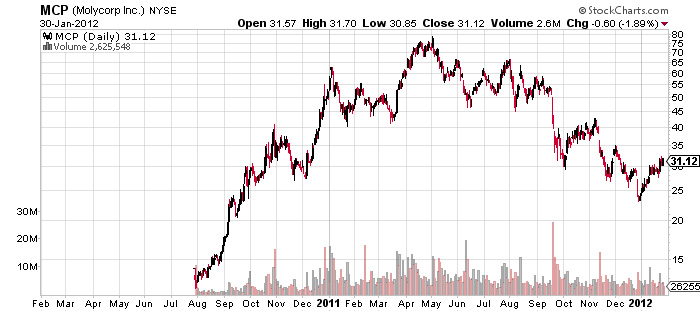
The metal prices themselves have followed suit, in a number of cases down well over 50% from their mid-2011 highs:


Some of this was simply a bubble bursting, but it’s also possible that the catalyst was more than just an amplified cyclical downturn. Vestas, along with a number of other wind companies, has found out that government subsidies aren’t forever, as the Spanish, Germans, and even the Americans are cutting direct subsidies to wind turbines. At the same time, other mines are increasing output, with Chile’s molybdenum output up 11% in 2011, and Toyota is threatening to release a rare-earths-free Prius. Rare earths prices are starting to stabilize, and it’s hard to see them going much lower.
While the world figures out a way around the problem, the US continues to throw environmental roadblocks in Molycorp’s way to actually re-opening the mine. Cong. Coffman’s well-intentioned proposal is to create a strategic reserve. By the time the bill actually passes, prices will quite possibly have risen again, and it’s not as though, in the long run, companies lack the incentive to retrieve these metals from the ground. To the extent that this is a national security issue, the solution is to let the companies mine the damn things, and to develop an ongoing industry capable of supplying the country’s needs, not only to guess as what we might need and stockpile them.
Sigh. Romney.
Posted by Joshua Sharf in 2012 Presidential Race, Colorado Politics, National Politics, PPC, President 2012 on January 25th, 2012
Michael Barone, that walking encyclopedia of American political history, has often made the comparison between the development of the Tea Party and the entry of the peaceniks into American political life:
Both movements represent a surge in political activity by hundreds of thousands, even millions, of previously uninvolved citizens.
Both movements focused on what are undeniably central, not peripheral, political issues: war and peace, the size and scope of government.
Both movements initially proclaimed themselves nonpartisan or bipartisan, but quickly channeled their efforts into one political party — the peace movement in the Democratic party, the tea-party movement in the Republican party.
…
But new movements prove troublesome for the political pros, and nowhere more than in the most problematic part of our political system, the presidential nominating process. (Is it just a coincidence that this is the one part of the system not mentioned at all in the Constitution?)
Peaceniks and tea partiers naturally want nominees who are true to their vision. They are ready to support newcomers and little-vetted challengers over veteran incumbents who have voted the wrong way on issues they care about.
But the things that make candidates attractive to movements can also make them unattractive to independent voters.
The Democrats struggled with this in the 1968, 1972, and 1976 cycles. The old-timers pushed through the accomplished Hubert Humphrey over the diffident Eugene McCarthy in 1968, but they lost to George McGovern in 1972. He was a more serious candidate than is generally remembered, but he did lose 49 states to Richard Nixon.
The anti-war movement didn’t get started in earnest until 1967, and Lyndon Johnson didn’t declare his intention not to run again until early 1968. The lateness of the primary calendar made it possible for Bobby Kennedy to declare late, and their paucity made it possible for the party elders to anoint Humphrey regardless of those votes. By 1972, the McGovernites had taken over the levers of power, opened up the primaries, and made most of them proportional. This insured a longer primary campaign, and did nothing to prevent a credentials fight over the Illinois delegation at the Convention. In the event, McGovern was nominated with fewer than 60% of the delegates, and defeated with less than 38% of the vote. The military defeatism and the electoral defeats helped usher the Scoop Jackson Democrats out of the party and, eventually, Ronald Reagan into the White House. The Democrats would elect the center-left but feckless Carter, and the decidedly un-peacenik DLC founder Bill Clinton, and it wouldn’t be until 2008 that they elected Obama in an encore of the first anti-war movement.
The Tea Party, while nascent in 2007, didn’t really gather steam until early 2009, almost four years ahead of the next Presidential election, and the Republicans in 2012 have likewise done away with early winner-take-all primaries. So it probably sits somewhere between anti-War 1968 and isolationist 1972. The Establishment is weakened, but not dead yet. If nominating Romney would be more like 1968, giving Gingrich the nod would look a lot more like 1972.
Of course, as Mark Twain said, history doesn’t repeat, but it does rhyme. Republicans not being Democrats, should Romney be the nominee, he likely won’t have to accept the nomination in the middle of police putting down riots from disgruntled Tea Party members. It’s unlikely that large cuts in spending will lead many Republicans into a socialist Exodus.
The similarities are alarming enough. Just as Humprhey’s defeat helped discredit the old liberalism, so a Romney defeat – or even a Romney presidency – could finish the job of discrediting vanilla conservatism that George W. Bush started, and open the door for a 1972-like candidacy by a Rand Paul-like figure. I don’t think I’m unduly cynical when I say that that very hope has led some in the libertarian wing of the party to campaign against Daniels, Perry, or Pawlenty as “not conservative,” or “not presidential,” while being willing to go along with a Romney nomination. (They’ll be disappointed. That so many in the Tea Party have cast their lot with Gingrich rather than the catastrophically irresponsible Ron Paul is actually a healthy sign that the word “conservative” will not be re-branded to mean “libertarian.”)
Republicans are looking for a conservative who is both ideologically grounded and a practical politician. While that may have been on offer earlier in the process, it’s not now, with the nomination fight now looking like that Star Trek episode where Kirk divides into two separate personalities, one nice but passive, the other more aggressive and less principled.
Romney’s problem is that even if you consider his public persona to be authentic, he seems rather timid for a man who built his career risking capital at the gaming tables of private equity. A early Marco Rubio endorser, he has Chris Christie’s support, but campaigns like Charlie Crist. His reaction to individual Social Security accounts as fiscally irresponsible confirms his image as narrowly technocratic. He campaigns as the safe, sane, sober, responsible alternative to both Gingrich and Obama, and it may well be that the American people want safe, sane, sober, and responsible after the drama of the last four years, even if it does represent a lost opportunity to do more.
Those who caricature Gingrich’s appeal as mere media-hatred, though, miss the point. Such an appeal, while superficial, isn’t just limited to Republicans; ask Ronald Reagan and George H.W. Bush. Showing backbone in clear, simple terms is not nothing, although it’s not enough. And it seems to give way to an opportunism of its own at inconvenient moments.
I’m not sure that Gingrich would lead to a 1964-type down-ticket meltdown. At the beginning of 1972, Nixon’s Gallup approval ratings were well over 50%, and stayed there until the onset of Watergate. Obama has nowhere near that level of public support, and an impending Presidential defeat would let Senate and House Republicans campaign all the more effectively as a check on Obama’s power. In 1972, the Democrats picked up a net 2 seats in the Senate, and lost only 13 seats of a 255-seat pre-election caucus in the House. Johnson’s approvals touched 80% when his party went from 258 to 295 seats in the House, and from 64 to 66 seats in the Senate. Even a Gingrich candidacy wouldn’t result in that kind of wipeout, although it would probably cost us a shot at the Senate.
Sadly, that might be enough. Unlike the Democrats, we can’t afford to wander in the political wilderness for another couple of decades. If Obama were re-elected, and we failed to retake the Senate, Obamacare would be permanently enshrined into law, and the American citizen transformed into a subject. Obama is willing to use executive power up to and beyond the fullest extent permissible by law. Congress’s best means of asserting its part of the check-and-balance system is the power of the purse. But Senate Democrats have deprived Congress of that power, putting government spending on auto-pilot by not even bringing a budget up for a vote. So failing to take the Senate would put all the burden back on the House Republicans to find a credible way to threaten – and if need be, go through with – a government shutdown, without committing political suicide in the process.
If nominating Romney is enough to help us carry the Senate, even if it isn’t enough to get us back to the White House, it will put the party in a position of strength to challenge him, especially given the Senate partisan profile up for re-election in 2014.
This isn’t a matter of giving in to the Establishment. If there were no other credible choices, if this were 2008, post-Colorado, and I were left with a meaningless vote, that would be one thing. But there’s nothing the matter with concluding that while the party Establishment was too quick to line up behind Romney in the first place, I can make my own choice to support him now, for my own reasons, at a time when my vote – fortunately – still matters. It’s called deciding, and that’s a very different thing from having something decided for you.
To this extent, Barone’s final paragraph is instructive: “Tea partiers will grouse if Romney is nominated. But maybe they need patience and perseverance. One lesson of history is that a movement can reshape a party. Another is that it takes time.”
Don’t Panic
Posted by Joshua Sharf in 2012 Presidential Race, PPC on January 22nd, 2012
Always good advice. Right now, there are a lot of Republicans who need to calm down and maybe make that second cup decaf instead of hi-test.
In the run-up to Iowa, one of the oft-repeated themes was that the presence of Gingrich had made Romney a better candidate, by forcing him to clarify his answers and deal with actual criticism and competition. If Mitt is smart – and since he’s been running for President for five years, and really seems to want the job, he had better be – he can use the latest Gingrich surge to make himself an even better candidate.
First, let’s acknowledge Gingrich’s deficiencies as a general election candidate. He doesn’t exactly have the highest Q-rating in the world; seen as angry in 1994, he’s seen as angry today. Americans may be angry, but it doesn’t necessarily follow that they want their President to be. If President Romney would be a tremendous lost opportunity, he can plausibly argue that candidate Gingrich would be worse. A President inclined to run against Congress couldn’t ask for a better foil than a former Speaker. And while I think Dan McLaughlin has done a credible job of showing that Gingrich is more Fabian than revolutionary in his conservatism, that won’t keep the Dems from rooting through the vast literature of Gingrich writings, Gingrich interviews, Gingrich TV appearances, and off-the-cuff Gingrich comments to reporters to “prove” how radical he is.
However, none of this is helping Romney very much right now, and it would behoove him to understand why. It’s not just Gingrich’s combativeness in the debates that’s winning him points. It’s a general trust that he’s capable of articulating a conservative vision on conservative principles, over a broad range of topics. When Juan Williams tried to turn an economic statement into a racial one, Gingrich pushed back, and answered the question completely without regard to race. When both Romney and Santorum attacked his promotion of individual Social Security accounts as either unrealistic or undesirable, was there any question who better understood entitlement reform? Conservatives see that, and are at least intrigued by the idea of having someone in the White House who will make the case, every day, for conservatism.
Romney hasn’t closed the deal with Republicans, even at this late date, because he’s been campaigning on his biography. His selling point is that as a businessman, he knows something about creating jobs. That’s great if the economy is still staggering a few months from now. But if the employment rate drops a another 1.0% or 1.5%, campaigning as a job-creating resume is going to be a lot less effective. (Yes, I know that the unemployment rate is less important than U6 and the labor force participation rate. You know what? Nobody cares. The unemployment rate is important politically for the same reason the Dow Jones Industrial Average is important: it’s a statistic with a memory.) The problem with nominating people whose biographies fit the moment is that the moment can change or the biography can find itself suddenly vulnerable, and you can find yourself rooting against peace and prosperity, to boot.
The good news for Romney is that with all the primaries and caucuses before April now proportional, the race is designed to go on longer. If he can explain why it makes no sense to claim to love capitalism while hating capital markets, he can reassure Republicans that it’s not all a pose. If he shows he can articulate not only why Republican candidates should be pro-business, but why Americans should be pro-capitalism, he’ll win going away. If he can explain why common American principles should lead Americans to support someone with his experience and ideas, he’ll be a much stronger candidate and eventually, a much stronger President.
The fact that Romney is getting tested this way in the primary, and that the nomination is, as of this writing, still very much in doubt, has got to be frustrating, but it’s all of a piece. By hoping to parley a weak front-runner status, bolstered by establishment support, into being everyone’s second choice, he’s allowed the nominating process to become a referendum on his fitness to represent the party and its ideals. He’s won minds but not hearts. And just as campaigning is about more than the written and unwritten rules, so governing is about more than technical and managerial proficiency.
The situation has got to be equally frustrating to Gingrich supporters, inasmuch as Gingrich the foil is still preferable to Gingrich the nominee for most Republicans.
But for Gingrich the professor, teaching profound political lessons to Mitt Romney may end up being his most valuable contribution.
Defensive Gymnastics
Posted by Joshua Sharf in 2012 Presidential Race, PPC on January 17th, 2012
Last night, Rick Santorum and Newt Gingrich went head-to-head on the long-term solvency of Social Security. Gingrich proposed – again – individual accounts, modeled after the highly successful Chilean “Little Passbook” system. (From Gingrich’s remarks, the system’s architect, Jose Pinera, was slated to give a presentation on the subject later, but you can see him speak here.) Santorum pointed out the plan’s Achilles’ Heel, the cost of covering defined benefits to current and soon-to-be recipients during the transition.
Instead, Santorum, and then Romney, proposed more tweaks to the system, of the kind that have gotten us into this mess in the first place. Santorum’s solution, raising the retirement age a couple of years, isn’t going to solve a mismatch caused by declining birth rates and decades-longer life spans. Romney’s seemed unaware of the existence of 401(k) accounts and IRAs.
To erstwhile Romney supporter Jennifer Rubin, however, not only is Santorum’s limited vision correct, it’s an excuse to boost the un-nominatable Santorum at the expense of Gingrich, who poses a real national threat to her candidate:
…we have a huge, nagging debt right now and he’s going to make it worse with his plan. And while Santorum was certainly right on substance, Gingrich’s glibness may have successfully concealed how really silly is his policy proposal.
In short, aside from the political hurdles (George Bush died on his sword over individual accounts) Gingrich’s Social Security plan is, as Santorum claimed, irresponsible.
Individual accounts funded by individual contributions – defined contribution accounts – are the right answer, and the longer we wait, the greater the cost, the greater the burden on the country’s finances. But to Rubin, the right answer, easier to implement today than tomorrow, is “irresponsible,” while ineffective tweaks and redundant savings plans are “right on substance.”
And this is only a taste of the defensive gymnastics, the excuses for timidity, the defenses of unnecessary compromise (and yes, folks, there is such a thing as necessary compromise) that a Romney presidency will likely bring.
No wonder those promises of “electability” are beginning to seem a little suspect.
-
You are currently browsing the archives for the PPC category.


