Archive for category Economics
Unions & Civil Rights
Posted by Joshua Sharf in Business, Economics, PPC on April 18th, 2011
One of the themes of April 4th’s Union Rights rallies across the country was the attempt to link state workers’ collective bargaining rights with civil rights. The date chosen was not only just before the Wisconsin Supreme Court special election, it was also the anniversary of the assassination of Martin Luther King, when he was in Memphis on his pro-labor campaign.
Now comes evidence that It Ain’t Necessarily So. From the heart of Unionland, Detroit Mayor Dave Bing and Detroit Public Schools chief Robert Bobb, both black, have proposed unilateral cuts to union benefits:
A new state law has emboldened the Detroit mayor and schools chief to take a more aggressive stance toward public unions as the city leaders try to mop up hundreds of millions of dollars in red ink.
Robert Bobb, the head of the Detroit Public Schools, late last week sent layoff notices to the district’s 5,466 salaried employees, including all of its teachers, a preliminary step in seeking broad work-force cuts to deal with lower enrollment.
Earlier last week, Detroit Mayor Dave Bing presented a $3.1 billion annual budget to City Council in which he proposed higher casino taxes and substantial cuts in city workers’ health care and pensions to close an estimated $200 million budget gap.
Mr. Bobb, already an emergency financial manager for the struggling and shrinking public school system, is getting further authority under a measure signed into law March 17 that broadens state powers to intervene in the finances and governance of struggling municipalities and school districts. This could enable Mr. Bobb to void union contracts, sideline elected school-board members, close schools and authorize charter schools
Mr. Bobb, appointed in 2009 by Democratic Gov. Jennifer Granholm and retained by Republican Gov. Rick Snyder, pledged last week to use those powers to deal decisively with the district’s $327 million shortfall and its educational deficiencies. Mr. Bobb raised the possibility of making unilateral changes to the collective-bargaining agreements signed with teachers less than two years ago.
This linkage involved trotting out Historic Local Lefties, probably all of whom marched with Dr. King at Selma, and singing old civil rights and union songs, and served as further evidence (as though any were needed) that the Left is caught in a 1960s time warp, evoking images from an era now 50 years old.
Given the average age at the union rally I was at, this doesn’t exactly resonate with people born since then.
And in the face of fiscal realities, as opposed to political wishful thinking, it doesn’t resonate much with leaders who happen to be black, either.
Rand and Cloward-Piven
Posted by Joshua Sharf in Business, Economics, PPC on April 17th, 2011
Leaving the movie aside, since I haven’t seen it yet, this certainly ranks as one of the weirdest criticisms of Atlas Shrugged:
For the past two years Glenn Beck has successfully demonized what he calls the Cloward-Piven strategy amongst his conservative audience. Using a 1966 article written by academics Richard Cloward and Frances Fox Piven, Beck has claimed that progressives are attempting to “collapse the system” by causing an economic downfall. Theoretically, this collapse would then usher in a new, socialist government. However, conservatives seem to be ignoring the fact that the same strategy is used, with an opposite goal, in the newly released movie Atlas Shrugged.
…
Atlas Shrugged is based entirely on “collapsing the system” upon itself in order to achieve a better ends. In the movie, if it stays true to the novel, a group of industrial leaders purposefully leave their businesses in order to collapse the economy.
While Atlas Shrugged reads at times more like a political tome than a novel, that’s no excuse for not reading like a novel.
First, the Strike – the Captains of Industry going on strike to protest their inability to actually create wealth – is a thought experiment. Capitalists, innovators, will do what they love to do, and they’ll find someplace to do it. They won’t go “on strike,” they’ll go to someplace where they can be capitalists. That used to be the US, and in order to demonstrate the thought experiment, Rand had pretty much every other country on earth turned into a People’s Republic, so there was no other place to go.
Second, the capitalists are people, but they’re also a stand-in for capital, which has gone “on strike” in the past, when punished for success, or when regulatory uncertainty is too great. Done so in the past, and may have been doing so for the last couple of years.
Third, at least one half of Cloward-Piven actively encourages street violence to get their way. There’s none of that in Atlas Shrugged. Societal breakdown is never pretty, but from Rand, it’s a warning, from Piven it’s a means.
Finally, and a little tangentially, the goal of the strikers isn’t a more “pro-business” environment. It’s a pro-market regulatory environment. One of Rand’s main points is that Big Business is perfectly able and willing to collude with Big Government and Big Labor to lock out the little guy, whether he be businessman or worker.
Honestly, this looks like another in a series of “I’m Rubber, You’re Glue” arguments by the left.
Some Tax Day Thoughts on the Tax Code
Posted by Joshua Sharf in Business, Economics, PPC, Taxes on April 15th, 2011
As Americans, for the third year running, hold Tax Day Tea Parties, it’s worth setting down a few thoughts on the tax code itself.
1) It’s too progressive
The US has the most progressive tax structure in the developed world. More progressive than the Japan, more progressive than the UK, more progressive than Sweden, for crying out loud. You make it big with Ikea, you’re better off going back to HQ than staying here.
This is a result of generations of structuring the code based on “who can afford” rather than “who has a stake.” Well, of course if you make more you can afford more. But it also means you can afford more shoes, maybe a nicer car, possibly a boat. It also means you can afford – if you choose – to indulge in hobbies or possibly lead charitable efforts.
The question “who can afford” answers itself, but it notably fails to ask, “afford what?” Pretty much every activity except stuffing cash under the mattress helps create more wealth, and in a society with a rule of law and secure property rights, even – perhaps especially – the poor get to participate in that wealth, too. So when the government says that it “needs” more of your money, it really “needs” to be sure that the least important thing it’s going to do with that dollar is more important than the most important thing its owner can do with it. That’s a high bar to get over. As it should be.
2) It picks favorites
Any tax system is going to do this sort of thing. Sales taxes will exempt food or clothing. But the possibilities for rent-seeking seem almost endless with out current tax system. Regulations may raise barriers to entry, but the Aristocrats of Pull are really made through the tax code, rewarding political allies and misdirecting massive amounts of resources in the process.
The income tax, since it’s stated as a percentage of some known amount – what you made last year – also encourages the government’s delusion that it’s really all their money, except for what they let you keep. It’s only with a tax code susceptible to endless manipulation that a President could talk about “reducing spending in the tax code.” When it gets to that point, there’s really nowhere left to go.
3) It encourages debt
This used to be worse. It used to be that all interest was deductible, but that was phased out a couple of decades ago, so now for individuals, we’re down to the mortgage interest deduction. But for businesses, most interest is still deductible, and while this encourages capital formation, it also leads to a debt-heavy capital structure. We’ve all seen what excess leverage can do, but other decisions get distorted as well. Successful mergers tend not to be financed with debt, but with cash, and it’s likely that a whole lot of bad M&A activity – doomed deals – wouldn’t happen if that interest weren’t deductible.
4) It can’t be complied with
Not, “it’s hard to comply with.” It can’t be complied with. We all know about the NTU studies asking IRS employees to work a difficult tax question, and having each of them come up with a different answer. The fact that an average citizen has to spend hundreds of dollars to file taxes every year, and still could end up getting hauled into tax court because he got the wrong one of twenty different right answers is an offense against everything we expect from the rule of law.
5) Business taxes are too high
Right now, the US not only has the most progressive tax system in the western world, we also have the highest business taxes in the industrialized world. Inidividually, either of these would be enough to start chasing wealth production out of the country. Together, they virtually guarantee it, particularly because we also tax dividend income. Dividends, of course, are just a distribution of profits to the owners. Profits which have already been taxed. Not all countries do this. Some allow a tax credit against dividends, and some just don’t tax them at all.
So as we go to our Tax Day Tea Parties, remember, it’s not just how much they’re taking. It’s the way they’re taking it.
Circular Logic on Gov’t Pensions
Posted by Joshua Sharf in Budget, Colorado Politics, Economics, PERA, PPC on April 5th, 2011
In this morning’s Denver Post editorial, explaining why government employees should only temporarily be asked to take more partial responsibility for their own retirement, comes this remarkable claim:
But it shouldn’t be a long-term fix. Shifting the makeup of the pension funds could adversely affect the financial soundness of PERA.
That’s because employee and employer contributions are treated differently. The money that employees put in the system goes with them if they leave the system. If the fund mix gets too out of whack, it could be a financial problem.
This is a classic example of thinking inside the fiscal box they’ve put the rest of us in. These pensions – the ones in question – are defined benefit plans. As has been pointed out in a number of places this morning, Colorado is uncommonly generous with the percentage of an employee’s income it tries to replace in pensions.
At a minimum, shouldn’t that obligation be either contingent on the employee leaving his money with the plan? If not, if they have the right to take that money with them, then ought not the pension plan’s obligation be reduced, proportional to the amount funded by the employee? If it’s the employee’s money, then, well, it’s the employee’s money, and if they want to be responsible for investing half of their retirement money on their own, then they should live with the consequences of that. It certainly doesn’t make any sense for the plan to have to shoulder more of the burden for an employee who leaves before retirement.
The real problem here is that it’s a defined obligation plan in the first place, and that it’s less than fully-funded. If the plan were fully-funded, if every dollar of future obligation were already invested for, then this wouldn’t be a problem. It’s complicated by the fact that none of these plans is fully-funded, so all of them rely on current contributions to pay current obligations, rather than socking that money away under the account for the individual.
It’s a result of lousy accounting having had a meet cute with lousy political incentives starting about 10 years ago. It’s no longer sustainable, and eventually we’re going to have to convert all of these plans over to defined benefit plans. If we can’t do that in one fell swoop, we can at least start by having public employees permanently assume a greater responsibility for their own retirement.
Scenes From Lincoln’s Union Rally
Posted by Joshua Sharf in Economics, Labor, National Politics, PPC on April 5th, 2011
So why is the IBEW out there at a rally dominated by AFSCME and SEIU?

“Keep your government hands off my…government pension!” Seriously, you can’t make this stuff up.

I wonder if he knows the history of the Davis-Bacon Act?

Ethanol and Natural Gas
Posted by Joshua Sharf in Business, Economics, Energy, PPC, Regulation on March 30th, 2011
UPDATE: And as if on cue, this morning, JJG, Barclays ETF on grains, is up almost 5% this morning. This is not just a generalized inflation play (meaning this isn’t just about the Fed printing dollars), since GLD and TBT (the bearish bet on the 10-year Treasury) are up, but only about 1%.
Much has been said about the contradictions between the energy policy that President Obama announced today, and how his government has behaved up until this point. But even taken on its own terms, today’s ethanol-and-natural-gas announcement contains enough internal contradictions to make it fall over like a basketball player with his shoes tied together.
The key point here is that ethanol already depends heavily on natural gas. Twice. Directly, as an ingredient in its production. But ethanol is made from corn, and corn – especially when planted in the same fields, year after year – requires a lot of fertilizer. And the key component in ammonia-based fertilizers like anhydrous ammonia, urea, and ammonium nitrate in nitrogen. From natural gas.
When I worked at the brokerage, one of the companies we covered was a fertilizer company (since bought out), based in the heart of the corn belt. We considered it an ethanol play, with the company remaining profitable as long as corn plantings increased and natural gas didn’t get too expensive. Again. Here’s the chart for the wellhead price of US natural gas:
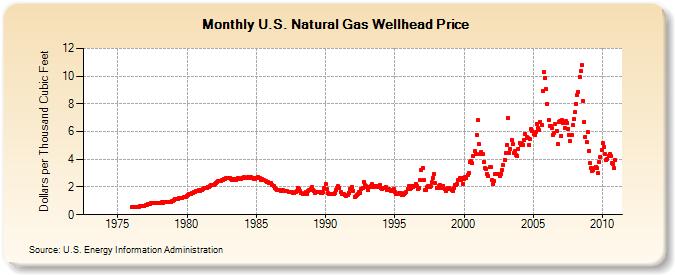
In 2007, during the last burst, corn planting came at the expense of soybeans, which returns nitrogen to the soil. This meant a large increase in the amount of fertilizer necessary. For the last few years, soybean planting has returned to its long-term trendline, and increased corn production appears to have occurred at the expense of winter wheat, which uses a comparable amount of fertilizer:

Up until now, that’s meant that increased corn plantings, inadequate though they may be, haven’t in and of themselves driven up the price of natural gas. This year, however, soybean plantings may be down, as corn nears its postwar high, meaning additional natural gas demand.
All of this is happening even without Obama’s intervention to commandeer even more of our food for fuel. We already push 1/3 (yes, one third) of our corn harvest into ethanol plants rather than kitchen tables, which amounts to about 8% of the world supply of corn. Any additional ethanol subsidies will only make things worse.
Moreover, Obama’s plan does absolutely nothing to increase natural gas production. To do that, he seems satisfied to ride herd on oil and gas companies that already have more than enough incentive to increase production, if only our government would let them. (Sadly, Colorado, between Ken Salazar and Diana DeGette, is playing a disproportionate role in enforcing that dictate.) He does, however, propose all sorts of subsidies to encourage increased natural gas consumption, promising to drive the price up even farther.
To circle back to my original point, this is going to make ethanol unprofitable even with subsidies. Just for fun, I went back and looked at the gross profit margin for Green Plains (GPRE), a major ethanol producer, and compared it to the natural gas price six months earlier, for the last 8 quarters:

The correlation is an astounding -0.96, which is about as close to metaphysical certainty as you get in statistical analysis. Those who know something about statistics will say that the outlier increases the correlation, and they would be right. If we get rid of the outlier, the correlation is still -0.84, and the slope of the line only changes slightly. If the other points, the ones below 6.00 on the price scale, were clustered together, that would be a problem. But they lie on a nice line of their own.
Using a very rough model, using the company projections for unit sales over the next year, assuming that interest rates don’t rise and the company doesn’t take on any additional debt, the wellhead price of NG would have to rise to 6.8 to eliminate the company’s pre-tax earnings completely for the next year. That’s happened twice over last decade, and this administration’s policies will only make it more likely. Let that happen, or interest rates rise, or both, and see how fast Green Plains decides that it really does need those subsidies – and more – after all.
To the extent that ethanol production can increase, it will help drive up natural gas prices. To the extent that it can’t, its price will rise, and it will need compete for ever-more-scarce natural gas.
Even if ethanol weren’t already a colossal waste of money and resources, this plan couldn’t be designed any better to make things worse.
In this at least, Obama’s being consistent with the rest of his economic policies.
Ethanol Changes Tactics
Posted by Joshua Sharf in Economics, Energy, PPC on March 27th, 2011
The ethanol industry is changing tactics to keep those universally unpopular subsidies coming.
Today’s ethanol industry can prosper without government incentives, the founder of Green Plains Renewable Energy Inc. said Thursday.
Ethanol has become an integral part of the country’s energy picture, in demand not only from motorists but also from oil refiners who use it to boost the octane of the gasoline they produce, said Todd Becker, president and CEO of Omaha-based Green Plains.
The economics of the fuel industry, combined with new production technology, make ethanol 40 cents a gallon cheaper than gasoline, on average, Becker said. That gives ethanol producers like Green Plains a cost advantage that will outlast the government’s 45 cents-a-gallon tax credit for ethanol-blending companies.
The blenders’ tax credit eventually will end, he said, but should be followed temporarily by incentives that would increase demand for ethanol. Those incentives would encourage gas stations to install equipment to sell high-ethanol fuel and the auto industry to make and sell vehicles that use high-ethanol fuel.
If Mr. Becker thinks ethanol is profitable, then he should be able to borrow against those earnings to build the delivery infrastructure himself. If gas stations think that ethanol is profitable, they should be able to finance the dispensing equipment. If I think ethanol is profitable, I’ll lend it to them.
But if they can only make all this happen with government subsidies, then maybe it isn’t really all that profitable after all, and directing resources to it is just more of the massive misdirection of resources that has been part and parcel of trying to grow fuel rather than drill, mine, or capture it.
Keep On Truckin’
Posted by Joshua Sharf in Business, Energy, PPC, Regulation, Transportation on March 21st, 2011
That was one of the less forgettable catch-phrases from the 70s, when the independent trucker seemed to embody what remained of the free spirit of America. The part, anyway, that was engaged in constructive work rather than the self-indulgent self-destructiveness that came to pass for independence during that decade.
In fact, trucking has become increasingly regulated over the years, so much so that the notion of the independent trucker, gamely staying awake to deliver his load, is a thing of the past. And with good reason. These are very large, very dangerous vehicles. They’re necessary, but they share the road with, and occasionally crush, passenger vehicles a fraction of their size and weight. As a result of making sure that drivers get a decent amount of rest, the number of fatalities involving heavy trucks, per 100 million miles traveled, was at 2.34 in 2005, down from 6.15 in 1979. More recent analyses have it falling even farther. And those same statistics show truck driver fatigue as a factor in only 1.7% of those crashes. The accident rates continue to decline.
So naturally, what we need is: more rest time!
That’s right. The government has proposed rules that will require longer rest times, fewer hours on the job, more frequent breaks. At first, this sounds like something truckers might like. Until you realize that it’s basically forced idleness, with little marginal benefit to the rest of us using the roads. Truckers hate sitting around. They have loads to deliver, and a forced 15-minute break is actually more stressful, because instead of taking the break when the need it, they’re just as likely to be sitting around watching the clock tick until they can get back on the road.
The company that I am currently contracting for, Werner Enterprises, ran a little experiment with one of their more seasoned drivers, asking him to work to the rule for a month to see what would happen. Turns out that idle trucks aren’t just the Devil’s workshop, they’re also expensive. Two-day trips stretched into three days, and his income, which is based on miles covered, dropped 6% year-over-year. Adopted nationwide, these standards would not only play havoc with the many businesses that use just-in-time inventory management, they would amount to a pay cut for the drivers they’re supposed to help. And in an industry that tends to face driver shortages in good times, anyway, it would require even more drivers, and even more trucks, with all of the overhead that implies, even before they drive their first mile.
This is not an industry that opposes regulation for opposition’s sake. They ended up supporting, for instance, the stricter rules against cell phone use. There are signs on many of the tables in the company cafeteria warning truckers against cell phone use, not on the grounds that if they get caught, they’ll lose their commercial license and have to hitchhike back home from Keokuk, but because it’s dangerous.
They object to this brilliant idea, cordoning off I-70 at certain hours, because it would greatly complicate route planning, on a fairly major truck thoroughfare. (C’mon guys, just widen the road, already.) In combination with the new rules, mandating stops where it might or might not be possible to stop, it would turn driving that stretch into a nightmare.
Colorado’s own Cory Gardner serves on the House Energy and Commerce Committee, which might be able to exercise some oversight here. (Although, so does Diana DeGette, who’s probably miffed that even after decades of trying, there are still trucks on the road at all.) Perhaps he can take a look at this.
Kibbutzim Go Private
Posted by Joshua Sharf in Economics, Israel, PPC on March 19th, 2011
Not much of a surprise, at this point, as noted by Claire Berlinski over at Ricochet:
Beit-Oren was founded as a die-hard socialist settlement in 1939. Predictably, it went bankrupt, because socialism doesn’t work. By the 1980s it had no means of subsistence, and the world’s ideological tides having turned, the larger kibbutz movement cut it off. In 1987 about half the population of the kibbutz decided to leave, an event known as the Beit Oren Incident.
In 1988, after an intense period of discussion and decision, the New Kibbutz was on its way with renewed strength and vigor, and many new members. The kibbutz’s financial situation improved, empty apartments were rented to new residents, the kitchen and dining room became an events hall, and various kibbutz enterprises recovered. In June 1995, the decision was taken to privatize services and individual income. This was to be the first in a series of privatizations. Within a short time after this decision, most kibbutz members expressed satisfaction with this arrangement.
As socialisms go, Kibbutzim were among its more humane manifestations. Unlike residents inmates of the Soviet bloc, people were free to go any time they wanted, and join the majority of Israel that was at least somewhat more capitalist. The country may have been conceived of and run by socialists, but actual kibbutzniks were always a small minority, and capitalism was a vital, if largely latent force in Israel from its beginnings.
In fact, as Sol Stern points out, Tel Aviv was a very capitalist enterprise from the beginning. And since Netanyahu, as Finance Minister, began privatizing large swatches of the economy, its entrepreneurial spirit has been given free rein.
So while it’s not surprising that Israelis are innovators when it comes to water, it’s at least a little ironic that a major Israeli venture capital firm, specializing in water projects, would be located in “Kibbutz” Lavi.
All this must be giving Haman fits.
Selling The Cure For The Disease They’ve Caused
Posted by Joshua Sharf in Business, Economics, Health Care, PPC, Regulation on January 23rd, 2011
According to the New York Times, the federal government, apparently unhappy with drug companies’ productivity in the last 15 years, has decided to go into business for itself:
The Obama administration has become so concerned about the slowing pace of new drugs coming out of the pharmaceutical industry that officials have decided to start a billion-dollar government drug development center to help create medicines.
The new effort comes as many large drug makers, unable to find enough new drugs, are paring back research. Promising discoveries in illnesses like depression and Parkinson’s that once would have led to clinical trials are instead going unexplored because companies have neither the will nor the resources to undertake the effort.
The Times then goes on to note that, “drug companies have typically spent twice as much on marketing as on research, a business model that is increasingly suspect.” NIH has long been involved in basic research, but this is the first time that the government will get into the business of actually developing and conducting clinical trials of drugs.
We’ll dwell for a moment – but only for a moment – on the Times’s, and by implication, the Administration’s, utter neglect of the possibility that the FDA’s culture of risk-aversion, insistence on testing for efficacy (as opposed to just safety), and the WTO’s failure to protect intellectual property have all contributed to a risk-aversion on the part of the drug companies.
But there may be something else going on here, too. It’s entirely possible that we’re seeing a short-term phenomenon that’s being mistaken – or portrayed – as a long-term one. In, City Journal (“Hooray for Blockbuster Drugs“), Paul Howard argues that the development of incremental improvements is a good thing. for a variety of reasons. It’s certainly something that the regulatory regime encourages. But aside from that, it’s the logical filling-out of major advances that came very quickly, based on basic research that was done much earlier.
Eventually, the diminishing returns from this sort of thing, and the increasing costs and uncertain returns of marketing them, should lead one or more major drug companies to take the leap and try to productize some of the results of gene-based research. The first efforts are likely to be more risky and more expensive, and our current policies have probably exacerbated a reluctance to take large risks in a down economy by raising those costs, both certain and uncertain.
The worst part? Paul Howard:
Some of these investments have been overhyped, but others will eventually produce breakthrough innovations, just as the investments of the sixties and seventies did. And when they do emerge, new technologies (including much more sophisticated diagnostics) will allow doctors to choose drugs for patients most likely to benefit from them. The advent of personalized medicine will also give companies powerful new marketing and pricing leverage. The size of the market for particular drugs may shrink—and drug companies may become smaller and more nimble to exploit fast-moving scientific discoveries—but insurers and governments will find it much more difficult to ration access to targeted therapies. (Emphasis added.)
Just at the time when the new drugs have the chance to democratize medicine in a way that the Internet has democratized political debate, the government is going to step in and make sure that doesn’t happen.
The $1 billion committed to the project so far is about 2% of what drug companies already spend on R&D. It’s hard to believe that this is a better answer than lowering regulatory costs and uncertainties.
-
You are currently browsing the archives for the Economics category.


