Archive for category Colorado Politics
Banana Democrats
Posted by Joshua Sharf in Colorado Politics on May 12th, 2013
There’s an area of Colorado, near Buena Vista in the south-central part of the state, known as the “Banana Belt” for its temperate climate. It’s unknown if State Sen. Greg Brophy (R-Wray) had that in mind when he claimed that HB13-1303 will turn the state into a “banana republic,” but his comments remain accurate nonetheless. The new law will, among other things, lower the residency requirement to 22 days, pre-register 16-year-olds when the get their drivers licenses, replace precinct voting with vote-by-mail and the occasional vote center, and permit same-day registration to cast regular ballots. It will require that mail ballots be sent to all registered voters, and will do away with the “Inactive Voter” status, which voters attain by not voting for several consecutive elections.
To many Republicans, this one included, these changes sound like a stamped, self-addressed invitation to vote fraud. Vince Carroll of the Denver Post has detailed some of the problems with the bill.
The bill would retain all the current means of registration – including being able to register using a utility bill and the last four digits of your Social Security number the license plate you saw outside, and then to proceed immediately to vote, using a regular ballot, not a provisional one set aside for after the registration was verified. County clerks had argued in favor of the bill, claiming that the SCORE system currently used to track voter registrations could easily be expanded to statewide use, and that once a statewide system is set up, there will be little trouble tracking voter registrations.
The fact is, the system we have now is manifestly riddled with bad registrations, old registrations, and dead people. And the very same people who wrote this bill, in collusion with the legislative Democrats, are the ones who not only stand in the way of cleaning up the rolls, but have tried to pry open the system with a judicial crowbar in the past.
I’ve been directly involved in a number of campaigns that involved going door-to-door for signatures. I don’t even bother with apartments, since the odds of the registrant matching the resident are somewhat south of hitting a given number on a roulette wheel. The voter rolls for these precincts are literally (not figuratively) filled with bad registrations. And it’s no good saying it’s not a problem because we’re only 6 months away from the last election. Since Colorado routinely has odd-year elections for ballot initiatives and school boards, we’re also only 6 months away from the next one.
The groups that were called into help write the bill – notably not including the Secretary of State’s office – have, in the past, sued the Secretary of State for ridding the voter rolls of dead people, criticized him for trying to get non-citizens off the registrations rolls, and filed suit in 2004 seeking to permit anyone to vote the full ballot anywhere, without any form of identification. In the decision in that case, the judge noted that:
But at the moment, if I were to try to design a system that maximizes the chances that fraudulent and ineligible registrants will be able to become fraudulent voters, I’m not sure I could do a better job than what Plaintiffs are asking me to do in this case—allow voters to vote wherever they want without showing any identification.
The entire opinion is worth reading, and I’ve quoted salient paragraphs from it at length before. For the moment, bear in the mind what that quote says about the character of Common Cause and the other co-conspirators to this hijacking of our electoral system.
The Democrats who wrote and voted for this bill have to be well aware of these fact. These are elected state representatives and state senators. Every last one of them – especially the Democrats who tend to come from urban areas – is a professional politician who got elected by working these very precincts. It beggars the imagination to believe that they are so unacquainted with their districts that they don’t know how detached the voter rolls are from reality. And that’s now, before these changes are put in place.
The only conclusions to draw are that the Democrats who voted for this bill are at best unconcerned about the integrity of our elections, and at worst see elections as a whole not as contests to be won, but as boxes to be checked off in the ratification of their power.
We are all from Buena Vista now.
It’s About Politics, Not Governance, With Guns
Posted by Joshua Sharf in Colorado Politics, National Politics, PPC on April 9th, 2013
As the US Senate begins today’s debate on gun control, Coloradoans can be forgiven for having a feeling of deja vu. That’s because the debate in Congress is intended to mimic the one in Colorado, and because it’s about politics, not about governance.
The one piece of the president’s broad gun control agenda that has survived public scrutiny is background checks on sales. This is a broadly popular idea, and even gun owners support it by large margins in poll after poll. But Dave Kopel of the Independence Institute has shown that in Congress, as in Colorado, while the bill will be sold as checks on sales, it actually does much, much more:
While the woman is out of town on a business trip for two weeks, she gives the gun to her husband or her sister. If the woman lives on a farm, she allows all her relatives to take the rifle into the fields for pest and predator control — and sometimes, when friends are visiting, she takes them to a safe place on the farm where they spend an hour or two target shooting, passing herover gun back and forth. At other times, she and her friends go target shooting in open spaces of land owned by the National Forest Service or the Bureau of Land Management.
Or perhaps the woman is in a same-sex civil union, and she allows her partner to take her gun to a target range one afternoon. Another time, she allows her cousin to borrow the gun for an afternoon of target shooting. If the woman is in the Army Reserve and she is called up for an overseas deployment, she gives the gun to her sister for temporary safekeeping.
One time, she learns that her neighbor is being threatened by an abusive ex-boyfriend, and she lets this woman borrow a gun for several days until she can buy her own gun. And if the woman becomes a firearms-safety instructor, she regularly teaches classes at office parks, in school buildings at nights and on weekends, at gun stores, and so on. Following the standard curriculum of gun-safety classes (such as NRA safety courses), the woman will bring some unloaded guns to the classroom, and under her supervision, students will learn the first steps in how to handle the guns, including how to load and unload them (using dummy ammunition). During the class, the firearms will be “transferred” dozens of times, since students must practice how to hand a gun to someone else safely. As a Boy Scout den mother or 4-H leader, the woman may also transfer her gun to young people dozens of times while instructing them in gun safety.
These are not far-out scenarios. Kopel notes that “transfers” are defined very specifically in the bill, with specific exceptions. And lest “transfer” be read narrowly to exclude loans, where someone retains possession, time limits on such transfers are laid out. In order to escape such notice, guns could be “gifted” to family members, but presumably those gifts would be considered taxable events.
The bill does include some exceptions, designed to provide plausible deniability to senators who want to claim they’ve made reasonable allowances. Those exceptions are subject to such severe restraints so as to make them all but meaningless. This was largely the same legislative and debate strategy used here in Colorado, and for fun, count the number of times reference is made on the floor of the Senate to what happened here.
All of these scenarios will fly under the radar. The plan is for the press to continue to repeat the “40% of sales” myth and to deflect attention from the real burdens of the proposed law. Western Democrats will be given enough cover to present their votes as reasonable to the folks back home, and Republicans opposing them will have the Hobson’s Choice of either caving (and dispiriting and disillusioning their supporters) or appearing obstructionist and unreasonable.
It’s the same strategy that the Democrats used with the Violence Against Women Act: take a non-controversial piece of legislation, load it up with partisan baggage, and dare the other side to vote against it. It was a key element in the 2012 campaign theme of a “War on Women,” and it didn’t really have anything to do with governing. Obama and the Democrats now hope to repeat the same trick, and set up the 2014 Congressional campaigns as one of the Republicans against the Suburbs, newly-competitive territory which the Dems see as the key to long-term victory.
The bills, largely written by Mayor Bloomberg of New York, suffer from the same lack of public process, examination, amendment, and debate as Obamacare and the ill-thought-out, and supposedly much simpler, magazine ban rushed through the New York State legislature in the wake of Newtown. That’s by design; while the mayor and the president may be true believers in disarming citizens, President Obama is a greater believer in winning elections.
To thwart this strategy, the Republicans will have to do more than filibuster. Their amendments – and thus the floor debate – will have to be focused on the question of “transfers” and the absurd outcomes that this bill creates. They’ll never have a better time to make their case publicly.
Why PERA’s Presumptions Are Faulty
Posted by Joshua Sharf in Colorado Politics, PERA, PPC on March 28th, 2013
Did you recognize the faulty presumptions in PERA’s spirited defense of defined benefit plans?
You have been given a false choice about why defined benefits plans are better than defined contribution plans.
In a recent EdNews Colorado Voices column, Colorado PERA Executive Director Greg Smith avers that PERA’s existing defined benefit structure best serves both the teachers and the taxpayers of Colorado. He was responding to a report by the National Council on Teacher Quality that leads the reader to support reforms to move away from the existing scheme and toward a defined contribution plan. Smith’s claims are wrong about the advantages of defined benefit plans in general, and PERA’s actuarial soundness in particular.
Smith cites a National Institute on Retirement Security (NIRS) report that claims three advantages for defined benefit plans over defined contribution plans:
- Less error in the amount saved for retirement,
- Less need to rebalance and re-allocate assets over time, and
- Better returns, largely as a result of lower transaction costs.
Each advantage turns out not to be dependent on having a defined benefit plan, but on having a professionally-managed, aggregated plan. The same advantages would accrue to a similar defined contribution plan that was also aggregated and professionally-managed.
PERA already has such an option, PERA Plus. It’s organized as a three-part 457(b) / 401(k) / Defined Contribution option. Like any set of diversified retirement offerings, it includes a variety of funds with different investment goals. For our discussion, the most relevant set of funds are those with target retirement dates. PERA has nine of these, with target dates every five years from 2015 to 2055, and an Income Fund designed to provide current income for current retirees.
Over time, as the target date for each fund approaches, that individual fund reallocates its assets into more conservative investments, before maturing and merging into the Income Fund. While each individual fund “ages,” all the funds collectively are maintaining a proper average. Taken together, they continue to represent the aggregate ages and target retirement dates of the entire set of members, the very source of the first two alleged advantages. The third, that of lower transaction costs, is completely independent of how liabilities are calculated.
There is no inherent reason why the assets of a DB plan should earn a higher return than those of an identically-invested DC plan. The only mandatory difference is that the defined benefit plan beneficiary has a share only in the specific benefits to be paid – the fund’s liabilities. By comparison, the owner of a defined contribution plan has a property right in the assets. Therefore, while a defined contribution plan is, by definition, always fully-funded, a defined benefit plan may have to seek additional funding, or trim back on its promises, in order to remain so.
The danger of unrealistic promises
It is therefore imperative that the promises being made to future retirees be realistic. All the more so if the promised benefits are being used to attract and retain qualified or exceptional teachers. Unfortunately, it is far from certain that PERA can afford the promises it is making, given its current funding levels. Recent legislative reforms (Senate Bill 10-001 in particular), while welcome and substantial, simply do not close the gap.
By PERA’s most recent published calculations, its unfunded liabilities remain at a staggering $26 billion, and its overall funded level is well below 60 percent, on a par with the chronically ill Illinois public pensions. In fact, a recent study by Barry Poulson suggests that PERA could be in the worst shape of any statewide plan in the country.
Let’s give credit where credit is due. PERA’s adoption of a 401(k)-like portability is indeed commendable. But if it’s designed to mimic the properties of a 401(k), it can hardly then provide an advantage over one.
While PERA is no longer “letting it ride,” as it did with its stock market investments of the late 90s, the 8 percent returns needed for a return to solvency come with risk. Even better-than-average returns during regular years won’t make up for prior losses in bad years, because funds must then catch up, while payments can’t be deferred.
What success SB1 does offer is predicated on both benefit reductions and payment increases. However, a court challenge to the limitation of COLAs to 2 percent has been upheld by a State Court of Appeals, and its future is uncertain at best. Should the lower courts find that limitation not to be justified, most of the immediate reduction in PERA’s unfunded liability will be wiped out.
On the contribution side, PERA plans to require supplemental increases, rising incrementally from 2 percent to 5.5 percent until 2018. School districts have been picking up the tab for these increases, rather than passing them on to the teachers themselves, as they are allowed to do. As a result, PERA now absorbs upwards of 15 percent of annual operating expenses in many large school districts, a number that is expected to rise to 20 percent as the existing plan increases for make-up contributions.
Disclosure of ties to lobbying group needed
It is also worth noting that the institute that issued the favorable DB article (NIRS) is the lobbying and public policy arm of the defined benefit public pensions, with a particularly close relationship with Colorado PERA. Smith sits on the board of directors of NIRS, as does Meredith Williams, PERA’s former executive director. Colorado PERA is both a charter member and in NIRS’s Visionary Circle, along with such other public plans as CalPERS and the Illinois Municipal Retirement Fund.
Inasmuch as NIRS is not an independent think tank, but instead is a creation of interested parties to the debate over public pensions, this relationship ought to have been disclosed.
While there is no doubt that total compensation is an important part of attracting and retaining effective teachers, those promises must be grounded in reality. Until realistic arguments are used, PERA will continue to fail not only its member teachers, but also the schools and parents it is intended to serve.
This article originally appeared in EdNewsColorado.
It’s A National Political Strategy
Posted by Joshua Sharf in Colorado Politics, National Politics, PPC on March 18th, 2013
On Friday’s Grassroots Radio, the discussion of Rep. Mike McLachlan’s (D-Durango) deceptive advertising of his own gun control positions turned to the national agenda being rammed down Colorado’s throat. I pointed out that while other states with Democrat majorities and governors – Illinois and Washington came to mind – had rejected similar proposals, Colorado had seemingly been singled out for lobbying by Mayor Bloomberg and Vice President Biden. Bloomberg has been open about his desire to influence other states’ policies, but traditionally, federal officeholders don’t meddle in state politics. Even Diana DeGette and Ed Perlmutter confined their post-Aurora comments to proposed federal legislation, not what Colorado ought or ought not do.
So something was up. Tomorrow’s New York Times tells us what: “If you can do it here, you can do it anywhere.” This was the article that Hick was waiting for, before announcing his intent to sign these bills on Wednesday.
It has been clear from the beginning that Obama plans to use gun control, not merely as a diversion from governing, but as a battering-ram issue to achieve his major 2nd-term objective: regaining the House of Representatives for the Democrats. To do that, he believes he must isolate the Republican House as being an obstruction to common-sense, practical gun control measures that most of the country agrees on. To do that, he must persuade enough Senate Democrats – especially Western Democrats – to back proposals that they really, really don’t want to even vote on, much less support.
Colorado becomes the key to providing them cover. The proposals – poorly-written, full of absurd outcomes – will have to be portrayed as practical compromises. The debate on the national level will mirror the deceptive line taken here: confusing sales with temporary transfers, or even loans to friends; outlawing magazines of more than 15 rounds, but forgetting to mention that inheriting such a magazine from a deceased parent is a criminal act, a felony, even. Colorado’s reputation as a western, freedom-loving state works in their favor.
This was a repeat of the entire Obamacare political drama, here at the state level. The Democrats in favor barely felt the need to argue for them on the floor, largely because when they did, they embarrassed themselves with references to pens as defensive weapons, whistles as substitutes for protection, and condescending to rape victims. State senators either abandoned, fled, or chastised their own town halls when the issue came up. Democratic leadership openly asked its members to ignore the public. The controversial bills passed without a single Republican vote, but over bipartisan opposition.
But the “If you can do it here, you can do it anywhere,” line of publicity conceals what really happened.
Ultimately, it makes the recalls of Sen. Hudak and Rep. McLachlan – along with whatever other vulnerable Dems can be included – even more important. Those recalls, like the recalls in Wisconsin, take on a national significance and urgency, not merely because of the issues involved, but because of the political implications at the national level. The promise of protection, of resources and money, to vulnerable Dems who backed him on this legislation, is the application of national resources to state races, just as the Blueprint was the application of state resources to local races. It is the Blueprint raised to a national scale. If Obama is able to implement that, then he will indeed have locked in substantial political changes that can change the society for the worse, for the long run.
On the other hand, if those promises can be shown to be empty – before the House of Representatives comes up for election, or has to vote on the national bills – then the entire narrative is turned on its head. Not only does Obama look like an unreliable friend, but the power of the issue dissipates. (That’s one reason why an initiative is more useful in the event that we fail to take back both the legislature and the governor’s mansion: only fiscal issues can be on the ballot in odd-numbered years.)
Hickenlooper, in 2012, specifically avoided charging voters up over this issue. Even in 2010, he didn’t really mention it at all. Colorado has not had a vigorous debate on these bills or these issues. This was not something done by us. It was something done to us.
It’s our move, Colorado.
Hick Nick Chicks’ Boomsticks
Posted by Joshua Sharf in Colorado Politics, PPC on March 18th, 2013
Governor John Hickenlooper (D) has announced that on Wednesday, he will sign the gun control bills passed by the Colorado legislature last week. These include the magazine ban and the background checks, even for temporary transfers between individuals who know each other. A number of women legislators today protested the disparate impact that this law will have on women’s self-defense.
But it wasn’t always thus. This was Hick in the immediate aftermath of the Aurora shootings here in Colorado:
Crowley: When you look at what transpired here – a man with no criminal background, not even any contact with police, a speeding ticket, I think was the only thing found there – when you look, and if you are not familiar with the interior West or the Midwest, obviously lots of rural places here on the East Coast, and don’t totally understand the gun culture, when you look at what this young man was able to acquire over three or four months: an assault weapon, a shotgun, a 9mm Glock, another 9mm, all of these tear gas things, and 6000 rounds of ammo from the internet, people stand back and look at that and say, “Shouldn’t some bell have gone off somewhere,” and you’re looking and saying, “Somebody’s collecting an arsenal.” And yet there was no way to connect all those things. Should there be?
Hickenlooper: Well, I mean I’m not sure there’s any way in a free society, to be able to do that kind of – he was buying things in different places. Certainly, you can try, and I’m sure we will try, to create some checks and balances on these things. But this is a case of evil, of somebody who was an aberration of nature, and, you know, if it wasn’t one weapon, it would have been another. He was diabolical. If you look at what he had in his apartment and what his intentions were. I mean, even now, it makes the hair on the back of my neck stand up. It’s terrifying, just the thought that he could spend so much time planning such evil.
Crowley: And do you see any law anywhere that might have stopped a man with no record, in a society that protects the 2nd Amendment, that might have prevented this?
Hickenlooper: Well, we are certainly looking and that, and trying to say, “How do you prevent this?” I mean, the Virginia Tech shootings, we’ve been looking at the shootings all across the country, and say, “How do we preserve our freedoms, right, and all those things that define this country, and yet try to prevent this from happening again?” Let me tell you, there’s no easy answer.
Crowley: What I hear from you is that you would be open to someone who wanted to suggest a gun law, or something that might prevent this sort of thing, but that at the moment, you can’t imagine what that would be.
Hickenlooper: Yeah, it’s just – I’m happy to look at anything, but again, it’s – this person, if there were no assault weapons available, if there were no this or no that, this guy’s gonna find something right? He’s gonna know how to create a bomb. I mean, who knows where his mind would have gone, clearly a very intelligent individual, however twisted. You know, I don’t know – that’s the problem, I mean this is really – this is a human issue in some profound way that this level of disturbed individual that we can’t recognize it, that the people around him obviously had no idea that this was something that he was capable of.
(Emphasis added.)
As I mentioned in December, when he suddenly changed his tune, these were not the words of a man who wanted to sound as though he were looking to impose new controls. Virtually all of the objections he raises to Crowley’s implications about new gun laws are the very same objections raised by Republicans and a few Democrats during the legislative debates.
The opening for pursuing this agenda now clearly comes from the Aurora and Newtown shootings, in short, the very events that Hickenlooper says earlier in the interview shouldn’t be determining our way of life. In the Denver Post at the time, he said that he “wanted to have at least a couple of months off after the shooting in Aurora to let people process and grieve and get a little space.”
The net result, in fact, was that gun control was barely discussed at the state level during the election, and here in Colorado was treated almost exclusively as a federal issue, as Reps. Perlmutter and DeGette staked out strong positions in favor of reviving the so-called Assault Weapons Ban and even stricter measures. This suited Hick just fine, since any suggestion that he was seriously looking at the sort of laws passed last week might have complicated the Dems’ narrative about te Republican “War on Women” and civil unions.
With the election behind him, and with some pressure from Bloomberg’s Mayors Against Illegal Guns (of which Hickenlooper was Colorado’s sole member in 2010), and a little arm-twisting from Vice President Joe Biden, Hick feels free to go ahead an implement changes he had rhetorically taken off the table only months before.
Copied from the following post: It’s a National Political Strategy
On Friday’s Grassroots Radio, the discussion of Rep. Mike McLachlan’s (D-Durango) deceptive advertising of his own gun control positions turned to the national agenda being rammed down Colorado’s throat. I pointed out that while other states with Democrat majorities and governors – Illinois and Washington came to mind – had rejected similar proposals, Colorado had seemingly been singled out for lobbying by Mayor Bloomberg and Vice President Biden. Bloomberg has been open about his desire to influence other states’ policies, but traditionally, federal officeholders don’t meddle in state politics. Even Diana DeGette and Ed Perlmutter confined their post-Aurora comments to proposed federal legislation, not what Colorado ought or ought not do.
So something was up. Tomorrow’s New York Times tells us what: “If you can do it here, you can do it anywhere.” This was the article that Hick was waiting for, before announcing his intent to sign these bills on Wednesday.
It has been clear from the beginning that Obama plans to use gun control, not merely as a diversion from governing, but as a battering-ram issue to achieve his major 2nd-term objective: regaining the House of Representatives for the Democrats. To do that, he believes he must isolate the Republican House as being an obstruction to common-sense, practical gun control measures that most of the country agrees on. To do that, he must persuade enough Senate Democrats – especially Western Democrats – to back proposals that they really, really don’t want to even vote on, much less support.
Colorado becomes the key to providing them cover. The proposals – poorly-written, full of absurd outcomes – will have to be portrayed as practical compromises. The debate on the national level will mirror the deceptive line taken here: confusing sales with temporary transfers, or even loans to friends; outlawing magazines of more than 15 rounds, but forgetting to mention that inheriting such a magazine from a deceased parent is a criminal act, a felony, even. Colorado’s reputation as a western, freedom-loving state works in their favor.
This was a repeat of the entire Obamacare political drama, here at the state level. The Democrats in favor barely felt the need to argue for them on the floor, largely because when they did, they embarrassed themselves with references to pens as defensive weapons, whistles as substitutes for protection, and condescending to rape victims. State senators either abandoned, fled, or chastised their own town halls when the issue came up. Democratic leadership openly asked its members to ignore the public. The controversial bills passed without a single Republican vote, but over bipartisan opposition.
But the “If you can do it here, you can do it anywhere,” line of publicity conceals what really happened.
Ultimately, it makes the recalls of Sen. Hudak and Rep. McLachlan – along with whatever other vulnerable Dems can be included – even more important. Those recalls, like the recalls in Wisconsin, take on a national significance and urgency, not merely because of the issues involved, but because of the political implications at the national level. The promise of protection, of resources and money, to vulnerable Dems who backed him on this legislation, is the application of national resources to state races, just as the Blueprint was the application of state resources to local races. It is the Blueprint raised to a national scale. If Obama is able to implement that, then he will indeed have locked in substantial political changes that can change the society for the worse, for the long run.
On the other hand, if those promises can be shown to be empty – before the House of Representatives comes up for election, or has to vote on the national bills – then the entire narrative is turned on its head. Not only does Obama look like an unreliable friend, but the power of the issue dissipates. (That’s one reason why an initiative is more useful in the event that we fail to take back both the legislature and the governor’s mansion: only fiscal issues can be on the ballot in odd-numbered years.)
Hickenlooper, in 2012, specifically avoided charging voters up over this issue. Even in 2010, he didn’t really mention it at all. Colorado has not had a vigorous debate on these bills or these issues. This was not something done by us. It was something done to us.
It’s our move, Colorado.
Rep. McLachlan Hopes His Constituents Don’t Have Internet
Posted by Joshua Sharf in Colorado Politics, PPC on March 14th, 2013
I’m not sure what other explanation there is for this remarkable statement in today’s Durango Herald. Commenting on his eventual vote for HB-1224, the magazine limit that would essentially ban all magazines, McLachlan had this to say to his constituents:
Fields originally wanted the limit set at 10 bullets, but McLachlan successfully amended it in February to raise the limit to 15. He later said he wanted to see a 30-round limit.
McLachlan voted again Wednesday for the 15-round limit and told the Herald he decided to support the bill after no Republicans stepped forward to help him raise the limit to 30.
He asked gun lobbyists to get Senate Republicans to try to raise the limit, but they were more interested in killing the bill than improving it, he said.
“The reason we’ve ended up where we are today is, in part, their fault because they never tried to put a 30-round limit forward,” McLachlan said.
Not so fast. HB-1224 was assigned to the House Judiciary Committee, on which McLachlan sits. The record shows that he introduced Amendment L006, which raised the limit from 10 to 15 rounds, as he says. But there was a proposed amendment to the amendment, which would have raised it from 15 rounds to 31 rounds. That amendment to L006 failed on a 7-4 strict party-line vote, with McLachlan voting against. Eventually, L006 did pass, raising the limit to 15 rounds.
If McLachlan wanted a 30-round limit, that was his chance, and he turned it down. It was also ample evidence that a 30-round limit had little-to-no support among Democrats. He could only hope to blame Senate Republicans, in the expectation that his constituents would be unaware that he had voted to kill just such an amendment, if he believed that his constituents weren’t listening online to the debate, or couldn’t look up his votes in committee.
McLachlan is facing a potential recall over this vote. He only won election in a fairly Republican district by 900 votes in a strong Democratic year here in Colorado. And it’s far from clear that repeating the defensive, condescending tactics of so many Obamacare-burdened Democrats in 2010 will serve him any better than it did them.
Forty Years of PERA
Posted by Joshua Sharf in Budget, Colorado Politics, PERA, PPC on March 13th, 2013
We’ve been here before with PERA. Sort of. Most people following the issue remember that in 2000, PERA was over 100% funded, and that its funding ratio has fallen steadily since then. What they don’t know is that back in 1974, PERA was woefully under-funded, at about the same 60% funded ratio that it is now. It took advantage of the long bull market to pull itself out of that situation:
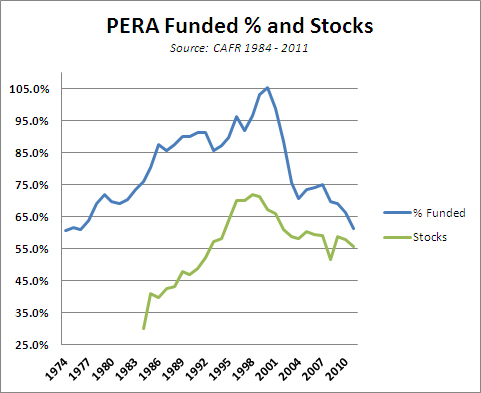
Note that as the funded ratio rose, so too did the percentage of the portfolio allocated to common stock (both domestic and foreign) rose, as PERA basically decided to let the bets ride, rather than re-allocate to maintain the lower-risk portfolio. When the bubble burst, they ended up paying the price for having stayed too long at the fair. Now, PERA has returned to a somewhat more conservative allocation strategy, targeting 25% of its money for fixed income, and a target of 58% in stocks. Nevertheless, this is a far cry from the 45% or so in bonds that they held up until 1992 or so, and the nebulous “Alternative Investments,” which includes things like venture capital (and in which I’ve included the Lumber investments), suggests that PERA is still chasing yield there:

So this just puts us back where we were before, right? We climbed out of this hole before, we can do it again.
Not so fast. First, as noted before, PERA’s in a less aggressive portfolio now than it was in 2000. This is a good thing, since it takes out some of the volatility from its portfolio. But it also means that it probably can’t count on a run of good luck to lift it out of unfundedness the way it did last time. Also, as we’ve previously noted, the fall from grace in 2001 and 2002 wasn’t just a matter of poor returns, it was also a matter of increasing liabilities with more generous benefits. That hasn’t gone away.
And not all 60% funded ratios are created equal. Here are PERA’s inflation-adjusted, per-capita unfunded liabilities since 1974 (constant 1983 dollars):

On a per-capita basis, the overhang is about 4x what it was in 1974. So in fact, we’re in much, much worse shape than we were 40 years ago when this roller-coaster ride began.
Public Pensions and Real Returns
Posted by Joshua Sharf in PERA, PPC on March 4th, 2013
In the discussion on public pensions, there’s been a great deal of focus on the projected rate of return. I’ve posted on what I think is PERA’s optimistic 8% here, and on the fact that that’s actually an improvement from the 8.75% that they were projecting as recently as 2002. That said, for pension estimates, their inflation assumptions matter as much as their raw return assumptions. The actuarial consequences of poor inflation estimation are too much to summarize here. But even on the basic question of returns inflation matters: the real return on an investment is the nominal return minus inflation.
Over the last 10 years, public pensions have gotten some credit for modestly reining in aggressive growth assumptions. PERA, for instance, has moved from a 8.75% growth assumption to 8%, and CalPERS has made similar adjustments. Overall, the average growth assumption has dropped slightly from 8.04% to 7.86%. But the average inflation assumption for public pensions nationally has dropped from 4.0% to 3.31%. This means that instead of decreasing the real return assumption has actually gone up from just over 4% to just over 4.5%.


For the record, PERA’s inflation assumption was dropped from 4.5% to 3.75% in 2003, where it has stayed. Both the investment return and inflation numbers are higher than the national average and national median, though.
I don’t really think that the inflation numbers here are unreasonable. And my problem with PERA’s 8% return assumption goes beyond the average itself – 8% has been the historic return on stocks, and doesn’t take into account the additional volatility and risk that come with higher return. But it’s clear that PERA and other plans have been dining out on their flexibility on returns, while the increase in real expected returns goes unremarked-on.
The disconnect also highlights the price we’re going to pay – in accuracy, and eventually in dollars – for using the rate of return as the discount rate. Interest rates are closely tied to expected inflation, and here the funds themselves are admitting that the gap between the rate of return and the proper discount rate has been growing.
PERA – More Retirees, Fewer Workers
Posted by Joshua Sharf in PERA, PPC on March 3rd, 2013
This chart is more or less self-explanatory. Over the last 20 years, the number of workers per beneficiary within PERA has dropped from about 3.6 to just over 2.0:
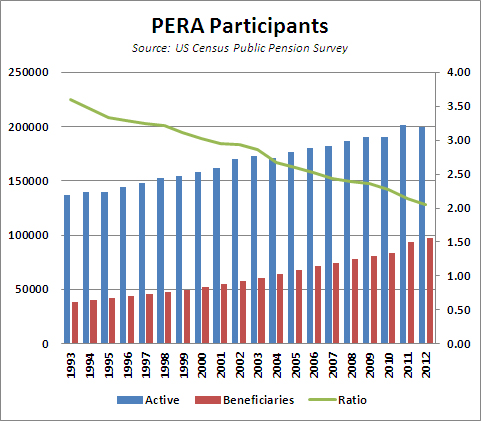
PERA’s CAFR includes the following disclaimer:
By itself, a declining ratio of actives to retirees and beneficiaries does not pose a problem to a Division Trust Fund’s actuarial condition. However, to the extent that a plan is underfunded, a low or declining ratio of actives to retirees and beneficiaries, coupled with increasing life expectancy, can complicate the Division Trust Fund’s ability to move toward full funding, as fewer active, contributing workers, relatively, are available to amortize the unfunded liability.
This is about right, although even a fully-funded system won’t stay fully-funded for very long under these conditions. Indeed, PERA was fully-funded as late as 2001. In the 90s, PERA’s long-term problems were masked by a tech bubble, and when that burst in 2000, the fund started to fall into an under-funded state that it’s never recovered from. Since under an underfunded defined-benefit plan, current expenses have to be paid for out of current contributions, and fewer workers are pulling the cart for each retiree, the deficient horsepower will have to be supplied by the taxpayers.
Aristotle’s Rhetoric on Acid
Posted by Joshua Sharf in Colorado Politics on March 1st, 2013
Tom, over at People’s Press Collective, conducts a mini-course on the rhetorical devices used by the Left to derail rational discussion, illustrated by a Twitter fight:
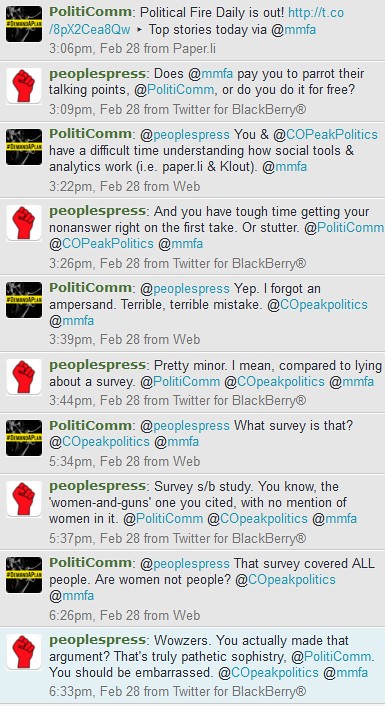
Most of us would focus on the logical fallacy in PolitiComm’s last tweet. By their argument, the study was about middle-aged Czech immigrants. After all, are they not people?
But that’s not the point of the post. Instead, Tom looks at the rhetorical devices used to distract, derail, and otherwise distort an argument. These are tactics that not only can ensnare smart people, they’re specifically designed to ensnare smart people. For instance:
- Distractions: responses aimed at luring their opponent into talking about something else, taking them “down a rabbit hole” and “into the weeds” by focusing on some trivial or secondary facet of their opponent’s argument, thereby miring their opponent in minutiae;
- Diversions: responses aimed at changing the subject entirely, moving it away from a topic they find threatening to their own interests or worldview and instead onto something threatening to their opponent’s;
- Deflections: explanations, justifications, or rationalizations which redirect criticism aimed at their sacred cows and onto their opponent, in an attempt to put the latter on the defensive instead;
Why is it important to learn how to recognize and counter these? Because they’re all tools used to limit our effectiveness. Too often we make the mistake of assuming that their paucity of logic and supporting facts is obvious to anyone following the debate. It’s not. And using them back at the Left is only marginally better than succumbing altogether: they lower the level of discourse to the point where rational argument can’t prevail, either because the discussion itself is so debased, or because other people listening lose interest and walk away convinced that there’s no difference between the sides.
Why are these tactics so common across so many sites and platforms? I suspect there are three main reasons: first, there are professional online activists who are trained to do this kind of thing in much the way Media Matters and others train people for appearances on television or teach them to call talk radio shows or write letters to the editor; second, many more people consciously or subconsciously emulate what they see other like-minded commenters doing; and third, there are people who are just
sociopathicnaturally gifted in this regard and need neither training nor example to create and employ such tactics.It’s important for center-right activists to learn to recognize these things so as not to be suckered in by them, and to fight back effectively when encountering leftists using them. Being able to spot, identify, understand, and respond to these tactics undercuts their power. Given enough education and discipline, perhaps we can return to a more rational and persuasion-based political conversation and jettison the juvenile bickering that seems to have become the norm since the emergence of social media and the ascendance of the infantile Progressive movement which dominates its political channels.
-
You are currently browsing the archives for the Colorado Politics category.


