Archive for category Colorado Politics
Anything Goes
Posted by Joshua Sharf in Colorado Politics on April 16th, 2010
That, apparently, is the philosophy behind the Democrats’ bill, HB-1408, for eviscerating the rules concerning Congressional redistricting. Next year, after the 2010 Census and elections, Colorado will, like every other state, draw new congressional district boundaries. In the past, with one notable exception I’ll discuss below, there have been certain statutory rules governing the drawing of those boundaries, describing what criteria the courts may or may not take into consideration. The Democrats’ bill would seek to repeal all of these statutory guidelines and replace them with..nothing.
In general courts could not use “non-neutral” factors such as “political party registration, political party election performance, and other factors that invite the court to speculate about the outcome of an election.”
Here are the “neutral” factors that courts could use, according to the relevant statute:
(I) First, a good faith effort to achieve precise mathematical population equality between districts, justifying each variance, no matter how small, as required by the constitution of the United States. Each district shall consist of contiguous whole general election precincts. Districts shall not overlap.
(II) Second, compliance with the federal “Voting Rights Act of 1965”, in particular 42 U.S.C. sec. 1973;
(III) Third, except when necessary to comply with subparagraph (I) or (II) of this paragraph (b), political subdivisions such as counties, cities, and towns shall be preserved intact and shall not be fragmented or dispersed across district lines. When applying this criterion, preservation of the most populous counties, cities, and towns shall take precedence. When county, city, or town boundaries are changed, adjustments, if any, in districts shall be as prescribed by law.
(IV) Fourth, communities of interest, including ethnic, cultural, economic, trade area, geographic, and demographic factors, shall be preserved within a single district whenever possible. Traditional communities of interest in Colorado include the western slope and the eastern plains.
(V) Fifth, each congressional district shall be as compact in area as possible, and the aggregate linear distance of all district boundaries shall be as short as possible; and
(VI) Sixth, disruption of prior district lines shall be minimized.
Presumably, the Voting Rights Act would continue to apply, and despite the failure to capitalize “Constitution,” one assumes that the Democrats don’t want to introduce wild disparities in district populations. The courts will still be bound by federal law in drawing federal districts. Those details aside, there are good, longstanding reasons for all of these exclusions and inclusions.
The absence of the additional restrictions would open the door to the sort of gerrymandering that characterizes Illinois:
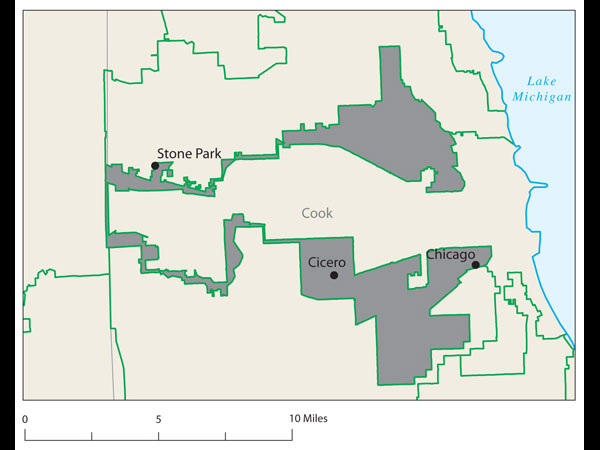
It also makes intuitive sense that cities and towns should have the same Congressional representation, where possible. In fact, they are merely a subset of (IV): communities of interest. It makes sense that interests, rather than parties, should be represented is legislatures. Citizens have interests. They may be economic, ethnic, cultural, or social, but citizens are far more likely to think about them on a daily basis than they are to think about their party affiliation, if any. Political parties may or may not be an expression of those interests, but are, at best, a secondary overlay on top of them. If this weren’t true, “Unaffiliated” wouldn’t be our largest party non-identification in Colorado.
This may be a perfectly logical choice, for a party that sees interests as tools of political power, rather than parties as expressions of coalitions of interests, but I doubt that most people think that way.
But aside from the philosophy involved, it’s important not to lose sight of the mechanics. Redistricting in Colorado is done by a tripartate commission from each of the branches of the government. Two each (one from each party) from the House and Senate, three appointed by the Governor, and the last four appointed by Supreme Court’s Chief Justice. If the commission can’t reach agreement, the District Court can impose a solution, as happened in 2002, when it adopted the Democratic plan for Colorado’s new 7th Congressional district. Interestingly, the court specifically included “competitiveness” in its ruling, despite a specific statutory injunction against using party registration as a criterion. This bill aims to remove even that potential legal obstacle.
HB-1408 is directed to the courts, not the commission, implicitly anticipating gridlock there. If this weren’t the case, the bill would remove any guidelines from the commission, as well. I don’t think it goes too far to suggest that the strategy here is to repeat 2002, obstructing a solution and then getting the courts to adopt a partisan plan.
CORRECTION: I am reminded by Matt Arnold that the reapportionment commission only applies to state legislative districts. Congressional districts are redrawn by the General Assembly alone, without the governor or the courts. Of course, this increases the chances for gridlock, but it also means that the composition of the Supreme Court will be less important in this regard, should this pass. Similarly, it means that the composition of the legislature will be far, far more important.
Testimony Helps Defeat Public Financing
Posted by Joshua Sharf in Colorado Politics, HD-6 2010 on March 28th, 2010
This past Thursday, I had the chance to testify against a HB-1156 that would have provided for limited public financing of state legislative campaigns. The bill was being carried by Rep. Court, and would have created a 2-for-1 matching system, up to $5,000 in matching funds for a State House of Representatives campaign, and up to $10,000 for a State Senate campaign. While it’s true that I oppose public funding of campaigns on philosophical grounds, my testimony focused primarily on practical concerns: the bill would have failed even on its own terms. I’m pleased to say that the committee voted it down 7-4, eventually voted to postpone indefinitely, 8-3.
The full audio of my remarks, and those of Rep. Court, will be available soon, but for the moment, here are the basic points that I made.
- In a time of fiscal constraints, it makes no sense to be providing welfare for politicians while we’re cutting K-12 education
- While a taxpayer checkoff would be available, it would likely produce little actual revenue, much like the federal campaign checkoff
- Funding is not truly voluntary, as the campaign account could be funded by general fund dollars
- The fund balance is not good measure of voter interest in the idea, since gifts and contributions could also fund the account. Funding all expenses for a campaign cycle would could somewhat more than $1 million, well within the means of a number of Coloradoans who routinely contribute more than that in independent expenditures
- There are conflicting provisions for distributing funds if there isn’t enough money to go around. These provisions produce an advantage for incumbents and those with existing political machines, and do nothing to promote competitiveness
- Campaigns are expensive because printing, mailing, and airtime are expensive, and since campaigns make up only a small part of the whole media market, they have almost no pricing power
- If a $400 limit is too low, a better route would be to seek relief under the Supreme Court’s Randall v. Sorrell ruling. It invalidated Vermont’s $200/person contribution limits, for districts that average 1/17th the size of Colorado’s
- There is little actual public concern; California turned down a public financing initiative by a 3-1 vote, while Alaska’s voters rejected it 2-1.
- In fact, according to the Justice Department, the cleanest states, like Nebraska, have few or no limits. And the best-run states, according to Governing magazine, Utah and Virginia, similarly have no limits
- Arizona’s public financing has failed to increase the diversity of its legislature, as measured by race, sex, or occupation
The proper response should be for the legislature to raise the campaign finance limits and require greater transparency and immediate reporting of who’s paying. This will encourage money to flow to campaigns, rather than to unaccountable 527s.
Norouz Mubarak
Posted by Joshua Sharf in Denver, HD-6 2010, Iran on March 28th, 2010
It was delightful to be able to spend a little time Friday celebrating Norouz, or the Persian New Year, with Denver’s Persian community. The Persian New Year is celebrated at the onset of Spring, and, like our own New Year, is essentially secular, celebrated by the entire country. So when my friend Ana Sami invited me to drop by, it was a no-brainer. I also had a chance to meet Tim Ghaemi in person, after having interviewed him for the Rocky Mountain Alliance’s Blog Talk Radio show last year.


In addition to the actual food, there’s usually a special table set, with a number of symbolic items:

For some reason, they all begin with “S” in Farsi, but here’s the list:
- Sabzeh – wheat or lentils grown in a tray or dish prior to Noe-Rooz to represent rebirth,
- Samanu – a sweet pudding made from wheat germ, symbolizing affluence,
- Senjed – the dried fruit of the lotus tree which represents love,
- Seer – which means garlic in Persian, and represents medicine,
- Seeb – which means apple in Persian, and represents beauty and health,
- Somaq – sumac berries, which represent the colour of the sun rise,
- Serkeh – which means vinegar in Persian, and represents age and patience,
- Sonbol – the hyacinth flower with its strong fragrance heralding the coming of spring, and
- Sekkeh – coins representing prosperity and wealth
There’s also usually a copy of the community-appropriate religious book, be it a Chumash, a Bible, or a Koran. This being an inclusive celebration, they had a copy of both the Koran and the Bible on the top shelf there, but the big red book there in the middle is actually neither. Instead, it is a book listing the 12,000+ vicitms of political executions under the current Iranian regime, a reminder that as is often the case, immigrants to America are freer to celebrate their holidays here than they would be back home.
Norouz Mubarak to Ana, Tim, and the rest of the Persian-American community here in Denver.
Free Speech Extends to Colorado
Posted by Joshua Sharf in Colorado Politics on March 22nd, 2010
In other news, the Colorado Supreme Court ruled today on the questions presented to it by the Governer and Secretary of State in light of the Citizens United case:
Pursuant to Section 3 of Article VI of the Colorado Constitution, the Governor submitted two interrogatories to the Colorado Supreme Court on February 9, 2010, concerning whether various provisions of Article XXVIII of the Colorado Constitution were unconstitutional in light of the United States Supreme Court’s decision in Citizens United v. FEC US 130 S. Ct. 876 (2010).
The supreme court answered both interrogatories in the affirmative. It held that to the extent section 3(4) of article XXVIII of the Colorado Constitution makes it unlawful for a corporation or labor organization to make expenditures expressly advocating the election or defeat of a candidate, it violates the dictates of the First Amendment of the United States Constitution. Similarly, it held that, to the extent section 6(2) of article XXVIII of the Colorado Constitution makes it unlawful for a corporation or a labor organization to provide funding for an electioneering communication, it violates the dictates of the First Amendment of the United States Constitution.
The uncertainty having been cleared up, this will no doubt be the green light for the House State, Veterans, and Military Affairs Committee to take up the bill providing for public funding of political campaigns. With my luck, they’ll take it up over Yom Tov.
Political Effect of the Lawsuit
Posted by Joshua Sharf in Colorado Politics, HD-6 2010, Health Care, Senate 2010 on March 22nd, 2010
Despite the fact that this is a legal decision, not a political one, I do believe that it will have at least one positive political effect.
Go ahead, tell me you didn’t feel deflated last night. No, you’re lying. I read your comments on Facebook and on the blogs and on the newspaper sites. I know what you were thinking: France called, they want their statue back.
Now, tell me you don’t at least have a little hope that we can pull back from the precipice. That week-long planned media celebration of historic achievements is stopped cold, even before the bill is signed into law.
Tell me you don’t feel better now than you did 4 hours ago.
Mandate This!
Posted by Joshua Sharf in Colorado Politics, Health Care on March 22nd, 2010
The Colorado legislative Republicans held a press conference this afternoon to announce that they had sent a letter (text below the fold) to Attorney General John Suthers, asking him to join with other states’ attorneys general in challenging the constitutionality of the individual health mandate here in Colorado. Jon Caldara of the Independence Institute joined them, making an impassioned plea and invoking, as he has recently and reluctantly, his heroic son who has undergone 9 life-saving surgeries in his 5 years. The legislators also pointed out a number of bills that the current Democrat majority has killed this session, including, reviewing new health care manates for cost and individual deductibility of health insurance.
The presser went on for a little over 20 minutes, so it’s in three segments:
- Rep. Amy Stephens, Sen. Mike Kopp, and Sen. Kevin Lundberg
- Jon Caldera, Sen. Greg Brophy, and Rep. Mike May
- Q & A
For the record, the legislators were quite clear that they were signing sending the letter, and had not coordinated with the Attorney General in advance. In fact, I saw the letter delivered with mine own eye, since I had headed over to the Law Office for…
About 90 minutes later, Attorney General John Suthers announced that he would, in fact, be joining the lawsuit. The lawsuit not only challenges the constitutionality of the individual mandate, but also of the IRS enforcement of that mandate, the fine they’d be able to impose, under the guise of a tax. While the Congress can regulate insterstate commerce, it can’t regulate commercial inactivity, which is what this bill tries to do. In addition, the legislation mirrors what the Democrats here in Colorado have done by labeling “taxes” to be “fees,” in this case, labeling a fine a “tax” in order to give jurisdiction to the IRS. As Randy Barnett points out, this essentially would give Congress the power to regulate anything, and the IRS power to enforce it. Moreover, the tax, even as a tax, would violate Article I Sections 2, 8, and 9, which provide that any direct tax has to be proportional to a state’s population, not tied to an individual’s economic (in)activity.
Regardless, this collective action is almost certainly only the first of many that will be filed, both by the states and by third parties.
I hate to turn this into a media criticism piece, but the fact that Congress can’t regulate anything, and that the IRS can’t enforce it seemed to be unexplored territory for the other reporters in the room. One lady tried twice to understand why this was different from the state requiring auto insurance (hint: the federal government isn’t a state, and there’s an action tied to car insurance, i.e. operating your car; merely being a breathing citizen isn’t sufficient justification for mandating interstate commerce, or punishing the refusal to participate in a market.
Second prize goes to Eli Stokol of Fox 31, who left the room convinced that this was a political decision, because thus far, only Republican attorneys general were involved. The notion that the lack of participation by Democrats could be just as political apparently didn’t register. Also, there are very liberal Democrats who don’t buy the mandate (so to speak) for a slightly different reason, that the government can’t force you to buy a private product, such as professor Tom Russell of the University of Denver School of Law. (Mr. Russell ran in last election’s primary for HD-6, as it happens.)
Young Mr. Stokol also asked why, if the 10th Amendment were applicable, why it hadn’t broken through in discussion before. The answer is that it has, and that if he had showed up having done his homework and done any sort of reading on the legal matters on display he’d know that.
The videos of the presser are here.
Straw Polls
Posted by Joshua Sharf in Colorado Politics, Governor 2010, Senate 2010 on March 17th, 2010
As part of the caucus process this year, both Democrats and Republicans in Colorado included a non-binding straw poll, essentially a test of grass roots strength among the candidates. Not surprisingly, the activitst-friendly candidates did well. Andrew Romanoff took about 50% of the vote to Senator Bennet’s 41% on the Democratic side. For the Republicans, Dan Maes got 40% of the vote to Scott McInnis’s 60%, which will probably be interpretes as a win for Maes, and Ken Buck barely edged out Jane Norton by 25 votes, which will certainly be considered a win for him.
How much does it matter? It’s hard to say. On the Democrat side, it may help boost Romanoff’s heretofore anemic fundraising. I have no insight as to whether or not folks were electing delegates based on their Senate preferances, though. For the Republicans, I suspect there’s a strong correlation between not supporting Jane Norton and supporting Dan Maes. This matters, because for the most part, people didn’t have to choose between delegates for Senate and delegates for Governor. It means that if Maes decided to continue on after convention (assuming he can’t make up the difference), he’ll go in as an underdog, but not a massive one. And it says that McInnis still faces significant discontent within his own party.
This suggests that the Colorado governor’s race is beginning to look a little like last year’s Presidential race. Hickenlooper is playing the part of Obama, positioning himself as a reasonable moderate, atlhough he’s actually quite liberal. McInnis is playing the part of McCain, the presumptive nominee that the party really doesn’t quite buy as being conservative enough. For all his harping on “unity,” McInnis is going to find that line increasingly irrelevant. And Dan Maes is playing the role of The Field: in addition to his own support, he’s picking up the protest vote against McInnis.
This doesn’t mean that things will play out the same way at all. Obama was running with a favorable political environment, Hickenlooper has to overcome the current distrust of the Democrats. McInnis is certainly more conservative than McCain. And Maes is a single individual, meaning that someone who votes for him is less likely to switch to McInnis down the line, if there’s a primary.
As for the Senate race, Tom Wiens and Cleve Tidwell were both banking on a strong showing at caucus, and didn’t get it. Fairly or unfairly, the race really narrows down to two candidates, and the question is whether or not, at or after state convention, Wiens’s and Tidwell’s supporters will split up or coalesce behind Buck. And while Norton has worked hard to court the activists and the Tea Partiers, it may not be enough this year.
Of course, there’s no real precedent for correlating straw poll support with election performance. In 2008, the only straw poll was at the presidential level, and Romney, the winner in Colorado, dropped out a few days later. The straw poll results will almost certainly correlate more strongly with County Assembly results – and thus with State Convention results – than with the broader party electorate in a primary. And a lot can happen at County. A disciplined voting bloc can win a disproportionate number of delegates.
Caucus Night 2010
Posted by Joshua Sharf in HD-6 2010 on March 16th, 2010
It’s humbling to get such a warm reception from my fellow Republicans and from unaffiliated voters in attendance as well. I’ll work hard to earn it!
Amazon Shoots and Misses
Posted by Joshua Sharf in Business, Colorado Politics, HD-6 2010 on March 9th, 2010
As most of Colorado knows, Amazon suspended its affiliate program in Colorado yesterday. Monday morning, many of us (myself included) awoke to find the following in our inboxes:
Dear Colorado-based Amazon Associate:
We are writing from the Amazon Associates Program to inform you that the Colorado government recently enacted a law to impose sales tax regulations on online retailers. The regulations are burdensome and no other state has similar rules. The new regulations do not require online retailers to collect sales tax. Instead, they are clearly intended to increase the compliance burden to a point where online retailers will be induced to “voluntarily” collect Colorado sales tax — a course we won’t take.
We and many others strongly opposed this legislation, known as HB 10-1193, but it was enacted anyway. Regrettably, as a result of the new law, we have decided to stop advertising through Associates based in Colorado. We plan to continue to sell to Colorado residents, however, and will advertise through other channels, including through Associates based in other states.
There is a right way for Colorado to pursue its revenue goals, but this new law is a wrong way. As we repeatedly communicated to Colorado legislators, including those who sponsored and supported the new law, we are not opposed to collecting sales tax within a constitutionally-permissible system applied even-handedly. The US Supreme Court has defined what would be constitutional, and if Colorado would repeal the current law or follow the constitutional approach to collection, we would welcome the opportunity to reinstate Colorado-based Associates.
You may express your views of Colorado’s new law to members of the General Assembly and to Governor Ritter , who signed the bill.
Your Associates account has been closed as of March 8, 2010, and we will no longer pay advertising fees for customers you refer to Amazon.com after that date. Please be assured that all qualifying advertising fees earned prior to March 8, 2010, will be processed and paid in accordance with our regular payment schedule. Based on your account closure date of March 8, any final payments will be paid by May 31, 2010.
We have enjoyed working with you and other Colorado-based participants in the Amazon Associates Program, and wish you all the best in your future.
Best Regards,
The Amazon Associates Team
The reaction to this has tended to fall along typically uninformed party lines. The Democrats tend to accuse Amazon of trying to avoid the new Internet Tax. The Republicans claim that this is just a natural response, pulling out of a suddenly burdensome situation. In fact, neither is quite right.
The law, HB10-1193, was one of the Dirty Dozen tax increases, an imposition of the state sales tax on a hitherto exempted category. Internet sales in fact have been taxed, if the seller has a physical presence in the state. Therefore, if you buy a washing machine from Sears online, since Sears has stores and warehouses in Colorado, you would have paid sales tax on that purchase. Companies with no physical presence in the state have been exempted from that sales tax here and in most states, because there was essentially no way to enforce the tax.
The Internet Tax supposedly sought to capture an estimated $5 million in revenue that was being missed, on the theory that affiliates based in Colorado provided a physical presence to the company. In theory, this was revenue that had migrated from taxable in-store sales to non-taxable Internet sales. However, this was wrong in both theory and practice, and Democrats in the House who voted for it (including HD-6’s current rep Lois Court) were operating under mistaken assumptions. First, there’s no way of measuring how many sales were made online that otherwise would have been made in stores, and how many were additional sales of items that would not have been available in state, or were from sales that were only available online. Secondly, good luck getting Amazon to turn over customer records.
Now, when Rep. Court was confronted with the fact that this tax was uncollectable, that companies out of state couldn’t be forced to comply, and that people might well alter their buying habits to avoid the tax, her reply was a consistent, “find me another $5 million.” In other words, she voted to pretend to raise $5 million and to make the state look foolish in the process.
Clearly, this proposed tax, whose enforcement would have fallen on the affiliates, would have created a huge administrative nightmare for the thousands of small affiliates in the state, many of whom would have folded up. It was also predictable under those circumstances that companies like Amazon might have folded up and terminated their affiliate contracts. But a concerted lobbying effort, led by my friends Marc and Claudia Braunstein, who own ShopAtHome.com, a business based entirely on affiliate relationships, and by the PMA, forced the State Senate to amend the tax so that the responsibility for tracking and paying the tax falls on purchasers now, rather than sellers. In other states, Rhode Island and North Carolina, that change wasn’t made, and Amazon pulled out. But it was expected that this would save the affiliate relationships here in the state.
So here’s where both sides are wrong, and where it becomes clear that Amazon has made at least a tactical error here. Their action is clearly not an attempt to evade paying the sales tax. The administrative burden of that tax falls on buyers, not Amazon, and if Colorado attempts to force a company based in Washington State to disclose the purchases of their Colorado customers, it’s going to find itself needing a supplemental appropriation to the Attorney General’s office. In fact, the predictable failure to raise revenue, combined with the black hole of legal expenses, might actually allow this change in tax policy to qualify under TABOR.
But precisely because of that, the action makes no sense to the affiliates. Without warning, thousands of Amazon’s sales partners found their incomes eliminated, despite their efforts. This looks an awful lot like friendly fire. These are business partners that the company has alienated and insulted. These are your allies, Amazon. What, have you been making a detailed study of the Obama Administration’s approach to Britain?
Now maybe Amazon is trying to get their affiliates to put pressure on the state to repeal the damn thing altogether, and Greg Brophy, chief among the Senators Who Get It, is already talking about that. But maybe Amazon is really ticked off at its affiliates. After all, they only lobbied to shift the administrative burden, and onto their customers, at that, rather than to stop the tax altogether. This is, at least, poor customer relations. It’s also possible that Amazon sees it as cowardly, since the affiliates were counting on Amazon to foot the legal bill to fight this thing. Never mind that Amazon could have passed some of this cost along to its Colorado affiliates in the form of reduced referral fees. But regardless of what Amazon thinks it’s trying to accomplish here, it’s awful PR.
In short, both the Republicans and Democrats are wrong. Doing this doesn’t make it any easier to fight the tax, and as a result, it’s hard to see why it’s a natural outcome of this otherwise horrible idea for a tax. But in the end, Amazon’s misfire is going to cost it a lot of the goodwill that it brought into this fight.
PERA Nears A Deal – UPDATED
Posted by Joshua Sharf in Budget, Colorado Politics, Finance, PERA on January 8th, 2010
The Denver Post is reporting that negotiators are nearing a deal on PERA, the generous defined-benefit plan that most state workers have benefited from over the years:
The major changes to the Public Employees’ Retirement Association include increasing employee and employer contributions by 2 percent and reducing cost-of-living increases for current retirees from 3.5 percent this year, capping them at 2 percent….
Several issues remain to be resolved, most revolving around age of retirement and years of service needed to get full benefits, but both men said those issues could be resolved by the time lawmakers convene for their 120-day session next week….
So let’s assume that accounting for the government worked the same as accounting for a private pension. In fact, in this case, there’s no good reason why it shouldn’t. Basically, the plan has assets and obligations, but both of those change over time. So the inputs to the model are 1) Actuarial Assessments, and 2) Interest Rate Assessments.
Actuarial assessments include things like Years of Service, Age of Retirement, Years of Benefits, Salary Increases (due to seniority), Benefit Increases (due to age). Interest rate assessments include benefit inflation, health care inflation, discount rate, and return on plan assets.
The things that can be adjusted generally fall into Actuarial Assessments, and that’s where the article focuses. Retirement age and years of service all fall into this category. What’s critical is the stuff that’s left out. We have no idea what the plan’s assumed rate of inflation, discount rate, rate of benefit inflation or health care inflation are, or what the assumed return on investment is. We don’t know what they’ve assumed them to be in the past. If those numbers are unrealistic, or even aggressive, we’ll likely find ourselves right back in the same place a few years from now.
Consider a simple scenario, where the plan assumes a constant 8% real return on plan assets. Historically, this might be reasonable. But if the bulk of the return is in the out years, the plan will have depleted its assets before those returns can catch up, and will run out of money. (Cool graphs on this topic here.) If you could forecast how returns would change over time, you’d have a more accurate model, but the fact is, as we’ve seen time and again, it’s impossible to make those sorts of predicts 5 years out, never mind 25 years out. Which means that the solvency of any defined-benefit plan is mostly guesswork. Promises of long-term solvency are simply mirages.
Maintaining a defined-benefit for incoming and even current employees is not realistic (promises made to those already retired must be honored). The only fair way to move forward is to transition to a defined-contribution plan, which has only assets, and by definitions, no liabilities. Unfortunately, the political will for this move doesn’t seem to exist.
UPDATE: According to the actuarial projections accompanying PERA’s legislative recommendations, they are indeed projecting a constant 8.0% return for the next 30 years. This strikes me as aggressive. But they key point to remember is that these returns are never constant, and that the shape of that returns curve strongly affects the ending balance. There is simply no way for even the best prognosticators to get that right, and worse, no acknowledgment in the docs that it even matters.
-
You are currently browsing the archives for the Colorado Politics category.


