Archive for category PPC
The DenPo Hits the Campaign Trail
Posted by Joshua Sharf in PPC on May 21st, 2012
The Denver Post this morning continues its fine tradition of election year in-kind contributions to Democrats with two pieces, one an editorial and one a blog post that may as well be.
Allison Sherry’s blog post (“Travel perks pervasive for Colorado lawmakers“), about Congressional travel perks, leads with Representative Doug Lamborn’s exciting life as a Congressional t0urist, and goes on to give more than twice the ink to Republicans as to Democrats, despite the fact that, including Senators, Democrats outnumber Republicans 5-4 in our Congressional delegation. Why?
Democratic Reps. Ed Perlmutter and Jared Polis filed extensions for 2011’s financial disclosures. They will be available this summer. On the Senate side, trips are not reported with the personal financial disclosures, but separately, and were not immediately available.
There’s nothing the matter with filing for an extension, I suppose, but if the congressmen can wait until summer to tell us where they’ve been on whose dime, one wonders about the urgency of the report in the first place.
The other piece is an editorial complaining about filibusters in the U.S. Senate. Such complaints have become fashionable, now Majority Leader Harry “Digger O’Dell” Reid (D-NV) has begun making noise about ramming through changes to the rules. It’s hard to say whether this is a signal that Reid is more or less confident of retaining control after November’s elections, but at a minimum, it dovetails nicely with the President’s efforts to blame his failures on the house of Congress that his party controls.
The problem is the DenPo bill of particulars:
This is the body that hasn’t passed a budget in three years, where dozens of judicial and executive appointments have been delayed for purely political purposes, where even measures with bipartisan support run into unnecessary opposition.
The editorial staff apparently still don’t have access to the Internet, where they’d find out that the budget is passed under something call Reconciliation rules, and thus not subject to a filibuster. Even if they can’t find the telegraph operator, carrier pigeon, or owl to get a question through to their research service, they might at least remember that the Senate Dems considered trying to pass Obamacare under Reconciliation in order to avoid the need for 60 votes.
As for judicial appointments, it’s old news that it’s only Democrat appointments that the Post worries about. Back in 2005, they objected to Republican suggestions of limiting filibusters of judges -who can’t be sent back to a committee for amendment – and referred to the so-called Gang of 14 Compromise as “sanity” and “cooler heads.”
Well, if it’s insanity at the DenPo, it must be an even-numbered year.
Colorado’s Windy Senator
Posted by Joshua Sharf in Colorado Politics, Energy, PPC on May 18th, 2012
In our last post, we looked at Sen. Mark Udall’s claims that Colorado’s renewables mandate had been a “great success.” This time, let’s look at his claims that “…wind, now, competes with coal and some would argue is actually cheaper than coal.”
The only way that someone could make that claim is if they ignored the subsidies that wind gets in comparison with anything we get electricity from today (that CBO report was issued just a few weeks ago at the behest of the very committee in which Udall serves and made his remarks):


The jobs that Bennet brags about include those from Vestas, which the company admits only exist because of those subsidies.
The proof, of course, is in the markets. The energy that could successfully compete with a power source that has its capital expenditures almost completely amortized – most coal plants were built decades ago – would seem to be a natural for investors. Unfortunately, well…
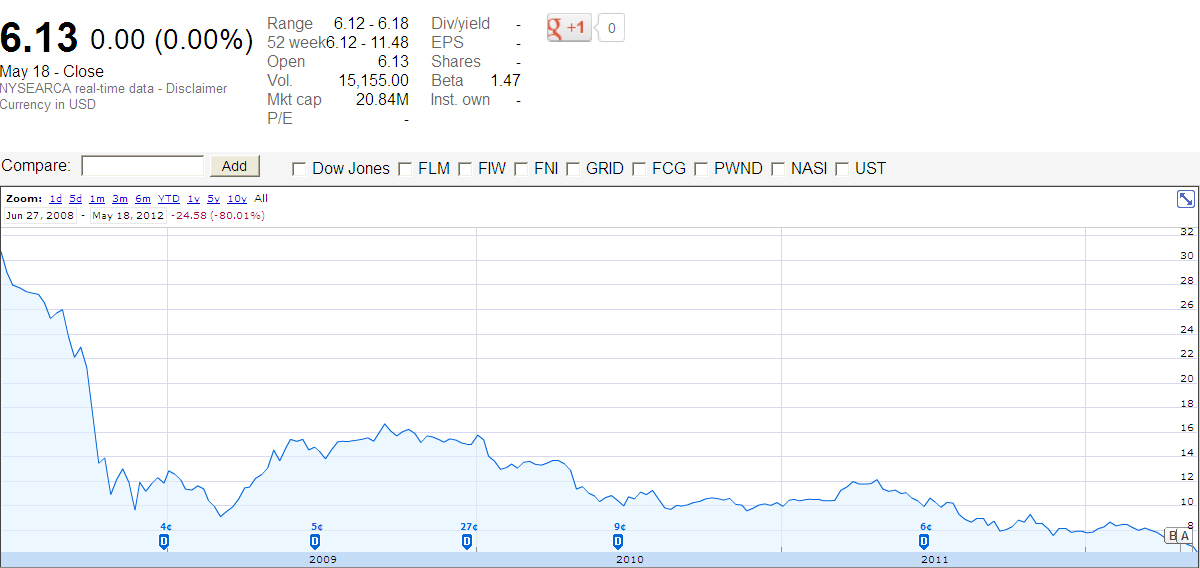
Proponents of wind energy will point to the various externalities associated with coal. Of course, wind has a few externalities of its own, like bird kills, higher local temperatures, and downwind crop & building damage.
Sorry, Mr. Udall. Wind isn’t competitive with coal, and although the Obama administration seems hell-bent on driving up the cost of coal, they’ve got a way to go, notwithstanding all the damage they’ll do to your wallet in the process. It’s not even close, and they still try to cheat.
Colorado’s Diminished-Capacity Senator
Posted by Joshua Sharf in Colorado Politics, Economics, Energy, PPC on May 18th, 2012
Yesterday, the Senate Committee on Energy and Natural Resources took up the Clean Energy Standard Act of 2012, which would “require covered electricity retailers to supply a specified share of their electricity sales from qualifying clean energy resources.” The target would start at 24% in 2015, climbing to its final, and permanent level of 84% by 2035. Senator Mark Udall (D-CO) made the following comments:
“With that, let me just say that this bill would be a step in the right direction. I also want to emphasize that I still support, as I know do many of my colleagues, a renewable electricity standard nationally. We’ve had great success in the State of Colorado with the renewable electricity standard, and I would argue in fact, we felt less of the effect of this Great Recession because of our energy sector’s capacity to innovate, create jobs, and provide power that’s less and less expensive. We all know for example that wind, now, competes with coal and some would argue is actually cheaper than coal.”
There’s enough material to keep us occupied for a week – and it may – but we’ll start with the idea that Colorado’s Renewable Electricity Standard has been a “great success.”
It may have been a great success for Xcel and its shareholders, but for the ratepayers, it’s a slowly building vacuum, sucking more and more of their decidedly non-renewable dollars. In 2011, the RES was responsible for something like 4.5% of Coloradoans’ electricity bills, and number that is only going to grow over time, as the RES ramps up to its final 30% requirement in 2020:
According to the Public Service Company’s 2010 RES Compliance Plan, the ECA is projected to be $6.3 million this year, before it balloons to $141 million in 2012. It then increases exponentially to $738 million in 2020, or almost 23 percent of total retail electricity sales—none of which would count against the 2 percent retail rate impact.
Assuming 1.5 million ratepayers in Colorado (current figure is 1.3 million) in 2020, and the mandated 20 percent renewable standard, the ECA cost alone will average nearly $500 per year per ratepayer.
The ECA is the Electric Commodity Adjustment, and it’s the means by which Xcel gets around the 2% per year rate limit that is supposed to protect consumers from the fact that renewables are, contra, Sen. Udall, much more expensive than traditional sources of electricity. More about that in a succeeding post.
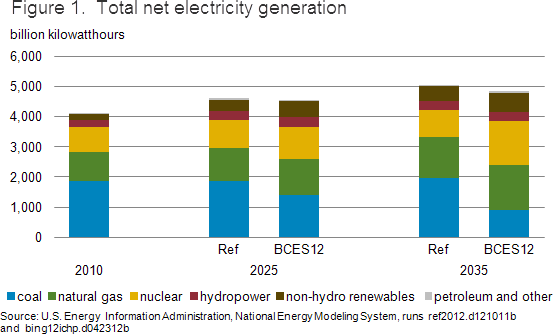
The Colorado plan, if extended to the country as a whole, will have the same deleterious effects on peoples businesses and homes. That link at the top of the page was to an Energy Information Agency study showing the effects of the proposed standard. Not only would the BCES cost dozens of gigawatts of capacity by 2035:
It would also raise the cost of electricity by about 18%:
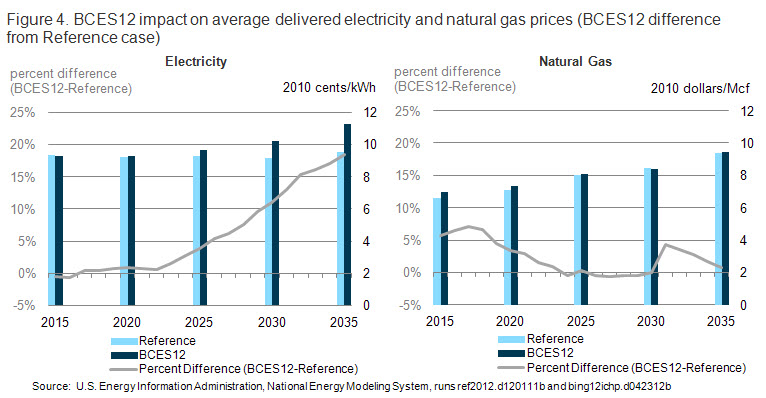
If you look closely, you see that the EIA assumes that nuclear will take the place of coal’s baseline capacity, but in fact, the extremely large up-front capital expenditures may make that prohibitively expensive, in which case we’ll have no choice but to cover as much as we can with solar and wind. The result of that little dream scenario? We have more capacity, but the price is 20% higher, rather than 18%. The increase in supply still isn’t enough to make up for the extra cost of wind and solar as sources.
Coloradans have excellent reason to wonder why their senator thinks that paying more than neighboring states for their electricity constitutes a “great success,” and Americans should run like the wind from any effort to replicate the experiment nationally.
EPA “Doesn’t Live In The Energy World”
Posted by Joshua Sharf in Colorado Politics, Economics, Energy, PPC, Regulation on May 14th, 2012
In a recent hearing of the U.S. House of Representatives Energy and Commerce Committee, EPA administrator Gina McCarthy said under questioning by U.S. Rep. Cory Gardner, R-Colo., and Committee Chairman Ed Whitfield, R-Ky., that her agency – despite issuing regulations that will have a profound affect on electricity production in the United States – “doesn’t live in the energy world.”
“Tri-State is a wholesale electric power supplier in Colorado that is owned by the 44 cooperative, generating – transmitting electricity and has come to my office multiple times trying to talk about their compliance with EPA’s Utility Max standards and…their estimate is that it would likely cost them $1 million …I’m asking you to comment on the rural co-ops which are non-profits.
Ms. McCarthy confirmed that some ratepayers would see their rates increase by about 3%, which the EPA calculated to be about $3 a month for the average family, there was this exchange between the panel and her:
Rep. Gardner: “And so that – the only way they can do that is to pass those increased costs on to their ratepayers?”
McCarthy: “I have trouble answering that question because I don’t live in the energy world, but my understanding is that compliance can be achieved by lower demand, as well as increased generation, fuel switching, and a number of techniques.”
Whitfield: “I think that’s the point that we’re trying to drive home. You’re right, Ms. McCarthy, you do not live in the energy world. But then you make extrapolations on gigawatt issues that are a reliability concern based on the chart I saw. DOE rolls over in acceptance of your electricity generation, or lack thereof, analysis, and when you have the people in the field who are disputing that analysis on the gigawatt issue, we’re debating with an environmental agency, not our Department of Energy. And if the analysis was close to what industry, financial people, FERC (Federal Energy Regulatory Commission), EEI (Edison Electric Institute) say then, we would cut some leeway.
“But the administrations proposal – actually, the environmental rules – and the effect on the electric grid, of 10 gigawatts, is laughable. And so, you can do all the analysis on emittants you want, but we reject the premise that you are experts in electricity generation, the cost of building plants, and developing those.”
Rep. Whitfield’s point is that the opinions of actual experts – which seem to be in broad agreement that the EPA rules run the risk of reducing the US’s overall electricity output – are being subordinated to the judgments of the EPA, which, by its own administrator’s admission, doesn’t live “in the energy world.”
Is it true? Well, the EPA estimates a loss of 10 gigawatts (GW) of electrical generation nationwide as a result of its new rules. This estimate is indeed not only out of line, but well out of line, with a variety of other estimates from Credit Suisse (50 GW realistic, 60+ GW possible), Friedman Billings Ramsay (45 GW), the North American Electric Reliabiliy Corporation, or NERC (33-70 GW), the Midwest Independent Transmission System Operator, or MISO (13 GW immediate, up to 61 GW retrofitted), and the Institute for Energy Research (34 GW).
It’s one thing to be independent of the industries you’re supposed to be regulating. But even independent regulatory bodies shouldn’t be making rules based on assumptions and models whose results virtually nobody in the field takes seriously. Maybe the EPA should live a little more “in the energy world,” a world it so closely regulates.
“Local Control” – Absolute or Absolut?
Posted by Joshua Sharf in Colorado Politics, Education, PPC on May 14th, 2012
Recently, WhoSaidYouSaid showed Colorado state Rep. John Soper, D-Thornton, telling public school employees to “go someplace else” if they didn’t like being due-paying members of the Colorado Education Association. Soper was speaking in opposition to HB12-1333, a bill that would have permitted teachers to opt out of union membership any time, with a 30-day notice.
The Democrats’ opposition, as you can see from our distilled video above, was largely based on the idea of local control of schools, enshrined in the Colorado state constitution. The repetition of the phrase by Rep. Millie Hamner, D-Summit, and Rep. Judy Solano, D-Brighton, struck me as a drinking game.
The problem is that “local control,” while it does extend beyond curriculum, is not absolute. According to the Colorado Department of Education, “local control” encompasses:
“Both by citizen preference and law, Colorado is a ‘local control’ state. This means that many pre-kindergarten through 12th grade public education decisions – on issues such as curriculum, personnel, school calendars, graduation requirements, and classroom policy – are made by the 176 school district administrations and their school boards.”
Local control would, according to the categories listed above, include things that actually affect the relationship among teachers, schools, parents, and children, but doesn’t seem to include the internal relationship between the teachers and their union.
In practice, according to David Kopel, research director for the Independence Institute, Colorado case law limits exclusive local control more than this definition – and Reps. Solano’s and Hamner’s insistence – would presume.
The state legislature can set ground rules for teacher dismissals. (Blaine v. Moffat County School Dist. Re No. 1, 1988, 748 P.2d 1280.)
Therefore, sect. 15 does not grant school districts absolutely immunity from legislative regulation of employee relations.
“For purposes of state constitutional provision giving ‘control of instruction’ to local school boards, local board discretion can be restricted or limited, where specific local board decisions are likely to implicate important education policy, by statutory criteria, judicial review, or both.” (Board of Educ. of School Dist. No. 1 in City and County of Denver v. Booth, 1999, 984 P.2d 639.)
As for Rep. Solano’s somewhat snarky assertion that, “If you’re for local control for one thing, it’s very difficult to be against local control for something else,” historically, that’s been far from true for either party. Insistent on local control in this case, the Democrats have, in the past, overridden it to press for Race to the Top funds, establish an arts curriculum requirement, and set sex education standards.
However, what has been true is that the left has been all too willing to use the facade of “local control” as an excuse to stifle reforms both large – as in the statewide school choice program struck down by the courts – and small, as in this case of letting teachers escape unwanted union membership, when they see them as a threat to the entrenched power of the teachers’ union.
Bully for Romney
Posted by Joshua Sharf in PPC, President 2012 on May 10th, 2012
So now, we’re suppose to believe that Mitt Romney was a bully? Conveniently, the Washington Post chooses to report the blockbuster story of a 1965 highschooler named Mitt Romney giving a gay classmate a haircut as an act of teenage terror on the day after Barack Obama earns his bona fides by declaring his support for gay marriage. And within a couple of days of the death of Vidal Sassoon.
Only it turns out that the “classmate” reporting the story wasn’t there at the time – he heard it 2nd, 3rd, 5th-hand from the ghost of the posthumously-converted 5th wife of Romney great-grand uncle, or something.
So it turns out that they also didn’t know – or even suspect – that the practice head for this budding stylist was gay. Next, we’ll find out that it wasn’t a haircut, or even a trim, but that Romney loaned him his razor. Doesn’t that really sound more like the Romney that we know?
Remember, too, this was in an upper-class Michigan suburb. Do you really believe that Mitt was conducting involuntary inductions into the Baldies from The Wanderers? Personally, I had him pegged for a Ducky Boys sort of guy, but you never can tell about some people.
Then, hours later, we hear that Obama’s autobiography contains an account of his shoving a classmate named “Coretta” and making fun of a college classmate named Tim, for apparently being too much like Mitt. I’m obviously not the first to suggest that “Coretta” is not a real person, but a composite character. (I’m sure we won’t have to wait too long for someone to do a Life of Coretta, showing her being picked on by Barack at various stages of life, from having her block tower knocked over in kindergarten to the last one, featuring him mercilessly taunting her by withholding his signature for a life-saving, but uncovered, medical procedure.)
Coming on the heels of the dueling dog controversies, you would think that Axelrod is seriously beginning to regret Obama’s choice of autobiographer.
Fostering Bad Legal Analysis
Posted by Joshua Sharf in Colorado Politics, PPC on April 25th, 2012
Among the more ill-conceived pieces of legislation to be passed by the Colorado Senate this year is Sen. Joyce Foster’s “Buy American” bill (SB12-004), that would give contractors bidding on government work a credit for using American-made materials.
So let me go back to the discussion when the Governor’s office came in and testified against this bill. They were terribly misinformed. I shared that information with them. And it wasn’t the Governor’s office that’s misinformed, it was these two people who testified that were misinformed.
Yesterday we heard also about a letter than many of us received from Canada. This will do NOTHING. This is part of the trade agreement. We have the trade agreement with Canada. We are doing business with Canada. We are doing business with Qatar and the fields in Qatar. This does NOTHING. And they were misinformed. When I tell you, friends, that I worked with the International Trade Office in 2000-2001, and my goal is to support international trade, I do!
…
It has NOTHING, it will do NOTHING to ruin our relationship with any other country that is part of the World Trade Organization. NOTHING. Other states, this is, as I said, Illinois put this together back in the 90s.
And I want to make another thing perfectly clear. Most of us are asked by different departments or different organizations or different agencies to come and lobby for them on their legislation, to bring legislation. This is my own legislation. You need to know that. This is my own legislation. My constituents have been coming to me for the last four years. “Joyce, why can’t we do something, why can’t we do something about bringing manufacturing back to the United States?”
Well, at least it’s good to know that Sen. Foster is finally sponsoring legislation that isn’t for the benefit of one or another of her family members.
But her contention that the bill won’t affect trade with countries covered by the WTO or NAFTA is simply incorrect. It’s based on two assertions. First, the fact that NAFTA and the WTO’s General Procurement Agreement (GPA) treat purchases from member nations as though they were domestic. Second, this passage in the bill:
(6) Nothing in this section is intended to contravene any existing treaty, law, agreement, or rule of the United States. No preference shall be granted under this section if the preference would contravene any treaty, law, agreement, or rule of the United States.
Let’s leave aside what the Supreme Court would do to a state that presumed to act otherwise, and to try to abrogate a treaty, and take the sentence at its word.
In fact, it can be completely true, contravene nothing, and still place WTO and NAFTA trading partners at a disavantage with respect to US firms, in several ways.
First, it’s important to understand that both the WTO GPA and NAFTA specifically exclude state-level governments from their procurement restrictions:
NAFTA Chapter 10 Procurement Obligations
Products produced in Canada fall within US government procurement obligations under chapter 10 of the NAFTA and the WTO GPA. Mexico, which is not a GPA signatory, is entitled to NAFTA protection. The essence of the NAFTA and GPA obligations is the same, as are most of the issues discussed above with respect to the GPA. NAFTA coverage applies to:
Goods, services and construction services whose country of origin is determined to be Canada or Mexico;
Federal government procuring agencies and “government entities” identified in the US NAFTA procurement annex (but not state and provincial procuring agencies, which are not covered by NAFTA chapter 10);
Contract values exceeding $50,000 for goods and services and $6.5 million for construction services; and
Contracts not excepted from coverage on grounds of national security or necessary to protect public order, life and health and intellectual property rights.
In point of fact, states have all sorts of restrictions of this sort which disadvantage Canadian companies, and the Canadian government keeps a comprehensive list of them.
NAFTA Chapter 10 coverage on government procurement is limited to the federal level. NAFTA Chapter 10 encourages, but does not require state, provincial or local buyers to provide equal treatment for offerors from outside their jurisdictions. Therefore, U.S. states may apply these preferences, which might disadvantage Canadian firms in their state and local government purchasing.
For reassurance, the US Trade Compliance Center agrees:
State and provincial government entities are not subject to Chapter Ten. The U.S. government encourages states to adopt NAFTA procurement disciplines, but the final decision rests with individual states. The Mexican and Canadian governments are currently working with their state and provincial governments to seek their voluntary, reciprocal participation.
Colorado would be adding to its list of preferences for in-state or American companies, and would, in fact, be further working against Canadian companies. This may or may not be wise policy, but to pretend this isn’t what the state is doing, or that it wouldn’t be allowed to do so under federal law, is simply factually incorrect.
The WTO GPA provisions are a little more complex. Only national governments are expressly included in its general application, but each accessory to the agreement has to file an Appendix 1, Annex 2 of which describes what sub-national organizations will be subject to its provisions, and to what extent. Thirty-seven US states are covered, including Colorado, “Executive Branch Agencies.” (This has since been extended to other US trade obligations, and became an issue when determining the degree to which the US could enforce US preferences under the stimulus package.)
It turns out that the WTO GPA was initially concluded in the mid 1990s under the General Agreement on Tariffs and Trade, an agreement, not a treaty. This means that is does not automatically become “the supreme law of the land,” in accordance with the Constitution. According to a study done by the Washington State legislature:
Under the Foreign Commerce Clause of the U.S. Constitution, Congress shall have the power to “regulate Commerce with foreign Nations, and among the Several States and with the Indian Tribes.”39In adopting the Fast Track legislation, Congress has delegated some of its power, albeit with defined limitations, to the President. However, Congress did not articulate a clear intent to legislate in an area traditionally held by the states’ government procurement.40Indeed, the Congress specifically evidenced the intent to not preempt state law in the case of the Uruguay Round Agreements.41As mentioned above, the failure to articulate such intent can be fatal to a federal attempt to override state law.
40See Bipartisan Trade Promotion Authority Act of 2002, P.L. 107-210.
41 See 19 USCS §3512(b)(2) (1999).
The obvious question is: why only 37 states, and how was their participation decided upon?
According to the National Conference of State Legislatures:
The United States is party to the World Trade Organization’s Agreement on Government Procurement (GPA). When negotiating the GPA, USTR solicited the state governors for permission to include state procurement and to bind state procurement processes to the GPA. USTR asserts that 37 states were voluntarily bound through this process to the GPA. In September 2003, USTR requested state governors to make similar commitments to several free trade agreements (FTAs) being negotiated at the time. NCSL recognizes that consultation with a limited number of governors is simpler than communicating with 7,500 legislators and that USTR has increasingly made these letters available publicly on the Internet. Nonetheless, the federal government must work with state legislatures to ensure that decisions about state procurement practices are made with their consent.
While different states may differ about whether or not the legislature in some way delegated trade authority to the executive, there can’t be much doubt that it hasn’t done so on a permanent and irrevocable basis. That is, the legislature should always, with an affirmative act, be able to modify the terms of a state’s participation in the WTO GPA. In 2005, in fact, Maryland undertook to do exactly that, passing HB514:
This bill prohibits the Governor and any other State official, without explicit consent from the General Assembly, from: (1) binding the State to the government procurement rules of an international trade agreement; or (2) giving consent to the federal government to bind the State to the government procurement rules of an international trade agreement. The bill also declares invalid any consent previously given by the Governor or other State official to bind the State to the government procurement rules of an international trade agreement.
The bill was passed over the governor’s veto, and a fuller exploration of the legal issues involved can be found in a 2005 opinion of the State Attorney General.
When I spoke with Sen. Foster personally about her bill, she couldn’t provide an answer as to how many contracts would be affected, the sum total of contracts affected, or the total cost to the state. It’s now apparent that Sen. Foster was as lazy in researching the law as she was in researching the economics.
Maybe she should stick to lobbyist-drafted legislation, after all.
An Etch-a-Sketch, or a Clean Slate?
Posted by Joshua Sharf in PPC, President 2012 on April 11th, 2012
The Romney campaign came out today with its recommendations (called, a “Unity Slate”) for the CD-6 and CD-7 Assemblies. Naturally, there’s been some grumbling that this represents yet another attempt by the establishment RINOs to dictate party policy or votes, or something, but in fact, it just represents commonsense politics and smart strategy on the part of the campaign.
First, it was the campaign, on the advice of the campaign’s higher-level volunteers, who selected these folks. It doesn’t have anything to do with the party apparatus per se.
Consider the alternative. It’s entirely reasonable for the Romney people to believe that the Ron Paul folks have a slate, but are circulating it among themselves. If the campaign didn’t promote a slate, it’s entirely possible, even likely, that they could have a plurality of the pledged delegates, and walk away with a minority, or even very few, of the delegates to national. Selecting a slate is a perfectly sensible way for the campaign to concentrate its delegates’ votes on a set of reliable delegates whom the party faithful can have confidence in when it comes time to vote in Tampa, and it’s also a way to highlight leaders in the party who can rally support to the candidate.
I’m neither part of the apparatus, nor a high-level volunteer, nor even a candidate for the national convention, and I was hoping the campaign would pick a slate for its delegates to focus on. Any campaign should. My understanding that those with long service in the party would get the nod over relative newcomers like myself was the reason I didn’t run.
So I would assume that the campaign will also suggest slates for CD-1 and State Assembly this weekend.
Just because the balloting process is open and transparent doesn’t mean that campaigns shouldn’t have strategies, or that they should broadcast them to their opposition.
A Zombie Bill For Zombie Voters
Posted by Joshua Sharf in Colorado Politics, PPC on April 5th, 2012
The Denver Post is reporting that the Colorado Senate Democrats, determined to send mail ballots out to Zombie voters (voters listed as, “inactive, failed to vote”), have found a Zombie bill for their purposes. The bill is all the more troubling since the Democrats have blocked virtually all efforts to clean up the voter rolls, ensuring that ballots will be sent out to valid addresses and ineligible or dead voters.
Here’s how they did it. Watch closely.
First, the players. The Republicans control the House 33-32. The Democrats control the Senate, 20-15. House Bill 1267 would have shortened the window for early voting. It was passed by the House, and killed by a Senate Committee, 3-2, on a party-line vote. Senate Bill 109 would send out mail ballots to inactive voters, and it passed the Senate, but was killed in the House Committee on a party-line vote. However, in the House, it had a Republican sponsor, Rep. Don Coram, which means that had it not been killed in committee, it might well have passed on the House floor.
So the Democrats in the Senate Committee moved to reconsider HB-1267, resurrect the bill, in effect, so they could amend it with the substance of SB-109, the Zombie Voter Bill. Once passed by the Senate, the re-animated HB-1267, with the form of the old bill but the substance of the new one, would return not to a House committee, but to the House floor, where it would be voted on. This would at least put Rep. Coram in the uncomfortable position of having to choose between voting against a bill whose substance he had previously supported, or voting for it, an becoming the only Republican to support the Zombie Bill for Zombie Voters.
Last year, when the Senate Democrats began playing these sorts of games, with Senate President Brandon Shaffer killing bills by committee inaction, Republicans essentially shut down the body until they relented. And that doesn’t even include the spectacle of the Democrats filibustering their own Congressional redistricting map.
A Republican House leadership committed to playing hardball probably has many more choices that I can think of, but two immediately come to mind. The House Speaker has considerably leeway in when to schedule floor votes. If Coram is willing to avoid voting for procedural matters, he can probably avoid voting on the substantive matter.
Second, what’s sauce for the goose is sauce for the gander. House Republicans in committee could do the same thing with any Democrat bill they killed, including SB-109, and replace its language with a favored, popular, but Democrat-hostile bill such as HB-1111, the bill the Senate Democrats just killed to have a statewide referendum on voter photo ID. This would send that bill back to a floor debate and vote by the entire Senate, where it might not pass, but would put the Democrats in the position of airing their flimsy, fraud-friendly arguments in a more visible forum.
Who’s Your Abu?
Posted by Joshua Sharf in Israel, Jewish, PPC, War on Islamism on April 3rd, 2012
Comes this report from Palestinian Media Watch, that a lecturer at Al-Najah University in Nablus is claiming that Moses led the Muslims out of Egypt. (No jokes about how if this is true, he’s the last Egyptian to have successfully led his people across Sinai.)
“We must make clear to the world that David in the Hebrew Bible is not connected to David in the Quran, Solomon in the Hebrew Bible is not connected to Solomon in the Quran, and neither is Saul or Joshua son of Nun [of the Bible]. We have a great leader, Saul, [in the Quran] who defeated the nation of giants and killed Goliath. This is a great Muslim victory. The Muslims of the Children of Israel went out of Egypt under the leadership of Moses, and unfortunately, many researchers deny the Exodus of those oppressed people who were liberated by a great leader, like Moses the Muslim, the believing leader, the great Muslim, who was succeeded by Saul, the leader of these Muslims in liberating Palestine. This was the first Palestinian liberation through armed struggle to liberate Palestine from the nation of giants led by Goliath. This is our logic and this is our culture.”
The Palestinians have a national obsession with delegitimizing not only Israel, but Jews and Judaism, in their effort to uproot Zionism, but you can’t help but laugh at this one. After all, they’ve tried being descended from Canannites and Jebusites in their efforts to ante-date Jewish claims. Back in his pre-Camp David days, Anwar Sadat wanted to avenge the killing of Palestinians like Goliath at the hands of shepherds like David. So it was only a matter of time before one of them decided that Louis Farrakhan had the right idea and that the Jews were actually Palestinians, or the Palestinians were actually Jews, or something. The Palestinian narrative has been so incoherent for so long, it’s surprising it took them until now to come out with this one. (I suppose this ancestral confusion was transplanted to my 2008 primary opponent, who was variously born in Jordan, Saudi, Jerusalem, and recently claimed in a interview to be a child of the Levant, which must have come as quite a shock to him.)
Ultimately, of course, none of this matters. If the Palestinians would leave the Israelis alone long enough to celebrate the Exodus peacefully, the Israelis would by and large be willing to leave the Palestinians alone to their genealogy. But as long as “this is their logic (sic) and this is their culture,” there’s not much hope for that, I’m afraid.
-
You are currently browsing the archives for the PPC category.


