Archive for category Colorado Politics
Field Work at DU
Posted by Joshua Sharf in Colorado Politics, PPC on November 8th, 2011
I didn’t do the field work. I was the field work.
For the last several years, I’ve been lucky enough to be invited to be the Conservative for Inspection by the Students at Prof. Christina Foust’s class on Anarcism and Conservatism. It’s always a terrific experience, being able to put conservative ideas in front of a set of students who probably don’t hear them very often on campus. And Prof. Foust, despite admitting to being left-of-center, has been unfailingly gracious, has always let the discussion go where it may.
This year was no different, although instead of me responding to questions and expounding on conservative solutions to the world’s problems, we tried to get the students more involved, asking them to explain their questions, come up with their own answers, and show how rhetoric is used to frame an issue by one side or another. Many of the students who take the course are prospective business students for some reason, so they tend to be focused on economic & business questions, and we did indeed spend a fair amount of time on those. But when we took up the question of taxing & spending, I took the opportunity to reframe it as one of government power, in a way that readers of this blog will be familiar with. It was, I hope, a small revelation for them. As was the emphasis on federalism and the role of the states as laboratories of democracy.
One student asked an interesting question about what they, as individuals, could do to help out with regards to the economy. I decided to take an economic rather than a political attitude towards the question. Alluding to Arnold Kling’s analogy of the Great Recalculation, as opposed to the Hydraulic Model of the economy, I suggested that 1) they should make themselves as appealing to potential employers as possible, and 2) they should think about starting businesses of their own. Both are necessary, as our economy adapts, and we struggle to figure out what goods and services people are willing to pay for.
At the end of the class, we took up the question of higher education, and how their time at the school would affect their lives. With most of them being business majors, I thought it was a good opportunity to mention the value that the much-derided humanities could have in their lives later on. Although I was a physics and math major, I took a number of history courses in school. I was graduating in 1987, and I had every reason to believe that my career would be spent fighting the Soviet Union. My ability to do that, to maintain perspective on that great struggle, and to stay grounded in it, would be enhanced by a greater understanding of world and European history. Even after I changed careers, I found that my most rewarding moments in b-school and as an equities research analyst were when I saw how understanding business, and understanding human nature and how the world works, are really one in the same.
The key element, I think, is that they need to take the classic authors on their own terms, not the politically-charged and ethnic- and gender- and all-too-abstract ways that many professors would try to present them. Immediately after the class, I happened to pick up a copy of the September 2001 Journal of Political Science, just to see what people were writing about before the world changed. There was an article about “Thucydides as Constructivist.” It’s a shame I didn’t look at it immediately before the class, because it’s exactly the kind of thing I would have advised the students to avoid, as utterly irrelevant to the historical lessons they should be getting from the History. Thucydides is writing a history of a war that actually happened, between two states and two ways of governing, and it’s important not to lose sight of the story he’s telling. The biases we should care about stem from his own political and military involvement in that war, not from some backward-projected modern critical categories.
Last week, the guests had been anarchists, so I took advantage of the home field advantage to compare (unfavorably) the OWS protestors with the Tea Party, in particular to show how the rhetoric being used by the Occupation is deliberately aimed so as to confuse the differences between the two. Hey, these kids are going to be making decisions someday; best that they know right from wrong.
There Is No National Bridge Crisis
Posted by Joshua Sharf in Economics, PPC, President 2012, Transportation on October 17th, 2011
Bridges make great campaign backdrops, as President Obama tried to exploit the other week while introducing his jobs bill. Trumpeting the desperate shape of America’s bridges, Obama spoke in front of a bridge between John Boehner’s Ohio and Mitch McConnell’s Kentucky, (a bridge that, as was noted at the time, wouldn’t have been eligible for funding under his new spending spree). Listening to him – and to just about every other public-works-booster in the last 20 years – you’d think that it was only a matter of time, months perhaps, before we found ourselves trapped behind rivers and gorges, as our bridges collapsed into dust.
Not so.
In fact, both as a percentage and in absolute terms, American bridges that are classified either Structurally Deficient or Functionally Obsolete has been falling for at least two decades. The percentage is aided by natural growth and new bridge-building. But that doesn’t account for the decline in absolute terms:

Over the last 19 years, we’ve added about 6% to our national bridge inventory, while the number of Obsolete bridges has declined by about 4% in absolute terms, and the number of Structurally Deficient bridges is down by over 40% in absolute terms:
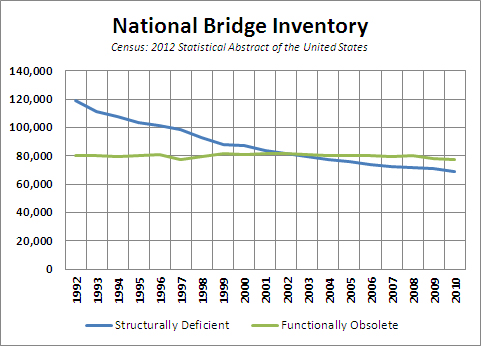
Structurally Deficient means that the bridge’s actual structure has deteriorated, or the bridge is on a working road and has had to be taken out of service. Functionally Obsolete means that the bridge is now too narrow or too low for the highway system that it’s a part of. And under the FHWA’s 10-Year Rule, no bridge that’s been built or upgraded or repaired to spec in the last 10 years is either Deficient or Obsolete. If a bridge is both Deficient and Obsolete, it’s only classified as Deficient. On a percentage basis, the achievement is even more striking:
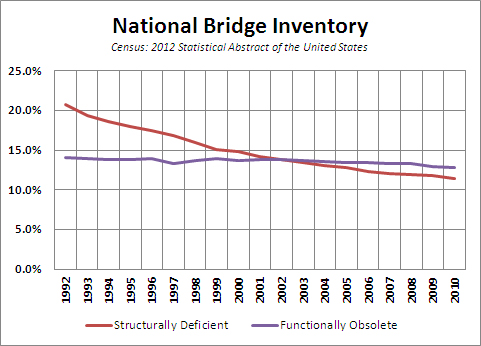
The percentage of Structurally Deficient bridges has declined from over 20% to just over 11%, and the number and percentage of Obsolete bridges has declined, even as the national highway system has been continuously upgraded and extended.
In Colorado, the percentages are better than the national average, and have been since 1998 (the first year I could find state-level records). Currently, they stand at 7% Deficient and 10% Obsolete, even as the number of bridges has grown by 8% since 1998.
It might also help to look at the highway spending numbers over the last 20 years. I suspect that some of the increase in the late 90s’ Obsolete totals is a result of upgrading the surrounding road system, and that the decline in Obsolescence in the last 10 years represents a shifting of priorities, even as the number of bridges continues to climb.
Notably, what you don’t see is any massive improvement in the numbers from 2009 to 2010, the Year Of the Shovel-Ready Project. There’s a slight improvement, but nothing out of line with historical trends, which suggests that all that ARRA money wasn’t really going where it was advertised.
It’s possible, I suppose, that we’re coming up on the end of the useful life of some large number of bridges sometime in the new few years, but I doubt it. We’ve been growing the system and doing maintenance since the 1950s, and this Bridge and Highway crisis is one I’ve been hearing about as long as I can remember. Once one of these memes makes it into the public discourse, it seems it’s almost impossible to get rid of, no matter how much progress has been made.
Not A Mirror Image
Posted by Joshua Sharf in Colorado Politics, PPC, President 2012 on October 12th, 2011
The Occupationists are the lefty equivalent of the Tea Party, and as such, pose as much of a threat to establishment Democrats as the Tea Party activists do to the establishment Republicans. In fact, it is a movement that has the potential to spin wildly out of control, devouring the Democrats who seek to control it. So goes the current thinking about the Occupy demonstrations that, with but few more demonstrators nationwide than Tea Party events got in individual cities last year, have suddenly occupied the national media’s attention.
This thinking is wrong, and there is every reason to believe that its promotion by Democrat activists is actually part of the strategy.
For one thing, if Peter Wehner is correct, and establishment Democrats need to be wary of Occupy, one could start by asking why they aren’t. From labor unions to the AAUP to the White House (somewhat more coolly) to Congressional Democrats, the left-liberal establishment has decided that this is a movement worth supporting.
The Tea Party, while it may have provided the energy behind the 2010 elections, was (and is) unhappy about the lack of a coherent conservative message coming from Republican leadership. Indeed, prior to the Tea Party’s emergence, it would have been hard to identify any coherent message coming from Republican leadership.
This is at least in part because the movement, such as it is, is essentially parrotting the line that the Democrat leadership has been peddling for four years, and amplifying over the last few months – blame capitalism, blame Wall Street, blame business, above all, blame “the rich.” They may not be happy about regulatory capture, but they’re not demonstrating against the regulations.
Because people were clearly tuning this message out when it came from the White House, Congressional Democrats, and labor unions (public or private), an “authentic voice” was needed to promote it, from people who could be portrayed as being true victims, rather than authors of their own misfortune.
Enter the unemployable graduates, holders of unmarketable sheepskins, and being crushed by student loans, of Occupy. This is not a spontaneous movement. Spontaneous movements do not advertise for paid organizing positions. It is another organized mob, intended to provide a sympathetic face to the Left’s arguments that whatever the problem is, it’s not government policies that got us here.
In fact, this strategy has already had a dry run. This summer. In Israel.
According to an investigative report by Maariv’s Kalman Libeskind, Democratic operative and pollster Stanley Greenberg, who, along with James Carville, Bob Shrum, and others, was part of a team sent by Bill Clinton to drive Netanyahu from office in 1999, is again trying to influence Israeli politics.
His mission: stoking economic discontent into a protest movement intended to again, replace Benjamin Netanyahu with a leader more willing to sell out to American leftists and make concessions to the Palestinians.
While the movement there doesn’t seem to have weakened Netanyahu, it does seem to have revitalized Labour to some extent. Israel has socialist roots whose symbolism still resonates there. (Political cultures, even within the Anglosphere, differ, thank goodness.) The mission here is not to undermine a sitting President, but rather to force the debate onto ground more favorable to the Democrats, to force Republicans to confront the presumed trump card of “fairness.”
For these reasons, the Occupy movement is less a mirror of the Tea Party, and more like the Democrats’ Portrait of Dorian Grey.
Conservatives and Republicans have already won a series of special elections and recall elections by coming up with answers to the political class and the public employee unions. Recognizing and pointing out that it’s the same set who’s pulling the strings here is the first step towards keeping the ideological and policy lines clear, and maintaining momentum going into the election season.
Build a Fence Around the Bubble
Posted by Joshua Sharf in Education, PPC, President 2012 on October 11th, 2011
Looks as though a lot of The Occupation could use a good college-level education. Someone’s noticed that The Occupation of those without an occupation is as much about the Higher Education Bubble as much as anything else (h/t Instapundit), only those involved don’t even realize it.
There’s just one thing that confuses me: a lot of these POWS seem to be mad that they were forced to accumulate a ton of debt with the stew-dent loans that they were tricked into taking to support them for 7 years while completing their degrees in Recycling Studies and beer pong. Now they find out – not only can they not get a job in the field that they picked to “follow their bliss” butt they’re expected to pay their loans back too! That is so unfair. No wonder they want to spread the the other 1%’s wealth around.
Butt seriously: why are they occupying Wall Street? Shouldn’t they be occupying the administration buildings of the universities? Aren’t they the ones cranking out worthless degrees that they’re charging $10-100,000 a year for? How, exactly, is this Colgate-Palmolive’s fault? Other than the fact they’re successful, greedy capitalists?
Actually, the American Association of University Professors noticed, too:
The dedicated students whom we teach at institutions of higher education are being forced to pay more for tuition and go deeper into debt because of cuts in state funding, only to find themselves unemployed when they graduate.
The majority of college and university faculty positions are now insecure, part-time jobs. In addition, attacks on collective bargaining have been rampant throughout the nation, as our job security, wages, health benefits, and pensions have been either reduced or slated for elimination.
Therefore, it is time to stand up for what is right.
Evidently, what’s “right” doesn’t include university faculty – or their former students – having to live in the real world, where all jobs are always insecure, health benefits have been disappearing for decades, and most of us have had to provide for our own pensions for our whole working lives. We actually accept these economic realities for ourselves, and bristle at the notion that someone else feels entitled get a lifelong scholarship for them, on our dime.
In fact, they’d like the laws of economics not to apply to higher education at all. Heavily subsidized, colleges have not necessarily put this money towards decreasing class sizes or improving instruction. Instead, they have raised tuition to match the subsidies, and put the money towards branding and administrative bloat. In Colorado, at least, they’ve managed to avoid accountability for their spending. Look at the University of Colorado website, and while you’ll have no trouble at all finding out where the money comes from, good luck figuring out how it gets spent. For years, the legislature has tried to get a straight answer to the question, “how much does it cost to educate a student from enrollment to awarding of a bachelor’s degree?” No dice.
Worse, as far as the students are concerned, colleges & universities have been marketing the generic bachelors degree as the key to lifetime employment security, regardless of the degree. This, at the same time as they have been marketing themselves to the taxpayers as the engines of technological growth. That 25%-30% of CU’s bachelor’s degrees over the last decade have been in psychology, the social sciences, or area & ethnic studies somewhat undermines both claims.
Now, I know of some sociology majors who, after have complete four years of college, have returned home to help out with the family business, and find the work fascinating. That’s fine if you’re expecting a $50,000 debt for finishing school. But I’m guessing that most people don’t have that opportunity. They, like their parents, have to work for someone else, and “Bring Your Kids To Work Day” is pretty much over by the time they’re 22. So they need a degree that will help prepare them for that.
This is not an attack on the liberal arts, or to suggest that math and science be studied solely in preparation for an engineering career. The wild success of The Teaching Company is proof that adults, with real financial obligations, can be enticed to pay hundreds of dollars for quality courses in history, philosophy, literature, music, and science. It’s proof that adults, with real world experience, realize the value of those subjects in helping them make sense of the world and grapple with tough issues.
The whining of the professors and their former students is, on the contrary, evidence of how the modern university instead cheats its current students by utterly failing them in this regard, and how easy it is to prey on college-bound students and their parents who only want the best for them.
That they have been the victims of a swindle almost as colossal as Social Security is undeniable. Too many students have been sold a bill of goods by their government and the universities they attend. Too bad they don’t have the critical thinking skills to be protesting at the right address.
Black Monday
Posted by Joshua Sharf in 2012 Presidential Race, National Politics, PPC, President 2012 on October 4th, 2011
No, not at the stock market, although there was plenty of bad news there, too yesterday.
October 3, 2011 was Black Monday for the Obama Administration. One long-developing scandal finally threatened to decapitate the most politicized Justice Department since John Mitchell, and another from Obama’s campaign past burst onto the scene, undermining the President’s carefully-tended post-racial image.
CBS News obtained documents that Eric Holder knew about Operation Fast and Furious long before he said he did, in sworn testimony before Congress.
New documents obtained by CBS News show Attorney General Eric Holder was sent briefings on the controversial Fast and Furious operation as far back as July 2010. That directly contradicts his statement to Congress.
On May 3, 2011, Holder told a Judiciary Committee hearing, “I’m not sure of the exact date, but I probably heard about Fast and Furious for the first time over the last few weeks.”
Yet internal Justice Department documents show that at least ten months before that hearing, Holder began receiving frequent memos discussing Fast and Furious.
CBS then links to three different memos that Holder would have received – and we can easily believe there were others – discussing Fast and Furious over the 10 months prior to Holder’s testimony.
In other words, the Attorney General of the United States lied under oath to a Congressional committee in order to save himself, confuse investigators’ timelines, and give himself more time to construct a “narrative.”
The Justice Department has an explanation, naturally:
The Justice Department told CBS News that the officials in those emails were talking about a different case started before Eric Holder became Attorney General. And tonight they tell CBS News, Holder misunderstood that question from the committee – he did know about Fast and Furious – just not the details.
If the first claim is true, the Administration will need to produce documentation not only about that earlier case, but also a broad paper trail about the Department’s handling of it. Remember, they need not only prove that such a case existed, but that the attorneys involved were discussing it, not Gunwalker.
As for Holder’s claim that he “misunderstood the question,” go to the link and watch the testimony yourself. Rep. Issa asks a simple, straightforward question: “When did you first know about the program officially called, ‘Fast and Furious?'” Holder then says, “I’m not sure of the exact date, but I probably heard about Fast and Furious for the first time over the last few weeks.”
I’m not sure what there was to misunderstand, unless such misunderstanding was deliberate. Whatever one thinks of Holder’s politics or the way he’s corrupted the Justice Department with politics, he’s a government lawyer with long experience testifying before Congress in various capacities. The idea that he didn’t understand the meaning of “when did you first hear?” is simply not credible.
The MSM has been singularly sympathetic to the Obama Administration, but its coverage of Fast and Furious has actually been pretty decent, given their time and space constraints. The Washington Post in particular has devoted significantly more space to this than it has, even, to campground signage in west Texas. With the emergence of direct evidence that the Administration, in the person of its Attorney General, has been not merely stonewalling, but also actively lying in order to cover up the scandal, the phrase “Worse than Watergate” begins to take on real meaning.
Combine that with evidence that Elana Kagan did the same during her Supreme Court confirmation testimony, in order to place herself in a position to defend the Progressives’ signature Obamacare legislation, and a patter begins to emerge of administration contempt for Congress, parallel to its contempt for the people its supposed to be governing.
At the same time, Andrew Breitbart uncovered photos of then-Senator Obama campaigning in 2007 with the New Black Panthers. (John Sexton over at Big Government has found the video of Obama’s speech that he gave at the same event, along with the take that the New Black Panthers’ Malik Shabazz had on Obama’s remarks.)
Barack Obama has carefully constructed an image of himself as post-racial, and used that image to great political effect. Sharing a stage with bigots and racial provocateurs like the New Black Panthers, even if only to shore up his authenticity among Black voters, does much to undermine that image. Now Attorney General Holder’s decision to drop a case that had already been won, against the Panthers in Philadelphia, begins to look less like just racial bias – a damning enough trait in a Justice Department – but also like political payback.
Normally, candidates get a couple of “resets” during a campaign. After they’re elected, it’s their record, not their campaign, that we judge them by. And for the most part, after they’re nominated for the next office, most of the primary campaign is forgotten. This can be useful, allowing the public to focus on the debate at hand, and deferring to the judgment of those who had to make previous nominating and election decisions.
But with a too-friendly press, such deliberate amnesia can also be manipulated, and in this case the MSM has been derelict in its duty. Only Juan Williams, evidently, commented on the joint appearance at the time, and the rest of the MSM ignored it, no doubt because it didn’t fit their narrative.
Barack Obama campaigned to white America as a post-racial healer, one who, for the price of a vote, offer absolution for its past racial sins. And yet, in the very speech where he quotes a latter from a pastor encouraging him to be true to his ideals, he’s compromising that image. Moreover, with such a tissue-thin level of achievement up to that point, and with a lamentable record as President, the facts of his past presidential campaign which were never vetted properly at the time become relevant to our judgment about him now.
Both of these, politically and substantively, are far more important than west Texas campground signage and whatever the appropriate level of contemporaneous outrage should have been, and far more important than astro-turfed “rallies” whose job it is to distract us and to change the subject.
The Candidates Return to Capis..er..Iowa
Posted by Joshua Sharf in 2012 Presidential Race, Colorado Politics, Governor 2010, National Politics, PPC on September 16th, 2011
And in the due course of time, every four years, presidential candidates return to Iowa. As a service to readers, I’m trying to keep an eye on the Council Bluffs calendar (and Sioux City on Sundays), so I can sneak over and record as many events as I can. While we see the debates, it’s often at these meet-and-greets that the candidates get a chance to do the retail politicking that will win or lose them votes.
This afternoon, it was Rick Perry’s turn, with an event at Tish’s Restaurant. He spoke for just under 11 minutes, didn’t take any questions, and dived right into the crowd to shake hands. He took a few more shots at Romneycare than we’ve seen before, updating the stump speech to talk about a Beacon Hill Institute report about its effects on the Massachusetts economy.
As these events are designed to do, it drew supporters, opponents, and undecideds, and Perry seemed to score his biggest applause on his standard line that he, “will work to make Washington as inconsequential as possible.” One Romney supporter I spoke with said that the crowd – about 120 people – was about the right size for a top-tier candidate event at this point in the cycle.
So presented here, for the record, is the current version of his stump speech.


Podcast: Play in new window | Download
The Wyoming High-Flow Toilet Scam
Posted by Joshua Sharf in Business, Colorado Politics, Economics, PPC, Regulation on September 13th, 2011
Hat-Tip to Amy Oliver for this. According to the Denver Post, utility managers are pushing to outlaw at a state level that which is already outlawed at a federal level: your normal, regular, works-with-one-flush toilet. You wouldn’t actually have to trade it your working toilet for the hobbled version, but according to the proposed law, “manufacturers could not sell” regular toilets.
The water savings wouldn’t be trivial, but are mostly notional: two generations from now it could amount to enough for 88,000 families of four. What population and use numbers went into that estimate, the Post doesn’t say. Even now, that’s barely 5% of the population, when home water use accounts for less than half of total consumption. And while the article notes that Denver’s sewage system functions less efficiently with lower flow, the operating costs of that inefficiency (both monetary and aquiferous), and the capital expense required to mitigate, go unmentioned.
Aside from the article’s shoddy economics, there’s also the incentive system it sets up. There’s already quite a grey market in regular toilets from housing projects (friends of mine were careful to preserve theirs when they remodeled a few years ago), and this will only make it worse. The ban would apply to manufacturers, not individuals or remodelers, so no doubt, there will soon be calls to “close the Home-Fixtures Show Loophole.” And at least until the big boys move in, and add another layer of middle-men to the process, you’ll see wild-eyed dreamers thinking up schemes like this.
Monty Python and the Jobs Speech
Posted by Joshua Sharf in 2012 Presidential Race, PPC, President 2012 on August 31st, 2011
This from the guy who claimed that he was a better political director than his political director.
For those of you who have better things to do than watch the national media try to keep their presidential Google Calendars updated, the President of the United States just suffered the worst stuffing since Joe Theismann threw Rocket Screen into the hands of Jack Squirek.
Trying to bigfoot upstage the Republican presidential debate scheduled for next Wednesday at 8:00 Eastern Political War Time, Obama tried to schedule what he’s billing as a major policy address on jobs to a joint session of Congress. Only someone apparently declined to remind him of local protocol. The President doesn’t get to summon Congress to hear him address them from on high. He asks permission to speak, and has to be formally invited. He may have tried to forget the results of the 2010 elections, but Speaker John Boehner hasn’t and the Speaker declined to sign off on the deal.
The President had a couple of options. He could request a time before the debate, and let the Republican candidates jointly deliver the rebuttal. Or he could pick a time after the debate, and risk having the TV cameras catch Dingell, or Conyers, or Akaka, or Inouye, or Lautenberg get an early start on their beauty sleep.
But the Speaker – and the networks covering the debate – wouldn’t budge. Instead, he chose to accept the Speaker’s invitation for Thursday night.
Opposite the season opener of the NFL.
Telestrator vs. Teleprompter in a battle for the hearts, minds, and remote controls of America. Good luck with that, Mr. President.
The game is New Orleans vs. Green Bay. How appropriate that the man with the permanently sub-zero approval index will be going up against the Frozen Tundra. Seriously, doesn’t he ever get tired of losing to Wisconsin?
It’s like the bridge scene in Monty Python and the Holy Grail:
“What is your name?”
“Barack Obama.”
“What is your quest?”
“To get re-elected.”
“What is the date of your speech?”
“September seve – no! Eighth! Ahhhhhhhhhhhhh!”
We’ve all been having a good time placing bets on when Obama will be attacked by some small, usually harmless water mammal, but this really is the sort of thing you could imagine coming out of the Carter White House. And it’s completely self-inflicted. If he gets the reservation for the 7th, he reminds everyone of the petty, thin-skinned, machine politician whose tactics don’t work so well at the national level. If he changes the date, he either looks weak or uninformed, and unlike blowing right through “God Save the Queen,” there’s no State Department protocol office to blame for this one.
Boehner could have been gracious, but why? Obama hasn’t exactly done anything to earn it. He invited the Republicans to a Health Care Summit, and then shot lasers out of his eyes when Paul Ryan had the temerity to question his arithmetic, which was worse than Standard & Poors’s. He used the State of the Union address to demagogue the Supreme Court, with the result that a number of justices have just stopped coming to that annual ritual. He invited the aforementioned Paul Ryan to a budget policy address, only to publicly embarrass him and propose nothing of his own. And then, after Cantor and Biden, and then Boehner and Reid thought they had debt ceiling agreements, he submarined each of them, leaving them to wonder why he was wasting their time.
A small man occupying a large office runs the risk of having it shrink wrap him at his desk, and that’s pretty much what’s happening to Obama.
You get the feeling that this is a president who wants to be Lyndon Johnson, but ends up looking like James Buchanan. He’s politicized virtually every aspect of governance, and sicced the NLRB, the Justice Department, and the EPA on his political enemies. But at the same time as he completely gets the vast administrative power of the Presidency, he equally completely doesn’t get its symbolic power. Which is why since John Boehner took the gavel back from the hands of America’s children, he’s gotten the better of Obama at every turn.
Odds are the speech itself – if anyone’s listening – will just confirm it. He’ll have nothing new to offer but more of your – or rather your grandchildren’s – money, and he almost certainly will allude to his preferred speaking slot. He’ll leave a couple of blank spaces until Wednesday night for the speechwriters to throw in some lines challenging the Republican themes of the night before, and the press will praise his courage. Even if he does claim to drop a couple of substantial regulations, the departments won’t actually change policy (see offshore drilling), or the regulations will show up in some other context.
So the President, with Democrats having loudly proclaimed that this was the summer to prepare the battlefield for next year’s election, finds himself out of ideas, at the mercy of events, with people having tuned him out, ready to fire him, focused on interviewing his replacement.
Are you ready for some football?
Bad News on the Colorado Jobs Front
Posted by Joshua Sharf in Business, Colorado Politics, Economics, PPC on August 19th, 2011
Colorado continues to shed workers and jobs, according to the latest release from the Bureau of Labor Statistics. On a seasonally-adjusted basis, Colorado’s unemployment rate held steady at 8.5%, but only because fewer people were looking for work.
| Labor Force | Employed | Unemployed | ||||||
|---|---|---|---|---|---|---|---|---|
| July 2010 | June 2011 | July 2011 | July 2010 | June 2011 | July 2011 | July 2010 | June 2011 | July 2011 |
| 2,682.8 | 2,682.0 | 2,674.4 | 2,446.2 | 2,453.2 | 2,447.9 | 236.6 | 228.8 | 226.5 |
| -8.4 | -7.6 | Change | 1.7 | -5.3 | Change | -10.1 | -2.3 | Change |
Since July of last year, we have 8400 fewer people in the labor force, and the number employed has barely budged. The number of unemployed has fallen roughly 10,000, but almost all of that is a result of people leaving the state or giving up. In the last month alone, the labor force shrank by 7600, and we lost 5300 jobs.
In the meantime, the average duration of unemployment has shot past 40 weeks:

This isn’t just lost income. It’s skills and connects that have gone stale, knowledge of their own market that has become outdated, and declining confidence that things will get better anytime soon.
The long-term unemployment is mostly among men, and mostly among less-educated, and those two classes increasingly overlap. Keep this sort of thing going long enough – and it doesn’t take too terribly long to become self-reinforcing – and we’re liable to have a lot of cities looking like last week’s London sometime before 2020.
Waterloo II
Posted by Joshua Sharf in PPC, President 2012 on August 15th, 2011
I’ll have some further thoughts about tonight’s first contact between enemy forces in Waterloo, but for now, here’s the raw sound of Gov. Perry and Rep. Bachmann. I thought Perry spoke well, got a little lost during the Q&A, but finished well. And I thought Bachmann connected well with people, showed why she’s such an effective advocate, and also finished strong. While Perry arrived early to work the crowd, Bachmann waited, and made a bit of a grand entrance, which meant she had to deal with more crowd noise, which was exacerbated by the fact that they left the house lights on during her talk.
| Perry Speech | |
| Perry Q&A | |
| Bachmann Speech |
Podcast: Play in new window | Download
-
You are currently browsing the archives for the Colorado Politics category.


